Anthropic's Own Data: Agent Hours Now 6x Human Hours, Junior Hiring Falls From 27% to 9%
On October 16, Anthropic published two internal research reports on its official research blog: by August 2026, employee-directed AI agent hours reached six times human hours, junior technical new hires fell from 27% to 9% of hires, and engineers' code output rose 5x after adopting coding agents — with agent-written code showing no difference in deletion or revert rates. The new bottleneck, the reports argue, is human attention.

On October 16, 2026, Anthropic published two internal research reports on its official research blog: How employment is changing at Anthropic and Working at the frontier shapes expectations for the future. Every number in them comes from inside the company: employment records, AI usage telemetry, output metrics, employee calendar and communication data, plus 17 employee interviews and a survey of 1,334 employees.
This may be 2026's first complete set of internal data from a frontier AI lab treating itself as the guinea pig. It is not a forecast, not a sampled survey, not a third-party estimate — it is telemetry plus hiring records plus causal comparisons. For vibe coding readers who work with coding agents every day, the reports land three direct hits: junior roles are shrinking while "knowing how to use AI" is becoming hard currency; agent-written code finally has hard quality data; and most intriguingly, once agents scale, the bottleneck moves from model capability to human attention.
6:1 — Agent Hours Hit Six Times Human Hours in August
The headline number in the first report is the agent-hours curve. In March 2026, total agent work hours surpassed human work hours for the first time; by August, employee-directed interactive agent hours reached six times human hours. The report puts it plainly: "By March 2026, agents worked more hours than employees. By August, there were six times more agents than employees at Anthropic, and productivity increased."
The 6:1 figure deserves a look at its methodology, which the report does not hide: it counts only employee-directed interactive agent sessions, and agent hours count only actual runtime — inference and active tool use, excluding any wait longer than 30 minutes. Human hours are estimated as headcount times 40 hours per week. In other words, this is not an inflated number padded with agents idling in the background; it is real work time. There is another layer to the March milestone: fleets of autonomous agents were already doing industrial-scale software engineering — filling in routine tests, maintaining infrastructure code, translating massive codebases — while the 6:1 figure uses the narrower lens of agents deployed by individual employees.

Junior Roles Shrink: New-Hire Share Falls From 27% to 9%
The other side of the hours curve is hiring composition. The report shows the share of junior-level employees in technical departments slipped from 21% to 14% since early 2025; the share of junior technical hires fell even faster, from 27% to 9%, contracting sharply after December 2025. Meanwhile, technical departments' share of total headcount fell from 61% to 56% — with the report explicitly noting that technical hiring kept growing in absolute terms, only to be outpaced by expansion in sales, finance, and recruiting. This is not a layoff story; it is a composition story.
Managers admitted the causality on the record. Around a third of ML managers and a fifth of SWE managers surveyed said they hired less because of AI. Discussion of declining demand for junior technical employees surfaced inside core technical functions as early as January 2026; by April, engineering and research teams had formally deemphasized hiring for lower-band technical positions. One manager's quote captures the shift in mindset: "the thing that raised eyebrows was the uplift for performance engineers in particular and it basically overnight changed what we were looking for."
Hiring criteria are changing too. Anthropic ran an automated coder over thousands of interview scorecards from hiring managers since 2024, and found mentions of candidates' creative use of AI tools roughly tripled for technical roles (from about 5% in 2024) and quadrupled for non-technical roles (from about 7%). The single biggest increase for technical candidates was in comments on autonomy and judgment, while discussion of domain expertise shrank as a share of overall assessment. As one manager put it: "I expect models to continue to be jagged, so for my team I want them to be fungible across domains."
One number that is easy to miss: Anthropic expanded rapidly but hired far less per dollar of revenue than the previous generation of large tech companies. At five years old, its revenue per employee was 2 to 4 times what Meta and Google managed at their own rapid-growth crests. In other words, agents are not only changing who gets hired but how many people growth requires. That is the basis for the report's claim that Anthropic is a "leading indicator" — it previews not the disappearance of a role, but a new growth function where revenue no longer scales linearly with headcount.
A necessary boundary with our October 13 Indeed piece: that article covered external labor-market data — US developer job postings up 15% year over year. This one is internal telemetry from a leading AI lab. The two datasets look contradictory but describe different slices: the overall market is expanding, while frontier organizations are undergoing structural substitution — junior execution roles eaten by agents, with the remaining jobs going to people who can direct agents.
Productivity and Quality: A 192-vs-74 Comparison, Commits Up 5x
The most rigorous section of the report is a causal comparison. To rule out the confound of booming business lifting output, the researchers followed 192 engineers as they adopted coding agents, against 74 engineers who had not adopted them during the study period — same company, same months, same business context, differing only in tooling. Result: after adoption, engineers' code output rose to 5x its velocity six months earlier.
But more commits do not mean better code, so the report ran an "AI code slop" test: for the same employee, in the same month, in the same coding directory, it compared code written by coding agents against code written directly by the human — measuring the share of lines subsequently removed or reverted. Finding: no difference. The quality panel also checked whole-commit explicit reverts, lint-suppression comments, and tests marked to be skipped — no systematic differences either. The report is honest about limits: tool adoption is not random (employees about to drive a big project are more likely to tool up first), which would bias estimates upward; and "lines deleted" is only a proxy for quality — AI errors may be harder to spot than human ones.
The productivity story is not engineers-only. Coding-focused AI agent sessions for non-technical employees leapt from 2 per month in August 2025 to 90 per month in May 2026. One sales representative built a custom dashboard with MCP integrations: "a build like this was out of my wheelhouse, especially with the UI, connecting all the tools, the MCPs. But I built this probably in three to four hours, just iterating on it." Sales closed more deals per rep, lawyers processed more contracts, finance pushed more invoices through. Inside technical teams, the engineer-to-product-manager ratio now sits around 17 to 1, and managers' own code commits doubled — the supervising and coordinating roles increasingly involve shipping code themselves.
The Attention Bottleneck: The Constraint Moves From Model Capability to Human Attention
This is the most opinionated part of the whole report. As agent output floods across humans' screens, the bottleneck is no longer what models can do but what humans can absorb. One engineer's quote has already traveled widely: "an army of Claudes, with every one asking for my attention."
Telemetry quantifies the line. In interactive, multi-turn sessions, the vast majority of agents' session time is not spent working at all but waiting — Claude sessions amount to around 80% idly waiting for human input. In the engineers' own words, people are "bottlenecking the agents." The report also did the math on reading load: converting each interactive session's agent output tokens to words at average reading speed, even non-technical groups are now producing enough Claude output to take up over half of the work week just to read.
Out of this grows a new kind of work: "meta-work" — writing monitors, visibility tools, agent pipelines. The share of employees' interactive Claude sessions devoted to managing AI rose from 10% in fall 2025 to 22% in spring 2026. Written standing instructions for agents grew from a few hundred in July 2025 to 8,500 a year later. One engineer set up an agent chief of staff to triage agent requests; another wrote a performance review for their Claude team: "Hey, let's talk about what is and is not working about our communication style." A lawyer shifted attention from reviewing legal questions to doing "SEO for legal advice" — writing frameworks that clients' agents would discover.
Agents are also rewiring the company's communication network. Analyzing one large department's public Slack channels, the report found agents eventually appeared in nearly half of active public channels. Interestingly, agents did not replace human interaction — human threads sustained the same number of human responses, with an additional layer of agent responses on top. But it creates a new demand: human work must be agent-visible. A decision made in an unlogged meeting leaves agents missing crucial context. One researcher said most organizations do not run this way, and leaders have to "defend feedback out in the open" — the price of deeply integrating AI.
Meanwhile, meeting time is up: the median employee spends 20% more time in meetings than a year ago, including 16% more even among technical individual contributors. The report's explanation is grounded: chasing bugs eventually uncovers organizational, systemic tech-debt issues that "require some amount of human convening and decision-making and governance to solve." Between managing agents, people jump into meetings — face-to-face coordination turns out to be irreplaceable.
This is where our cycle's other two stories rhyme: n1's BAND for Developers bets that multi-agent work needs a shared "room" (a coordination layer), and n2 has GitHub declaring "ambient intelligence" the next developer interface, with physical keys as essentially attention routing. Three stories, one thesis — once agents scale, the constraint moves from model capability to human attention. Anthropic's data is the first internal telemetry to back that sentence.
Beyond Code: Sales, Legal, and Recruiting Get Accelerated Too
The report stresses that the productivity story is not engineers-only. Sales representatives steadily adopted AI agents starting last September, and closed deals with more clients afterward. One account executive said Claude automations for email drafting and CRM integrations replaced around 20% of prior work tasks; another said the freed time let them talk to 30% more customers: "anytime you do anything a second time, you're kind of like, okay, how can I use Claude to make it so that I don't have to do it a third time?"
A lawyer built Claude automations to scan risks and opportunities, triage legal questions, and take first passes through public-facing copy. A recruiter used Claude for candidate sourcing, application tracking, and an analysis that would have taken "maybe a couple of weeks" — then spent the saved time redesigning outdated interview questions and meeting more applicants. Even administrative roles are shifting: an executive assistant built a personal assistant agent for scheduling and email triage, then focused on higher-order "chief of staff" tasks — her own words: the company has "already moved past the point of Claude augmenting away the really entry-level admin type role."
Model releases themselves accelerate the cycle. Using an automated Claude grader to rate deidentified sessions' task difficulty, the report found that whenever a new model lands, the share of tasks above the old model's 90th-percentile difficulty jumps by around 30% (from 10% to 13% of all tasks) and stays elevated for weeks — employees' first move with a stronger model is to tackle harder problems. An internal survey found the share of employees agreeing that "work processes make me as productive as possible" rose from 44% in late 2024 to 58% by November 2025. In an April 2026 open-ended question, 27% described productivity gains from Claude tools, and 20% said their role had shifted from doing work to managing Claudes.
The Expectations Gap: 91% vs 39%, Yet the Same Economic Model
The second report compared 1,334 Anthropic employees with nearly 11,000 US adults surveyed by Morning Consult. The gaps are enormous: 91% of staff versus 39% of the public expect AI to make a Nobel-level discovery by 2030; more than half of staff expect AI to do at least 80% of their current work by 2030, versus only 5% of Americans; employees expect AI will be able to do 75% of their work by 2030, compared to 28% for other Americans.
But the report's sharpest finding is the consensus beneath the disagreement: plotting "how much of my own work AI can do" against "how much unemployment will rise," both groups share essentially the same economic model — people who expect AI to do more of their own work anticipate similar increases in unemployment, with matching slopes. The employee group's 2030 US unemployment forecast: 12.2%. The report's summary is elegant: the two groups do not hold different theories about how AI affects jobs; they have different firsthand experiences of what AI can do. The difference is only in the AI capabilities they have personally seen.
Three Takeaways for Vibe Coding Readers
First, "knowing how to use AI" is becoming hard currency in hiring. Mentions of candidates' AI tool use in Anthropic interviews tripled to quadrupled in two years, and evaluation is shifting from domain expertise to autonomy and judgment. For anyone entering the field, the bar has moved: from "can you write code" to "can you direct agents to write code — and judge whether their output is right." Shrinking junior roles does not mean no jobs; it means pure-execution jobs are being eaten by agents.
Second, the "can AI code be trusted" debate finally has field data from a controlled comparison: same person, same month, same directory — agent-written code shows no difference in deletion or revert rates versus human-written code. That does not mean AI code is problem-free — the report notes AI errors may be harder to identify — but the "slop" thesis found no support in this company's telemetry.
Third, and most important: vibe coding's next frontier may not be stronger models but better tooling for managing agents. When your agents work six times your hours, when 80% of agent time is spent waiting on you, when 22% of your sessions go to writing monitors instead of writing code, the scarce resource shifts from coding speed to human attention. How to allocate attention, how to queue agent requests, how to write standing instructions for agents — these are becoming a craft.
Stated Honestly: The Report's Boundaries
Anthropic puts the caveats up front: an AI lab is not a typical company, and "many parts of Anthropic's employment practices cannot be replicated across the economy." Its employees are among the world's most adept AI users; the sample is inherently skewed. On productivity metrics, code commits per person is "a notoriously imperfect measure." The non-randomness of tool adoption biases causal estimates upward.
But that atypicality is precisely the report's value: it does not describe the present, it rehearses the future. Anthropic presents itself as a leading indicator — an organization that rebuilt its workflows around AI and walked, one to two years early, a road others have not started. The authors are Nathan Wilmers, Regina Catipon, Maxim Massenkoff, and Peter McCrory. Anthropic's own responses are also worth noting: the company is standing up an early-warning system to monitor jobs facing AI-driven transformation and prioritizing internal redeployments — with widespread stock ownership cited as one precondition for "pro-worker AI adoption."
One-line summary: in March 2026, agent hours surpassed human hours for the first time; by August, the ratio was 6 to 1; meanwhile, the junior technical new-hire share fell from 27% to 9%. The numbers are cold, but the question they point at is hot — when agents do six times your work, where should your time go? Anthropic employees' answer: managing agents. And that may be every knowledge worker's answer in the years ahead.
One last thought for vibe coding readers. The most portable lesson in this report is not any single number but a new working posture: treat agents as reports, not tools — write them standing instructions, build them monitors, periodically "talk" to them about what's working in your communication style, and write decisions down where they can read them. Anthropic's employees already do this, and they were driven to it by a 6:1 hours ratio. As the agents you command multiply, "can you manage" will decide your place sooner than "can you code." That sentence would have sounded like a platitude in 2024; after this report's data, it reads like meeting notes.
Comments (0)
Sources
Related articles
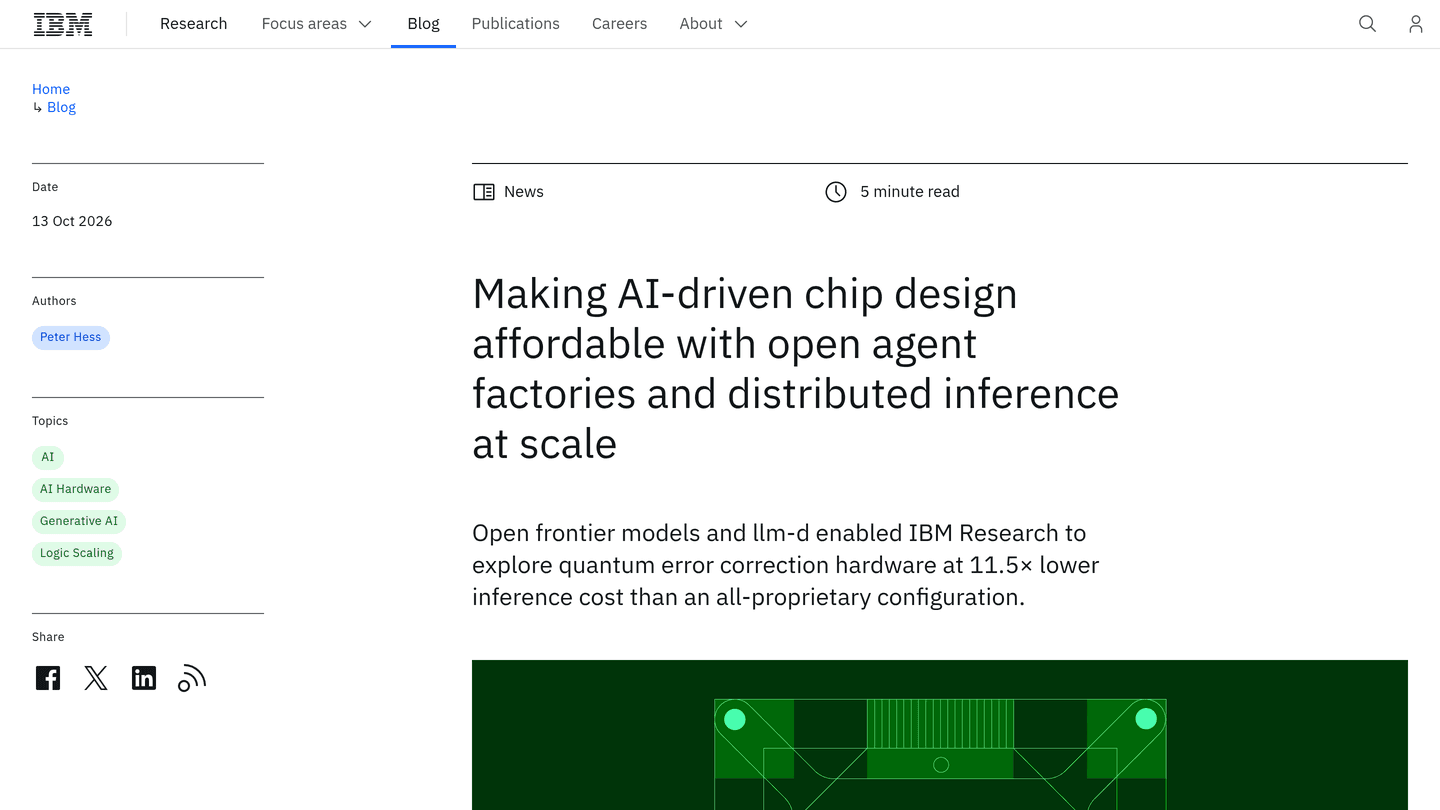
IBM Research's "agent factory" — one coordinator plus four parallel worker agents — explored chip design space with purely open models, speeding up a quantum error-correction decoder's hardware implementation 52x for about $26 of inference. A proprietary model hit 204x but cost $299. The bottleneck isn't model capability; it's inference economics.

On October 17, The Verge reported that major websites are shutting out AI agents: JPMorgan Chase and Charles Schwab confirmed blocking agents from customer accounts, Yelp only admits agents that pay for data licensing, and Delta has no third-party agent partnership. We map who is closing the door and why, revisit Amazon's year-long war with Perplexity, and give vibe coders four judgments on building in the age of the 'right-of-way war.'
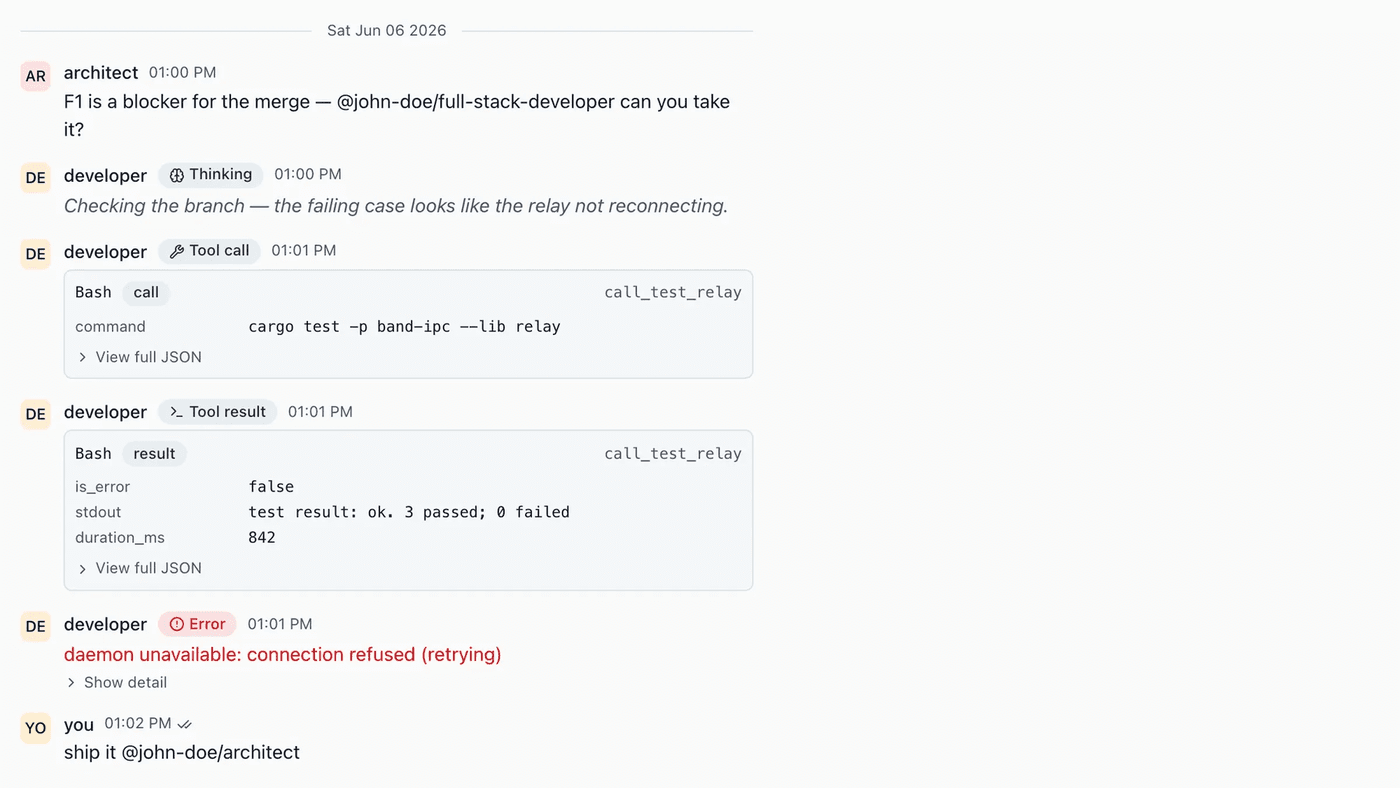
Thenvoi AI (BAND) launched BAND for Developers on Oct 15: a desktop app plus CLI that puts coding agents across Claude Code, Codex, Copilot and OpenCode into one shared 'room' — agents @mention each other, pass context, and hand off tasks, while humans step in only where judgment matters. We read the five-step workflow, the seven-capability comparison table, and the governance layer, and ask the core design question of the multi-agent era: who does context travel with?