Writing Code Is No Longer the Bottleneck—Verifying It Is: Blacksmith Rides the "CI Cloud" to Unicorn Status
Blacksmith raised a $66M Series C led by Sequoia at a $1B valuation. Weekly CI jobs grew 18x in ten months — as AI takes over writing code, verifying it becomes the new bottleneck and the new unicorn race.

The one-liner: the faster AI writes code, the more valuable the machines that verify it become
On October 21, 2026, CI (continuous integration) infrastructure company Blacksmith announced a $66 million Series C led by Sequoia, valuing the company at $1 billion — officially entering unicorn territory. Premji Invest joined as a new investor alongside existing backers Peak XV Partners, GV, and Y Combinator. Total raised to date: $125 million.
The cadence of the rounds tells its own story: just two months ago Blacksmith closed a $45 million Series B at a $550 million valuation; a year ago its $10 million Series A valued it at $60 million. Twelve months, 16x on valuation. What is the market paying for? CEO Aditya Jayaprakash put it plainly in the company's official blog post: "Writing code used to be the slow part of shipping software. It isn't anymore."
Now that AI owns the "writing," "verifying" is the new bottleneck — and verification is exactly what Blacksmith sells.
What Blacksmith does: selling CI as a "cloud"
CI is the unglamorous, indispensable machinery of software delivery: every code change gets built, tested, merged, and validated by automated checks before it lands.
Blacksmith's pitch is simple: companies hand over their CI workloads, and Blacksmith runs them faster than the customers could anywhere else, "with zero operational overhead." Its customer list is persuasive — Mercury, Granola, Handshake, LangChain, some of the fastest-moving software teams of the last two years. The company says more than 10,000 companies now trust it with their most critical workloads.
Why does CI deserve its own cloud? Jayaprakash's argument is concrete: CI is the spikiest workload a company runs. A single customer's demand regularly jumps from zero to tens of thousands of CPUs and back again. For the past three years, Blacksmith has mostly been building the infrastructure muscle to absorb those pulses as a matter of routine — exactly the thing general-purpose clouds are bad at, and unwilling to optimize just for you.
The numbers: 90M+ CI jobs a week, ARR up 17x
The disclosed metrics are striking:
- CI volume: from 5 million jobs per week in January to more than 90 million per week now — roughly 18x in ten months;
- ARR: up 17x (no absolute figure disclosed);
- Compute: just under 10 MW under management across US and European data centers today, with a plan to 5x that footprint in 2027.

Blacksmith weekly CI job volume. Source: Blacksmith official blog, "Building the CI cloud: our Series C" (Oct 21, 2026).
The most informative line is buried in the blog post: Anthropic disclosed last month that as Claude took over most of its code output, its CI job volume grew 25x in six months. Anthropic is just the furthest along the adoption curve — Blacksmith says it is seeing the same trend across its customer base and expects "many to reach that point soon."
Another Jayaprakash line worth quoting verbatim: "As agents write more of the world's software, the question that matters is whether it can be trusted." CI is the machine that answers that question.
Our take: infrastructure money is rotating from "writing code" to "verifying code"
For three years, AI coding money flowed almost entirely to the "writing" end: Copilot, Cursor, Windsurf, and the foundation models themselves. Blacksmith's round marks a turn — when code output approaches free, the scarce resource becomes the ability to verify code: compute, test pipelines, sandboxes, review.
This is the other side of the coin we covered in our Daytona piece ("agent cloud," $60M Series B to unicorn): Daytona solves "where agents work," Blacksmith solves "who checks the agents' work." Two unicorns in three months on the same thesis means the market has formed a consensus: in the agent era, infrastructure bets are on "execution" and "verification," not "generation."
For indie developers and vibe coders, three practical implications:
First, CI queues are becoming a stealth tax on small teams. You generate 40 commits in an afternoon with Claude Code; each triggers a full GitHub Actions test suite. Once the free minutes burn out, you're either queueing on shared runners or paying. AI made "committing" cheap; "verifying every commit" did not get cheap. Services like Blacksmith are verification capacity, retail-packaged.
Second, "fast" itself is becoming a competitive edge. Blacksmith sells not just compute but "faster than you could run it yourself." At an agent's pace of dozens of pushes a day, CI shrinking from 20 minutes to 4 means 5x faster trial loops — which directly decides how many iterations you ship per day. For a small team, that may be the highest-leverage small spend available.
Third, watch for the new cost black hole. In our guide on LLM inference cost engineering we did the model math; now add the CI math. The more code your agents write, the faster the CI bill climbs. Put budget alerts on CI from day one — or you'll get "surprises" from both the model bill and the compute bill.
Reality check: three numbers to discount
As usual, three discounts on the official narrative:
- 17x ARR, 18x job volume: base effects are real — January's 5M weekly jobs was a small base. Even so, 90M real CI executions a week after ten months is hard engineering proof; CI can't be gamed, every execution burns real compute.
- "Faster than anywhere else": vendor-claimed, not independently tested. GitHub's hosted runners, Buildkite, Depot, and Namespace (which just raised a $42M Series B for coding infra) are all chasing the same workload.
- 10 MW of compute: non-trivial, but a rounding error next to hyperscalers. Blacksmith's bet is "specialized beats general" — and on spiky CI scheduling, specialization does have structural advantages. How deep the moat is depends on whether utilization keeps up after the 5x expansion in 2027.
What to watch next
Blacksmith says the capital goes toward scaling the team and compute footprint — 5x by 2027. Three signals worth tracking:
- Whether it ships a usage-based tier for indie developers — that decides whether vibe coders can actually use it;
- Whether a second model lab follows Anthropic in disclosing its "AI-code CI multiple," validating the trend;
- Whether GitHub responds by upgrading hosted runners — once a giant gets serious about "fast CI," startup windows close fast.
The bottom line: AI made writing code close to free, which made "proving the code is right" the luxury good. Blacksmith's $1 billion valuation is a bet on exactly that. If your agents push dozens of commits a day, go look at your CI bill now — it's probably quietly becoming your second-biggest AI expense.
Comments (0)
Sources
Related articles
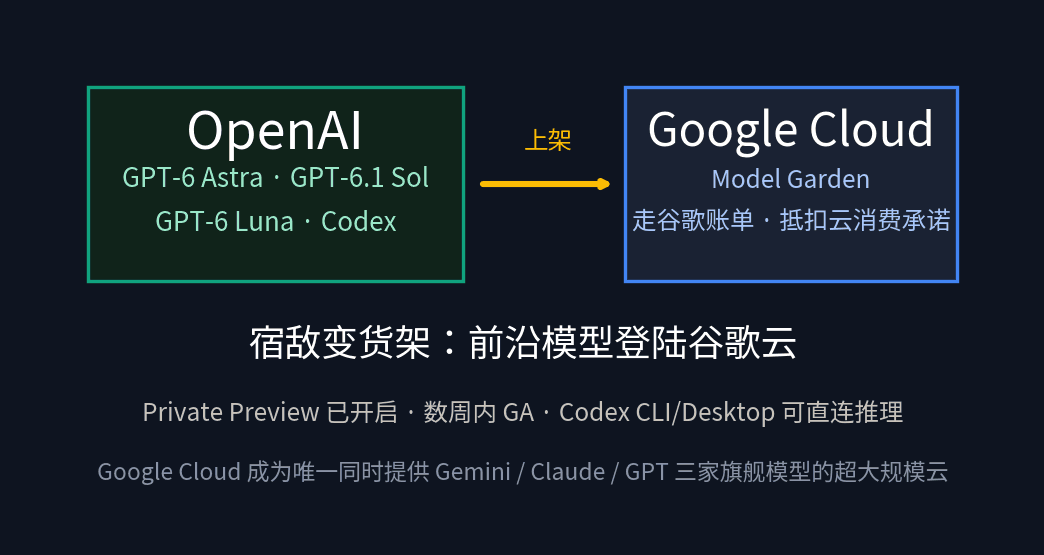
Google Cloud announced on October 21, 2026 that OpenAI's frontier models (GPT-6 Astra, GPT-6.1 Sol, GPT-6 Luna) and the Codex coding agent are coming to Model Garden — billable through Google Cloud Marketplace against existing cloud commits, with Codex CLI able to run inference on the Gemini platform.

OpenAI's October 19 research post turns COBOL, Fortran and Visual Basic into measurable capabilities for the first time: the open-source MultiLangBench (reimplement SQLite 3.40.1 from docs alone, across 20 languages) plus a COBOL migration test demanding byte-for-byte parity. GPT-6.1 Sol's migration accuracy jumps from 5.4% to 97.9%. Every number is vendor-reported — this piece discounts each claim and offers three practical takeaways for legacy-system maintainers.

Anthropic had Claude scan 25 open-source projects — 5M+ lines — not to find bugs but to shrink attack surfaces: 493 issues found, OpenSSH removed ~1/5 of its pre-auth reachable code. A third path for defense.