From Rival to Shelf: OpenAI Models Land on Google Cloud, and Codex Bills Through Google
Google Cloud announced on October 21, 2026 that OpenAI's frontier models (GPT-6 Astra, GPT-6.1 Sol, GPT-6 Luna) and the Codex coding agent are coming to Model Garden — billable through Google Cloud Marketplace against existing cloud commits, with Codex CLI able to run inference on the Gemini platform.
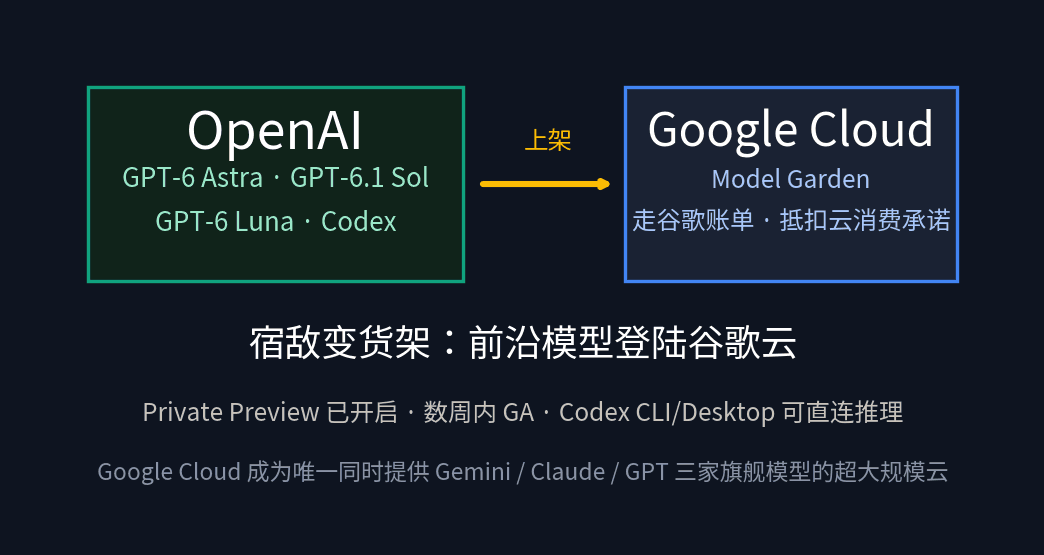
If there is an "unfinished business" list in the AI world, the love-hate saga of OpenAI and Google ranks near the top. One is the challenger behind ChatGPT, the other the incumbent behind Gemini, locked in close combat for three years over model leaderboards, release cadence, and talent. But on October 21, 2026, a Google Cloud blog post rewrote the feud: OpenAI's frontier models and the Codex coding agent are landing on Google Cloud's Model Garden, effective immediately — the rival, now a product on the shelf.
According to the official Google Cloud blog (footer stamped Published: 2026-10-21) and same-day reporting by Reuters' Krystal Hu, GPT-6 Astra, GPT-6.1 Sol, and GPT-6 Luna open in private preview to select enterprise customers today, with full GA "in the coming weeks." The details are where it gets serious: customers can buy through Google Cloud Marketplace and bill against their existing cloud commit; locally-run Codex CLI and Codex Desktop can even connect directly to the Gemini platform for inference — OpenAI's agent, on Google's cloud, running OpenAI's models, on Google's bill.
A quick history of the "rivalry": how the feud started
Before "rival turns shelf," the rivalry itself deserves a recap. OpenAI and Google have circled each other for nearly a decade, but the hand-to-hand phase is the last three years:
- Late 2022: ChatGPT shipped and caught Google flat-footed. "Code Red" inside Google; search, the crown jewel, was suddenly seen as disruptable by a chatbot. For two years Google's release rhythm was effectively set by OpenAI: GPT-4 shipped, Google rushed Bard; GPT-4o shipped, Google rushed Gemini multimodality.
- 2024–2025: the talent war went white-hot. Researchers poached back and forth, signing bonuses more outlandish each round. Meta jumped in too (the mid-2025 "sky-high poaching" spree is still fresh), making it a three-way brawl.
- 2026: the fight moved to agents and cloud. OpenAI pushed Codex, Google pushed Antigravity and Gemini Agent; OpenAI worked on distribution, Google on shelf space. Mid-fight they discovered something: on "selling models to enterprises," their interests aligned — OpenAI needed channels, Google needed traffic.
So "rival turns shelf" is not burying the hatchet — it is settling the账 (settling the accounts). Model-layer competition continues (GPT-6 vs. Gemini leaderboards will keep duking it out), but distribution-layer cooperation banks the revenue first. Tech history repeats this "coopetition" endlessly: Samsung fought Apple in patent court while supplying iPhone screens; Microsoft fought Google in cloud while paying Android patent royalties. Adults don't choose; adults take both.
For observers, there is a simple litmus test for real vs. fake coopetition: exclusivity. This launch has none — OpenAI still sells on AWS, Google still sells Claude. That is genuine cooperation, not a marriage of convenience. The less exclusive, the more durable, because it depends on no one's "loyalty," only on shared interest.
Five details in the announcement that actually matter
Press releases are usually mostly water, but these five details are all substance:
- 1. Three flagship models at once, not watered-down versions. GPT-6 Astra, GPT-6.1 Sol, and GPT-6 Luna are OpenAI's current frontier line, not last-gen clearance. Private preview for select enterprises first, GA in weeks — the standard cloud-vendor playbook of "enterprises first, then scale."
- 2. Billing goes through Google, deductible against commits. This is the most concrete one. Big enterprises sign tens or hundreds of millions in annual cloud commits; previously that money could only buy Google's own services. Now OpenAI model calls count too — the CFO doesn't need a separate "AI budget" approved, it just flows from the existing commit. For enterprises with glacial procurement, this is a decisive barrier removal.
- 3. Codex CLI / Desktop can connect directly to the Gemini platform for inference. Note the wording: not just "Codex can call OpenAI models on GCP" (obvious), but local Codex tools can point their inference backend at the Gemini platform. OpenAI's agent toolchain and Google's inference infrastructure are starting to interoperate — the decoupling of tools from models is more thought-provoking than the shelf listing itself.
- 4. Antigravity and Gemini Agent are next. Google says OpenAI models will subsequently arrive in Antigravity (Google's agent IDE) and Gemini Agent. Picture it: in Google's IDE, a dropdown offering GPT-6.1 Sol for your coding session — the "rival's" model, as one menu option.
- 5. Google Cloud becomes the only hyperscaler with all three. Gemini (in-house), Claude (Anthropic has long been on GCP), GPT (as of today) — the three flagship closed models, together on one cloud for the first time. AWS has Claude and GPT, Azure has GPT and Gemini (via partnership); only GCP shelves all three.
From "Microsoft exclusive" to "three-cloud distribution": OpenAI's road to the shelf
Zoom out, and this launch is step three in OpenAI's distribution evolution, each step landing on a structural shift in the industry:
 OpenAI frontier-model cloud distribution, April → October 2026. From exclusive to three clouds in six months.
Step one: the Microsoft-exclusive era. OpenAI models were long distributed only through Azure and Microsoft channels — the architecture since the 2019 alliance: Microsoft supplied compute and cash, OpenAI supplied models, exclusively bound. For early OpenAI it was a lifeline — only Microsoft would underwrite frontier-training burn without a cap.
Step two: April 2026, exclusivity expired, AWS listed next-day. The moment the exclusive license lapsed, AWS announced OpenAI models practically "next-day delivery." The signal: OpenAI would no longer lock itself to any single cloud; it was going omnichannel.
Step three: October 21, 2026, GCP. All three hyperscalers covered. OpenAI's distribution strategy officially flipped from "exclusive binding" to "shelf-ification" — like Coca-Cola in every supermarket, models must appear in every channel enterprises already pay through.
Note OpenAI's diplomatic art. Greg Brockman personally fronted the October 21 announcement, while also declaring "Microsoft remains OpenAI's primary cloud partner." Translation: the shelf can hold three vendors, but the "first wife" is still Microsoft. That line is for Microsoft's ears — don't flip the table because I sell on your archenemy's cloud — and for the market's — diversified distribution doesn't mean a broken strategic relationship. Such is the decorum of the adult world.
Thesis: hyperscalers are becoming the "general distributors" of frontier models
The biggest structural meaning here is not about OpenAI or Google, but about what "cloud" is becoming. Five years ago hyperscalers sold compute (GPU hours); from 2024 they sold "model APIs" (Bedrock, Vertex AI, Azure OpenAI); as of October 2026 they sell "a unified shelf of every frontier model + unified billing + unified compliance."
Think like an enterprise customer: a bank wants AI, compliance demands data never leaves its own cloud VPC, procurement must go through existing frameworks, billing must be consolidated. If it's on GCP, there's no more separate OpenAI contract, no separate legal review, no separate bill — a few clicks in Marketplace and GPT-6 is inside its VPC, the invoice folding into the cloud commit automatically. The friction reduction for "AI landing" is exponential. Model capability doubles every 6 months, but enterprise procurement hasn't changed in 6 years — whoever stuffs models into enterprises' existing procurement pipes first eats the growth. GCP just took that bite.
From the other side, this is de-risking as necessity for OpenAI. Eggs in three baskets: Microsoft as strategic shareholder and compute backstop, AWS as the largest enterprise customer pool, GCP as the differentiated "all three under one roof" story. No single vendor's policy swing (like the early-October Microsoft/Meta in-house-AI pivot chatter that got Claude cut off) can zero out OpenAI's distribution. We covered that Microsoft/Meta in-house shift and the Claude cutoff on October 6 — read together with today's news, the conclusion is crisp: in this industry, "being exclusively bound to one cloud" is flipping from asset to liability; "listed on every shelf" is the 2026 survival strategy.
One more subtle competitive angle: with all three onboard, the pressure actually lands on AWS and Azure. "Which cloud lets me call the most frontier models natively" is becoming a real decision dimension in cloud selection. Azure has the OpenAI bloodline advantage, AWS the broadest enterprise base, GCP now plays the "all three" card — 2027's cloud war may be fought over "whose shelf is fullest" instead of "who has the most GPUs."
The two absentees: how Claude and Microsoft read this
Two characters absent from the announcement but affected by it deserve their own paragraphs.
Anthropic first. Claude has long been on GCP (via Vertex AI) as one of the shelf's headline external models. Now GPT-6 moves in next door, same Marketplace, same billing, head-to-head. That's not bad for Anthropic — arguably the opposite: the "all three under one roof" narrative is free advertising GCP runs for Claude (look, even OpenAI sells here, so the shelf is neutral and trustworthy). Enterprise buyers naturally like comparing three options, and Claude's coding reputation (recall Anthropic's October 21 research on Claude doing attack-surface reduction across 25 open-source projects — the technical brand keeps scoring) means it doesn't fear the side-by-side. The real losers may be second-tier models listed on only one cloud — the fuller the shelf, the harder the long tail is to see.
Microsoft next. Brockman's "Microsoft remains the primary cloud partner" reads less as promise than as reassurance. Reality: Azure OpenAI Service used to be the only compliant front door to OpenAI models; that "only" died when AWS listed in April 2026, and the GCP launch drives another nail in. Azure's counter is clear: shift the bet from "exclusive OpenAI distribution" to "in-house models + exclusive integration" (the early-October in-house AI pivot chatter points exactly there), while the equity-plus-compute entanglement with OpenAI preserves the "primary" title. Azure's future differentiator won't be "only here can you buy GPT" but "GPT runs deepest and integrates tightest here" — from channel advantage to integration depth.
One line for all three mindsets: OpenAI thinks "don't put eggs in one basket," Google thinks "my shelf is fullest," Microsoft thinks "the first-wife seat is not up for grabs." Everyone got what they wanted — that's the anatomy of a good deal.
A note for developers in China: enjoy the show, mind the pattern
One reality check: OpenAI models and Google Cloud are both unreachable directly from mainland China. So this news's direct significance for Chinese developers is roughly zero — you can't open Model Garden or buy that SKU. But beyond the show, two patterns are worth noting:
- Pattern one: more architecture options for overseas business. If your product serves overseas users on overseas servers, you can now do "one-stop" three-model provisioning on GCP: one compliance audit, one bill, no cross-cloud VPC plumbing. Overseas SaaS AI architecture can converge on single-cloud multi-model, cutting ops complexity by an order of magnitude.
- Pattern two: Chinese clouds will follow the "shelf-ification." Alibaba Cloud, Volcengine, Tencent Cloud long ago built "model plazas" (Model Studio, MaaS platforms), mostly stocking in-house and open models. OpenAI-on-GCP will accelerate Chinese giants' push to list "external flagship models" — not OpenAI (out of reach), but Claude and other foreign models in compliant local versions. The MaaS competition logic is universal: fullest shelf wins the enterprise customer.
So the right posture for Chinese developers: enjoy the show, but memorize the pattern — "unified shelf + unified billing + unified compliance" — and check whether your cloud is moving that way. If yes, it's riding the trend; if no, its enterprise customers will eventually be poached by a cloud with a shelf.
What this means for vibe coders and indie developers
The honest caveat first: private preview starts with select enterprises; indie developers can't click that button yet. But don't scroll past — three ripples reach your toolchain:
- 1. GPT-6 in Antigravity's dropdown is a matter of time. Google explicitly promised Antigravity and Gemini Agent next. If you already use Antigravity (Google's agent IDE), a future model dropdown with GPT-6.1 Sol means no more jumping to a webpage, no separate API key — "model" degrades into "one menu item." That is shelf-ification's terminal form.
- 2. Decoupling Codex tooling from inference backends benefits everyone. Codex CLI/Desktop connecting directly to the Gemini platform for inference shows OpenAI splitting "agent tools" and "model inference" into separately sold layers. For developers: pick agent tools for workflow experience, pick models for capability and price, mix and match. Run Codex's interaction on Gemini's inference — the era of tools locking you to models is loosening.
- 3. The model price war moves from "website price" to "cloud price." With GPT on three clouds, vendors will discount for big commit buyers and hand out credits to pull commit consumption. That transmits into API pricing — model calls in 2027 will only get cheaper. Indie developers harvest the "cloud subsidy" layer: watch each cloud marketplace's free tiers and startup credits, and harvest away.
One longer-term call: when every frontier model is buyable on any cloud, "model" becomes fully utility — priced, undifferentiated, metered. A vibe coder's real moat was never "which model you used" but "what you built with it." The fuller the shelf, the more it proves the game isn't about sourcing — it's about your product.
Four things to watch next
The announcement is just the opening; the next few weeks of execution decide how much it weighs. Watch these four milestones:
- 1. GA timing and pricing. "GA in the coming weeks" is elastic — watch Google Cloud's changelog: will GA pricing mirror OpenAI's list, or does GCP add channel margin / commit discounts? That decides whether "billing through Google" is about convenience or real savings.
- 2. The Antigravity / Gemini Agent integration shape. A simple "model dropdown," or deep "OpenAI models + Google toolchain" mashups (GPT-6 writes code, Gemini tests it)? Only the latter is real tool-model decoupling.
- 3. The AWS and Azure countermoves. Will AWS also land "all three"? Will Azure turn deep OpenAI integration into exclusive features? Their next moves set the intensity of the "shelf war."
- 4. Real enterprise adoption data. How many "select enterprises" actually shift production traffic during private preview? Will CFOs fold AI budgets into cloud commits? Until those numbers land, "unified billing" remains an unproven thesis.
Keep these four in your notebook and come back in two months — then we'll know whether "rival turns shelf" was an industry inflection point or just beautiful PR.
Verdict: the neutral platform won, but the "neutrality" is performative
A final, slightly sardonic observation. The endpoint of OpenAI's distribution strategy looks like "neutrality" — I sell on every cloud, favoring none. But don't forget Brockman's "Microsoft remains the primary cloud partner" is still warm; and don't forget GCP got all three precisely because it has the least historical baggage with OpenAI — sometimes "neutral" is just another word for "hasn't picked a side yet."
The real winner is the "platform" position itself. When models become shelf goods, pricing power, billing relationships, and compliance endorsement settle with the platform. OpenAI needs GCP's shelf, GCP needs OpenAI's traffic; the only losers may be old players still betting on "exclusive model lock-in."
For developers, one operational conclusion: from today, evaluating a model no longer starts with "which cloud is it on," only "is it on the cloud you already use." If yes — open Marketplace, order, bill against the commit. Frontier models, as easy to buy as a VM, for the first time. That is the real worth of "rival turns shelf." And the next time you see GPT-6.1 Sol in Antigravity's dropdown, remember today's announcement: you're not choosing a model, you're choosing the post-channel-revolution world.
Comments (0)
Sources
Related articles

Two unauthenticated PHP remote code execution flaws (CVE-2026-109618/109619, CVSS 9.2), found by AI-assisted auditing under OpenAI's Patch the Planet program, forced emergency patches across four PHP branches on October 21, 2026 — after details leaked early and attack traffic was spotted before the fix shipped.
VideoGen unveiled Model 1, its first AI video model: text or images in, finished multi-shot videos up to ten minutes out. Its 'thinking harness' plans screenplay and pacing before generating pixels — but all cost and speed claims are vendor-reported for now.
ASI raised a $325M Series C at a $3B valuation for AI that manages physical assets — air traffic, power grids, military operations. Backed by an $875M FAA contract and a $99M US Army deal, it is capital's latest vote for Physical AI over chatbots.