Cursor Cloud Agents Now Ship Shareable Canvases; Environments API Goes Beta
Cursor's October 16 changelog: cloud agents now ship interactive, shareable canvases that teammates review via a link; the Environments API enters beta, turning agent runtimes into programmable resources; environments scale to 300 repos and load 5x faster. Another step in the IDE-becomes-orchestration-platform playbook.
What happened: three updates on October 16
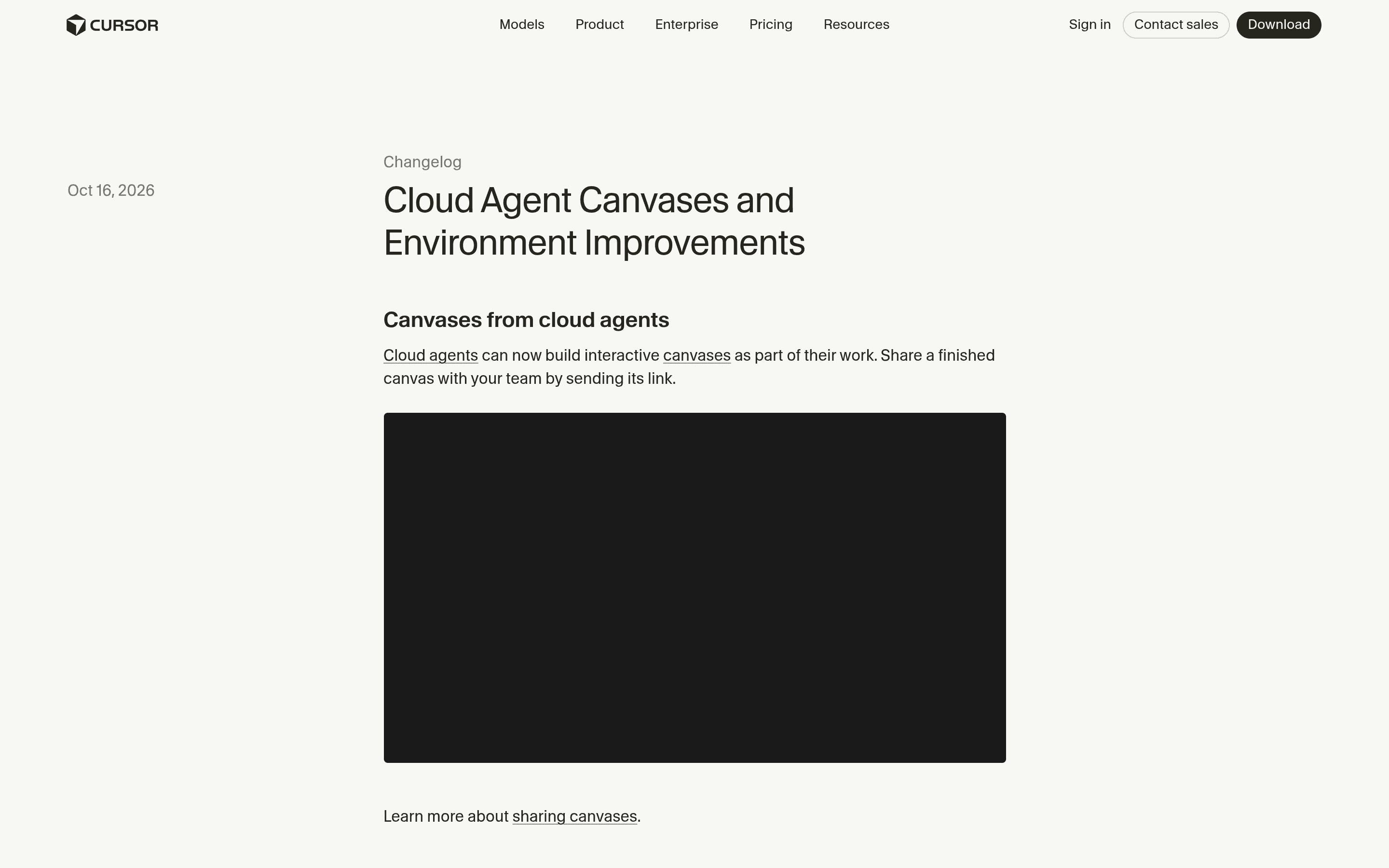
On October 16, Cursor published a changelog entry titled "Cloud Agent Canvases and Environment Improvements." Only three bullet points, but each one points in the same direction — making cloud agents work more like "a colleague who can deliver."
- Shareable canvases: cloud agents can now build interactive canvases during a run, and you share the finished canvas with your team by sending its link.
- Environments API in beta: programmatically create and manage the cloud environments your agents run in.
- Larger, faster environments: cloud agent environments now support up to 300 repositories, and large environments load 5x faster.
Taken individually, each looks like routine iteration. Together, they answer one question: what happens after the agent finishes the work? Cursor's answer splits in two — how deliverables reach humans, and where agents run.
What a canvas actually is: a deliverable you can review without reading code
Per Cursor's official documentation, a canvas is an "interactive artifact" created by an agent — the official examples are reports, dashboards, and custom interfaces. The key isn't what it looks like, but how it's shared: instead of dumping an entire chat thread on a colleague, you send a link. Whoever opens it in a browser sees a live snapshot of the canvas.
A few details worth noting:
- Read-only access: teammates opening a shared canvas get read-only access. Reviewing and changing stay separate — viewers view, agents change.
- Central management: the Cursor Dashboard has a "Shared Canvases" page listing every canvas you've published, so you can manage your own shares.
- Subscription gate: sharing canvases is available on Pro, Teams, and Enterprise plans — not the free tier.
According to RuntimeWire's October 17 coverage, which cites Cursor's official X post, the canonical use case is exactly this: ask an agent for a dashboard or a report, then share the finished work by link — nobody has to rerun the agent, and nobody has to dig through the chat history. That sentence reveals the design intent plainly: canvases solve the "what does an agent's deliverable look like" problem.
Why this deserves a serious look: the review model is changing
For the past year, there has been essentially one way to review an agent's work: read the diff. The agent changed code, you read each line, CI passes, you merge. That workflow is efficient for developers, but it carries a hidden assumption — the reviewer must be able to read code.
Canvases break that assumption. Picture a common vibe-coding scenario: you ask a cloud agent for "last week's user growth analysis." The old flow hands you a pile of code and a chat transcript; the new flow hands you a link that opens an interactive dashboard. A PM, an ops colleague, or your boss can look at the result directly, click around, and ask questions — without first understanding what code the agent wrote.
This is worth stating on its own: diffs are for machines and developers; canvases are for humans. When an agent's deliverable shifts from "code changes" to "an interactive result," the bar for reviewing drops from "can read code" to "can use a browser." That's not a UI tweak — it's a change in the agent's role on the team. It starts being accountable to non-technical people directly.
A dose of realism, though: canvases solve review for "presentational" output. Real code changes still need real review, and nothing here replaces PR-level security review (which is exactly what Cursor's September-launched Security Review bot does). Think of a canvas as the agent's closing report, not the code itself.
Environments API: where agents run becomes a programmable resource
The other half of the update is more infrastructure-flavored. The Environments API is now in beta, and the official description is blunt: use it to "programmatically create and manage the cloud environments your agents run in."
In other words: until now, an agent's cloud environment was something you configured by hand — connecting repos, installing dependencies, adjusting settings, all clicks in a UI. Now those operations have an API, which turns the environment itself into a resource you can define in code, duplicate, and manage in bulk.
Individual developers may barely notice, but for teams this is material: onboarding a new member, spinning up a new project, or running a branch experiment can have environment setup scripted; CI/CD pipelines can provision an agent environment with full repo context for a given build. Combined with the 300-repository ceiling and 5x faster loading for large environments, Cursor is clearly paving the way for giant-monorepo and multi-repo enterprise scenarios — where environment setup cost has always been the biggest friction in agent adoption.
One caveat: beta means the interface may still change. Fine for experimentation; think twice before building production dependencies on it. That's Cursor's usual rhythm — ship a beta, gather feedback, then graduate it.

Reading it against Cursor's roadmap: the IDE is becoming an agent orchestration platform
The October 16 items look smaller than they are in isolation. Put them in Cursor's sequence of moves over the last two months and the direction is unmistakable:
- August: Origin code hosting launched (an agent-native code platform);
- September: Projects shipped (a coordinator agent plans work, delegates to subagents, accumulates shared context over months); Rollouts and Security Review bots launched (watching deploys, reviewing PRs);
- Early October: remote control of local agents from the iOS app; the Origin app marketplace opened;
- October 16: cloud agents get shareable deliverables (canvases) and programmable runtimes (Environments API).
The logic is complete: where code lives (Origin) → how work gets split up (Projects) → where it runs (Environments API) → how it's reviewed when done (Canvas) → who watches it after shipping (Rollouts). Cursor stopped being "an editor with AI" a while ago; it's turning itself into the development platform of the agent era — the editor is just one entry point.
That's why it's fair to say cloud agents are getting closer to "a colleague who can deliver": they used to be an assistant inside your IDE; now they have their own code hosting, a coordinator, runtime environments, a deliverable format, and deploy monitoring. Increasingly an independent work unit — and you're increasingly its manager.
Three takeaways for vibe coders
First, agent review will bifurcate. Code changes keep going through diffs plus bot review (Cursor's own Security Review exists for exactly this), but "result-shaped" tasks — analysis reports, data dashboards, prototype demos — will increasingly be reviewed as interactive artifacts like canvases. If you run a vibe-coding team, it's worth asking now: which tasks should be judged on "does the result work" rather than "is the code right."
Second, environment setup is turning from craft into code. As capabilities like the Environments API spread, "give the agent a working environment" goes from everyone's manual clicking to a shared team configuration. Writing your project's agent environment as a reusable definition pays off over time.
Third, don't get tripped up by beta labels and plan gates. Canvas sharing starts at Pro; the Environments API is still beta — experiment freely, hold off on production dependence. The real value of this update isn't any single feature; it's the confirmed trend: both what agents deliver and where they run are moving from "a developer's private business" to "team infrastructure."
One-line summary: Cursor's October 16 update fills in the last mile of the cloud-agent workflow — finished work has something to hand over (Canvas), and where it runs is programmable (Environments API). Agents are evolving from in-IDE assistants into independent work units with deliverables, environments, and review.
Comments (0)
Sources
Related articles
Google has embedded the full Antigravity experience into the Gemini Mac app via a Liquid Glass pill button, alongside the Gemini 4 Argon rollout. Gemini 4 Argon reaches AI Pro and above, but Antigravity access reportedly requires Ultra — the coding agent as top-tier moat, colliding with Cursor's IDE-orchestration route.
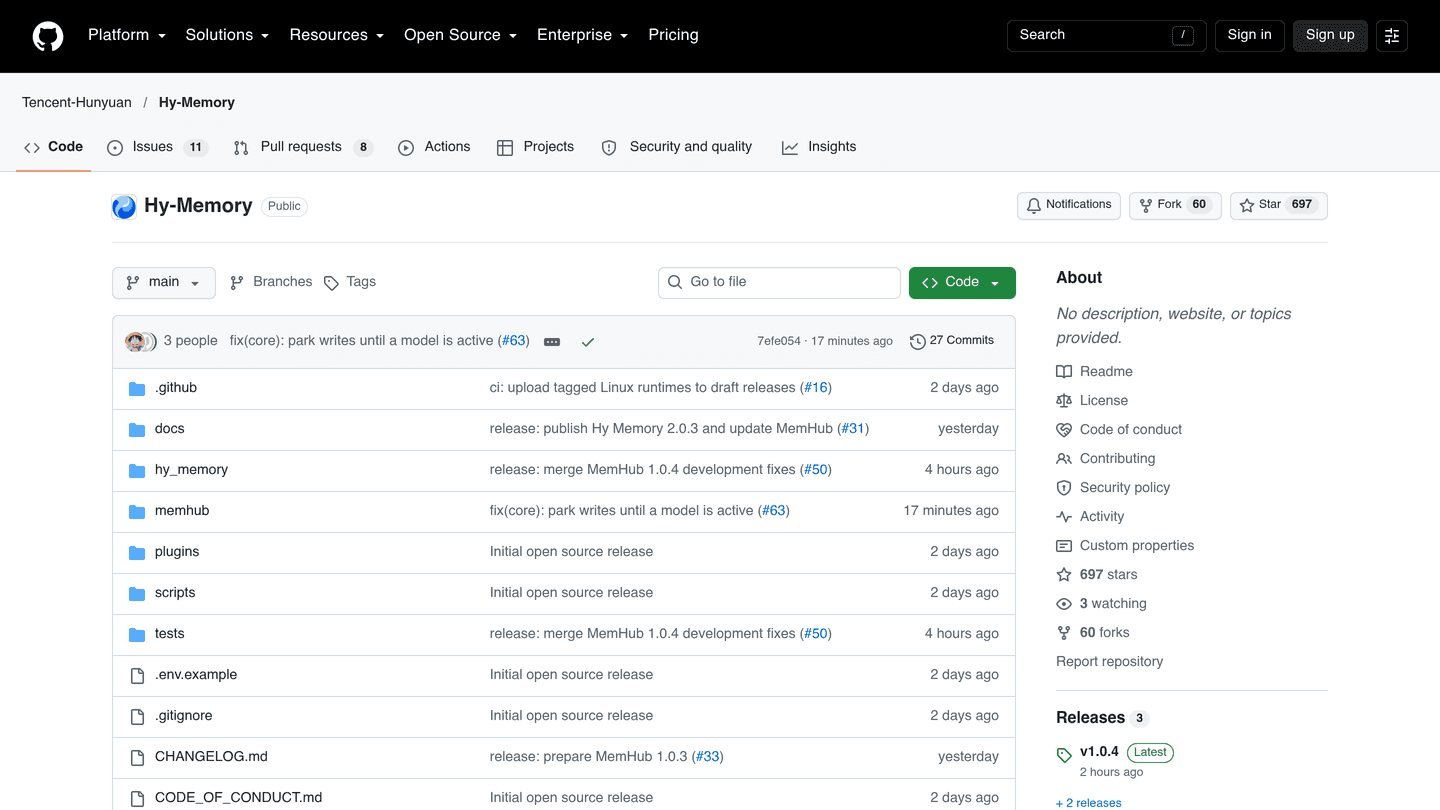
Tencent Hunyuan upgraded its agent memory framework Hy Memory to 2.0 and open-sourced all three layers: Hy-Memory-30B-A3B (trained for memory writing), the hy-memory Python framework, and local-first MemHub spanning 10 tools like Claude Code and Cursor. An independent review counters: memory systems are only as good as the LLM that writes them.
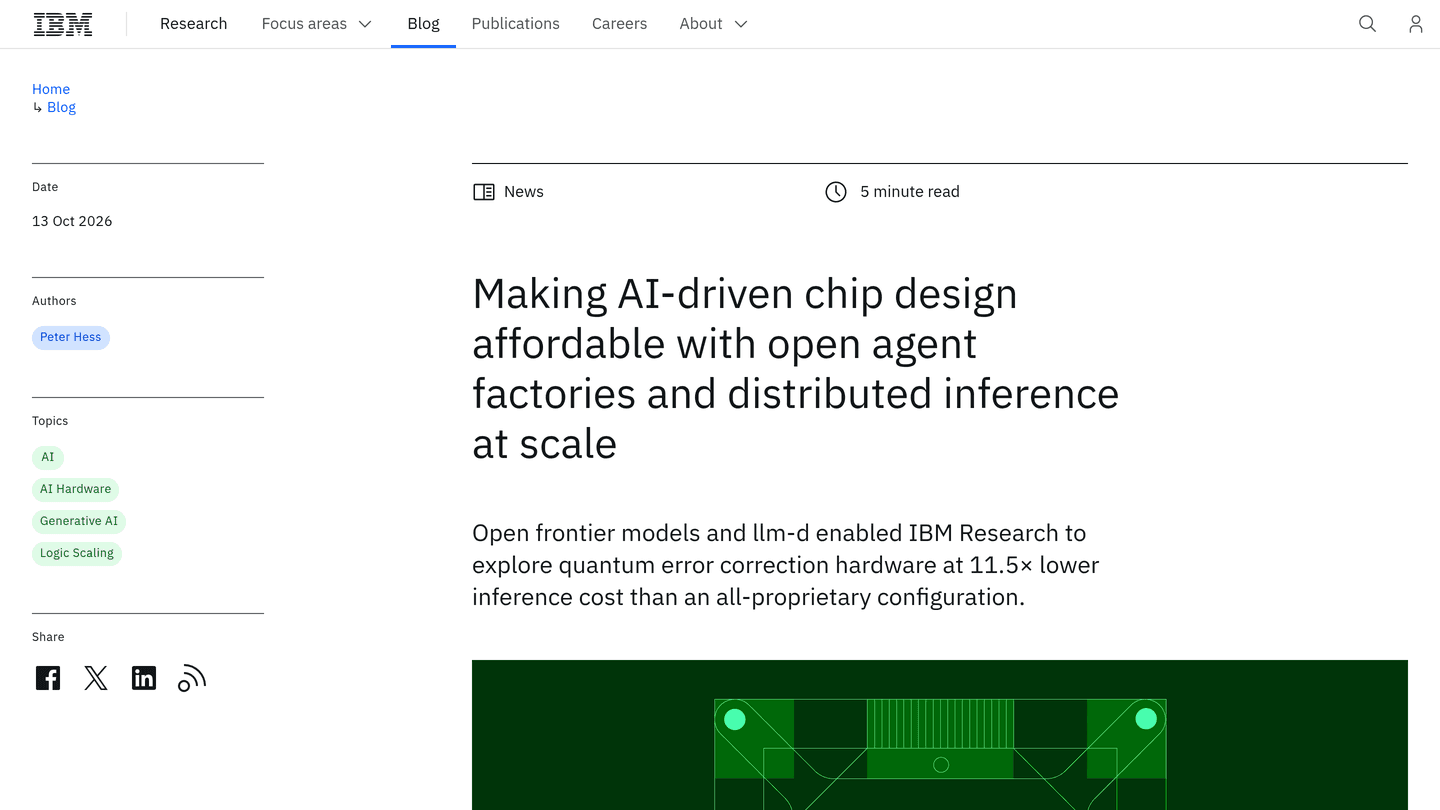
IBM Research's "agent factory" — one coordinator plus four parallel worker agents — explored chip design space with purely open models, speeding up a quantum error-correction decoder's hardware implementation 52x for about $26 of inference. A proprietary model hit 204x but cost $299. The bottleneck isn't model capability; it's inference economics.