Cursor Folds Into The X Subscription: Grok, Cursor and X Premium in One Plan, Third-Party Models Now Billed at API List Price
On October 12, 2026, Cursor announced The X Subscription: Grok, Grok Bot, Cursor and X Premium bundled into one plan with at least double the Grok coding usage — but third-party models are billed at API list price from the first request, and legacy Ultra is closed to new signups. We break down the changes, redo the cost math for four kinds of vibe coders, and offer three playbooks: wait, switch, or go hybrid.
One announcement rewrote Cursor's subscription logic
Late on October 12, 2026 (US Eastern Time), Cursor's official team posted Introducing The X Subscription in the Release Discussions section of its community forum. The timestamp at the top of the post is unambiguous: October 12, 2026, 10:51pm. Within hours, hundreds of replies flooded the thread — people were still asking "where did my $20 plan go" at 3 and 4 in the morning. This was no ordinary price adjustment. It was the first real step in wiring Cursor into the xAI system, and the day Cursor's founding promise got repriced.
The change in one sentence: Cursor no longer sells its subscription on its own. It has been folded into a bundle called The X Subscription, sold together with Grok, Grok Bot, and X Premium. Meanwhile, third-party models (Claude, GPT, and the rest) have been kicked out of the included usage pool — you can still use them, on Premium tiers and above, but every request is billed separately at API list price from the very first one.
What the new subscription actually contains: five key changes
Emotions aside, let's unpack the facts from the announcement itself.
1. Four products, one price: Grok + Grok Bot + Cursor + X Premium
The new plan bundles four things into a single subscription: Grok (chat, voice, image and video generation), Grok Bot (AI teammates), Cursor (local and cloud coding agents), and X Premium (checkmark, creator tools, fewer ads, with higher tiers removing timeline ads entirely). The official line: "for the first time, one AI subscription supports the full path from thinking and creating to building and sharing." Translation: xAI wants your whole day inside its ecosystem — code in Cursor, ask Grok, post on X, one bill for all of it.
2. One shared usage pool, three surfaces, weekly refresh
Paid plans include a pool of Grok model usage shared across the Grok apps, the Grok tab on X, and Cursor, with the allowance refreshing weekly. The official quote: "one heavy day doesn't use up your month." For vibe coders this is a genuine improvement: under monthly plans, the nightmare was burning through your quota in the first few days and staring at an empty tank for the rest of the month. Weekly refreshes cut that risk into four pieces, which makes bursts far more forgiving.
3. At least double the Grok coding usage at comparable tiers
The hardest promise in the announcement: "Each X Subscription plan includes at least twice as much coding usage with Grok models as the comparable Cursor plan," and "each comparable new tier provides more usage per dollar than the plan it replaces." This is the only number in the whole post that is unambiguously good for users — and the chip xAI is using to offset the controversy.
4. Third-party models: the door stays open, but the meter runs separately
This is the eye of the storm. On Premium and above you can keep using third-party models in Cursor, but that usage is fully outside the subscription: billed from the first request at API list prices through top-ups, with optional spending caps. The announcement does throw existing users a lifeline: if you stay on your current Cursor plan and don't switch, your included third-party usage continues — "until you switch." Note the wording: not forever, just until you switch.
5. Old Ultra closed to new signups; Teams and Enterprise move too
The old Cursor Ultra plan is no longer available to new subscribers. On the Teams and Enterprise side, Premium, Super, and Ultra are offered at the same per-seat prices as individual plans — lower per seat than the older Cursor Teams plan — with 3x more coding usage, plus SSO, admin controls, consolidated billing, usage analytics, and SOC 2 compliance. Enterprise customers can manage Grok and Cursor from one dashboard with a single shared usage pool.
The switch is rolling out in waves: existing Cursor, SuperGrok, and X Premium subscribers will see the option in their billing settings over the next few days.
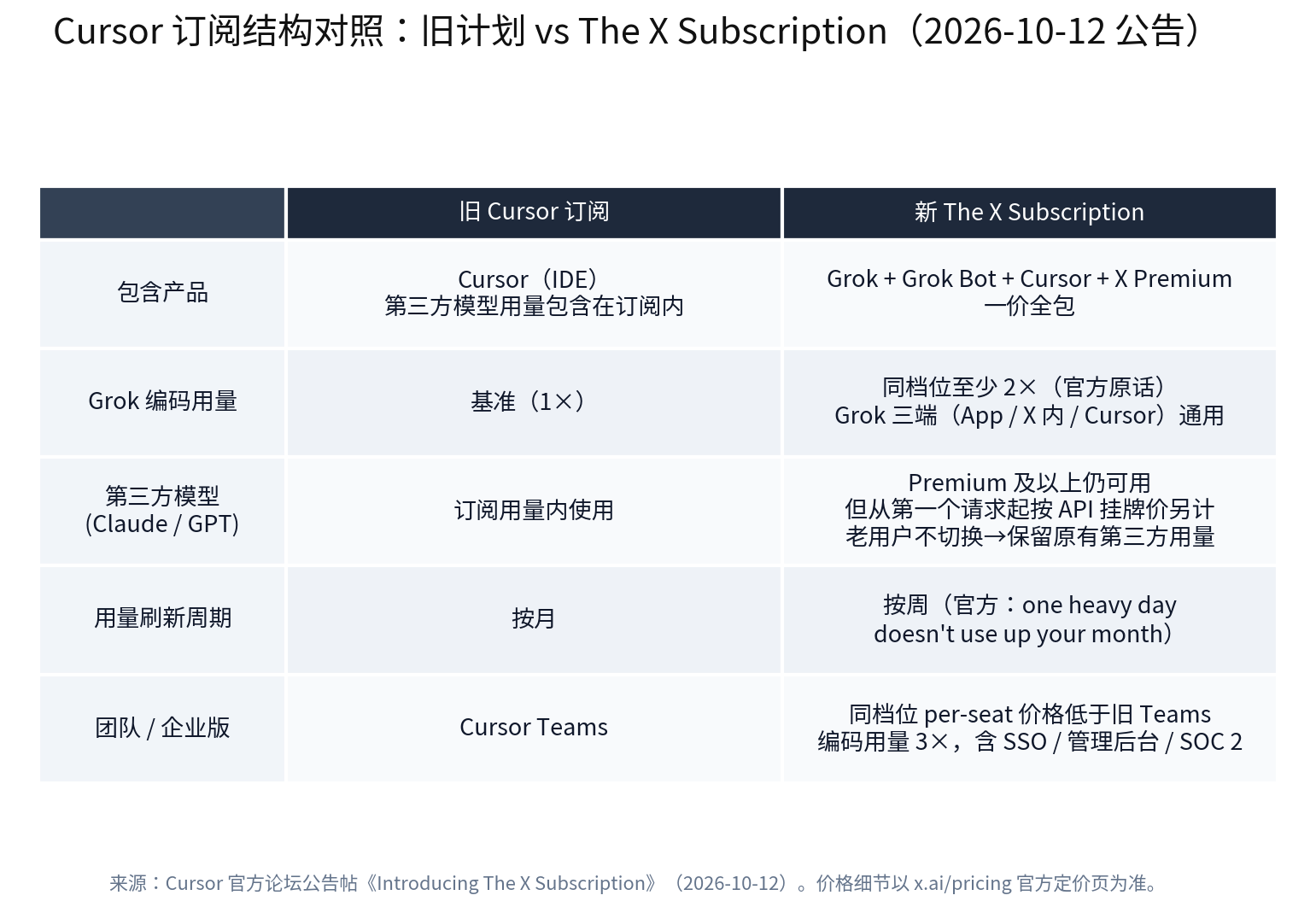 Old Cursor plan vs. the new X Subscription: the biggest structural change is third-party models moving from "included in the plan" to "billed separately at API list price," while Grok usage doubles and the refresh cycle goes weekly. See x.ai/pricing for official pricing details.
Why the community exploded: three fuses
The announcement thread's comment section is the best thermometer for this story. Across hundreds of replies, the recurring themes weren't cheers for doubled Grok usage — they were three fuses.
Fuse one: "model neutrality" got dismantled
One widely resonated long comment put it bluntly: Cursor earned its place not through its own model but by being "one editor where you can use the best models." Many users have Codex, Claude Code, and Cursor all installed — and Cursor is the one that stays open all day precisely because it isn't locked to any single model vendor.
The new plans change that equation: the monthly fee only buys Grok usage, while Claude and GPT are billed at API list price from the very first request. For anyone whose daily driver is a third-party model, "almost none of that money goes toward what they actually need." The commenter's verdict was harsh: everything Cursor built over the past few years — its user base, its reputation — comes down to one thing, model neutrality; now the team is tearing that out with its own hands and filling the gap with a model that hasn't yet proven itself for coding. Users aren't fooled; they'll vote with their feet — and the ones leaving first are the people paying $200 a month, with all three tools installed, who made Cursor their primary workspace.
Fuse two: Ultra, same name, different product — sloppy communication
The new Ultra and the old Ultra share a name but aren't the same product: the old Ultra included third-party model usage, while the new Ultra's fee only buys Grok usage (per pricing details relayed by users in the thread, the new Ultra is $200/month for 50x Grok usage plus X perks and Grok Bot). An official staffer confirmed in the thread that "it isn't the same as the previous Cursor Ultra plan." For longtime users, that's a completely different product hiding under the most familiar name — while old docs still say "includes Other Models." That kind of mismatch burns trust fast.
Fuse three: the vanishing $20 tier and the feeling of a forced price hike
One user who had been paying $20 since the beginning demanded answers: the tier they'd been on for ages simply ceased to exist, and the company hadn't even sent a warning email — "are you just planning to charge me $30 instead while also removing all third-party models?" Per thread discussion, the new entry tier is $30 (user-relayed; check the official pricing page). For these users the change is double: the monthly fee jumps 50% while third-party model usage gets removed from the plan. "Pay more, get less" is the most dangerous signal any subscription product can send.
Recalculating the cost model for vibe coders
Ranting aside, the math still has to be done. The impact varies wildly by user type, so let's split it into four archetypes (besides the announcement text itself, specific price figures below are relayed by users in the thread; confirm exact tiers at x.ai/pricing):
A. Heavy Grok users: clear winners
If you're already deep into Grok — daily Q&A in the Grok app, the Grok tab on X, and happy to code with Grok models — this is a win: at least double the coding usage at comparable tiers, X Premium and Grok Bot thrown in, one pool across three surfaces refreshing weekly. The new plan is practically tailor-made for you.
B. Third-party-model-first users: clear losers
If Claude or GPT is your daily driver and Cursor is just the shell you call them from, nearly all of this is bad news. Example math: suppose you were on the $20/month Pro plan and burned roughly $40 worth of third-party model calls in Cursor each month (common for heavy vibe coding) — that used to be inside the subscription. After switching, with a hypothetical $30 entry tier, that $40 of third-party usage gets billed at API list price from the first request. Your monthly spend goes from $20 to $30 + $40 = $70, up 2.5x — while the $30 fee buys Grok usage you'll never touch. That's the arithmetic behind the thread's verdict: "almost none of that money goes toward what they actually need."
C. Legacy $20 light users: the forced hike
If you're a longtime $20 user with modest usage who occasionally taps a third-party model, you face the most frustrating variant: don't switch, and the old plan is a countdown timer labeled "until you switch"; switch, and the fee jumps to $30 first while third-party models cost extra. For light users the extra absolute cost is small, but the feeling of a passive price hike stings.
D. $200 Ultra users: stuck in the middle
Per the thread, the new Ultra at $200/month delivers 50x Grok usage. If you're Team Grok, that's unprecedented generosity; if you're Team Third-Party, exactly $0 of that $200 goes toward your actual workflow, with third-party calls billed on top. The official promise — keep your included usage if you don't switch — is real, but the "continues for now" phrasing (users in the thread explicitly asked for a commitment that legacy Ultra can be renewed indefinitely; the official line so far is only "until you switch") makes long-term planning impossible.
The one-line summary: in the new plan's value equation, the weight of Grok usage has been cranked to maximum and the weight of third-party usage zeroed out. The closer your workflow is to Grok, the more you win; the further away, the more you lose. There is no middle ground.
Our take: this isn't a repricing, it's a picking of sides
Reading this as a mere "price change" misses the point. At its core, it's Cursor moving from "model-neutral platform" to "xAI ecosystem on-ramp" — a textbook case of using pricing to filter users.
Why xAI is doing this is straightforward: after the integration, Cursor's strategic value is no longer "the money from IDE subscriptions" but "funneling developer traffic into the Grok ecosystem." However strong Grok's models are, an ecosystem doesn't spin up without users — and Cursor happens to hold several million of the most active AI programmers. So pricing becomes the most direct lever: make Grok usage generous at "at least double," push third-party models onto the steep slope of "API list price from the first request," and let price signals choose for users. That's not a conspiracy; it's all out in the open in the announcement.
Why the backlash runs so deep is subtler. Cursor's base has a delicate structure: its heaviest-paying users are precisely the most "model-agnostic" ones — three tools installed, whichever model is strongest gets used, with Cursor's value being that it "doesn't pick sides." The new plans use price to force them to pick a side, and the side being pushed is a model whose coding chops are still unproven. The weightiest line in the whole thread: "First make Grok genuinely competitive for coding, and users will switch on their own. What’s happening instead is that the model hasn’t won yet, and pricing is being used to force the move." The order is backwards — and that may be the single most important sentence of this controversy.
There's an industry signal here every vibe coder should note in 2026: model vendors are turning "subscriptions" into "ecosystem locks." On the same day, Meta launched its first frontier model, Muse Wonder, with the strongest version, Wonder Full, kept off the API and reserved for Muse Code subscribers — "best model locked to subscribers" and "third-party models billed separately" are two sides of the same coin: when model capability becomes the scarce resource, vendors' first instinct is to wall it inside their own subscription. Cursor's move is just the one closest to vibe coders' wallets.
So does Grok deserve this bundling? That's the real decider. If Grok's coding ability proves itself over the next few months, the "at least double usage" generosity becomes genuine competitiveness and the anger fades on its own. If it doesn't, Cursor slides from "one editor where you can use the best models" to "an editor with Grok inside — something anyone else can build." The thread already said it; xAI should take it as a warning.
Recommendations: three playbooks for three kinds of users
1. Existing users: don't rush to hit "switch"
The official word is clear: your included third-party usage continues if you don't switch. Since "until you switch" is a one-way door, don't push it yet. Wait for the first wave of switchers' real bills, for the x.ai/pricing details to settle, and for more data points on Grok's coding reputation. Holding off isn't conservatism — it's the most rational strategy when information is incomplete.
2. Grok loyalists: you can board now
If Grok is already your main model, the math is very friendly: doubled usage, three surfaces sharing one pool, weekly refresh, plus X Premium. Just verify your tier mapping (e.g., which new tier your old $60 plan maps to) once the switch option appears in your billing settings, then click with confidence.
3. Third-party loyalists: consider a "hybrid architecture"
If you can't live without Claude or GPT, don't fight the pricing head-on — change the architecture: use Cursor as a pure editor plus Grok for light tasks, and route heavy third-party calls through direct API access or CLI tools (like Claude Code or the Codex CLI), paying for actual usage. Your total cost may end up more transparent and more controllable than "new subscription + top-ups." Model neutrality, after all, is a workflow design — it doesn't have to live inside one particular subscription.
One last thought: subscriptions can be swapped; your workflow is yours. The real value of this episode isn't which tier to pick — it's the reminder that every vibe coder should recalculate their tooling cost model every six months. Models change, pricing changes, and your ledger has to change with them.
Primary source: Cursor's official forum announcement, "Introducing The X Subscription" (published 2026-10-12; header timestamp October 12, 2026, 10:51pm). See x.ai/pricing for official pricing details. Specific tier prices cited here (e.g., $30 / $200) are relayed by users in the announcement thread — confirm against the official pricing page.
Comments (0)
Sources
Related articles

Harvard economists analyzed 718 firms and 300M work events: AI coding agents lifted code volume 30% and PRs 23%, yet finished software didn't budge — while PR review time rose 49%. The bottleneck has moved from writing code to reviewing it.

Meta Superintelligence Labs has released its first frontier model series, Muse Wonder and Wonder Full: self-reported SWE-Marathon hits 57.5% vs 46.3% for Opus 5.5, but the third-party Artificial Analysis index still trails 56 to 58; the standard model is $4/$20 via API while the best version is locked to Muse Code subscribers — with Contributor mode training on your code by default.
Google DeepMind's new Polaris team is hiring Research Engineers to build evaluation frameworks for AI coding agents — no degree required, no minimum years of experience. The reported total comp of $550K–$1.1M comes from Tamay Besiroglu's X post (base salary is listed at $164K–$252K). Polaris hand-builds a small number of tasks, about a week each, to mirror real-world coding complexity. Evaluation itself has become a frontline lab job.