Meta's First Frontier Model Muse Wonder: Beats Opus 5.5 on Coding Benchmarks, Best Version Locked to Muse Code Subscribers
Meta Superintelligence Labs has released its first frontier model series, Muse Wonder and Wonder Full: self-reported SWE-Marathon hits 57.5% vs 46.3% for Opus 5.5, but the third-party Artificial Analysis index still trails 56 to 58; the standard model is $4/$20 via API while the best version is locked to Muse Code subscribers — with Contributor mode training on your code by default.

Meta has finally handed in its frontier homework. On October 12, 2026, Meta Superintelligence Labs (MSL), led by Alexandr Wang, released the company's first frontier model series: Muse Wonder and the beefed-up Muse Wonder Full. It is Meta's first "top-tier model" launch since it reorganized its AI teams and founded MSL in August 2025 — and the first time it has publicly admitted that its best models will be neither free nor open.
Why this matters to vibe coders goes beyond "one more model that can write code." The way Wonder is being sold — the best version locked behind a subscription, your code used by default to train the next generation, closed weights with no downloads — is rewriting the commercial rules of coding AI. And its benchmark scorecard is a live lesson in how much to trust vendor-reported numbers.
What launched: two versions, two ways of selling
The Wonder series has two members. The standard Muse Wonder is served through the Meta Model API (model identifier muse-wonder-1.0), with roughly a one-million-token context window and text, image, audio, and video inputs. The Muse Wonder Full runs at "maximum reasoning effort" and is what Meta calls its strongest model yet — but it is not on the API. It is available only to paid subscribers of Meta's Muse Code programming assistant.
On pricing, standard Wonder costs $4 per million input tokens and $20 per million output tokens, with cached input at $0.20. That price list matches Claude Opus 5.5 exactly, while GPT-6 Astra and Claude Fable 5.1 list at $10/$50. In other words, Meta has placed Wonder squarely in the "premium frontier" price band rather than continuing the budget route of Muse Spark 1.3 ($1.25/$4.25). Zuckerberg said on X that Wonder is "a much larger and more advanced class of models" than the Muse Spark family — and the pricing has more than tripled to match.
Wonder Full's access model is the more interesting design: the Power Usage tier at $50/month (20x the Everyday plan's allowance) and Maximum Usage at $200/month (80x). To use Meta's best coding capability, you first become a Muse Code subscriber. That is the most thought-provoking commercial design of the whole launch, and we'll unpack it below.
Technically, both models were trained at Meta's Prometheus data center in Ohio — what Meta describes as a gigawatt-scale compute cluster — continuing the "large-scale pretraining plus reinforcement learning" approach of Muse Spark 1.3. They also power Meta's personal AI assistant Muse. Muse, launched in September, has seen its download growth slow (per the Wall Street Journal), and Wonder is expected to bring users back.
The scorecard: Meta's self-reported numbers look great; third-party evaluations are more restrained
First, the data from Meta's official model card — the most eye-catching part of the launch:
- SWE-Marathon (long-horizon software engineering): Wonder Full 57.5%, Claude Opus 5.5 46.3%, GPT-6 Astra 42.5% — a lead of more than 11 points;
- DeepSWE v1.1 (software engineering): Wonder Full 79.0%, Opus 5.5 74.2%, GPT-6 Astra 74.1% — ahead;
- Harvey LAB-AA (legal tasks): Wonder Full 13.1, Opus 5.5 just 4.2;
- AutomationBench (business automation workflows): Wonder Full 45.4, Opus 5.5 41.2, GPT-6 Astra 41.6.
But the same table has rows Meta didn't shout about: on Terminal-Bench 4.0, Opus 5.5 leads with 59.6 against Wonder Full's 57.1; on HealthBench Pro, Opus 5.5 leads 65.6; on JobBench professional tasks, it's essentially a tie at 75.3 vs 75.4. In other words, Wonder Full wins on long-horizon, cross-application agent tasks and loses on short, sharp tasks like terminal operations and knowledge Q&A — which matches its product positioning as a long-horizon agent model, so at least the story is internally consistent.
The real cold water comes from third parties. The independent evaluator Artificial Analysis scores its Intelligence Index (ten evaluations covering reasoning, knowledge, coding, and professional tasks) as: Opus 5.5 at 58 in first place, Wonder Full at 56 (tied with Claude Sonnet 5.5), GPT-6 Astra, Gemini 4 Argon, and Claude Fable 5.1 all at 53, and standard Wonder at 52. On aggregate capability, Opus 5.5 still leads; Wonder Full is "near the frontier," not "at the top of the frontier."
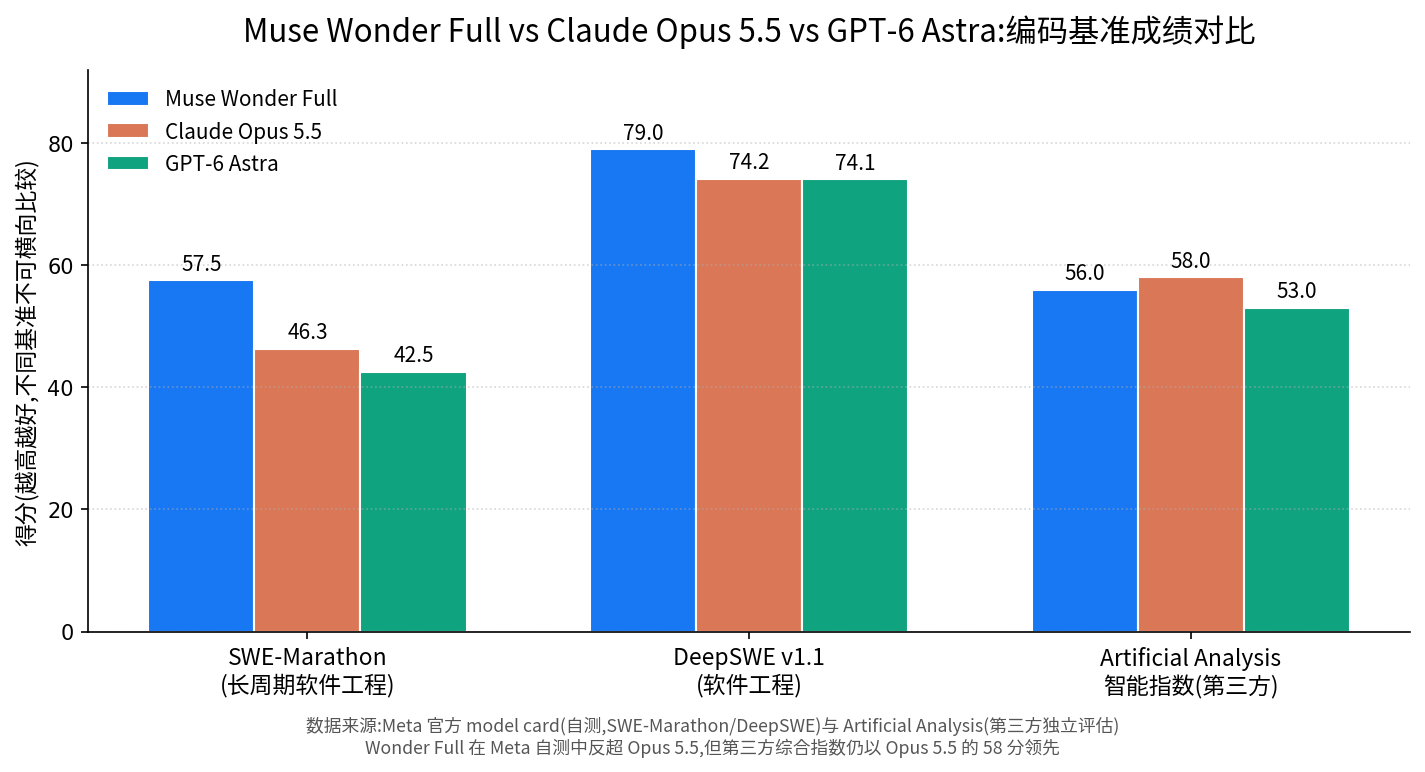 The gap between self-reported and third-party results: Wonder Full beats Opus 5.5 on Meta's own SWE-Marathon and DeepSWE, but trails 56 to 58 on the Artificial Analysis third-party composite index. Sources: Meta's official model card (self-reported) and Artificial Analysis (independent evaluation).
Methodology caveats must be stated honestly here. Meta's own model card admits the comparison table mixes "internally conducted evaluations, vendor-supplied scores, and third-party results"; VentureBeat's verification further notes that some software-engineering comparisons used different coding tools across models, making them less controlled than testing everything under identical conditions. Abacus.AI's Bindu Reddy also publicly questioned the comparability of Meta's self-reported scores on X. The correct posture toward launch-day numbers is always: discount self-reported scores, use third-party indices for positioning, and test on your own workflow for the answer.
Pricing, itemized: per-token price is only half the story
The $4/$20 API price list looks "on par" with Opus 5.5, but vibe coders should look at a different set of numbers. Artificial Analysis estimates the actual cost of running its average Intelligence Index task: about $4.52 for Wonder, $5.98 for Opus 5.5, and GPT-6 Astra the cheapest at about $3.26. Lower per-token prices don't mean less money per completed task — token consumption efficiency varies widely across models. For long-running agent work (repeatedly reading documents, invoking tools, generating long outputs), cost-per-task is the real ledger.
And for individual developers, the real battleground isn't the API price list at all. Wonder Full isn't on the API — it only comes via the $50/$200 Muse Code subscriptions. Meta has turned "the strongest coding capability" into a subscription privilege. That contrasts sharply with Anthropic, which offers Opus 5.5 through both API and subscription. Your "strongest model" is now deeply tied to one IDE — a new form of vendor lock-in: it used to be editor habits that got locked in; now it's the model capability itself.
There's also a landmine buried in the terms, which VentureBeat singled out: Muse Code subscriptions default to Contributor mode — Meta may use your prompts, code, files, and outputs to train future models. Pay-as-you-go API access runs in Standard mode (your data is not used for training), but subscribers must manually disable Contributor mode, and the change only applies to future submissions. If you feed a commercial project's code into Muse Code, you're effectively signing a data-licensing agreement by default. Turn it off in settings before subscribing — or simply don't put sensitive code in there.
Active Memory + Active Focus: the right direction, insufficient evidence
Setting the commercial design aside, Wonder has two genuinely noteworthy new capabilities in product thinking. Active Memory lets agents preserve key personal and professional context across conversations — per Meta research scientist Kavya Kopparapu in the launch video, the model should "remember what's important to you over days, weeks, months, and beyond." Meta even built its own MemoryBench memory benchmark for this, claiming Wonder beats Fable, Opus, and Astra on it. Active Focus tackles another chronic agent ailment: when hitting unexpected obstacles, changing requirements, or failed attempts, the agent doesn't give up midway but revises its plan, explores alternatives, and asks permission before consequential actions.
My judgment: this is a watershed design in the shift from "chat models" to "long-horizon agents," and the direction is exactly right. What's the most painful experience for vibe coders? Not that the model can't write code — it's that "open a new session and it forgets the entire project's context." Memory is becoming the next battleground for coding agents; Cursor and Claude Code are all patching this, and Meta has made it a native model capability.
But the evidence deserves a discount: MemoryBench is Meta's own benchmark with no independent third-party replication yet; how Active Memory behaves in real projects (what it remembers, what it forgets, what happens when it misremembers) awaits large-scale developer testing. These two capabilities are "differentiators worth testing separately," not "verified moats."
The real signal: the Llama open-weight era is over
The fact most easily drowned out by benchmark numbers — yet with the biggest long-term impact — is this: the Wonder series is closed; no weights are released. Neither model's parameters are downloadable, self-hostable, or modifiable. For contrast: the lightweight Muse Glimmer that Meta released in August still came under Apache 2.0, while Wonder shuts the door completely.
From Llama to Wonder, Meta has completed its pivot from "open-source evangelist" to "closed subscription vendor." That signal carries three implications for vibe coders: first, stop waiting for an open-weight Wonder to run locally — Meta has closed that road; second, the gap between open and closed frontier models may widen again to 6–12 months (some analyst notes are already calling it); third, Meta has learned the full OpenAI/Anthropic playbook — the strongest capability is rented, never sold, and subscriptions plus a data flywheel are the new business model.
This also explains why Wonder Full must be tied to a Muse Code subscription: Meta doesn't want API call volume; it wants developers locked into its toolchain, with Contributor mode turning their code into training fuel for the next generation. In the open era, Meta earned ecosystem influence with Llama; now it wants subscription revenue and data.
What it means for vibe coders: a third name on the shortlist
First, the landscape. As of October 2026, the coding-model map is a three-way race: Opus 5.5/Sonnet 5.5 behind Claude Code, GPT-6 Astra behind Codex, and Wonder Full behind Muse Code. That Meta went from "laggard" back to the table in about a year (MSL was founded in August 2025) says a lot — the frontier race is now a four-way brawl among OpenAI, Anthropic, Google, and Meta.
Now three concrete judgments:
First, don't rush to switch tools. SWE-Marathon's 57.5 vs 46.3 sounds beautiful, but the third-party composite of 56 vs 58 says Opus 5.5 still leads overall. Wonder Full's edge concentrates on long-horizon, cross-application agent tasks — if your daily work is "iterating fast inside a single repo," you may barely feel that edge. Before switching "chips," run a one-week comparison on your own repo: the same task in Claude Code and in Muse Code, counting first-pass success rate and rework cycles.
Second, do the subscription math. The $50/month Power Usage and $200/month Maximum Usage tiers sit in the same subscription tier as Claude Pro/Max and ChatGPT Plus. But note Meta describes its tiers as "multiples of the Everyday plan" — how many tasks that actually buys, and how overages are billed, isn't transparent at launch. My advice: start with standard Wonder via API ($4/$20) to test cheaply, and only consider locking into a Wonder Full subscription once the results justify it. The most expensive tier is always "a tax on uncertainty."
Third, test the "resume across sessions" scenario separately. If Active Memory works in real projects — you come back a week later and the model still remembers your architecture decisions and code conventions — then Muse Code's long-project experience could genuinely pull ahead. That's the one capability in the Wonder series that could create a generational gap, and the proposition most worth an afternoon of your time to verify. If memory misremembers and hallucinates context instead, it's just a marketing word.
One-line summary
Meta used Wonder to prove it's back among the leading frontier labs: going from an AI-team reorg to an Opus-5.5-class frontier model in a year is serious execution. But for vibe coders, the real question was never "whose benchmark is 2 points higher" — it's whether you accept the new rules Meta just wrote: the best version is rented, never sold; your code trains the next generation by default; and the open-weight road is closed. Benchmark scores expire; business rules don't — read the rules before picking your tool.
Primary sources: Meta's official research blog (research.meta.ai/blog/muse-wonder) and the Meta Newsroom announcement; benchmark figures from Meta's official model card (2026-10-12) and the Artificial Analysis Intelligence Index; pricing and subscription terms cross-verified via VentureBeat and TechCrunch. Meta's self-reported scores carry methodology caveats, as noted in the article.
Comments (0)
Sources
Related articles

Harvard economists analyzed 718 firms and 300M work events: AI coding agents lifted code volume 30% and PRs 23%, yet finished software didn't budge — while PR review time rose 49%. The bottleneck has moved from writing code to reviewing it.
On October 12, 2026, Cursor announced The X Subscription: Grok, Grok Bot, Cursor and X Premium bundled into one plan with at least double the Grok coding usage — but third-party models are billed at API list price from the first request, and legacy Ultra is closed to new signups. We break down the changes, redo the cost math for four kinds of vibe coders, and offer three playbooks: wait, switch, or go hybrid.
Google DeepMind's new Polaris team is hiring Research Engineers to build evaluation frameworks for AI coding agents — no degree required, no minimum years of experience. The reported total comp of $550K–$1.1M comes from Tamay Besiroglu's X post (base salary is listed at $164K–$252K). Polaris hand-builds a small number of tasks, about a week each, to mirror real-world coding complexity. Evaluation itself has become a frontline lab job.