Genie 4 Is Here: Google's World Model Finds Its Voice — and Puts Gemini in the Loop as Director
Google DeepMind's Genie 4, announced October 27, is the first real-time world model to generate audio natively: its characters can converse, and its weather, camera and cast can be rewritten mid-simulation by a text prompt, while Gemini 3.8 Flash directs the loop frame by frame. Inside: the four upgrades, the Apollo robotics experiment, the official limitations, and a three-horizon outlook.
On October 27, Google DeepMind announced Genie 4, its new generation of world model. Sundar Pichai called it "our most realistic and interactive world model" — but the headline is not visual fidelity. Photorealism stopped being news for generative models a while ago. What Genie 4 actually adds is three things the field has been missing: its worlds have sound for the first time, the people inside them can hold a conversation, and sitting in the middle of the generation loop is another model acting as director — Gemini 3.8 Flash, watching every frame, breaking goals into steps, checking progress and replanning on the fly.
Genie 4 is rolling out as a research preview to trusted testers, with access for Google AI Ultra subscribers in Project Genie and early access partners through the Gemini API and Google AI Studio to follow. Here is what this generation actually changes, what Google itself admits it cannot do yet, and where these capabilities are most likely to land first.

First, a distinction: a world model is not a longer video generator
The difference between a video model and a world model is not duration — it is whether you can step inside. A video model hands you a finished clip. A world model synthesizes an environment frame by frame, in real time, as you navigate it: walk forward and the world ahead of you is computed on the spot; push a door, turn around, change the weather, and it has to answer with something causally consistent. The Genie line has been closing gaps in that chain since 2024. Genie 3 delivered basic real-time interaction and scene consistency. Genie 4 attacks the three remaining weak points at once: sound, people, and the reasoning needed to keep multi-step events from falling apart.
DeepMind states the ambition plainly: understanding and simulating the world is a crucial part of building AGI, and safe, infinitely variable simulations can train robots and agents as well as unlock new interactive experiences. In other words, Genie is not a demo toy. It is Google building a "practice first in imagination" pipeline for its robotics and agent businesses — a point the robotics experiment below makes vivid.
A quick lineage helps calibrate the jump. Genie 1 (2024) learned interactive 2D worlds from unlabeled video, proving a model could learn how a world plays just by watching. Genie 2, later that year, generated explorable 3D environments from a single image. Genie 3 (August 2025) brought real-time interaction, 720p output and minute-scale consistency to a research preview, and reached consumers for the first time through Project Genie. Genie 4's increments are not about resolution but about dimensions: audio is one new dimension, conversational people are another, and Gemini's in-loop reasoning is the third dimension that holds the other two together. That is why this release deserves its own story — it is not adding pixels, it is adding the components of worldhood.
Upgrade one: the world can be edited mid-flight — real-time text steering
Genie 3 already allowed conditions to change mid-simulation. Genie 4 turns that into an everyday natural-language operation. While a simulation runs, you can type a prompt to change the weather, move the camera, or introduce a new person or object, and Gemini adapts your instruction to the surrounding scene instead of pasting the new element in. Between your inputs, Gemini keeps monitoring and steering the scene so the world continues to progress cohesively on its own.
This sounds like a game console's cheat codes, but the mechanism is fundamentally different. A traditional engine changes weather by adjusting parameters; Genie 4 re-imagines what the entire world looks like under new conditions — the light, the wet ground, how people react — without breaking the illusion. For creators, generation and directing collapse into a single act: you are no longer rendering a video, you are staging a world, live.
Upgrade two: better physics, and people who finally feel like people
DeepMind says Genie 4 sets a new standard of realism for real-time interactive simulation, with more credible physics — aerodynamics, collisions and more. But the company itself names the "most dramatic leap" elsewhere: people. Characters in Genie 4 move naturally, respond organically to their environments, and can be interactively steered in real time — ask her to turn, walk over, pick something up, and the motion no longer reads like a puppet on strings.
Why do people matter this much? Because humans have always been the world model's most obvious failure: drifting faces, melting hands, mechanical gait. A world that cannot simulate a person walking across a room is unfit as a training ground and constantly breaks immersion as a storytelling medium. Pushing people past the plausibility threshold unlocks two application families at once: simulation training where a human presence matters (service, healthcare, emergency response), and narrative experiences built around character interaction.
Upgrade three: for the first time, the world makes its own sound
Genie 4 is DeepMind's first real-time world model to generate audio natively — not a soundtrack dubbed on afterwards, but sound computed together with the world itself. Every world carries the ambient sound of its setting, from wind in the trees to waves crashing at the beach. All accompanying audio in the launch demos was produced directly by Genie 4.
The real frontier, though, is speech. Genie 4 introduces interactive dialogue that adapts on the fly: characters converse with each other, and react to your inputs and to events in the world, in real time. Combine this with the previous upgrade and the implication snaps into focus — a character who can move, respond to their environment, and talk back is no longer an "NPC asset." It is the embryo of a character. Every genre that runs on dialogue — games, film, education — just became generatable in principle.
Upgrade four: Gemini moves into the generation loop
The architecturally significant change in this generation is that Genie no longer works alone. Genie 4 is built on the Gemini family: Gemini Omni anchors the simulations in real-world appearance and behavior, while other Gemini models supply the reasoning needed for coherence and continuity. In operation, Gemini 3.8 Flash serves as the guiding agent in the loop — as Genie generates the world frame by frame, Gemini continuously observes the scene, breaks goals down into a sequence of steps, and reviews incoming frames to verify each step succeeded. When the world shifts or the user intervenes, it adapts its plan in the moment.
DeepMind calls this direction "hybrid world models": structured reasoning from code and language models supplies the skeleton — event structure, narrative timeline, causality — while pixel-level simulation supplies the flesh: how the world looks, sounds and responds. One makes it make sense; the other makes it look and feel real. This is bigger than one product. It hands the whole field a reusable architectural pattern: a generative model renders, a reasoning model keeps the world honest.
One experiment worth watching: robots rehearsing inside imagined worlds
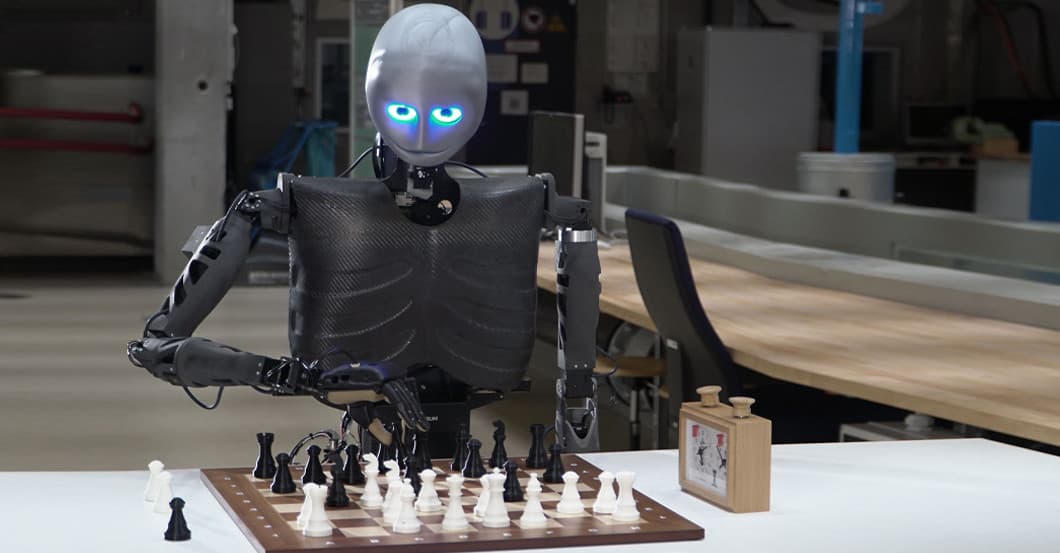
Buried in the launch post is an experiment with a loud signal. DeepMind connected its frontier reasoning model, Gemini 4 Argon, with Genie 4 under the Gemini Robotics umbrella. Argon breaks a user-instructed task into steps and interleaves them as text captions into Genie 4 while it renders; because Genie 4 can be steered by text in real time via Gemini, the simulation adapts as the task progresses. In the demo, the pair simulate Apptronik's Apollo humanoid robot playing a game of checkers, decomposed into real-time steps.
The stakes here are cost structure. The most expensive part of training real robots is trial and error: broken hardware, dangerous scenarios, long-tail data you cannot collect. A world model trustworthy enough to let a robot run a task in imagination first — and fail there, exhaustively — would rewrite the economics of physical AI. Genie 4 is not yet "trustworthy enough" (see the limitations below), but Google placing Argon, Genie and Gemini Robotics side by side in a single announcement tells you exactly where it intends to go.
Who gets it, and when
The timeline, precisely: Genie 4 is out now as a research preview for trusted testers only. It is "coming soon" to Google AI Ultra subscribers in Project Genie, and to early access partners of the Gemini API and Google AI Studio; a public waitlist for Project Genie is open. On safety, Google says Genie 4 ships with guardrails consistent with its other models, passed rigorous internal safety evaluations before the preview, and that all video and audio it generates carries SynthID, the company's imperceptible watermark for identifying AI-generated content.
TechCrunch reports that Genie 4 can maintain a consistent scene for up to about two minutes — roughly double its predecessor. Two caveats belong with that number: it comes from media reporting, not from an official spec sheet in DeepMind's post, and it should be read as an order of magnitude under favorable conditions, not a per-generation guarantee.
Credit where due: the limitations Google lists itself
Unusually, DeepMind devoted a full section of the launch post to limitations, in specific terms. Genie 4 keeps environments coherent over short sessions; the longer a simulation runs, the more complex prompt edits accumulate, and the more you navigate, the more visual details and object permanence can shift or drift. Complex physical interactions, real-time audio accuracy, rendering legible text, spatial accuracy and long-term consistency are all named as active research areas.
Treat that candor as the correct filter for every launch video: each official recording is a short session under curated conditions — an upper bound, not an average. The honest water level of world models today is "a few minutes of intervenable dream," still two mountains — object permanence and long-term consistency — away from "hours of trustworthy simulation." Which is exactly why the first real deployments are in drafting and pre-visualization rather than production pipelines.
The race: world models have become a big-tech arms race
Genie 4 does not land in a vacuum. As TechCrunch recounts, Runway released its second world model, GWM Worlds 2, a couple of months ago — also playable, also with audio. Fei-Fei Li's World Labs is being acquired by AMD. Amazon remains in talks to buy Decart. And Rivian has acquired Third Dimension to bring simulation in-house for self-driving testing.
Read together, those deals say the buyers of world models are no longer just content companies. Carmakers want them to synthesize long-tail driving scenarios; chip companies want position in the next compute workload; cloud platforms want them as training grounds for agents. Google's edge is full-stack ownership: Genie for worlds, Gemini for reasoning, Gemini Robotics for embodiment, TPUs for compute and AI Ultra for distribution. Its handicap is equally clear: a research-preview release cadence runs about half a step behind product companies like Runway.
Where this lands: a three-horizon outlook
Ordered by distance, with the first horizon grounded in what trusted testers are already doing, and the third labeled as extrapolation rather than anyone's roadmap.
Near term (testers are doing it now). Film and advertising pre-visualization in "draft mode": directors step into a live simulation and shoot multiple takes in real time, adjusting camera, lighting, dialogue and action on the fly — the cost of finding a scene drops from a shoot day to a prompt. Game and interactive-experience concept design: from a sentence to an explorable prototype in seconds, testing art direction and mechanics in natural language before a line of engine code exists. Immersive journalism and history: photojournalists are testing turning a single 2D archival photograph into a navigable, populated environment, and simulating how short-lived events like flash floods and wildfires unfold. Enterprise scenario generation: a zero-to-one way to spin up a scene that has never existed, without waiting on a modeling vendor.
Mid term (arrives when the capability does). Simulation training grounds for robots and self-driving: bulk-synthesize the long-tail and dangerous scenarios that are impossible or irresponsible to collect in reality, rehearse in the world model, then transfer — the Argon-plus-Genie experiment is the prototype of this pipeline. Infinite training environments for agents: generate endlessly variable, causally consistent worlds for reinforcement learning and evaluation, attacking the agent field's chronic shortage of good environments and opponents. Education and professional training: historical sites, surgical procedures, factory emergency drills — enterable, repeatable, conversational simulations. Commerce and spatial design: turn a floor plan or a product photo into a world you can walk through before you commit money.
Long term (paradigm-level extrapolation). Playable world generation as a new medium: when coherence stretches from minutes to hours and hybrid models wire narrative skeletons into generation, games stop being developed and start being directed — players reshape the world as they play, and characters genuinely converse and remember. Personalized interactive narrative: a persistent world generated for one person, with NPCs who keep their personalities and memories, rewrites what entertainment and companionship products can be. And world models as the agent's inner sandbox: future agents rehearse consequences inside their own world model before acting — which is the deep logic of Google fusing reasoning with simulation. Let machines make their mistakes in imagination, not in reality.
What it means for indie builders. World models are becoming a new kind of runtime. The old pipeline for interactive experiences was model, code logic, tune engine. When a world can be generated and re-directed by prompt, the pipeline becomes direct first, engineer second: play the experience into existence with a world model, prove it is fun, then decide which parts deserve a traditional engine rebuild. For vibe-coding creators, that raises the ceiling of a prototype from static pages and click-through demos to enterable worlds. When the Gemini API early access widens, expect the first studios embedding Genie-class capability into real products in the three places closest to revenue: game prototyping, virtual showrooms and training simulation.
The real signal is not the graphics
Look at Genie 4's four upgrades together — editable, humanlike, voiced, directed — and none of them is a pure fidelity play. Google is moving the world model from "generate a convincing video" to "generate an environment that can be entered, intervened in, heard, causally reasoned about, and managed by another model." The first is a content tool. The second is infrastructure.
For developers, the milestones worth tracking are not the demo reels but two dates: when Gemini API and AI Studio early access widens beyond partners, and what retention looks like once Project Genie reaches AI Ultra subscribers. The first half of the world-model race is about whose world looks realest. The second half is about whose world gets used first. Genie 4 has taken a strong position — even if, by its own admission, its dreams still only last a few minutes.
Comments (0)
Sources
Related articles
Arda emerged from stealth with $232 million raised and a $1.5 billion Series A valuation, promising AI agents that turn CAD files into assembly plans. The pitch is real, but so far only Anduril vouches for it, and the robotics roadmap is still ahead.

On October 23, 2026, Chroma signed a definitive agreement to join Replit to build the context layer for the self-driving company. Open-source ChromaDB continues, but Chroma Cloud winds down in 60 days: writes stop November 22, reads stop December 22. Price and closing date were not disclosed.

On October 26, 2026, Anthropic publicly filed its S-1: Class A shares under ANT, but with no share count or price range set and the statement not yet effective. The real story is not the $80.7B net loss — it is the $693M operating loss, 11,900 enterprise customers, and founders keeping 50.1% of voting power.