Manus Is Back: Butterfly Effect Raises Over $500M at ~$4B Valuation
Butterfly Effect raised over $500M led by Boyu and IDG, with Tencent, Sequoia China, and ZhenFund joining, targeting a ~$4B valuation. One month after going independent following the collapsed $2B Meta deal, Manus 2.0 and personal agent Cue launched — a comeback for China's general agent.
Over $500 Million, One Month Independent
On October 8, Butterfly Effect announced on its official WeChat account: the company has closed a new funding round of over $500 million (approximately ¥3.35 billion), led by Boyu Capital and IDG Capital, with existing investors Tencent, Sequoia China, and ZhenFund all doubling down. The target valuation is around $4 billion — the planned round valuation Bloomberg reported in September, double the $2 billion valuation at the time of the Meta acquisition.
Get the timeline straight: Butterfly Effect only resumed independent operations on September 1. In other words, one month independent, over $500 million raised. Last December, Meta announced it would acquire Manus for "over $2 billion" — the third-largest acquisition in Meta's history. After the deal was called off, everyone assumed the story was over. Founder Xiao Hong himself said: "I thought our journey had ended as a footnote; I never expected we might get to write a chapter."
Now the footnote has become a chapter. $500 million, a $4 billion valuation, Boyu + IDG leading, Tencent, Sequoia, and ZhenFund all adding on — this isn't "surviving." This is capital voting with real money: the independent-agent road is still worth a heavy bet.
Timeline: From 10 Million Visits in 4 Hours to a Collapsed Acquisition
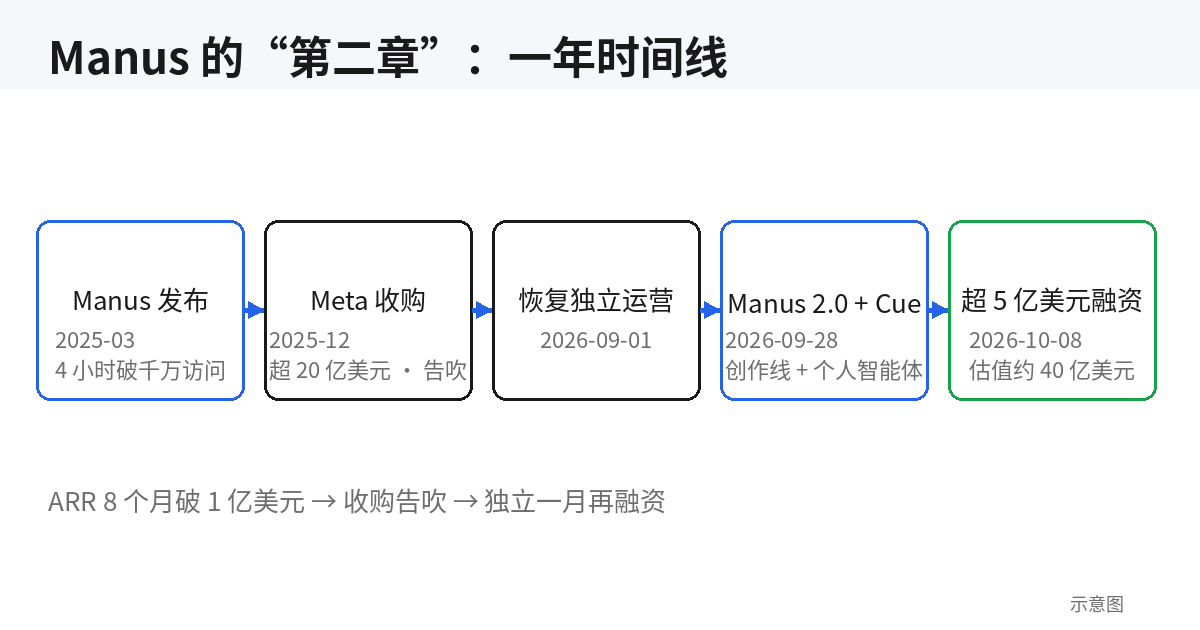
The Manus story is so dense it deserves a timeline retelling, because every chapter explains today's $500 million:
- March 2025: Manus launches. Four hours after launch, the site passed 10 million visits. Invite codes were scalped for hundreds of dollars on secondhand platforms. That was the moment the "general agent" concept truly broke into the mainstream — before it, "agent" was a word in papers; after it, a product shape everyone talked about.
- Around November 2025: from launch to $100 million in ARR in just 8 months. Eight months, $100M ARR — a pace that ranks in SaaS history. It proved one thing: users will pay for "an agent that does work," and they'll pay eagerly.
- December 2025: Meta announces the acquisition of Butterfly Effect for "over $2 billion" — the third-largest acquisition in Meta's history. The top two are WhatsApp and Oculus. Manus's name sitting alongside those two says everything about its weight.
- Mid-2026: the deal is called off. The parties stay tight-lipped about why, but the outcome is clear: Manus did not become a Meta division.
- September 1, 2026: independent operations resume.
- September 28, 2026: Manus 2.0 + the personal agent app Cue launch — less than a month independent, and a next-generation product is already on the table.
- October 8, 2026: the over-$500M round is announced.
Connect the timeline and the $500 million logic clicks: capital isn't buying "a company that went independent again" — it's buying "the team that hit $100M ARR in 8 months + a just-shipped second-generation product + a proven paying market." The collapsed $2B Meta deal left an indelible pricing anchor: one of the companies that best understands traffic on earth was willing to pay $2 billion for this company. Today's $4B valuation is that anchor plus an option on "post-independence new products."
Don't underestimate the months between "deal called off" and "independence resumed." For a star company, a collapsed acquisition is the most dangerous moment: core talent wavers — "is the company dying?"; customers hesitate — "should we renew?"; rivals swoop in to poach. That Manus held together through those months, resumed independence on September 1, and shipped 2.0 on September 28 — that organizational resilience is itself a scarce asset. Investors can read it: people who ship new products in the darkest hour will only be fiercer in fair weather. Boyu and IDG leading, with Tencent, Sequoia, and ZhenFund all adding on, is in some sense a premium paid for that resilience.
Manus 2.0 and Cue: Two Product Lines, One Logic
The September 28 Manus 2.0 launch carried a lot of signal. Break it into two lines:
The creation line: Manus Studio
A local client, Manus Studio, built around "write code, then generate videos and online games." Note the ambition in that phrasing: this isn't "a tool that helps you write code" — it's "code is just the means; the output is videos and games." Code degrades here into an intermediate language. Users don't want code; they want works.
That's a smart positioning. Over the past year, "writing code" in agent-land has become a bloodbath: Cursor, Codex, and Claude Code pushed coding agents to the extreme. But "write code and it becomes something else" — videos, games, interactive works — is still an open slot. Manus Studio's bet: the next generation of creative tools won't be "a better editor" but "say a sentence, get a work" agents. Code is just one of the ways it talks to the world.
The personal line: Cue
The personal agent app Cue goes further: it has its own phone number, email, payment capability, and computer — it can answer calls on your behalf and pay within a budget. Translation: Cue isn't "a chatbot that replies for you." It's a digital double with an identity, a wallet, and the power to act.
"Pay within a budget" deserves its own spotlight. The agent industry has chanted "let agents spend for you" for two years, stuck on trust and risk control — who dares hand an AI their credit card? Cue's answer is "within budget": the user sets boundaries, the agent decides autonomously inside them. That's the key leap from "tool" to "representative": the real agent economy starts with "daring to let it spend."
And "answering calls for you" may be Cue's easiest breakout feature. Think about how many calls you don't want to take but can't ignore: couriers, food delivery, realtors, telemarketers. An AI phone double that understands context, responds by your rules, and relays what matters — that need requires zero market education. Everyone gets it.
Xiao Hong's "Selling Computers" Business
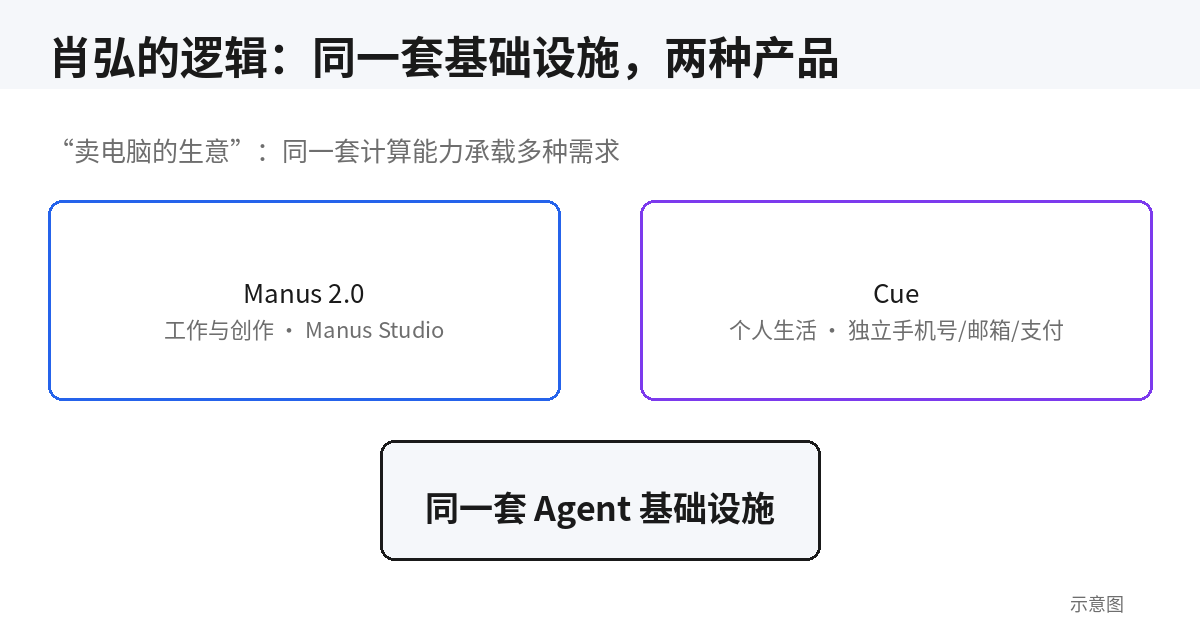
Behind the two product lines sits Xiao Hong's "general agent" logic: Manus handles work and creation, Cue handles personal life, sharing the same infrastructure. In his own words, this is the "selling computers" business.
The metaphor deserves unpacking. What's the computer-selling business? Not selling software or services — selling "the vessel for getting work done." In the PC era, Microsoft sold the OS and Intel sold chips, but the "computer" category itself was neutral — you could run anything on it. Xiao Hong's point: Manus and Cue aren't two apps; they're two form factors of one "agent computer." The real product is the infrastructure underneath that understands tasks, calls tools, and executes.
If that logic holds, the imagination runs large. Today's agent products are mostly "features"; tomorrow's may be "devices." You no longer buy "an app that writes weekly reports" — you acquire a "digital employee" with a phone number, an email, payment ability, that takes your meetings, returns your calls, pays your bills, makes your videos. Manus is its "work mode," Cue its "life mode" — one identity, two scenarios, one brain.
The $500 million will most likely burn toward that infrastructure: stronger task execution, more reliable tool use, a "digital identity" system covering more scenarios. The hiring notice already footnotes it: 17 roles open at home and abroad, based in Beijing — the team is expanding, recruiting for the business of "selling computers."
The Skepticism: The Window Is Narrowing
Applause section done. Now the skepticism — equally real, equally hard.
The biggest objection: model vendors are absorbing task execution into their own products. Codex looks more like an agent every month; Claude Cowork made "doing work on your computer for you" an official feature. When OpenAI and Anthropic make "execution" part of base model capability, where is the independent agent company's window?
History has a version of this script: in the early mobile internet, a wave of independent companies doing "in-app search" and "app distribution" were all absorbed by OS vendors. The Sherlock effect — every Apple system feature kills a batch of indie apps. But counterexamples exist too: WeChat didn't kill every social app; Shopify wasn't absorbed by Amazon. The key distinction: are you "a feature of the system" or "a scenario the system can't contain"? Manus's bet is the latter: the complexity of workflows and the long tail of personal life don't fit inside a model vendor's generic product shape. Codex can write your code, but it won't take the realtor's call or book a flight inside your budget — the more specific and personal the scenario, the more room for independent agents.
The second objection is retention. $100M ARR in 8 months is glorious, but agent retention curves remain a mystery: many users pay for novelty; how many renew for sustained value? Of Manus 1.0's paying users, how many converted to 2.0? Is an agent "can't live without it after one use" or "cancel when the novelty fades" — investors of this $500M surely asked, and only time can answer.
Third, Cue's "own phone number + payment capability" sounds sexy, but compliance and risk control are hell-level difficulty. An AI that calls and spends for you — how do you guard against telecom fraud, card theft, identity spoofing? How will regulators view "an AI owning a phone number"? These aren't product problems; they're survival problems. Any single blowup could halt the entire product line.
The Question the $500 Million Must Answer
Put both sides together and the real question surfaces: can Studio's "write code, make videos/games" creation story convert into sustained payment and retention?
Why this question? Because Manus 1.0 already proved "people pay for general agents" ($100M ARR in 8 months), Cue's "personal agent" story needs time (launched 10 days ago), while Studio's creation line is 2.0's most concrete, most measurable bet: will creators keep paying for "say a sentence, get a video/game"?
Creative-tool history counsels cautious optimism. Figma, Canva, and CapCut all proved users pay recurringly for lowered creation barriers — but only if the output quality holds up. Studio's test isn't "can it generate" but "is the generated thing usable": is an AI-made online game actually fun? Is an AI-edited video actually publishable? Between demo and work lies a river called "quality control" — whether Manus can cross it sets this line's ceiling.
My judgment: over the next 12 months, watch three numbers to judge whether the $500M is well spent — Studio's paid conversion rate, Cue's daily-active retention, and overall net revenue retention (NRR). ARR can be stacked with new logos; NRR can't be faked. If NRR is still above 120% a year from now, the $4B valuation is the floor. If it drops below 100%, today's round is a local top.
Verdict: A Comeback, but the Second Half Just Kicked Off
A final verdict in three layers.
First, I buy the "comeback" narrative. From a collapsed Meta acquisition to $500M one month after independence — that's not luck, it's a hard core: the team that did $100M ARR in 8 months, a just-shipped 2.0, and the joint endorsement of Boyu, IDG, Tencent, Sequoia, and ZhenFund. Among Chinese general-agent players, only this one can show all three at once. Not falling apart in the darkest hour, and shipping new product instead — that alone deserves the $500M bet.
Second, the risks are equally undisguised. The absorption pressure from Codex and Claude Cowork is real, Cue's compliance landmines are real, Studio's quality-control river is real. At least half of the $4B valuation is option pricing on the "general agent" endgame — and "option" means it can go to zero.
Third, the "selling computers" business. This is where I want to add one more thought: if Xiao Hong's logic holds, the agent industry's endgame isn't "whose app is most usable" but "whose infrastructure is most reliable" — just as the PC era was ultimately won by Intel and Microsoft, not by any killer app. Manus is betting on becoming the "Intel Inside" of the agent era. That bet is large — large enough that $500 million is only the down payment.
A year ago, Manus showed the world what a general agent looks like for the first time. A year later, it's spending $500 million to prove an independent agent company doesn't need to sell itself to a giant to thrive. Whether the footnote became a chapter — check the NRR in a year. But at least today, the chapter opens beautifully.
Primary source: Butterfly Effect's official WeChat account announcement, October 8, verified via Sina Finance (Shanghai Securities News lineage) and PEdaily (China Venture) reprints.
Sources
Related articles
TypeSafe raised an $870M Series A at a $7.5B valuation. Its flagship model Jev launched September 15 — it doesn't output text, only probabilities. Led by a16z with Sequoia and DCVC, judgment is splitting off from generation as agent infrastructure's new category.

Perplexity shipped Decider, an open-weights decision model: 27B params, Apache 2.0, V1 at $0.04/M input — cut to $0.02/M six days later in V1.1. Self-reported 85.71% vs Jev's 84.51%: the closed-vs-open script replays in a new lane.

Zhipu's flagship GLM 5.3 is generally available on Amazon Bedrock: a 753B-parameter MoE with a million-token context window and a leading 84.5 on the CyberGym security benchmark. AWS demoed it driving the open-source pentest agent Strix in an authorized security test. Behind the listing sits a revenue-share deal on invocation volume — Chinese and American models sold on the same cloud shelf, with Zhipu's Hong Kong shares jumping over 7% on the news.