No Generation, Only Judgment: TypeSafe Raises $870M Series A as Jev Hits $7.5B Valuation Three Weeks After Launch
TypeSafe raised an $870M Series A at a $7.5B valuation. Its flagship model Jev launched September 15 — it doesn't output text, only probabilities. Led by a16z with Sequoia and DCVC, judgment is splitting off from generation as agent infrastructure's new category.
A Round Worth Reading Twice
AI funding news in 2026 has become numbingly abundant, but this one is worth putting your coffee down for: TypeSafe has raised an $870 million Series A at a $7.5 billion valuation. The round was led by Andreessen Horowitz, with participation from Sequoia and existing investor DCVC — and a16z's Martin Casado is joining the board directly.
It's not the amount itself that stops you — there have been bigger rounds this year. It's the timeline: Jev, TypeSafe's flagship model, was only released on September 15. A model that has been live for just over three weeks raised nearly $900 million and hit a $7.5 billion valuation in one step. The last time we saw this cadence was the early foundation-model boom, when OpenAI and Anthropic took turns resetting records.
The company claims "a third of Fortune 500 companies are already using the model." Hold that thought with a question mark — we'll come back to do the math. But the market has clearly voted: Casado, a16z's infrastructure veteran, joining the board in person signals that this isn't an ordinary model launch in their eyes, but the starting gun of a new category. Consider who Casado is — the face of a16z's infrastructure investing, the Databricks-era crowd. His posture says: this company isn't selling a model, it's selling infrastructure.
One detail many missed: on the very day Jev launched, September 15, the company also closed a $40 million seed round led by DCVC. The seed money hadn't even warmed up before the $870 million Series A was done. Two rounds in about three weeks, with a product launch in between. That's not fundraising — that's capital racing to grab a lane before it fills up.
What Jev Actually Is: A Judgment Machine
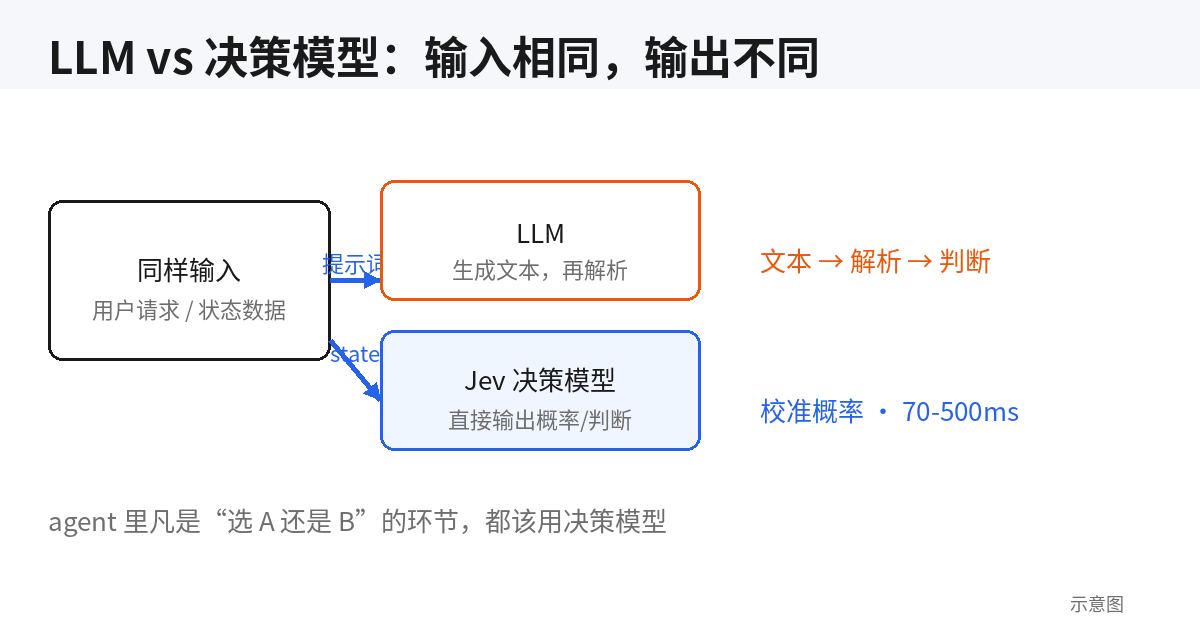
First, nail down the key concept: Jev is not an LLM. It does use the transformer architecture, but it doesn't output text. It outputs probabilities — what the company calls "calibrated decisions."
In plain language: you give Jev a context and a question, and it doesn't write you an essay. It tells you "option A has probability 0.83, option B 0.12," or "the probability this content violates policy is 0.07." No token-by-token autoregressive generation, no sampling temperature, no "let me think." Input in, judgment out, with latency between 70 and 500 milliseconds.
The company was founded in 2024, and the three founders have serious credentials: Diogo Almeida was previously a researcher at OpenAI, Sasha Sheng is a former Meta research engineer, and there's Erik Gafni. The classic "star researchers leave big tech to start up" script — except this time the direction isn't "build a stronger generative model," but throwing generation out entirely.
The trade-off is worth savoring. For three years, nearly every star startup has been answering "how to generate better": longer context, stronger reasoning, cheaper tokens. TypeSafe went the other way and asked a neglected question: in agentic systems, is the highest-frequency action "writing" or "choosing"? Their answer is the latter — so they built a machine designed purely for choosing.
Why This Isn't "Just Another Small Model"
For the past two years, the agent world has harbored an open secret: everyone has been using LLMs for things they're bad at.
Think about your own agent code. Intent routing: have the LLM output "A/B/C" and parse it with a regex. Content moderation: have the model generate the words "violation/compliant" and string-match them. Ranking and scoring: have it emit a string of digits and parse it into a float. Reranking in RAG: have the model score each document. Behind every "choose A or B" moment in an agent sits a full text-generation call — hundreds or thousands of tokens generated, just to extract a few bits of information.
It's like baking an apple into a pie just to weigh the apple, then picking it back out. Absurd — but there was no alternative: nothing besides an LLM could understand complex context and render a judgment. Classifiers were too dumb (fixed schemas only); LLMs too expensive (burning hundreds of tokens for a few bits). The whole industry sat stuck in that middle ground for two years, making do.
Jev's bet is that "judgment" deserves to be its own model category. Just as recommender systems once split off from search, and vector databases split off from databases. When a step is frequent enough and peculiar enough in shape, it stops being "a use case of LLMs" and becomes a dedicated component. History rhymes: every infrastructure maturation is marked by specialized tools growing out of general ones.
This is my judgment: this is a paradigm shift in agent infrastructure, not an incremental capability gain. Generative models solve "how to write"; judgment models solve "what to choose." For three years the industry competed on writing better, while the "choosing" step ran naked — guest-starring generative models, expensive, slow, and flaky. Jev is the first to productize "choosing" properly. And once a category is established, the followers won't be one or two.
A Concrete Scenario
Picture an e-commerce support agent. A user says "my package hasn't moved in three days," and the agent must first decide: is this a tracking inquiry, a return request, or a complaint? The old approach stuffs the message into a prompt with a few few-shot examples, has the LLM output the four characters for "tracking inquiry," then string-matches into a branch. One judgment, 800 input tokens minimum, 10 output tokens, 1–2 seconds of latency — and occasionally the model outputs something like "this looks like a tracking inquiry," breaking your parser.
With a judgment model: the input is the message plus three options, the output is three probabilities, in 70 milliseconds. No few-shot, no instruction overhead, no parse failures, no retry logic. What you save isn't just money — it's an entire layer of glue code and exception branches.
The Cost Math: When Output Is Free
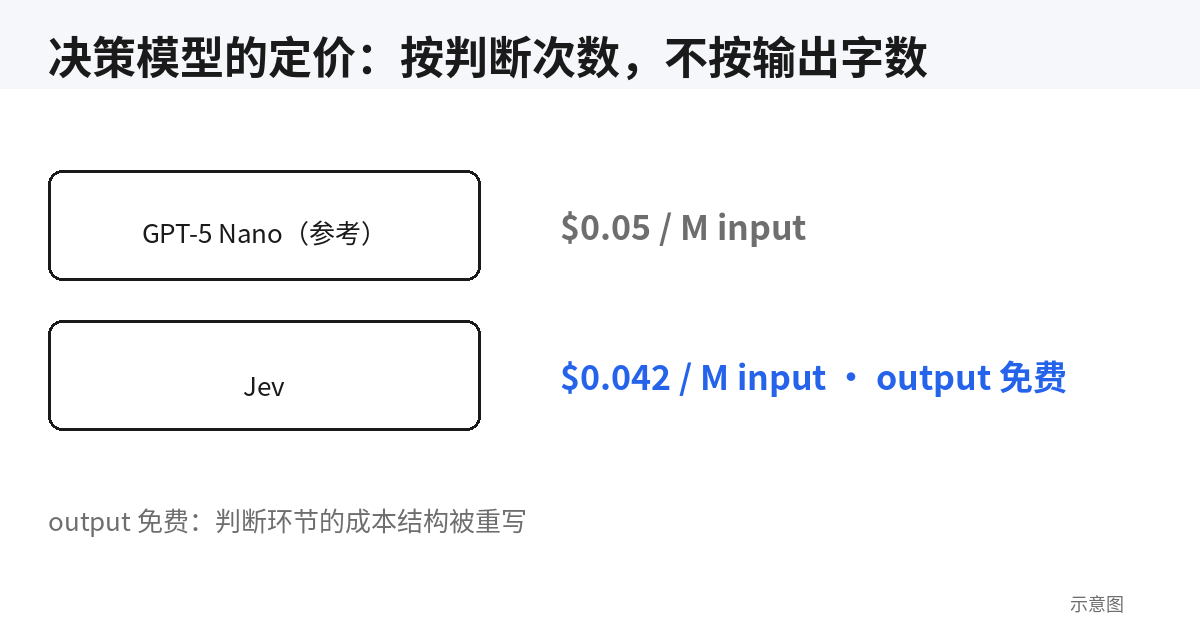
Now the pricing, because pricing is the sharpest part of this story. Third-party data shows Jev is priced at $0.042 per million input tokens, with output free. For comparison: GPT-5 Nano charges $0.05/M for input. Jev is cheaper than that — and the output side is outright free.
Run the numbers. Suppose your support agent does 100,000 intent classifications a day. With an LLM: each call needs ~800 input tokens with few-shot examples plus 20 output tokens — 80 million input tokens a day, $4 a day at GPT-5 Nano prices, $120 a month. With Jev: input might be just 200 tokens (no few-shot, no "please output JSON" instruction overhead) — 20 million tokens a day, $0.84 a day, $25 a month. 80% cheaper, with latency dropping from seconds to hundreds of milliseconds.
But the real meaning isn't "saving money" — it's that the cost structure gets rewritten: priced per judgment instead of per token; output free because output was never the product — the judgment is. That changes design intuition for agents. You used to batch multiple judgments into one LLM call to save tokens; now you can afford to be lavish: call the judgment model at every step, fast and cheap. Architectures shift from "save wherever possible" to "call whenever appropriate."
There's also a hidden cost: the instability tax. Judging with an LLM means writing "retry on parse failure" logic, handling the model's occasional off days, and writing test cases covering output-format variations for every judgment step. Those engineering costs never show up on the bill, but every agent team pays them. A judgment model outputs structured probabilities — that tax is waived outright.
My judgment: within 12 months, "decision cost per task" will become a core metric for agent teams, the way everyone watches token cost today. And the first teams to migrate routing, classification, and scoring off LLMs onto judgment models will bank real cost and latency advantages — not theoretical ones, but numbers visible on next month's bill.
The Pursuers Have All Set Out
Whether a category is real depends on who follows. The gun fired at Jev, and the pursuers arrived far faster than expected:
- OpenAI rushed out a Decisions API — when the incumbent starts copying your homework, the homework is right. OpenAI's entry is an official stamp on the "judgment model" category, and it turns the lane from "startup storytelling" into "territory giants must contest."
- Perplexity didn't just follow — it open-sourced its 27B Decider outright (we cover that separately: a price war, halved in six days). An open-weights player's entry drops the bar for "judgment models" from "call an API" to "deploy it yourself."
- Cloudflare and AWS are entering too — and their arrival is the most telling signal. They don't build models; they sell utilities. When cloud vendors start selling "judgment" as a utility, the category is entering the standard-infrastructure sequence, like vector search and object storage before it.
Note the speed: Jev launched September 15, and by the October 9 funding announcement, every rival was already in the field. A three-week-old category with a complete competitive landscape. That's rare even in AI history — new categories usually spend 12 to 18 months in the "only one company telling the story" phase.
Why so fast? Because the demand already exists; no market education needed. Every agent team's codebase is littered with dozens of "have the LLM output an option, then parse it" hacks. Jev was just the first to productize that pile of hacks. The followers aren't chasing Jev's technology — they're chasing the position Jev pointed at: the empty "judgment layer" slot in agent architecture. Once an empty slot is visible, everyone piles in.
The Signal for Developers: Your "Choose A or B" Code Is Becoming a Standard Part
Something actionable. Tonight you can run a "judgment audit" on your own agent codebase:
- Everywhere a prompt says "output only A/B/C," "output a score from 1 to 10," "answer yes or no" — that's a judgment call you're having a generative model do at a premium.
- Everywhere a regex, JSON parse, or string match follows to extract the model's output — that's parsing overhead, glue code that shouldn't have to exist.
- Everywhere there's "retry if parsing fails" logic — that's the instability tax of judging with a generative model. You've been paying it; you just never booked it.
These steps are becoming standard parts. Just as you no longer write your own HTTP parser or connection pool today, a year from now you probably won't hand-roll a classifier out of LLM prompts either. Whatever shape judgment-model APIs take, agent frameworks' middle layers will take the same shape — expect LangChain, CrewAI and the rest to support decision models as first-class citizens in their next major versions.
My concrete advice: design new projects as a two-layer architecture — a generation layer plus a judgment layer from day one, with routing, classification, scoring, and moderation on judgment models and writing, summarizing, and code generation on LLMs. Don't migrate old projects all at once — pick the 1–2 highest-frequency judgment steps as a pilot, run it for two weeks, and compare cost and latency. The ecosystem is early and API shapes may still shift, but the direction won't. Pilot early, get the data early.
The Skepticism, Stated Upfront
Applause aside, there are three hard objections.
First, "a third of the Fortune 500" is a company claim, with no third-party audit. Jev has been live three weeks — a third of the 500 completing procurement, integration, and rollout in that window? That pace would be extreme even for a free product. The likelier reading is "an employee signed up for a trial counts as usage." Capital can pay for stories, but discount to the strictest reading when making technology choices — treat it as "dozens of large enterprises piloting."
Second, $7.5 billion is expectation pricing, not acceptance pricing. In three weeks, no data on retention, renewal, or expansion can exist. a16z is betting on the terminal position of the "judgment layer" category: win the bet and $7.5B is the floor; lose it and it's a one-round wonder. Don't mistake valuation for technical validation — valuation validates capital's anxiety, not product maturity.
Third, the moat question. Probability outputs, calibration — that's engineering know-how, but how deep? Perplexity produced a self-reported 85.71% vs 84.51% in six days (see our companion piece), and once open weights ship, the mystique around "calibration" halves. Judgment models may commoditize faster than LLMs: their output space is small and evaluation criteria are crisp — what's easy to measure is easy to catch up with, and what's easy to catch up with can't charge monopoly rent.
But none of the three shakes my core judgment: the category is real; the valuation is a bet. For developers, what matters isn't whether TypeSafe is worth $7.5 billion — it's that from today, "judgment" has dedicated models serving you, and those "generate text with an LLM, then parse it" steps in your code are becoming last-generation practice. As for Jev vs. Decider vs. Cloudflare's Clef — our companion piece has the selection guide.
Generative models taught machines to write. Judgment models are teaching machines to decide. The second half of the agent game may shift from "writing better" to "choosing better." And this time, the first team to make "choosing" a standalone business got $870 million in three weeks.
Primary source: TechCrunch, October 9 (first reported by Bloomberg the same day; company announcement followed).
Sources
Related articles

Butterfly Effect raised over $500M led by Boyu and IDG, with Tencent, Sequoia China, and ZhenFund joining, targeting a ~$4B valuation. One month after going independent following the collapsed $2B Meta deal, Manus 2.0 and personal agent Cue launched — a comeback for China's general agent.

Perplexity shipped Decider, an open-weights decision model: 27B params, Apache 2.0, V1 at $0.04/M input — cut to $0.02/M six days later in V1.1. Self-reported 85.71% vs Jev's 84.51%: the closed-vs-open script replays in a new lane.

Zhipu's flagship GLM 5.3 is generally available on Amazon Bedrock: a 753B-parameter MoE with a million-token context window and a leading 84.5 on the CyberGym security benchmark. AWS demoed it driving the open-source pentest agent Strix in an authorized security test. Behind the listing sits a revenue-share deal on invocation volume — Chinese and American models sold on the same cloud shelf, with Zhipu's Hong Kong shares jumping over 7% on the news.