Meticulous Raises $15M Series A: As AI Code Gets Cheap, Trust Becomes the Most Expensive Thing
Autonomous testing startup Meticulous raised a $15M Series A; customers include Notion, Dropbox and Wiz. Its deterministic browsers and pixel-level diffing turn testing from a last check into a merge gate.
If the Harvard/Jellyfish study that circulated last week diagnosed the AI coding era's illness — code volume up 30%, shipped software flat, review as the new bottleneck — then a funding announcement from almost the same moment is the prescription: autonomous software testing company Meticulous announced a $15 million Series A led by Chemistry, with Menlo Ventures participating.
The amount itself isn't the story. What deserves coverage is the timing and the customer list: Notion, ElevenLabs, Dropbox, Wiz, LaunchDarkly — companies famous for engineering quality have already made Meticulous "the gate you pass before merging a PR." As AI drives the cost of writing code to the floor, "trust" becomes the most expensive thing in the software delivery chain — and Meticulous sells trust.
1. The funding facts
According to the company's official press release dated October 6, 2026 (distributed via PR Newswire on October 8), Meticulous raised $15 million in Series A funding led by Chemistry, with participation from Menlo Ventures and a heavyweight angel roster: former Stripe executive Lachy Groom, Poolside co-founder and co-CEO Jason Warner, Dropbox co-founder Arash Ferdowsi, former Adobe Chief Product Officer Scott Belsky, Vercel founder Guillermo Rauch, Segment founder and former OpenAI engineering lead Calvin French-Owen, Hex CTO Caitlin Colgrove, and former Cursor Head of Engineering Jason Ginsberg, now a Member of Technical Staff at xAI.
The company was founded by brothers Gabriel Spencer-Harper (CEO) and Quentin Spencer-Harper (CTO, formerly of Palantir). The release's headline is blunt: "Meticulous Announces $15m Series A to Enable Every Developer to Ship at the Speed their Agents Code." Note the framing: it's not selling "testing" — it's selling "shipping velocity."
2. It solves exactly the problem the Harvard paper identified
Placed on the Harvard study's coordinate system, Meticulous sits in a very clear spot. The paper found agentic tools lifting code volume +30% and PR counts +23% while resolved issues stood still; average PR review time rose 49% and send-back rates nearly doubled. The bottleneck is review, and review is slow because of distrust — reviewers can't tell what AI-generated code actually changed or what it might have broken elsewhere.
Meticulous's product logic moves the "dare I trust this" question out of human heads and into a machine pipeline. It automatically generates and maintains "thousands" of user flows covering edge cases, replays them in full inside deterministic browsers, and detects differences down to a single pixel. More importantly, it doesn't just tell you "a test failed" — it visualizes the complete blast radius of a change, so engineers, PMs, and designers can preview the full impact before merging.
LaunchDarkly's Director of Engineering Zach Davis put it in the release in words that read like the Harvard paper translated into plain English: "We're moving into an era where code generation is relatively inexpensive, but that means code review and the feedback loop become the bottleneck." When customers summarize it that way themselves, the pain point is not a "future trend" — it's the present tense.
3. The tech: why "deterministic browsers"
Meticulous's stack has three keywords worth unpacking, because they map exactly onto three new testing problems of the AI-generated-code era:
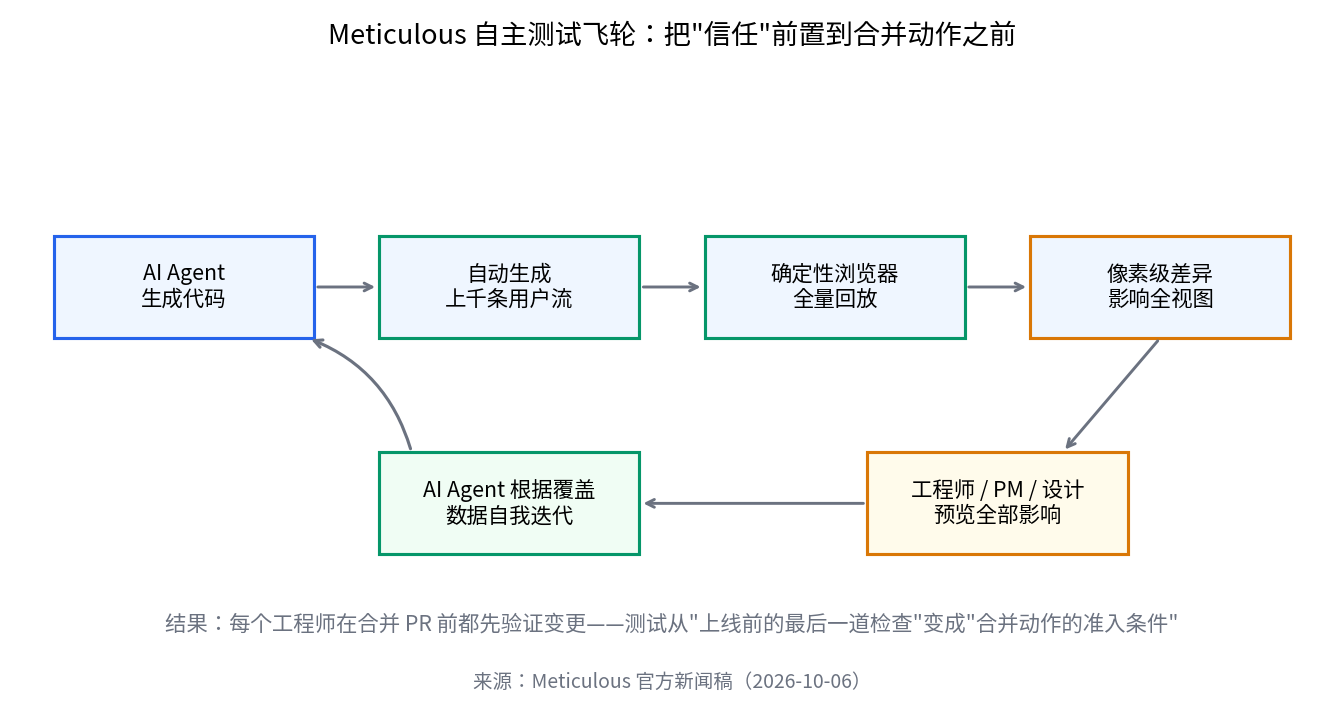
The Meticulous testing flywheel: AI generates code → thousands of user flows auto-generated → deterministic browser replay → pixel-level diffs and full impact view → human preview / agent self-iteration. Source: company press release.
First, automated generation and evolution of test cases. Traditional testing's biggest cost isn't "running" — it's "writing" and "maintaining." Change the UI and hundreds of assertions break with it. Meticulous auto-generates thousands of user flows and lets the suite evolve on its own. That matters especially for AI-generated code: an agent can touch ten places a day, and hand-written tests can't keep up with that change velocity — only machine-generated tests can chase machine-generated code.
Second, deterministic browsers — zero noise. Frontend testing's chronic disease is flakiness: the same test passes and fails on alternate runs because of network jitter, animation timing, or font loading. Meticulous uses deterministic browsers to kill that noise so every replay is reproducible. Without determinism, "pixel-level difference detection" would be an empty promise — you couldn't tell whether a pixel changed because the code changed or because the browser rendered 50ms slower this time.
Third, from "assertions" to "full impact view." Traditional tests answer "did my pre-written assertions pass"; Meticulous answers "what did this change actually affect." That distinction is critical: assertions only cover what you thought to test, and AI-generated code is best at introducing regressions precisely where you didn't think to look. Pixel-level diffs plus full user-flow replay effectively bring "the places you didn't think of" into the inspection scope.
One more detail: the release explicitly notes that AI coding agents can use this coverage data to iterate on their own work before submitting it for human review. That closes the loop: agent writes code → deterministic machine testing feeds back → agent fixes itself → humans only review what machines have already verified. In theory, that pre-stage absorbs a large chunk of the paper's +49% review time.
4. What the customer list signals

In high-velocity teams, the testing dashboard is turning from "reference information" into "the basis for merge decisions."
Notion, ElevenLabs, Dropbox, Wiz, LaunchDarkly — the customer list says more than the round size. These companies share traits: high-frequency iteration, users extremely sensitive to quality (a Notion outage gets the whole internet complaining; Wiz, a security company, can't afford its own security incidents), and famously high engineering bars.
One easily skimmed line in the release: "At Notion, ElevenLabs, Dropbox, Wiz and LaunchDarkly… every engineer depends on Meticulous to verify their changes before merging a PR." Note "every engineer" and "before merging a PR" — Meticulous has moved from "the QA team's tool" to "a pre-merge gate for every developer," from "the last check before going live" to "the admission requirement for the merge action." When a tool's position changes like that, its pricing power is a different animal entirely.
Translated for vibe coding practitioners: "do you have autonomous testing hooked up" may become, like "do you have CI" today, a dividing line for whether a project looks serious. You can skip it today; in two years, without it your PR reads as "unverified AI-generated code."
5. What the angel list signals
Now the angels: Vercel founder Guillermo Rauch, Dropbox co-founder Arash Ferdowsi, former Cursor Head of Engineering Jason Ginsberg, former OpenAI engineering lead Calvin French-Owen… that's nearly a roster of "people who have personally lived through AI code inflation." They either build developer tools (Vercel, Cursor) or run engineering at scale (Dropbox, OpenAI). They're not betting on "the testing sector" — they're betting that "the verification layer becomes the new infrastructure of the AI coding era."
Jason Ginsberg's identity is telling — former Head of Engineering at Cursor, now at xAI. Cursor is one of the defining AI coding tools, and its former engineering head just backed a company that verifies AI-generated code. That positioning alone shows where industry consensus is moving: the generation battle is over; the verification battle just started.
6. Takeaways for vibe developers

Writing code gets cheaper; verification gets more valuable — the most basic supply-and-demand fact of the AI coding era.
Meticulous is an enterprise product; a $15M-Series-A company isn't serving indie developers yet. But its logic ports directly to a personal workflow. Three takeaways:
1. Treat your "verification budget" as seriously as your "generation budget." Many people cap agent tokens but set no floor on verification time. Flip it: every time you have an agent generate code, force it to also state "how I verify this is correct" — run tests, record a demo, show the diff's blast radius. Code without a verification plan doesn't get committed.
2. Record "user flows," not just assertions. Meticulous's core insight: the best way to cover edge cases is replaying real user journeys. The indie-developer low-fi version — record a few end-to-end demo scripts for your core features (one Playwright recording session), and run them in full after every big change. That catches AI regressions better than 100 hand-written unit tests.
3. Let the agent "self-review" before submitting. The release's point about "AI agents iterating on coverage data" is something solo developers can do today: have the agent run the tests, read the failure logs, fix them itself, and only then hand you the final diff. You should be reviewing what machines have already verified once — not the first draft. That directly hedges the paper's +49% review time.
7. My take
The most memorable thing about this round isn't $15 million — it's a footnote to an era: AI coding competition has officially entered its second half. The first half was "who generates fastest"; the second half is "who verifies hardest."
Harvard's research tells us code inflation has already happened; Meticulous's funding tells us someone is already pricing that inflation — by pricing it as "trust as a service." Whether the verification layer becomes a standalone giant category is too early to call; but the direction is clear: as generation approaches free, verification is what's scarce. Indie developers should start accumulating verification assets today: test flows, replay scripts, checklists. In the AI era those aren't costs — they're moats.
After all, AI can write code for you, but it can't take responsibility for it. And "responsibility" now has a listed price.
Comments (0)
Sources
Related articles

Cognitum One released Ruflo, an open-source agent orchestration platform turning one mission into a 100+ agent end-to-end workflow — 74K stars, MIT licensed. Competition is sinking from models to harnesses.

Harvard economists analyzed 718 firms and 300M work events: AI coding agents lifted code volume 30% and PRs 23%, yet finished software didn't budge — while PR review time rose 49%. The bottleneck has moved from writing code to reviewing it.
AI-written code runs perfectly for one user and can collapse under 100 concurrent ones on launch day. This guide gets your first k6 script running in 15 minutes: derive load scenarios from real user behavior, read p95/p99 and saturation signals, locate DB, connection-pool and third-party API bottlenecks with a three-axe method, convert test numbers into paying-user capacity, and put load testing into CI as an automatic gate.