Microsoft's Maia 300: 40% More Tokens Per Megawatt, Built for Agentic Inference
Microsoft unveiled its third-generation Maia 300 AI accelerator on Oct 12, claiming 40% more tokens per megawatt than leading GPU systems (vendor claim, unverified) and scaling to multi-gigawatt deployments from 2027. We break down the official blog post: why Microsoft is betting big on in-house inference silicon in the agent era, and what cheaper inference means for vibe coders.
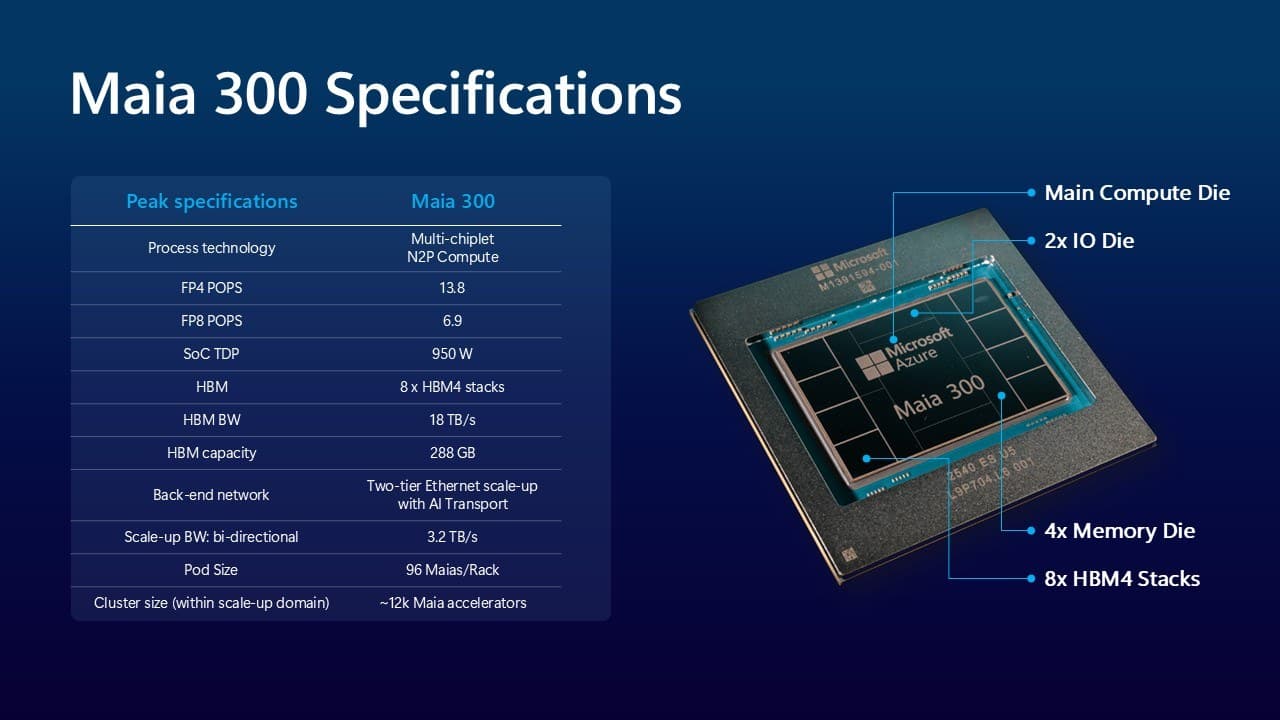
On October 12, Scott Guthrie, Microsoft's executive vice president of Cloud + AI, announced the third-generation in-house AI accelerator Maia 300 on the Official Microsoft Blog — and set a big target alongside it: starting in 2027, scale the Maia family to multi-gigawatt deployments, making it the primary inference system for Microsoft products and services. Satya Nadella called it "our biggest bet yet on our own silicon" the same day.
This is not a routine hardware refresh. It landed at the OCP Global Summit, at a moment when Microsoft's capital spending is projected to exceed $175 billion this fiscal year — and at an inflection point: the center of gravity of AI workloads has shifted from training to inference, and the rise of agents is making the inference bill grow exponentially.
In this piece, we break down Guthrie's official blog post paragraph by paragraph, verify every number and timeline in it, and place them inside a bigger judgment: why is Microsoft placing its biggest bet on in-house inference silicon in the agent era — and what does it mean for vibe coders who work with agents every day?
First, a note on sourcing discipline, so nothing below is misread. Microsoft claims Maia 300 delivers 40% more tokens per megawatt than "leading GPU-based systems" — but it did not name which GPUs, nor disclose the test workload. That is a textbook vendor claim with no independent verification. Every such number below is explicitly labeled as "Microsoft's claim." That is not harshness toward Microsoft; it is basic discipline when reading any vendor hardware launch: a custom chip's report card deserves to wait for production benchmarks.
What was announced: the facts
From the official blog post, the key points on Maia 300:
Positioning: Guthrie describes Maia 300 as a "complete intelligent system" aimed at three emerging workload types: long-context reasoning, latency-sensitive conversational experiences, and sustained, multi-step agentic tasks. Note the wording — the previous generation, Maia 200, was framed as "running Copilot production workloads." This generation writes "agentic tasks" directly into the design goals. It is the first time Microsoft has admitted at the silicon level that agents are not a software-layer toy — they are a workload the infrastructure must be designed for.
Hardware: a multi-chiplet architecture separating compute, memory-controller, and I/O functions; compute chiplets built on TSMC's N2P process; eight HBM4 stacks totaling 288 GB of memory with 18 TB/s peak bandwidth; 950W TDP; enhanced MXFP4 low-precision format support; on-die SRAM as a software-managed scratchpad to relieve HBM pressure; scale-up networking over an Ethernet-based AI-optimized transport. Microsoft's design philosophy: move data more efficiently rather than piling up raw compute — the bottleneck of inference systems is data movement, not multiplication.
Rack form factor: 96 accelerators per rack within a 167 kW power envelope, 27.6 TB of total HBM capacity, 1.7 PB/s of aggregate bandwidth. Microsoft claims a full rack delivers 7x the token throughput of a Maia 200 rack (Microsoft's claim).
Timeline: Maia 300 begins production deployments in 2027; the Maia family scales to multi-gigawatt starting 2027. More architectural details are promised at Ignite 2026 in San Francisco this November.
Where Maia 200 stands: this is the half of the blog post that is easy to overlook but arguably more important — the previous generation is already working. Maia 200 is running production workloads in data centers across the US, Europe, and Australia, serving Microsoft Copilot and supporting the MAI team's next-generation models; GitHub Copilot and Microsoft Foundry are slated to follow by the end of this year. Microsoft says that for built-in AI features in Teams, Copilot, and Cowork, Maia 200 delivers 1.7x more tokens per watt than "leading GPU infrastructure" (Microsoft's claim).
 Microsoft's official Maia 300 specification infographic from the company blog. All figures are Microsoft's claims: the 40% tokens-per-megawatt figure was published without a named baseline or test workload and has no independent verification.
Three generations: from Athena to agentic inference
Laid side by side, Microsoft's custom-silicon roadmap is remarkably clear. We generated a comparison chart of the three generations' key specs (all figures from Microsoft's official announcements; figures marked * are Microsoft's claims):
 Azure Maia three-generation specification comparison. Maia 100 (2023) was the "we can build chips too" declaration; Maia 200 (early 2026) was the proof that "the chips can run production workloads"; Maia 300 is the third step — "redesigned for the agent era." Figures marked * are Microsoft's claims without independent verification.
Maia 100 (November 2023, Ignite 2023) was the fruit of the "Athena" project: TSMC 5nm, 105 billion transistors, billed at the time as one of the largest chips on 5nm. Designed for large language models like GPT-3.5 Turbo and GPT-4, it was Microsoft's first proof to the world that it could build AI chips. But back then it was more of a strategic declaration — "reducing dependence on Nvidia" — than a real product.
Maia 200 (announced January 2026) was the turning point: 216 GB of HBM3e, 7 TB/s of bandwidth, a 750W SoC, inference-first design. The key change: it actually went into data centers and actually started serving Copilot's production traffic. Microsoft had its first complete "our chips serving our products" loop — and, crucially, real workload profiling data. Guthrie writes in the blog that production experience with Maia 200 "directly informed the design of Maia 300." That sentence deserves a pause: the value of in-house silicon is not just cost savings — it is a full set of real workload profiles telling you exactly what to optimize next.
Maia 300 is the third step on the roadmap: the first time "sustained multi-step agentic tasks" appears explicitly in the design goals. From "we can build chips" to "the chips run production" to "redesigning chips for agent workloads" — Microsoft's custom silicon took three years. The cadence mirrors Google's TPU (now on its seventh generation) and AWS's Trainium (third generation): every cloud giant is doing the same thing; Microsoft just started later and is catching up fast.
Judgment 1: agents changed the structure of the "compute ledger" — inference is the main battlefield
Why bet big on inference chips now? The answer is in the workload mix.
In the training era, the compute ledger was "one-off": train a model, burn the money, done. GPU vendors' narratives revolved around peak FLOPS — whoever's card computed fastest won. In the agent era, the ledger is "recurring": a single agentic task can run for tens of minutes, call the model dozens or hundreds of times, stuff tool outputs into long contexts, and pile up KV cache. Inference is no longer the "final payment" after training — it has become rent, billed by the second. Microsoft's line in the blog — "AI is becoming a foundational layer of every application" — translated into finance reads: inference cost is a recurring cost, growing linearly — even super-linearly — with agent adoption.
That is why Maia 300's headline metric is not peak compute but tokens per megawatt. For a cloud vendor, the hard constraint on a data center was never "can we afford the cards" — it is "how much power can this campus get." When power becomes the ceiling, the yardstick for chips changes from "how fast is each card" to "how much useful work per unit of electricity." Microsoft putting 40% tokens per megawatt (its claim) in the headline is essentially a story for Wall Street: our AI gross margins have a defense line, and it is custom silicon.
My judgment on this logic: the direction is right; hold the number with skepticism. Inference dominating the workload mix and power becoming the hard constraint are industry consensus — Nvidia itself is pushing a "token economics" narrative. But until Microsoft names the baseline and the methodology, 40% is a marketing figure. Remember the direction of the conclusion, not the number itself.
Judgment 2: power is the new oil — the "inference sovereignty" race is officially on
The word "multi-gigawatt" deserves a pause. A gigawatt is a power-plant unit, not a chip unit — a large nuclear reactor is roughly 1 GW of capacity. Microsoft is saying that starting in 2027, just running Maia chips will consume several nuclear plants' worth of electricity. That is not rhetoric; it is an honest admission that AI infrastructure is approaching physical limits.
The power constraint explains the urgency. Training can be queued and time-shifted; inference cannot — when a user asks a question, the electricity has to be there. When every call from Copilot, GitHub Copilot, Teams, and Foundry passes through inference clusters, "tokens per megawatt" directly determines how many users Microsoft can serve and how thick its margins are. A telling detail from Reuters' coverage: Microsoft may deploy more than a million Maia chips in 2027 (note the qualifier "potentially"). A million chips at nearly a kilowatt each — that is why the deployment unit is counted in gigawatts.
Zoomed out, Maia 300 is the latest shot in the cloud giants' "inference sovereignty" race. Google has TPUs, AWS has Trainium and Inferentia, Meta has MTIA, and both OpenAI and Anthropic are building custom chips — plus Microsoft's Maia, not one of the five giants is willing to stake its inference lifeline entirely on Nvidia. Nvidia draws more than half of its quarterly revenue from hyperscalers; that structure is inherently unstable: the bigger the buyer, the more it wants to build its own.
Interestingly, Microsoft is fighting this war on two legs: in-house chips like Maia (shedding dependence) on one side, and partnership with Nvidia on the other — on October 7, Nadella and Jensen Huang shared a stage to unveil the RTX Spark-powered Surface Laptop Ultra, pushing agents onto Windows laptops. Custom silicon for the cloud to cut costs, Nvidia partnership for the edge to capture the entry point. The two look contradictory but follow one logic: for agents to be everywhere, cost must come down on both ends. Cloud cost falls via Maia; edge cost falls by stuffing inference into users' own devices (where users pay the electricity bill).
That also explains why the "local agent" trend we covered last cycle (e.g., the local-deployment route of Nemotron-class models) and Maia 300 are two sides of the same coin: the endgame for agents is not "everything in the cloud" or "everything on-device" — it is inference cheap enough to run anywhere. Microsoft betting on both ends shows it sees exactly that.
What it means for vibe coders: agent calls are getting cheaper
Chips are Microsoft's business; ours is the question: what does this have to do with how I write code every day? The connection is direct: falling inference cost is the most important "tax cut" of the agent era.
Do the math. In a vibe coder's daily expenses, a growing share is the "agent token bill": one medium-complexity agent task — reading the repo, changing code, running tests, looping through bug fixes — easily burns hundreds of thousands of tokens. At today's API prices, that is a few dollars per run. It sounds small, but run it a dozen times a day and it outgrows the subscription itself within a month. Many indie developers have started rationing tokens: long tasks left unopened, long contexts withheld — precisely the uses where agents are most valuable, suppressed by price.
The significance of inference chips like Maia 300 is to push that cost curve down. The transmission runs through three channels. First, cheaper model APIs. Pricing on Azure Foundry and the OpenAI API is ultimately anchored to inference cost; once custom silicon cuts the marginal cost per token, price cuts are a matter of time — recall how AWS lowered its model-hosting prices after Trainium came online. Second, looser caps on subscription products. GitHub Copilot-style monthly subscriptions dread power users eating all the compute; cheaper inference leaves room to relax rate limits and quotas, turning "unlimited agents" from marketing copy into something real. Third, better free and low-cost tiers. For students and indie developers, free quotas cover more agent tasks and experimentation gets cheaper.
The deeper impact is on how we work. When agent calls are cheap enough not to think about, you start using agents for things that feel "not worth it" today: backfilling test coverage across the whole repo, running three rounds of performance optimization against profiling data, trying five approaches in parallel and picking the best. Today's price-constrained uses become tomorrow's default workflows. A tool's price determines how the tool gets used — vibe coding's shape will be remade by inference cost.
Transmission takes time, of course. Maia 300 does not reach production until 2027, and Microsoft's price cuts will not arrive tomorrow. But once the direction is set, expectations move first: model vendors' pricing strategies and agent tools' quota designs will already be planned around "inference keeps getting cheaper." The pragmatic conclusion for vibe coders: stop designing your long-term workflows around today's token prices — every step you still do manually "because agents are too expensive" deserves a second look.
A dose of caution: three things to discount
Reining in the optimism, three things need to be said plainly.
First, 40% is a vendor claim, not a benchmark. Microsoft did not say which "leading GPU-based systems" it compared against, what workload it ran, or at what precision. Nvidia's GB300 rack is 72 GPUs at 142 kW; Maia 300's rack is 96 accelerators at 167 kW — different card counts, different power draws; the "per megawatt" denominator itself deserves scrutiny. Until a third party gets the silicon and tests it, 40% is a statement of intent. The same applies to the 7x rack throughput and 1.7x tokens per watt.
Second, scaling deployment is another hard battle. Designing a chip and filling global data centers with it are two different things. Per The Information's August reporting, Maia 200 was running in only two US data centers at the time — from "it runs" to "multi-gigawatt" lies supply chain, yield, operations, and software-stack adaptation. Microsoft announced Maia 200 in January 2026 and Maia 300 in October; that cadence reads more like a "roadmap declaration" than a production rhythm. The real test is 2027.
Third, the competition is not standing still. At the same OCP summit, Nvidia handed its Vera Rubin rack designs to OCP and AMD published its Helion open rack blueprint — open ecosystems versus closed custom silicon, Nvidia's classic playbook. And remember: Maia serves only Microsoft's own workloads and is not rented out (unlike Google Cloud renting TPUs or AWS renting Trainium instances). Maia's efficiency dividend reaches third-party developers only through Microsoft's product pricing — nobody gets to "rent Maia compute" directly.
Closing: chips are the "utilities" of the agent era
The most memorable thing about Maia 300 is not the 40% figure — it is the turning point it marks: agents have gone from "application-layer innovation" to "infrastructure-layer design input." When "sustained multi-step agentic tasks" appears in a chip's design goals for the first time, the industry has reached a new consensus — the future compute ledger is denominated in agent token consumption.
For vibe coders, this story's actionable takeaway is one sentence: the downward curve of inference cost is certain; agents will get cheaper and more ubiquitous. Start designing your workflows as if agent calls were free — by the time the price cuts actually arrive, you will already be ahead.
Two dates worth watching: Ignite 2026 in November, where Microsoft promised more Maia 300 architectural details; and Microsoft's October 28 earnings, where capex and AI gross-margin numbers will show how far the "custom silicon cuts costs" story has traveled financially. We will be back to check today's judgments against them.
Note: all performance figures in this article (40% tokens per megawatt, 7x rack throughput, 1.7x tokens per watt) are Microsoft's claims; Microsoft has not disclosed the comparison baselines or test methodology, and there is no independent third-party verification. Maia 300 is expected to begin production deployment in 2027.
Comments (0)
Sources
- Official Microsoft Blog — Scott Guthrie: Microsoft to expand Azure Maia system to multi-gigawatt deployments (2026-10-12)
- Reuters — Microsoft plans huge deployment of its own AI chips, with an eye on saving costs (2026-10-12)
- Data Center Dynamics — Microsoft unveils Azure Maia 300, says chip will be its primary inference system (2026-10-12)
Related articles

Microsoft has hung a "maintenance mode" banner atop the microsoft/autogen README: the 61K-star project will receive no new features and is community-managed going forward, with new users pointed to Microsoft Agent Framework 1.0. We verify the banner verbatim, recap three years of multi-agent framework evolution, and lay out a migration decision checklist for existing users.

Alibaba's Qwen team announced QwenGyre on Oct 12 — an elastic online RL framework for extreme-long-horizon agent training. The Elastic Scheduler flows GPUs between rollout and training on demand; the Trajectory Processor converges branching execution trees into bounded training samples. On Qwen 3.8 2.4T, 48 steps dropped from 134.55h to 75.42h, NL2RepoBench pass rate 52.48%→58.54%. Note: "open-sourced" headlines conflict with the paper linking no public code.
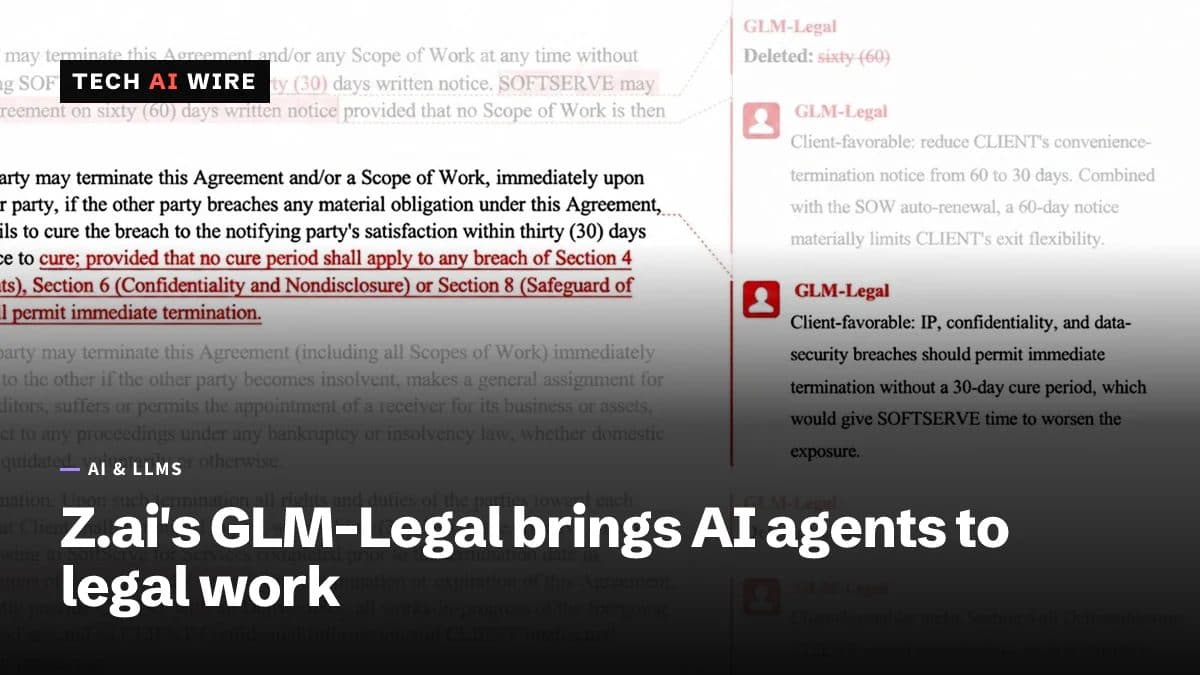
Z.ai launched GLM-Legal, a legal-domain agent model scoring 19.2% all-pass on Harvey LAB — nearly 3x its base model — at just $0.15 per test. But its official chart selectively omits the 6 higher-ranked models, led by Muse Spark 1.2 at 25.42%. We strip the makeup: how the score was earned, what it cost, and what it means for builders.