OpenAI Developer Weekly: One-Sentence Custom Voices + Pre-Warmed Agent Sandboxes
OpenAI's Oct 12-16 developer updates: free sandbox pre-warming for the Agents API (unattached sandboxes expire after 5 minutes); native Decisions API integration in GPT-Live that fires while the caller is still speaking; and prompt-to-voice — a custom GPT-Live voice from one text description, free to create — plus 9 new preset voices in German, French, Hindi, Japanese, and Korean. Catch: prompt-made voices are GPT-Live-only, 100 per org, disclosure required.
In one sentence: OpenAI just absorbed the two slowest jobs in building a voice agent
Between October 12 and 16, 2026, OpenAI shipped three developer-facing updates aimed at the same audience — people building voice agents and coding agents: on October 12, the Agents API gained sandbox pre-warming; on October 15, GPT-Live got native Decisions API integration; on October 16, GPT-Live launched prompt-to-voice (custom voices from a text description) alongside 9 new multilingual preset voices.
A necessary boundary first: this site previously covered Microsoft's MAI voice stack (October 1) and Sesame's on-device voice assistant — those were Microsoft's voice model lineup and Sesame's consumer voice product respectively. This piece covers only OpenAI's developer API line: GPT-Live voice updates plus Agents API sandbox pre-warming. Different vendors, different product shapes — no conflation.
And a necessary transparency note. The author re-verified primary sources on October 22, 2026: the official OpenAI Developer Community post on sandbox pre-warming (marked October 12, 2026, 5:22pm) was opened directly and confirmed unchanged; the three GPT-Live updates come from OpenAI's official API changelog, but no directly openable full URL for the changelog page surfaced in public search, and the @OpenAIDevs original post was likewise not directly openable. So wherever this piece says "the changelog says," read it as "as cited across multiple outlets from OpenAI's official documentation" — six independent sources (pondero.ai, Tech Times, digitalapplied.com, rohitai.com, voiceaispace.com, and AI Dev Weekly) agree exactly on both dates: October 15 (native Decisions integration) and October 16 (prompt-to-voice + 9 new voices), with consistent factual detail. Readers who want to check the original can look up those two dates in the OpenAI API changelog.
Prompt-to-voice: a third path to a custom voice, no recording required
Before October 16, giving GPT-Live a voice that "belongs to your product" meant choosing between two paths. Path one: use an OpenAI preset voice — zero effort, but every other product using it sounds identical to yours; brand distinctiveness zero. Path two: go through the voice-cloning flow with real recorded, consented audio — open only to eligible customers, slow and heavy. For most teams building phone support or voice assistants, the reality was: tolerate sounding like everyone else, or go the old road of voice actors, studios, and licensing paperwork.
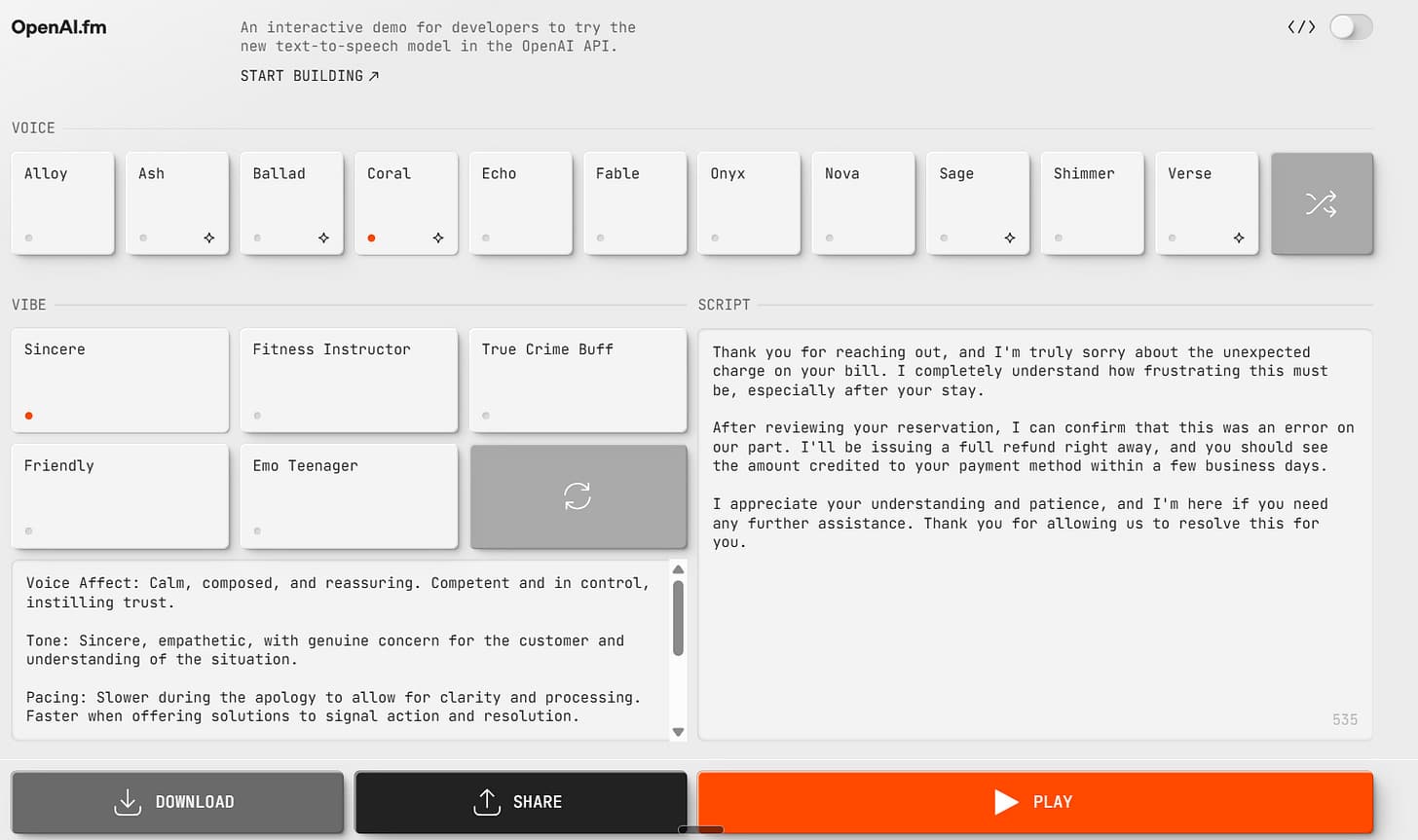
Prompt-to-voice is the third path: send a text description — say, "a calm customer-support voice with a slight Indian accent" — to /v1/audio/voices, and the API generates and saves a reusable voice ID. Teams that prefer no code can do it in the voice Playground instead. Creating the voice is free; speaking with it later bills at normal GPT-Live session rates (about $0.05 per minute for the voice layer).
The interesting thing isn't "one more feature" — it's that prompt-to-voice turns "voice" from an asset (something recorded, licensed, and managed as audio files) into a prompt. Anyone who has done vibe coding will recognize the flavor: describe it and it's done. You no longer scope a project, schedule studio time, and run procurement for a brand voice — you write a sentence, iterate on the description a few times, and stop when it sounds right. The cost of iterating on a voice drops from "weeks" to "minutes," and that's the real damage: it doesn't kill a competing feature, it kills the project-management overhead of "having a custom voice" as a thing.
But the boundaries need spelling out, because there's an easy trap here. Prompt-generated voices work only inside GPT-Live — not with OpenAI's TTS endpoint, the Realtime API, or audio in Chat Completions; each organization can keep at most 100; and OpenAI policy requires disclosing to end users that they're hearing an AI voice. In plain language: the voice you sculpt from a sentence is locked inside the GPT-Live ecosystem — it can't be exported or carried elsewhere. If your support system splits voice traffic between GPT-Live and another voice stack, this voice can't cross that wall. Decide before you commit: is your voice agent betting on GPT-Live for the next three years? If yes, this path is delicious. If not, it's a sweet set of chains.
The three voice routes, in one table
| Route | Cost | Limitation | Best for |
|---|---|---|---|
| Preset voices | Zero creation cost, billed per session | You sound like every product using the same voice — no brand identity | Fast MVP validation, internal tools where voice doesn't matter |
| Prompt-to-voice (new) | Free to create; calls billed at normal GPT-Live rates (voice layer ~$0.05/min) | GPT-Live only; max 100 per org; must disclose AI voice to users | Phone support and voice assistants that want brand identity without a recording pipeline |
| Recording-based cloning | Highest cost: recording, consent, staffing | Eligible customers only; requires consented recordings from a real speaker | Cases that genuinely need a specific human voice (IP character, spokesperson) |
Hidden in this table is a selection tip: listen to the 9 new preset voices from October 16 before sculpting a custom one. Multilingual teams especially — the new voices cover German (Nuri, Juni, Flitz), French (Brise, Sillage), Hindi (Nira), Japanese (Harema, Shida), and Korean (Noeul). If your support line takes German calls, Nuri may already be enough, sparing you the whole customization loop. Preset voices have zero creation steps; don't customize for customization's sake.
One more boundary that's easy to mix up: on October 15 OpenAI also rolled out GPT-Live-1.1 on the ChatGPT side with 13 new voices (two each for French, German, Hindi, Japanese, Korean, and Mexican Spanish, plus Bubbie for English). That's the consumer ChatGPT update — a separate line from the developer API, where the model remains gpt-live-1 and the new additions are the 9 voices above. Don't merge the two voice lists when reading the news.
October 15: native Decisions API integration — decide before the caller finishes
Prompt-to-voice solves "who it sounds like"; the Decisions integration solves "how fast it reacts." Previously, making a structured decision mid-call meant: GPT-Live notifies your own backend, your backend calls the Decisions API, the result comes back into the call — a full round trip, happening inside the hundreds of milliseconds while the user is speaking and waiting. Now GPT-Live can call Decisions directly, skipping that hop.
Technically, developers attach triggers to transcript events: session.input_transcript.delta (while the caller is still speaking) or session.output_transcript.delta (as GPT-Live itself responds), each trigger returning a small set of choices — an expression, an intensity level, a gesture. In plain terms: a support agent can decide what tone to answer in before the user finishes the sentence, instead of waiting for the full utterance, a backend round trip, and then responding.
Why does this deserve its own headline? Because the second-biggest pain for voice-agent builders is "real-time decisions need their own backend." Voice interaction runs on a latency budget measured in hundreds of milliseconds; every extra backend hop is a hesitation the user can hear. By pushing decision-making into the call path, OpenAI absorbed work that used to belong to "your backend." For small teams that's pure win — one fewer low-latency service to build and babysit. For teams with complex backends, it's a prompt to audit: how many hops in your decision chain can this native integration eat?
October 12: Agents API sandbox pre-warming — free, but mind the clock
The third update isn't on the voice line, but it's equally solid on the agent-infrastructure line: the Agents API now supports pre-warming OpenAI-hosted sandboxes. Three steps: create an environment → wait for it to be ready → pass its environment_id when creating a session. When the user request arrives, the sandbox is already warm and the session attaches immediately — no cold-start seconds.
The pricing is the interesting part: pre-warming is free — no charge until you attach the environment to a session. But two expiry clocks demand attention: an unattached sandbox environment expires after 5 minutes, and a session that has been used once expires after 20 minutes of inactivity. Translation: pre-warming isn't "prepare an hour ahead and wait" — it's "create it tens of seconds before you expect the user." A classic cost-accounting design: OpenAI converted the cost of idle compute into a scheduling-design cost for developers. Your orchestration logic gains a new job: create environments ahead of expected traffic, don't squat on them during lulls.
The official alternative route is self-hosted sandboxes, documented end to end — configuration, packages, files, compute, networking. Teams whose data can't leave their network, or who already run mature container orchestration, will find self-hosting the longer-term answer; teams that want fast validation get the zero-ops shortcut of hosted pre-warming. Both roads are officially paved — pick by your compliance and ops reality.

The competitive read: OpenAI is taking the "voice layer" back from third parties
There's an industry signal worth savoring. For the past two years, "give your AI a good proprietary voice" was effectively owned by third-party voice companies like ElevenLabs — their pitch was voice cloning, voice marketplaces, multilingual coverage. OpenAI's GPT-Live model was capable, but on the voice side it offered only two extremes — preset voices and heavyweight recording-based cloning — leaving the huge middle market of "wants some character, doesn't want the hassle" to others.
Prompt-to-voice is OpenAI's weapon back into that middle ground. It doesn't compete with ElevenLabs on studio-grade cloning fidelity; instead, with the low friction of "one sentence generates a voice," it keeps the long tail of teams that "want brand feel but have no budget for a project" inside its own ecosystem. Combined with the 9 multilingual preset voices (3 German, 2 French, 2 Japanese, 1 Hindi, 1 Korean), the strategy is legible: cover the "good enough" cases with presets, cover the "wants character" cases with prompt-to-voice, and leave only the "must be a real human voice" hard cases to recording-based cloning. A three-tier funnel, each tier designed to keep users from flowing to a third party.
The practical impact for developers: if your current voice stack is a spliced "OpenAI for conversation + third party for voice" architecture, this update is worth re-pricing. Spliced architectures carry real hidden costs — two billing systems, two latency sources, two compliance surfaces (the voice one being especially thorny). Prompt-to-voice makes the "full-stack OpenAI" option viable on the voice layer for the first time. The reverse also holds: if you're deeply invested in third-party voice assets (say, a trained library of proprietary voices), moving to GPT-Live means rebuilding — price that by the size of your voice assets; there's no universal answer.
A workflow a vibe coder can run this week
String the three updates into one end-to-end workflow and see what a solo developer can ship this week. Say you're building a phone support agent for your small shop, taking German and English calls:
Step 1 — pick the voice (10 minutes). Listen to the 9 new preset voices from October 16 first; German's Nuri, Juni, or Flitz will probably have one you like. If one fits, take it — zero creation steps. If not, sculpt one with prompt-to-voice: "a slightly slower German support voice, softer when apologizing." Creation is free, so iterate without guilt. Remember the 100-per-org cap — name your voices well and don't litter the org with "test1, test2."
Step 2 — wire up real-time decisions (half a day). Delete the glue code that used to go "GPT-Live notifies backend → backend calls Decisions → result fed back" and replace it with the native integration: hang the trigger on session.input_transcript.delta so the agent picks its tone before the user finishes speaking. What you save isn't just one network round trip — it's an entire low-latency backend service you'd otherwise maintain. For a solo dev, one fewer service to babysit is a week of life back.
Step 3 — pre-warm the sandbox (one hour). If your agent runs code in a sandbox (checking orders, modifying bookings), create the environment before the shop's peak hours, wait for ready, and pass environment_id at session creation. Callers get instant answers instead of "please hold while the system starts up." And mind the 5-minute expiry: don't create it an hour early — time it minutes before the peak.
Three steps done, and you have a phone agent that sounds like your brand, reacts as fast as people talk, and starts without the wait — with meaningfully less glue code than last month. That's the real meaning of this batch for vibe coders: it teaches no new concepts; it just deletes your code. What got deleted happens to be exactly the grunt work you "had to build yourself" — the voice-actor pipeline, the low-latency decision backend, the cold-start wait. OpenAI absorbed the grunt work; you write business logic.
The take: OpenAI is paying two "experience taxes" for you
Seen together, the three updates are really one move: OpenAI absorbing the two "experience taxes" in the voice-agent chain that are hardest to explain to a boss.
The first is the brand tax. "Our support voice sounds identical to everyone else's product" used to be unsolvable — customization meant recording, recording meant a project. Now it's a sentence. When the cost structure changes, the decision chain changes: custom voice work went from "should we scope two weeks for this?" to "write three sentences and try." When something's cost drops from "project-level" to "experiment-level," its adoption curve looks completely different. That's the shared flavor with vibe coding: describe to implement — compressing what used to need cross-functional collaboration into one person's few minutes.
The second is the latency tax. The native Decisions integration and sandbox pre-warming each eat one wait the user would otherwise feel — a backend round trip mid-call, a cold start at session setup. In voice interaction, users hear a 300-millisecond hesitation; a 3-second cold start makes them hang up. None of these optimizations is glamorous — not one makes the model smarter — but they decide whether a voice agent is "usable" or "good." Infrastructure wins always look like this: they don't raise the capability ceiling, they raise the experience floor.
But look at the other side of the coin. The GPT-Live lock-in on prompt-to-voice is a real wall — your voice assets bind deeply to OpenAI's voice stack, and migration cost starts accumulating the day you press "generate." The 100-per-org cap is fine for most teams, but multi-brand operations (one voice per brand, one per market) should plan naming and reuse up front. And the disclosure duty: you must tell users they're hearing an AI voice — not a suggestion, a policy; leave room for it in support scripts and compliance docs.
On the pre-warming side, the real cost isn't money (it's free) — it's scheduling design. The 5-minute expiry means your pre-warming logic must be coupled to traffic prediction: predict well, skip the cold start; predict badly, the environment expires and you've pre-warmed nothing. Businesses with clear peaks and troughs (support's morning/evening rush) get great value from this; fully random traffic should be modeled for hit rate before committing.
Reader action list
1. Listen to the 9 new preset voices before sculpting a custom one. German Nuri/Juni/Flitz, French Brise/Sillage, Hindi Nira, Japanese Harema/Shida, Korean Noeul — multilingual support teams will likely find a fit, with zero creation steps. Custom is nice, but don't customize for its own sake.
2. Treat your first prompt-to-voice description like prompt engineering. "A calm support voice" and "a slightly slower support voice with a light Indian accent, softer when apologizing" are two different voices. Be specific, iterate, regenerate when unhappy — creation is free.
3. Audit your voice-asset lock-in. If half your voice traffic runs on GPT-Live and half on another stack, prompt-generated voices can't cross over. Answer first: are you betting on GPT-Live for three years?
4. Count the backend round trips in your call path. The native Decisions integration eats one "notify backend → call Decisions → feed back" round trip. Draw your real-time decision chain and count how many hops this integration can remove.
5. Model pre-warming hit rate. 5-minute unattached expiry, 20-minute idle expiry — is your traffic predictable? Predictable means pre-warm; random traffic means pilot small first.
6. Compliance first. Put the AI-voice disclosure into support scripts; in the self-hosted vs. hosted sandbox decision, lead with data-compliance requirements.
Back to the opening line: OpenAI shipped no smarter model this week, but it made "a voice agent that sounds like your brand, reacts as fast as people talk, and starts without the wait" meaningfully cheaper to build. For developers who work with agents daily, that kind of update beats parameter-count news — because it changes what you can ship next week.
Comments (0)
Sources
Related articles

Anthropic released API version 2026-10-21 on October 21 — the first new version since 2023-06-01. temperature/top_p/top_k are gone (sending them returns 400), Admin API fields are renamed, SDKs switch to Authorization: Bearer, and the license moves to Apache 2.0. Here is the full breakdown and a migration checklist.

Landing page gets them in; docs decide whether they stay. This guide covers the full playbook for vibe-project developer docs: the 5-minute Quickstart test, the Divio four quadrants, API reference that machines generate, docs-as-code discipline, navigation, metrics, i18n, and an honest assessment of llms.txt.

llm-d 1.0 is out: the open-source distributed inference framework backed by IBM, Red Hat, Google, NVIDIA and CoreWeave now ships Day 2 capabilities — multi-tenant QoS, zero-downtime upgrades, session-aware routing. IBM's demo: 3,000 coding agents at ~$0.11 per million tokens. We unpack the release, the Kubernetes analogy, and the self-host vs. API cost math for vibe developers.