Robots Finally Get a Sense of Touch: Panasonic's T-Rex Moves Eggs and Screws in Light Bulbs, Beating Vision-Only Methods by 30 Points
On November 5, 2026, Panasonic, UC Berkeley, NVIDIA, and Stanford unveiled T-Rex: a VLA model wired to ten fingertips, with 5 Hz motion planning and 20 Hz tactile correction running on separate clocks. It averaged 65% across 12 delicate tasks; the strongest baseline managed 35%, and T-Rex itself falls to 42% without touch.
First, the verdict: vision models hit a wall, and touch alone cannot break through it — but this team found a way around the wall

On November 5, 2026, Panasonic Holdings, together with Panasonic R&D Company of America, UC Berkeley, NVIDIA, Stanford University, Sapienza University of Rome, and ItalAI, announced a robot manipulation model called T-Rex — short for Tactile-Reactive Dexterous Manipulation. In one sentence: it lets a two-handed robot see and feel at the same time, and the moment a fingertip senses slipping or too much pressure, the robot changes what it is doing.
The numbers first. Across 12 real-world tasks that demand delicate force control — turning a page, moving an egg, squeezing toothpaste, unlocking a door with a key, pulling out a card, screwing in a light bulb — T-Rex averaged a 65% success rate. The best existing method managed only 35%. A 30-point gap is rare in robot manipulation, and it is not a trick on one task: T-Rex came first on all 12. My judgment is that the value of this work is not the 65% itself, but what it proves — adding touch to a vision model crudely can backfire, and you need a different architecture to make it work. That is a lesson worth remembering for anyone building embodied AI or robot demos.
Why robots have always been clumsy: eyes that see, fingers that feel nothing
Some background first. The dominant approach in robot manipulation today is the VLA model — vision-language-action: a camera sees the scene, the model reads an instruction in plain language, and it outputs how the arm should move. VLA models have improved fast over the past two years, and they handle grasping, placing, and sorting reasonably well. But give them a job that needs a sense of touch and they fall apart.
The examples in Panasonic's announcement are concrete: pulling one card out of a stack, or inserting a key and turning it. People do these things by feel — force, slip, and deformation sensed through the fingertips — with vision only as backup. Conventional VLA models rely mostly on camera images, and even when they use tactile signals, they often treat them as static input: read once and forget, with no response when contact conditions change mid-action. Two practical bottlenecks make it worse. First, there is almost no large-scale training data that carries tactile annotations. Second, vision-language models update slowly, while tactile feedback needs high-frequency control — the two rhythms simply do not match.
That explains a set of numbers in the T-Rex paper that look counterintuitive at first glance: remove the tactile input and T-Rex's own success rate falls from 65% to 42%; but force touch into the existing π0.5 model and its score drops from 17% to 6%. Touch is not a seasoning you sprinkle on top and everything improves. Put it in the wrong place and it drags the whole system down. Those numbers are the most honest part of the paper, and the most worth reading.
Two clocks are the core idea: the slow one plans, the fast one corrects
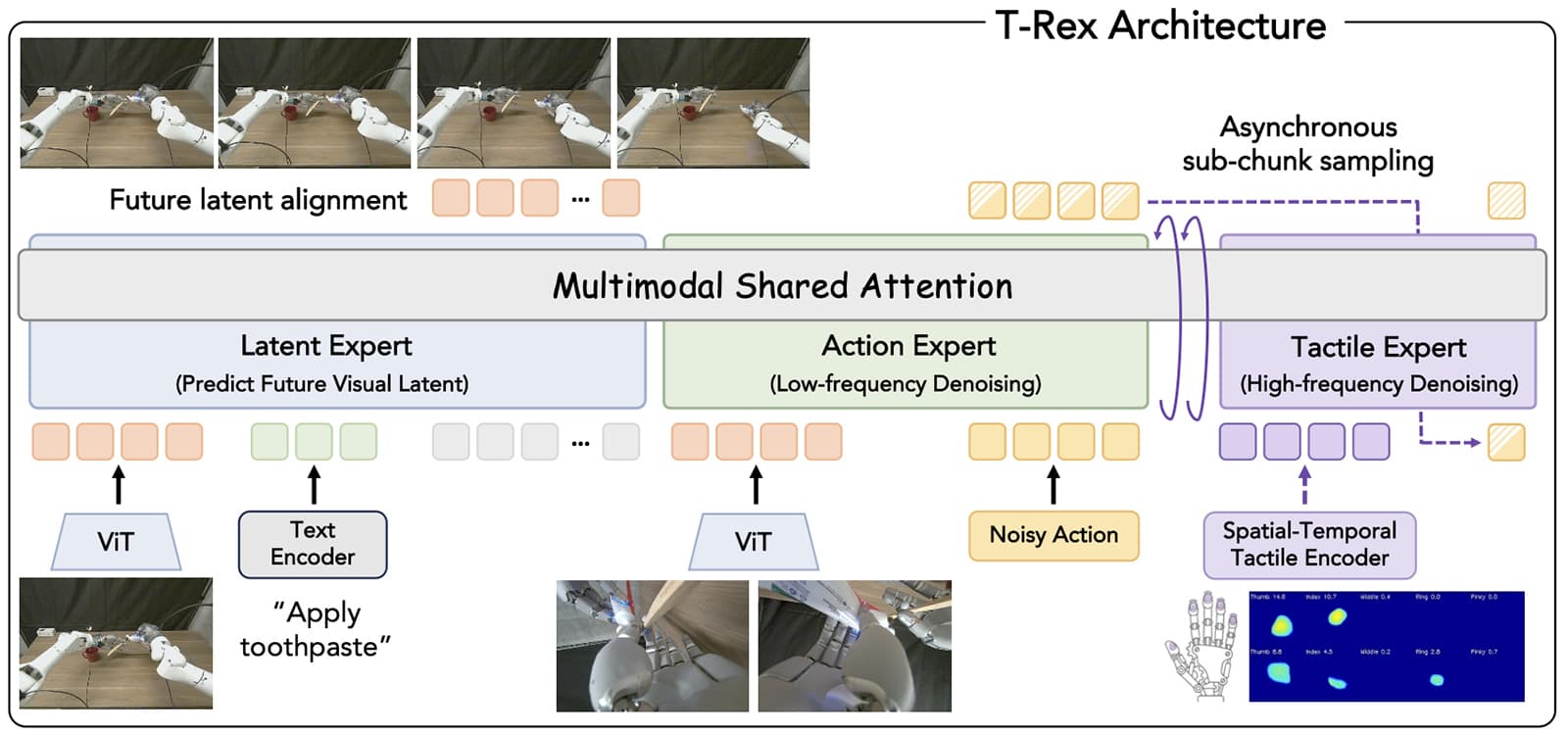
T-Rex's answer can be summed up as "two clocks, each doing its own job." The model is split into a slow expert and a fast expert. The motion-generation module, which processes vision and language, plans the overall movement at roughly 5 Hz. The action-correction module, which processes tactile input, fine-tunes the movement in real time at roughly 20 Hz. Touch corrects four times for every vision update, so a slipping card or an eggshell under too much force gets handled without waiting for the vision model to run again.
The paper calls this structure a variable-rate Mixture-of-Transformer (MoT), paired with a temporal tactile VQ-VAE encoder that compresses high-frequency touch signals into a form the model can use. Three experts divide the work: the latent expert predicts what the visual scene should look like in the next few steps; the action expert generates the overall motion at low frequency through denoising; the tactile expert refines the motion at high frequency, also through denoising. In Panasonic's architecture diagram, the three modules are linked by a layer of multimodal shared attention, and the tactile expert exchanges information with the action expert through asynchronous sub-chunk sampling.
In plain language: do not make a slow brain handle millisecond-level finger reactions. Give the fingers their own fast lane. The idea itself is not brand new, but T-Rex is the first work to implement it end to end for bimanual dexterous manipulation and to back it with a 12-task real-world scoreboard.
The data was "played" into existence: 100 hours, first learning to see like a human, then learning to touch like a robot
Data is the other half of this work. The team collected it on a 58-degree-of-freedom bimanual dexterous robot: a Dexmate Vega-1 body with two 7-DoF arms and two 22-DoF Sharpa Wave dexterous hands, with tactile sensors on all five fingertips of each hand. More than 200 everyday objects combined with 22 basic actions produced over 7,700 demonstrations — 100 hours in total. Every episode synchronously records video from head and wrist cameras, the robot's states and actions, force and deformation from ten fingertip sensors, and a natural-language instruction.
Training runs in three stages: first, learn broad visual and motion knowledge from 22,889 hours of human egocentric video; then learn robot-specific contact-rich behavior from the 100 hours of tactile-annotated data (mid-training); finally, fine-tune each task with roughly 100 demonstrations. This "watch humans first, then learn to touch" recipe is worth noting — it admits an honest reality: robot tactile data is expensive and scarce, so human video has to build the foundation, with tactile data reserved for the crucial middle stage.
The dataset is open source. That is genuinely useful news for indie developers and small teams working on embodied AI: until now, the first step of reproducing this kind of work was blocked by data, and now there are 100 hours of touch-synchronized "play" data available to use directly. The paper is on arXiv as 2606.17055, and the project page is live.
The 12-task scoreboard: where it wins, and where it still loses
The evaluation covers three difficulty families: force-sensitive contact, deformation-aware manipulation, and the hardest bimanual force-deformation tasks. T-Rex averaged 65%; the strongest baseline, EgoScale, scored 35%; π0.5 scored 17%; Tactile-VLA 15%; RDP 6%; π0.5 with touch bolted on 6%; ViTacFormer 3%. T-Rex was the top method on every one of the 12 tasks, beating the weakest baseline by more than 20 times.
But the 65% figure deserves a cool head: it means one attempt in three still fails. Move the egg twice, and the third time it may crack; screw the bulb in twice, and the third time it may go in crooked. That is still a long way from "ready for the factory floor or the warehouse." The team's own announcement aims first at assembly steps in manufacturing — inserting, removing, and screwing components — and handling soft or fragile items in logistics, with the goal of reducing the burden on frontline workers. That restraint makes the announcement more credible, not less.
One timing note: the results will be presented at the Conference on Robot Learning (CoRL) in Austin, Texas, from November 9 to 12, 2026. What we have now is a pre-conference announcement and an arXiv paper; the live peer discussion has not happened yet, and all the numbers come from the team's own evaluation. Read them with that in mind: 65% is a self-reported figure, not yet independently reproduced.
This is not T-Rex's first appearance: in the August preview the dataset was half the size
Attentive readers may find the name familiar. In August 2026, NVIDIA's Jim Fan already previewed this work on X, mentioning a dataset of 50 hours and about 5,500 demonstrations at the time. By the formal November release, the dataset had doubled to 100 hours and more than 7,700 demonstrations, and the evaluation had grown into a complete 12-task scoreboard with full baseline comparisons. November 5 is the moment T-Rex went from "preview" to "full paper plus open dataset" — not its first appearance. That distinction matters: if you followed it in August, what is new here is the doubled data and the complete baseline comparisons, not a re-read of old news.
What the three experts actually do: the architecture diagram translated into plain language
The paper's architecture diagram looks intimidating at first: latent expert, action expert, tactile expert, with a layer of "multimodal shared attention" on top. Taken apart, each piece has an intuitive job. The latent expert "imagines": from the camera image and the language instruction, it predicts what the visual scene should look like over the next few steps — mentally rehearsing the action. The action expert "moves": at low frequency it denoises and generates the overall motion trajectory, deciding where the arm goes and how the hand opens. The tactile expert "corrects": the moment fingertip sensors report force and deformation, it produces a residual refinement at high frequency — not recomputing the whole action, just adding a small correction: grip a little lighter, ease off, change the angle.
The "residual refinement" design is the key point. The tactile expert does not grab the steering wheel; it only makes small adjustments to it. That is why it can run at 20 Hz: the corrections are small and cheap to compute, with no need to rerun the vision model every time. Run the vision model at 20 Hz with full recomputation and latency and compute would both break down — the robot would stutter. Two clocks work because they accept that different signals have different natural frequencies; forcing them onto one rhythm helps nobody.
The tactile signal itself is not fed raw into the model either. The team uses a temporal tactile VQ-VAE encoder to first compress the continuous force and deformation readings from ten fingertips into discrete "tactile tokens" before the tactile expert sees them. This step is easy to overlook, but it decides whether the touch signal can be used reliably at all: raw tactile readings are noisy and high-dimensional, and feeding them straight into a Transformer invites the model to learn the noise. Encode first, model second — a pragmatic link in the pipeline.
One more detail deserves its own mention: asynchronous sub-chunk sampling. The tactile expert and the action expert do not exchange information in lockstep; the tactile side samples a small chunk whenever it has one and hands the correction over. This asynchronous design truly decouples the two clocks — tactile corrections never wait for the vision side's full beat to finish, and vision planning is never interrupted by touch. In the architecture diagram it is drawn as two purple dashed lines looping between the experts in the upper right corner. It looks decorative. Its job is simple: keep the fast lane and the slow lane from blocking each other.
The hardware is not cheap either: what robot produced these numbers
Talking about the algorithm without the hardware would be misleading. T-Rex's 65% was achieved on a 58-DoF bimanual dexterous robot: a Dexmate Vega-1 body, two 7-DoF arms, two 22-DoF Sharpa Wave dexterous hands, with tactile sensors on all five fingertips of each hand. In other words, the fingers alone have more degrees of freedom than many industrial arms have in their entire body, and the fingertip sensor density is far beyond what an ordinary two-finger gripper can offer.
That implies two things. First, the 65% figure carries a hardware dividend and cannot be transferred directly to a household robot or a warehouse arm with a simple gripper. Second, the genuinely scarce resource may not be the algorithm but a hardware platform stable enough to collect 100 hours of tactile data — a hand that breaks, a sensor that drifts, or a calibration that slips all show up directly in the final score. Collecting more than 7,700 clean, synchronized demonstrations is itself proof of engineering capability.
For developers who want to follow up, the realistic path is not to copy the hardware but to start from the open dataset: 100 hours covering 200-plus everyday objects and 22 basic actions across force-sensitive, deformation-aware, and bimanual coordination tasks. Even if your robot has one hand and a few touch points, the "contact, then correct" patterns in that data are still useful. Read the data first, talk about reproduction second — that is the honest order.
The other side of 65%: how far is robot manipulation from "usable"
Flip 65% over and it is a 35% failure rate. In the lab's 12 tasks, one attempt in three fails — unacceptable on a real production line, where a cracked egg is waste and a misassembled precision part can mean a whole batch sent back. So T-Rex is best understood as a research milestone, not a product launch. Panasonic's own wording leaves room: it talks about aiming to apply the technology to manufacturing and logistics, not about deploying it now.
Another caution: all 12 tasks were designed and evaluated by the same team, which also chose the difficulty, the success criteria, and the baselines. EgoScale and π0.5 scoring 35% and 17% on T-Rex's task set does not mean they would score the same on their home turf. Comparing success-rate numbers across papers always needs care. What is genuinely persuasive is that T-Rex won all 12 tasks on its own set — and that removing touch dropped it back to 42% in the ablation study. The ablation at least proves the touch signal is doing real work inside this architecture, not sitting there as decoration.
There is also an open question: where does the 100 hours of data generalize to? Two hundred-plus everyday objects sounds like a lot, but the real world has unlimited objects; 22 basic actions cover common primitives like pinching, pushing, twisting, and pulling, but what happens with an unseen material or an unfamiliar shape is unanswered in the paper. The CoRL presentation on November 9 is worth watching: the first thing peers are likely to ask is how the method performs outside its own task set.
Still, the direction is right. Vision-language models spent the last two years teaching robots to "see and understand." The next barrier is "feel and hold steady." T-Rex matters because it offers a workable way to organize that: do not force every signal through the same slow model; let fast signals take the fast lane and slow signals the slow lane, and connect them with residual corrections. That way of organizing things will probably survive even as models get bigger and hardware gets better.
What this means for vibe coding developers
Most VibeFix readers do not build robots directly, but two lessons from T-Rex travel well. First, before adding a new signal to a system, ask whether its rhythm fits the modules already there. The touch signal was not wrong; stuffing it into a slow channel designed for vision was — the same trap as bolting a real-time module onto an AI app without respecting the existing architecture and watching the whole thing slow to a crawl. Second, an open dataset lowers the barrier more than open model weights. Not everyone can run T-Rex's model, but once 100 hours of touch-annotated data is public, any small team curious about embodied AI has a starting point.
Looking further ahead, VLA is moving from "can see" to "can feel." Vision models taught robots to recognize things; the next step is reacting in the instant of contact. T-Rex's 65% shows the path works, and also shows it has just begun. For most people, the thing to look forward to is not a robot squeezing toothpaste for you one day, but the manufacturing and warehouse jobs where "the eyes can see it but the hands cannot do it" finally getting a workable answer. That is also where Panasonic's announcement lands: solve the concrete problems in factories and warehouses first, and talk about the bigger vision later.
Summary
Panasonic, Berkeley, NVIDIA, and Stanford's T-Rex uses a dual-clock design — 5 Hz planning plus 20 Hz tactile correction — to reach a 65% success rate across 12 delicate manipulation tasks, 30 points above the strongest baseline. Removing touch drops it back to 42%, and bolting touch onto a baseline drops that baseline from 17% to 6% — the comparison figures are more worth remembering than the headline number. The 100-hour tactile dataset is open source, and the paper will be presented at CoRL on November 9. Sixty-five percent is not the finish line, but it proves one thing: for a robot to do fine work, it first has to learn to work by touch.
Comments (0)
Sources
Related articles

Sarvam AI released Prism on November 3: a decision model that does not generate long text but scores given options, averaging 71.8 at 44 milliseconds, with weights open under Apache 2.0. Its real selling point is not being the smartest, but being calibrated, order-stable, and fit to serve as the judgement layer inside automated workflows.
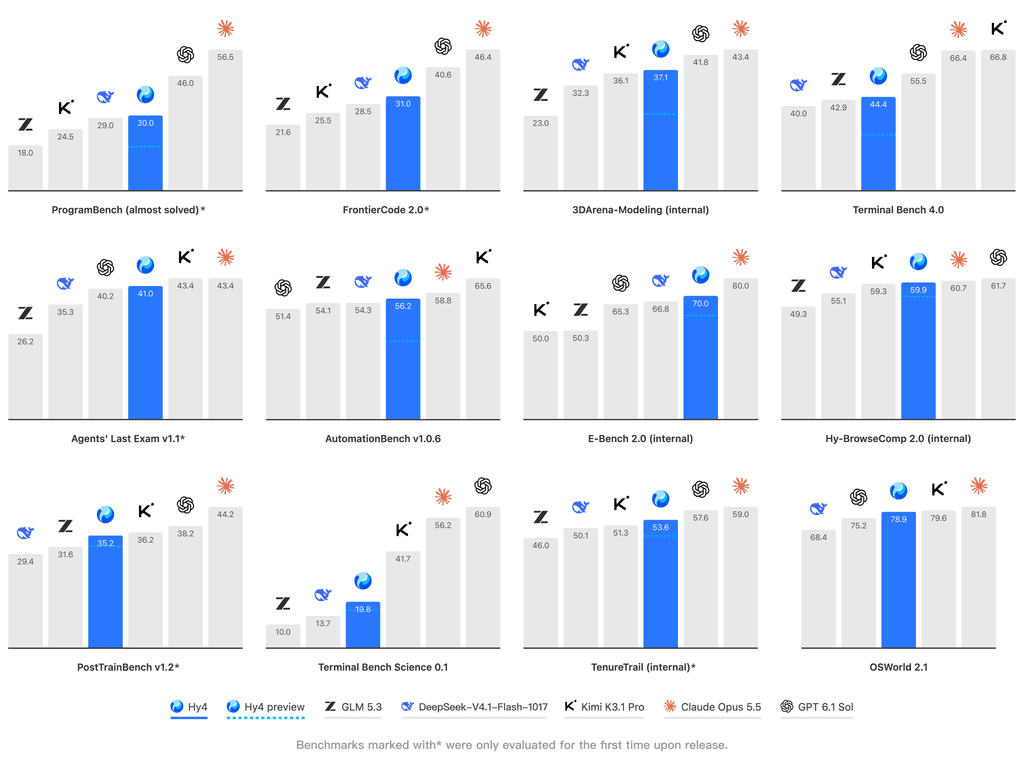
Tencent released the full version of Hy4 on November 4, adding visual understanding and computer-use capabilities at unchanged pricing. The weights, however, have not been released for download yet, so Hy4 today is first a hosted service, not a locally deployable open model.
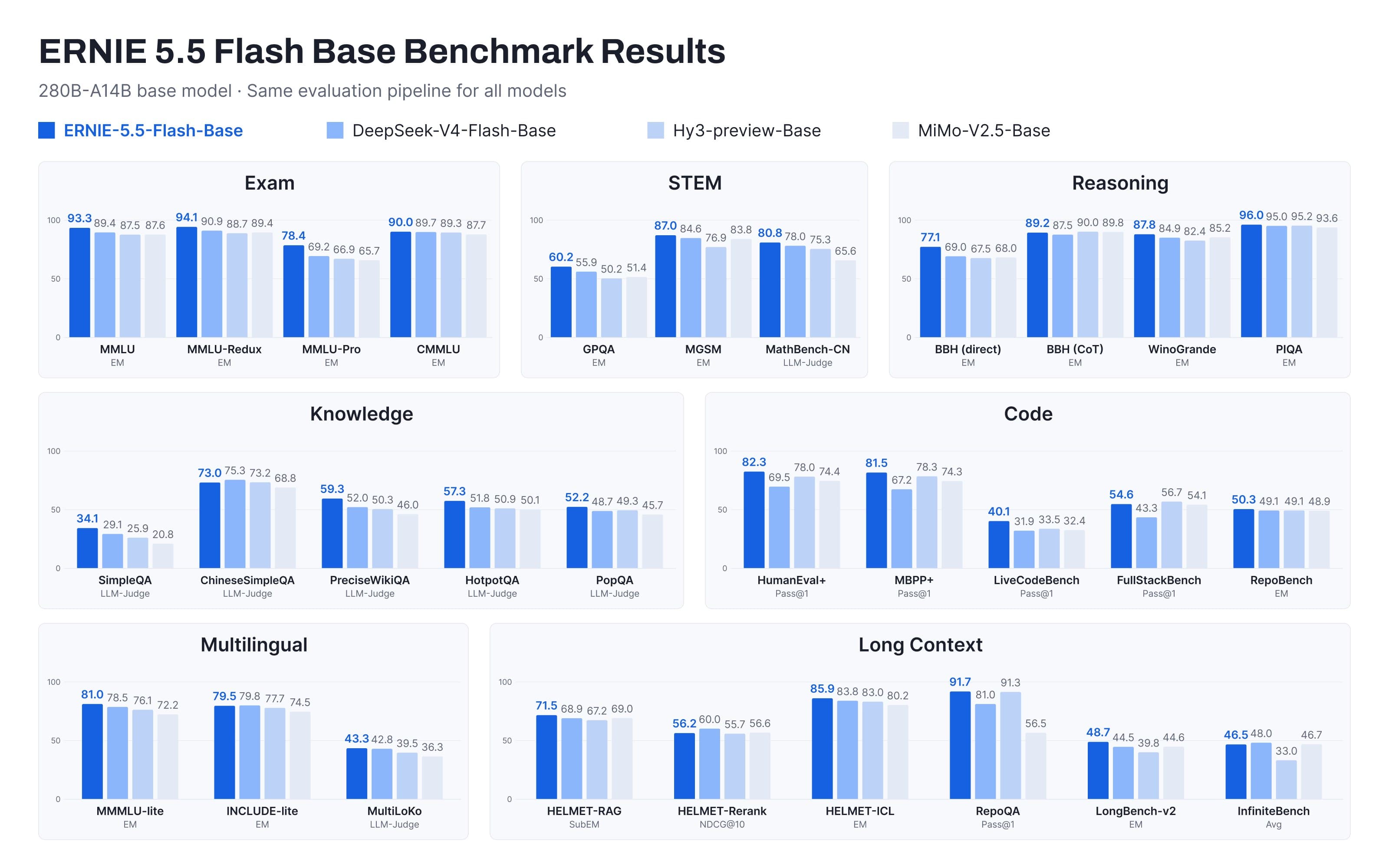
Baidu released ERNIE-5.5-Flash-Base on November 5: a 280B-parameter base model with 14B active per token, first in 24 of 30 benchmarks by its own report. The weights are downloadable — but the custom license excludes the EU, UK and South Korea and caps free commercial use at $50M revenue.