Recursive Open-Sources Flint: A Laptop Coding Model It Says Was Largely Built by AI
Recursive released Flint: a free coding model for ordinary laptops, Apache 2.0, weights on Hugging Face. Its 40B-MoE design activates only 2.5B parameters per inference; vendor tests claim ~131 tokens/sec on M4 Pro MacBook, about double Gemma 4 and Nemotron 3.5 Lightning (not independently verified). It tops the sub-50B SWE-Bench Verified group per the vendor; Wired's third-party test saw it nail every task first try. The hook: Eureka Machine research system co-built it in under four months.

In one sentence: a 40-billion-parameter model that only "uses" 2.5 billion when it works — so it fits on a laptop
On October 21, 2026, TechCrunch reported on the first model from AI startup Recursive: Flint, a free coding model that runs on an ordinary laptop, open-sourced under the Apache 2.0 license with weights on Hugging Face. The headline numbers: 40 billion total parameters, but as a mixture-of-experts (MoE) model it activates only 2.5 billion parameters per inference — roughly 6.25% of itself. For reference, Meta's Muse Spark Open, released last week, uses 816 billion parameters and needs at least 1TB of memory. Flint bets the other way: not on being big, on using only a sliver at a time. The reporting date was re-confirmed by the writer on October 22, 2026 by re-opening the TechCrunch original (page marked Published: 2026-10-21T20:27:41+00:00, Updated: 2026-10-22T01:02:45+00:00, unchanged); Recursive's official "Introducing Flint" announcement (recursive.com/updates/introducing-recursive-flint) serves as the first-party company source below — "the company says" comes from that page, "reported" comes from TechCrunch.
But Flint's parameter table isn't the real story. It's the provenance: Recursive says its automated research system, the "Eureka Machine," contributed to nearly every step of building Flint — pretraining, post-training, inference optimization — and a small team built it from scratch in under four months. In other words, this is the first downloadable, laptop-installable, offline-runnable public artifact of the long-debated idea of "AI building AI." The model is free; the claim isn't. This piece keeps vendor-reported numbers and third-party testing clearly separated before asking whether it's worth installing.
The numbers first: a 2.5B / 40B MoE betting on "active parameters"
The technical portrait, all from first-party sources. Flint is a mixture-of-experts model: 40B total parameters, 2.5B active per token. The official announcement discloses the architecture search's starting point — the Eureka Machine began from a 35B-total / 3B-active baseline, tried different expert configurations and widths, and landed on 40B / 2.5B as the best speed-plus-coding combination. Note what that implies: throughput on local hardware sat in the objective function alongside benchmark scores. That's a different training philosophy from "climb the leaderboard first."
The company's performance positioning: among MoE models with under 50B total parameters, Flint leads on agentic coding benchmarks (SWE-Bench Pro v2, Terminal-Bench 2.1, SWE-Bench Verified); it also rivals 25–40B dense models on coding scores while running more than five times faster. Don't drop the qualifier on that "5x" — it's anchored to "dense models with similar scores," not the whole industry.
What does "runs on a laptop" actually mean? The company says Flint's weights are on Hugging Face under Apache 2.0, working with llama.cpp, Ollama, Unsloth, LM Studio, vLLM, and SGLang; it also released rec, a lightweight inference engine optimized for M4 Pro and M5 Pro/Max. Context window is rated up to 512k tokens, but the official recommendation is to stay within 256k for coding — an honest gap between the spec number and the practical range, worth remembering.
The speed numbers: 131 tokens/sec, about double same-machine rivals — vendor-tested
Speed is Flint's flashiest claim, so attribution first: everything below is Recursive's own testing; no third party has independently verified it. The company line: over 125 tokens per second on a MacBook Pro with M4 Pro (TechCrunch cites ~131 tok/s); over 150 tokens per second on a 64GB Nvidia RTX Spark at short contexts. On the same M4 Pro, Google's Gemma 4 and Nvidia's Nemotron 3.5 Lightning managed 58–69 tok/s — Flint claims roughly double. The company adds "up to twice as fast as comparable models" on Apple Silicon and RTX Spark.

How should you read these numbers? The direction is credible; discount the absolute values. MoE activating 2.5B per token plus low-bit quantization plus custom kernels genuinely compounds into a throughput advantage — "much faster" is very likely true. But the precise 131 comes from the vendor's own harness (temperature 1.0, top-p 0.95, top-k 20, averaged over a 128k-token session, prefill excluded). Your prompts, your temperature, your context length will move it. The right way to read vendor speed numbers is for order of magnitude and ratios, not the integer 131.
One telling detail: the company qualifies "over 150 tok/s" with "at short contexts." Inference speed degrades as context grows; adding that qualifier suggests the numbers were cherry-picked under favorable conditions — honest, but know what the conditions are.
How accurate: #1 under 50B parameters on SWE-Bench Verified — also the vendor's claim
Attribution again, first: all of the following are vendor claims. Per TechCrunch, Flint outperformed other models under 50 billion parameters on SWE-Bench Verified (a benchmark of fixing real-world software bugs); on Recursive's own six-test average, only Alibaba's Qwen3.8 27B scored higher. The official announcement is more granular: the lead is in the "MoE under 50B total parameters" group, evaluated on SWE-Bench Pro v2, Terminal-Bench 2.1, and SWE-Bench Verified, with sampling details disclosed (agentic evals: agent timeouts up to 5 hours, average pass@1 over at least 5 attempts).
Two reading notes. First, "best MoE under 50B" is a carefully chosen group title — the narrower the group, the more champions. Flint's real peer group is the "25–40B dense models" tier, where the company's own word is "rivals," not "beats." Second, an "own six-test average" is a vendor-picked set — but Qwen3.8 27B sitting on top actually lends a little credibility: a fully self-serving leaderboard usually puts the house model alone at number one.
Which makes the most meaningful accuracy signal the third-party one: Wired's Will Knight tested Flint on a 48GB Mac, building small programs — a to-do list app and a web-scouring research tool. His verdict: small coding models often errored out or lagged behind Claude and Codex, but Flint "nailed his coding requests every time." That's the only public third-party test so far. The sample is tiny — a few small programs, one machine, one person — but it validates what vendor numbers can't: whether it gets real tasks done in one shot. For an independent developer, that signal beats a leaderboard.
The real hook isn't the model, it's how it was made: the Eureka Machine
Frankly, Flint's parameters and speed wouldn't be disruptive in the 2026 model release cycle. What earns this story its slot is the "how it was built" narrative. The Eureka Machine, the company says, contributed to nearly every part of Flint's model-building stack: data, optimizers, training recipes, infrastructure, inference optimization. The official description: it automates the full research loop — proposing ideas, implementing them, testing them, using results to decide what to try next — exploring multiple directions in parallel and combining promising ideas. A "small team of people and agents" built Flint from scratch in under four months.
Three concrete contributions, described in unusual detail in the announcement: First, architecture. The 35B/3B-baseline to 40B/2.5B search described above was run by the Eureka Machine, not set by human intuition. Second, quantization. This is the most "machine researcher" passage: against common practice, Eureka quantized the output layer (lm_head) to 4 bits — because with only 2.5B active parameters, the output layer is a large share of weights read per token, so it had to be compressed; to recover accuracy, it added an offline distillation stage where the quantized model trains on its own pre-sampled responses from a self-discovered coreset, with the 16-bit model as teacher. Result: the final NVFP4 model scores within 0.7 points of the 16-bit model across benchmarks, with nearly half the training steps of the quantization-aware-training baseline. TechCrunch's paraphrase — "low-bit training shrank Flint by 71% with almost no quality loss" — matches. Third, kernels. Eureka wrote specialized kernels for low-bit projections, MoE ops, attention, and prompt processing; on M4/M5 chips it produced a Metal megakernel fusing the entire decode forward pass.
You can taste the narrative strategy: Flint the model is the appetizer; the Eureka Machine is the main course. Every engineering highlight doubles as evidence that "the automated research system does real researcher work." Whether that narrative holds depends on a question the company didn't answer: how much researcher time did Eureka actually save? TechCrunch states it plainly — Recursive didn't say. For reference, OpenAI said last month that by mid-August its AI agents were logging 3.1 workdays for every human researcher workday. Both companies tell the "agents do research" story; neither gives the hard "how many human-hours saved" number. Until that number exists, apply your own discount rate to the "AI builds AI" progress bar.
The take: two threads, both hitting indie developers' pain points
Setting the narrative aside, Flint's value to vibe-coding readers is concrete, on two threads. Thread one is offline / private / no bill. The model runs on your machine; code never leaves it — something cloud APIs can't offer people working with private repos or client code; no per-token billing for developers who call models all day — that's real money. The company's own words: work offline, keep data on your computer, avoid API fees. Each is unglamorous alone; together they're the entire reason local small models exist.
Don't underestimate the license either: Apache 2.0 means Flint isn't just downloadable — it's commercially usable, modifiable, distillable. Indie developers can fine-tune it into a personal model matching their code style, ship it inside offline products, build on it without asking permission. At a time when "open weights" is increasingly marketing-speak (many nominally open models carry commercial-use restrictions), a clean Apache 2.0 is itself a statement. A generous license usually means the company isn't interested in making money from the model itself — what Recursive wants to sell was never Flint the model, but "the Eureka Machine keeps producing Flints."
Thread two is the first downloadable public artifact of "AI building AI." Recursive self-improvement has been debated for years: AI builds better AI, which builds better AI — some see the road to superintelligence, others fear it slipping out of human control. Recursive's current version is restrained: TechCrunch is clear that today's form is "an AI research assistant overseen by people" producing "a model small enough for a laptop"; Socher told Wired the longer-term goal is full recursive self-improvement with humans overseeing and able to stop it. Flint's significance isn't that it proves recursive self-improvement — it's that it drags the debate out of papers and podcasts into something you can ollama pull. The debate continues, but now there's a physical exhibit.
My judgment: Flint reads as a "manifesto product" — its primary job isn't topping leaderboards, it's proving "Recursive can ship." $650M raised at a $4.65B valuation in May (GV, Nvidia, AMD Ventures), a $410M AWS compute deal in June that the CEO framed as "less about headcount and more about agent count." A company that took that much money to bet on "agents doing research" had to deliver something runnable, downloadable, usable as its first artifact — Flint is it. Whether it holds up long-term on coding ability is the next model's problem.
The honest side: what the vendor didn't say, and the limits it admits
The admitted limits first, from the announcement's "Running Flint" section, worth paraphrasing faithfully: break complex tasks into smaller subtasks with explicit instructions — "it may need more guidance than the larger closed-source coding models you're used to." TechCrunch's version matches: the company acknowledged Flint needs more hand-holding than the big paid assistants, suggesting large tasks be split up. That's the small-model honesty tax: fewer parameters and fewer active parameters mean weaker "read my mind" ability — you slice tasks thinner and write more explicit instructions. And Wired's "nailed it every time" came on small-program-scale tasks — a to-do app, a research scraper — not refactoring a 100k-line legacy codebase.
Now what wasn't said. First, how much researcher time Eureka actually saved — unsaid; "under four months" sounds fast, but with no baseline (how long would the same small team take without Eureka?) it's atmosphere, not data. Second, how far the 131 tok/s test conditions (temperature 1.0, top-p 0.95, 128k-session average) sit from real coding — temperature 1.0 is a divergent sampling setting; you'll likely run lower for code, and the speed number will move. Third, long-term maintenance: the weights are open, the rec engine is open, but the Eureka Machine itself obviously isn't — the core asset of "AI building AI" stays locked inside the company. What you can download is the exhibit, not the method.
This isn't nitpicking; it's calibration. Flint is a usable local coding model, not a point-of-no-return revolution. Its biggest historical value may be as a reference point — every company telling the "AI builds AI" story from now on has to answer: can your thing be downloaded, run, and independently verified like Flint? A downloadable manifesto beats ten papers about the future. Install it, run it, then decide whether to believe Recursive's story — in that order.
Background: who is Recursive
Recursive emerged from stealth in May 2026 with $650M in funding at a $4.65B valuation, backed by GV, Nvidia, and AMD Ventures — a lavish number for a company that hadn't shipped anything. CEO Richard Socher is Salesforce's former chief scientist, a familiar name in NLP circles. In June the company signed a $410M compute deal with AWS, framed at the time as "less about headcount and more about agent count" — money for compute, not hiring. In retrospect, that's the footnote to this story: a company that wrote "stack agents" into its compute deal ships a first model deeply co-built by agents. The narrative is self-consistent.
On the timeline: stealth exit in May, Flint on October 21 — five months. The "from scratch in under four months" claim roughly fits the public timeline (some of the gap went to fundraising and team-building, which is reasonable).
The reader's verdict: how to test whether a local small model "actually works"
Ending on the practical. If this story tempts you to test whether a local small model "actually works," do it in this order — don't start by refactoring production code:
1. Set your acceptance criteria before downloading. Flint's official positioning is a "daily coding model," not "the strongest coding model." Acceptance tasks should be your real daily work: writing a script, adding tests, commenting functions, translating code between languages. Don't grade it on "can it pass SWE-Bench" — that's the vendor's arena, not yours.
2. Start small, honoring the company's honest advice. It asks for decomposed tasks and explicit instructions — comply: one job at a time, specific instructions. Wired's "nailed it every time" task scale (to-do app, research tool) is a good starting point.
3. Don't copy the vendor's temperature. They benchmarked speed at temperature 1.0; you'll likely run 0.2–0.3 for code — watch the real accuracy-vs-speed tradeoff. Remember: you'll only ever reproduce your own numbers, never "131."
4. Do your own accounting. Local means no token bill, but there's electricity, fan noise, and waiting time. The comparison should be "the monthly fee I pay for code completion/chat today," not "is it stronger than Claude" — those are different dimensions, and mixing them yields wrong conclusions.
5. Watch the niche, not the leaderboard. Flint's real competitors aren't Claude Code or Codex — they're Gemma 4 and Nemotron 3.5 Lightning, the other "runs on your machine" small models. Its battlefield is inside your laptop, not in the cloud.
To close: Flint may not be your default coding model tomorrow, but it's very likely "the first decent model built by AI that fits in a laptop" — and "downloadable, runnable, independently verifiable" is exactly what the grand "AI builds AI" narrative has been missing. A downloadable manifesto beats ten papers about the future. Install it, run it, then decide whether to believe the story — in that order.
Comments (0)
Sources
Related articles
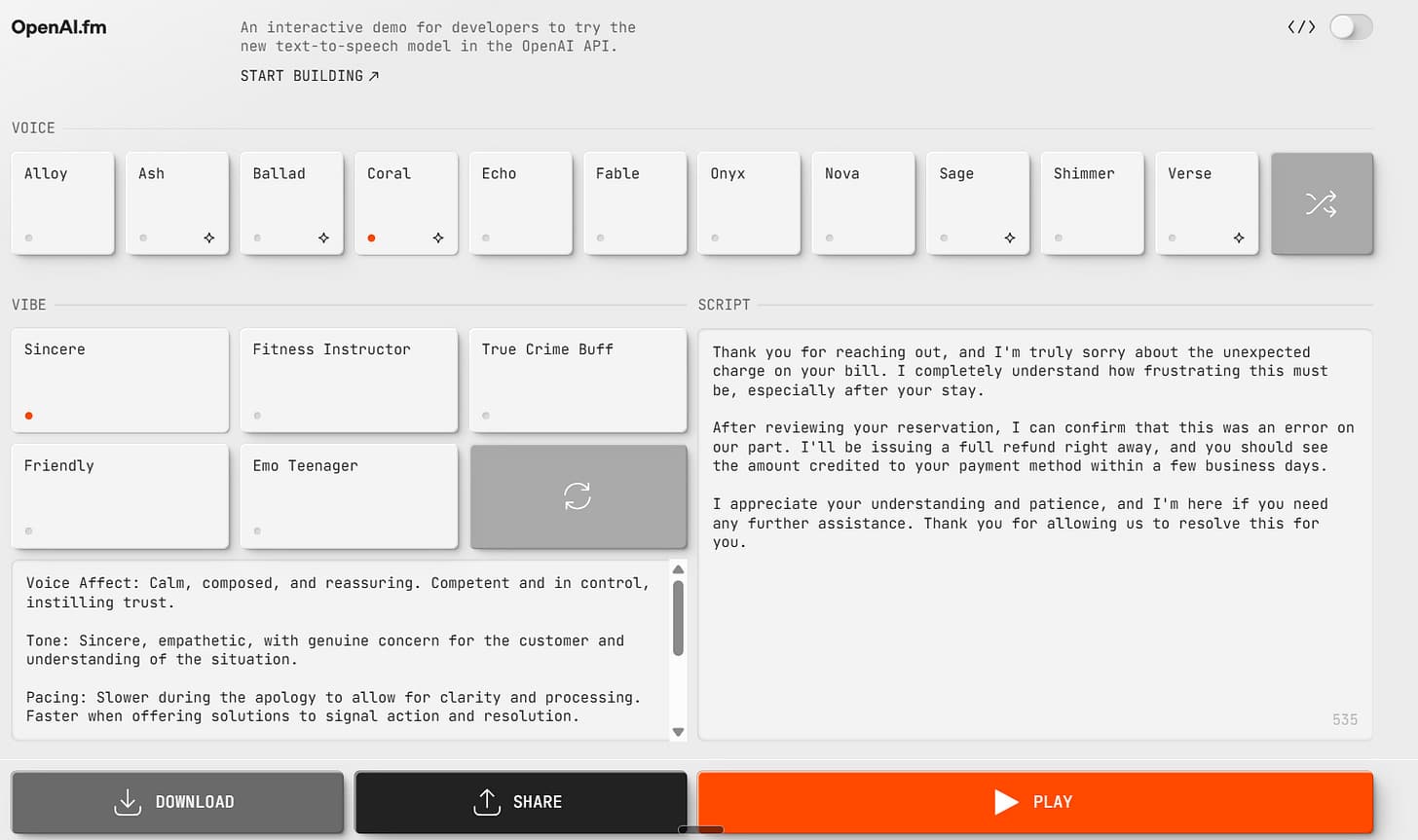
OpenAI's Oct 12-16 developer updates: free sandbox pre-warming for the Agents API (unattached sandboxes expire after 5 minutes); native Decisions API integration in GPT-Live that fires while the caller is still speaking; and prompt-to-voice — a custom GPT-Live voice from one text description, free to create — plus 9 new preset voices in German, French, Hindi, Japanese, and Korean. Catch: prompt-made voices are GPT-Live-only, 100 per org, disclosure required.

Anthropic opened Claude Duet as a research preview on Oct 21, 2026: a proactive agent with a morning brief and app checks every few hours. Before sending, paying, signing or deleting it shows the exact draft — but securities trading and inter-account transfers are forbidden even with approval. It runs on Claude Opus 5.5 in its own cloud VM. Sharpest detail: checks run every few hours, not real-time, because continuous checks burn Pro/Max quotas.
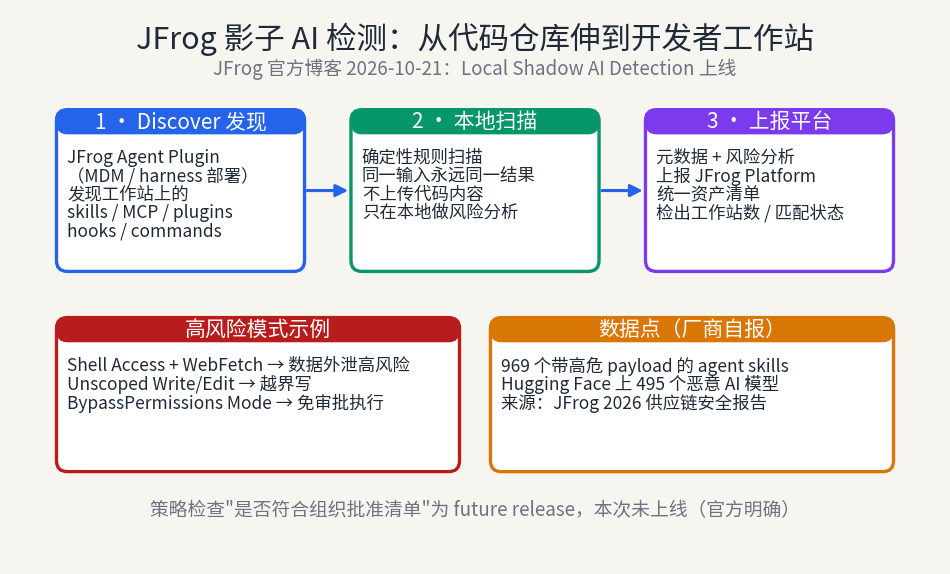
JFrog extends Shadow AI detection from repositories to developer workstations: the Agent Plugin discovers unregistered AI assets — skills, MCP servers, hooks — on laptops, scans them with deterministic local rules, and reports to a unified inventory. But the approved-list policy check is still a future release: visible, not yet stoppable. Individual developers should build their own skill inventory too.