After the Money Arrives: A Tax & Compliance Field Guide for Indie Developers
Taxes aren't an "after you scale" thing — they're an "after your first dollar of revenue" thing. A practical field guide for indie developers: three real-world cautionary tales, US/EU/China compliance playbooks, the minimum one-person toolchain, and a 30-minute monthly reconciliation SOP.

Picture a scene you may find familiar. One Friday night, your SaaS blows up on Product Hunt, and Stripe payment notifications keep popping up, one after another. You stare at the MRR curve and feel like your life is about to change. Three months later, a letter arrives — not a glowing user review, but a back-tax notice, plus late fees. The first time you seriously think about "taxes," the clock has already been ticking for a full year.
In the indie developer storybook, taxes are always the last lesson learned — and the most expensive one. Write bad code and you can roll it back; ship a broken release and you can hotfix it. But a tax bill doesn't disappear just because you "didn't know at the time." It's not dramatic, it's not sexy, so we collectively postpone it until "after we make it big." The reality is: taxes aren't an "after you scale" thing. They're an "after your first dollar of revenue" thing. The moment that first payment lands, the compliance clock starts running, whether you're ready or not.
This article is not tax advice (there's a formal disclaimer at the end). It's a field map: to help you see the traps indie developers fall into most often, figure out where you stand in each jurisdiction, and build the minimum compliance toolchain for a one-person team. The goal is to build low-cost compliance habits while revenue is still small — not to pay ten times the price catching up after revenue gets big.
Three cautionary tales: nobody teaches you before the money arrives, and it's all tuition after it does
The stories below are typical scenarios compiled from public reporting and community discussions. People and details have been fictionalized; the core lessons are real.
Story one: the 1099 letter in the US
A Chinese indie developer living in the US built a Mac productivity tool as a side project and collected tens of thousands of dollars in subscription revenue through Stripe over the year. At tax season he reported all his income honestly and felt he had nothing to worry about. The next year, a letter from the IRS arrived: he had missed several 1099 forms. One was for payments to a part-time designer — he assumed that since he paid via PayPal, "the platform already reported it" and he didn't need to issue a 1099-NEC himself. Another was a 1099-K issued to him by a platform, whose numbers didn't match what he had reported, triggering an automated mismatch.
There are two lessons here. First: 1099s run both ways — you'll receive 1099s for money you collect, and you may need to issue 1099s for money you pay out (to contractors, consultants, freelancers). Second: the filing thresholds change every year. Under the new rules effective for 2026, the reporting threshold for 1099-NEC and 1099-MISC has risen to $2,000 (it was $600 for 2025), while the 1099-K threshold for third-party payment platforms has reverted to the old standard of "over $20,000 and more than 200 transactions" — which means you may never receive a 1099-K, but every dollar of income still has to be reported. Many developers mistake "I didn't get a form" for "I don't owe tax." That's the biggest misconception of all: your filing obligation has nothing to do with whether a form exists. It has everything to do with whether you received money. (All threshold figures in this paragraph are as of October 2026; always check the official IRS guidance.)
Story two: the EU VAT back-bill
Another developer, based in China, built an English-language SaaS with customers across Europe. He reasoned the way many domestic founders do: I'm registered as a sole proprietor in China, so my taxes are handled in China. Then one day, the finance department of a German corporate customer emailed asking for an EU VAT invoice. Digging further, he discovered that for the past two years, the subscriptions he had sold to individual consumers in the EU should have carried VAT payable in each customer's country — and he hadn't paid a cent of it.
The EU rules are counterintuitive for many developers: where you are doesn't matter; where your customer is does. For digital services sold B2C to EU consumers, VAT is due in the consumer's country, at that country's rate. Germany 19%, France 20%, Hungary 27% — every order can carry a different rate. The good news is that the EU has a one-stop filing system, OSS (One Stop Shop), so you don't have to register in 27 countries one by one. The bad news: if you've never registered for OSS, historical liabilities don't vanish because "you didn't know." The back-bill, plus penalties, can arrive all at once.
Story three: mixing business and personal money at home
The third story happened in China. An indie developer collected several hundred thousand yuan in outsourcing fees and template sales through his personal WeChat account, with the money going straight into his personal bank account — "it's all the fruit of my own labor," he thought. Later, when he wanted to formalize the business and register a company, the accountant shook her head after one look at the books: personal and business money were hopelessly mixed in one account, the WeChat transaction history couldn't distinguish income from transfers between friends, and two years of records were essentially impossible to reconstruct. Worse, large, frequent business receipts flowing through a personal account can itself trigger banks' anti-money-laundering monitoring.
This story's lesson is the most plainspoken — and the easiest to ignore: mixing business and personal finances is the most common and most lethal category of tax problems for indie developers. Unlike VAT, there is no scary statute that jumps out at you; it's a chronic condition. Only when you want to raise money, sell the company, or formalize operations do you discover the past books are a tangled mess, and reconstruction is brutally expensive.
All three stories point to the same conclusion: tax disasters almost never happen because developers "wanted to evade taxes." They happen because developers "didn't know they had entered some jurisdiction's firing range." The fix isn't to become a tax expert — it's to build a minimal sensing system: know where your money comes from, which path it travels, and what obligations each path carries.
First, locate yourself: three common identities and what they mean for taxes
Before any discussion of specific rules, answer one question: legally speaking, who are you? Indie developers typically fall into three identity categories, each with completely different tax implications. Choosing the wrong identity — or operating long-term with no identity at all — is the root of much trouble.
Category one: domestic sole proprietorship / small-scale taxpayer (China)
This is the most common starting point for indie developers in China. The sole proprietorship (个体工商户) is cheap and simple to register, ideal for the early stage when monthly income is still unstable. On taxes, the central question for a sole proprietor is the assessment method: deemed (assessed) taxation versus books-based (audited) taxation.
Under deemed assessment, the tax authority assigns a deemed taxable-income ratio based on your industry and scale, and you pay tax as a fixed percentage of revenue. Bookkeeping is simpler, but only if your business qualifies for deemed assessment under local policy — and that policy stance has been tightening in recent years. Under books-based assessment, you pay tax on actual profit (revenue minus deductible costs), which requires complete books and supporting documents. A common misconception: hearing that "deemed assessment means lower taxes" and chasing it single-mindedly, without checking whether your business type and local policy still allow it. The decision rule is simple: if your cost structure is clear (servers, contractors, marketing all with proper invoices), books-based assessment is usually fairer; if your business is nearly zero-cost — just a laptop and you — only then does the simplicity of deemed assessment pay off. Either way, "no books at all" is not an option — deemed assessment doesn't mean you don't have to keep records.
As a small-scale VAT taxpayer, there are preferential thresholds for VAT (the exact standard follows official policy and is adjusted from time to time), but "small-scale" doesn't mean "tax-free," and certainly not "no filing required." Filing zero returns, skipping filings for long stretches, or issuing invoices without filing, are all behaviors that get you flagged.
Category two: a US LLC (or other US entity)
Developers whose customers are mainly in the US and who register a US company via Stripe Atlas or similar services often choose an LLC. The LLC's defining feature is "pass-through" taxation: the company itself generally doesn't pay income tax; profits flow through to the owners' personal returns. In other words, an LLC doesn't help you "avoid taxes" — it helps you "isolate risk" and "look legitimate." Every dollar of tax owed is still owed; only the filing path changes.
Before choosing an LLC, think through three things. First: are you a US tax resident or a nonresident? Nonresident LLC owners face completely different filing obligations and forms (such as 5472 and 1120) than residents, and the penalties for missing them are severe — a part that most "register in the cloud" tutorials never mention. Second: an LLC is registered state by state, and annual fees and franchise taxes vary enormously between states. Choose a state based on "where your business actually happens," not "which one is most famous." Third: an LLC needs an EIN (Employer Identification Number). The application is free, but the process and documentation requirements have changed in recent years — use the official IRS channel and skip the middlemen's "expedited packages."
Category three: operating under the EU OSS system
Strictly speaking, OSS isn't an "identity" but a filing mechanism — yet for many indie developers selling into Europe, it effectively is their European tax identity. The positioning logic to remember: whether you have an "establishment" in the EU determines whether you use Union OSS or Non-Union OSS; whether your annual cross-border B2C sales in the EU exceed €10,000 determines whether you may use your home-country rate or must use destination-country rates. If you're based in China selling SaaS to European users, the most common path is Non-Union OSS: no threshold relief — from the very first B2C digital-service sale, you charge the customer's country's rate and file accordingly.
The practical way to locate yourself: draw a "money-flow map." Which countries do your customers come from? Which payment platforms does the money pass through? Into which country and under which entity's name does it finally settle? Once that map is drawn, your tax identity and the boundaries of your obligations become mostly clear. Many developers are shocked the first time they draw it: their "tiny one-person business" actually spans three tax jurisdictions.
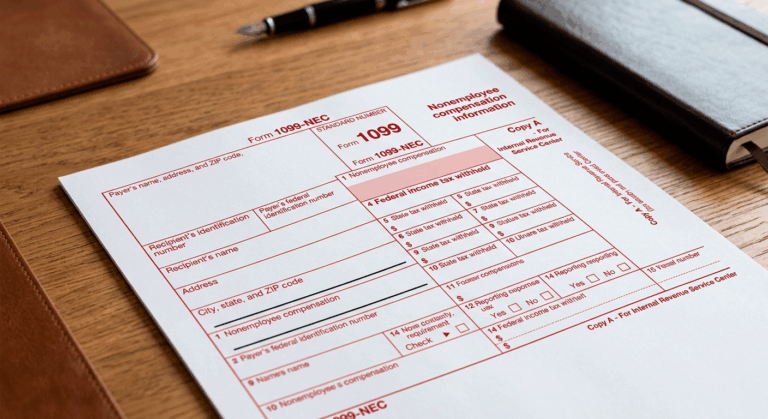
US track: EIN, 1099s, and sales tax nexus
The US is the most common "first bucket of gold" market for indie developers, and also the most fragmented rulebook: federal, state, and local levels, each with its own logic. The good news is that a one-person SaaS team really only needs to watch three things.
EIN: your US tax ID card
The EIN (Employer Identification Number) is a nine-digit number issued by the IRS — essentially your business's ID card in the US tax system. Even with no employees, you'll likely need one if you have a US entity, want to open a US business bank account, or take payments through Stripe on certain rails. The application itself is free; through the IRS website, US applicants typically get it instantly, while non-US residents face a more winding process that may involve fax or mail, measured in weeks. The rule of thumb: wherever a form asks for a "Tax ID," first confirm whether it wants an EIN or an SSN — don't mix them up, and never hand your SSN to a platform that shouldn't have it.
The 1099 family: understand both receiving and issuing
The 1099 series is how the IRS cross-checks income, and indie developers encounter it in both directions:
- 1099-K (what you receive): issued to you by third-party payment processors (Stripe, PayPal, etc.), reporting what you collected through that platform. As of October 2026, the federal threshold is over $20,000 in a year AND more than 200 transactions (2025 legislation scrapped the planned phase-down and restored the old standard, retroactively). Two caveats: direct credit-card transactions have no dollar minimum; and some states (e.g., Massachusetts) have their own lower thresholds — no federal form doesn't mean no state form.
- 1099-NEC (what you issue): when you pay US-based contractors or freelancers for services and hit the threshold, the filing duty is yours. Starting in 2026 the threshold rose from $600 to $2,000, and it will be inflation-adjusted from 2027 on. The classic trap: contractor payments made by PayPal or credit card generally travel through the 1099-K channel, so you don't issue an NEC for them — but payments by bank transfer, check, or cash are your responsibility. Payments to non-US (nonresident) contractors go through the W-8BEN + 1042-S system, not 1099s.
Remember the single most important sentence: a form is just the IRS's "reconciliation statement," not a tax bill. No form doesn't mean no income, and a form only reports gross receipts — what you're actually taxed on is net profit after deductible business expenses. Keep records of every platform payout and every contractor payment; at tax season, your present self will thank your past self.
State sales tax nexus: when a state considers you "doing business" there
This is the piece SaaS developers overlook most. The US has no national sales tax; every state sets its own. "Nexus" is the test for whether you must collect and remit sales tax in a given state. Since the 2018 Supreme Court decision, states have widely adopted "economic nexus" standards, commonly $100,000 in annual sales or 200 transactions (exact figures differ by state; some use only the sales threshold).
For pure SaaS there's another layer: states disagree completely on whether SaaS is taxable at all, and under which category — some tax it as a service, some exempt it, some look at your servers or delivery method. The pragmatic one-person-team strategy: first nail down the rules of the two or three states where your sales are largest, use a tool like Stripe Tax to automatically determine rates and collection duties, and don't try to master all 50 states at once. When your sales in a state approach that state's threshold, that's when you study that state's specific rules seriously. Threshold figures follow each state's department of revenue; the numbers in this article are as of October 2026.
Europe track: VAT and the OSS one-stop filing
Europe's rules are far more unified than America's — but "unified" doesn't mean "simple." For indie developers, European tax boils down to one core question: for every digital service you sell to an EU consumer, VAT is due in the customer's country.
B2B and B2C are two completely different roads
First, separate enterprise customers (B2B) from individual consumers (B2C), because the treatment differs enormously:
- B2B: if the buyer is an EU-registered business that can provide a valid VAT number, the "reverse charge" usually applies — you invoice at 0% and the buyer accounts for the tax in their own country. Your job is to validate their VAT number through the EU's VIES system at the time of sale and keep the validation record. That record is your key audit evidence; don't just store the number.
- B2C: selling to individuals means no reverse charge. You must charge VAT at the consumer's country's rate and file and pay through the OSS system. Keep at least two non-contradictory pieces of location evidence per customer — billing address, IP address, the country of the payment method, and so on.
Hybrid SaaS products (both individual and business customers) crash here most often: the checkout flow has no B2B/B2C branch and applies one logic to everyone, leaving both sides non-compliant. Adding an "I'm a business customer" option plus a VAT-number field to your checkout is one of the cheapest, highest-return compliance upgrades you can make.
The three OSS schemes and the €10,000 line
OSS (One Stop Shop) lets you register in one EU country and file all EU countries' B2C VAT in a single quarterly return, instead of registering in 27 countries one by one. It comes in three flavors:
- Union OSS: for businesses established in the EU, covering intra-EU cross-border B2C goods and services.
- Non-Union OSS: for businesses outside the EU, covering B2C telecom, broadcasting, and electronic services only (your SaaS, online courses, and e-books all fall here). You can register in any EU country of your choice.
- IOSS: for imported low-value goods (under €150) — irrelevant for pure digital products; just know it exists.
The key number: €10,000. EU-established businesses whose annual B2C cross-border sales to other EU countries (goods + digital services counted together) stay at or under €10,000 may choose to file at their home-country rate; above it, destination-country rates apply via Union OSS. Non-EU businesses get no such cushion — from the first B2C digital-service sale, you charge the destination rate and file through Non-Union OSS. Based in China, selling SaaS to European users? That's the default path. Filing is quarterly, with tax computed per country at each country's rate and paid in aggregate.
A few Europe details that are easy to miss: post-Brexit, the UK is a separate system — it doesn't go through OSS and needs its own UK VAT handling; EU rates are tweaked every year, so don't hardcode a rate table in your code; and since January 1, 2025, live virtual events and other digitally delivered sessions with real human interaction are explicitly taxed where the customer sits — if you sell courses or consulting with a live component, that change hits you directly.
China track: sole proprietorships, invoicing, and separating business from personal money
The tax environment for indie developers in China has its own logic: plenty of preferential policies, but ever-stricter demands on the books. Three practical priorities:
Deemed vs. books-based assessment: choose by your cost structure
The positioning chapter gave the conclusion; here's the selection method. Open your expense sheet: if servers, cloud services, contractors, and ad spend make up more than ~30% of revenue and you can get proper invoices for them, books-based assessment is usually the better deal, since it's taxed on real profit. If your business is just a laptop plus you, with almost no deductible costs, only then does the simplicity of deemed assessment pay off. But watch two trends: first, the policy stance on deemed assessment has been tightening for years, with many regions raising the bar for new approvals; second, "deemed" doesn't mean "no books" — the tax authority can ask for your income and expense records at any time. Before deciding, check with your local tax bureau or an accountant — don't pick a jurisdiction based on an agent's "1% tax haven park" pitch. Whether a park's preferential policy actually matches the substance of your business is the first question asked in any audit.
Invoicing and platform withholding: the revenue path determines the compliance move
Chinese developers' income usually travels one of three paths, each with different tax actions:
- Platform settlement (app stores, mini-program platforms, course platforms): many platforms withhold individual income tax on your behalf or require you to provide an invoice before settling. Read the tax clause before signing: is the quoted price pre-tax or post-tax? Who issues the invoice? Does the platform give you a tax-payment certificate for what it withheld? Those certificates are core documents to keep.
- Corporate clients (businesses buying your SaaS or outsourcing services): they'll almost certainly require a VAT invoice (fapiao). Business you can't invoice for is business you basically can't do in China's B2B market — so "can I issue invoices" must be solved before pricing and signing, not when the client starts chasing you.
- Direct personal receipts (WeChat/Alipay transfers): the riskiest path. Occasional small personal transfers are fine, but long-term, large, frequent business receipts through a personal account are hard to characterize as income and can trigger bank monitoring. The right move is to consolidate receipts into a business account or a compliant sole-proprietor collection channel as soon as possible.
Separating business and personal money: three things to start today
Mixing accounts is a chronic disease, but the prescription is simple — and you can start today. First, open a separate bank account (or at least a separate bank card) dedicated to business receipts, never mixed with living expenses. Second, run business spending through that same card, and keep a separate ledger for business WeChat/Alipay activity — even if it starts as a humble spreadsheet. Third, pick one fixed day each month to reconcile that account's transactions against your revenue records, and clear any discrepancy the same day. These three things cost almost nothing, but they determine whether, two years from now, you hand your accountant or the tax bureau a set of books — or a tangled mess.
Toolchain: the minimum compliance setup for a one-person team
The thing tax compliance fears most is "it's all in someone's head." A one-person team has no finance department; the only way out is to push the rules down into tools. Here's a battle-tested minimum setup, ordered "working first, optimized later":
Layer one: calculate tax automatically at checkout
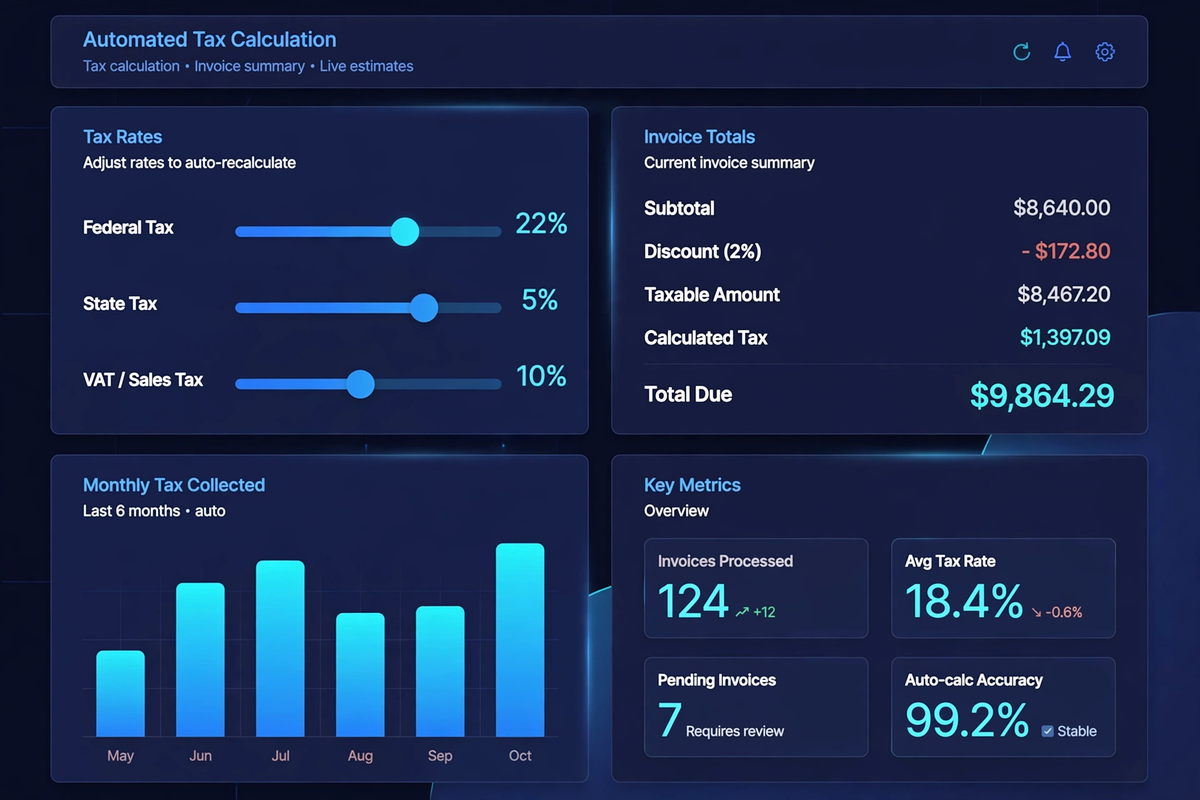
If you take payments with Stripe, Stripe Tax is the starting point: it determines the rate by customer location at checkout, collects the tax, and generates filing reports per jurisdiction. For SaaS it covers the mainstream scenarios — US state sales tax, EU VAT, UK VAT, and more. It's priced per transaction, entirely affordable for a team with early-stage revenue. The decision rule: if your customers span three or more countries/states, an automated tax engine like Stripe Tax isn't optional — it's mandatory. A manually maintained rate table breaks the moment the third jurisdiction shows up.
Teams not on Stripe can look at TaxJar (strong on US state sales tax, with filing services per state) or Anrok (built specifically for SaaS, a better fit for subscription models across many jurisdictions). Ask three questions when evaluating: does it support my payment rails? Does it cover my customers' jurisdictions? Will my accountant accept its filing reports? Three yeses before you sign.
There's an even more thorough route: the Merchant of Record (MoR) model, e.g., platforms like Paddle or Lemon Squeezy. An MoR becomes the legal "seller of record": it handles tax collection, filing, and refund disputes, and you simply receive net revenue. The price is a higher fee (typically several points above a pure payment rail), in exchange for transferring the compliance burden. For a one-person team that wants nothing to do with taxes, the MoR option deserves a serious calculation: the extra fee versus your own time cost plus error risk.
Layer two: bookkeeping and reconciliation tools
Automated tax calculation solves "how much tax to collect"; bookkeeping solves "how much you actually earned this year." Cloud accounting software like QuickBooks or Xero connects directly to your bank account and Stripe and auto-categorizes income and expenses; the logic is the same everywhere. The one core requirement: every movement of business money must be findable in the system and traceable to an invoice, contract, or platform settlement statement.
Layer three: calendar reminders
It sounds embarrassingly low-tech, but it's the most effective: put every jurisdiction's filing deadline, payment deadline, and annual inspection date on your calendar, with reminders two weeks ahead. OSS files quarterly; US state sales tax filing cycles range from monthly to annual; Chinese sole proprietors have quarterly filings and an annual reconciliation. Many late fees aren't caused by "no money to pay" — they're caused by "forgot to pay."
Bookkeeping discipline: a 30-minute monthly reconciliation SOP
Tools can record; only discipline creates compliance. Here's an SOP designed for a one-person team — 30 minutes a month, non-negotiable:
- Pull statements (5 min): export the month's settlement report from Stripe/your payment platform and your bank statement. Confirm every receipt landed in the business account — nothing "conveniently" went to a personal account.
- Reconcile revenue (10 min): match every line of the platform settlement against your order/subscription records. Watch for three anomalies: refunds not synced, duplicate charges, and which day's exchange rate was used for foreign-currency settlements.
- Reconcile expenses (10 min): server bills, contractor payments, tool subscriptions — go through them one by one. Confirm every expense has supporting evidence (invoice or receipt); log the ones missing evidence and chase them down within the month.
- Update the tracker (5 min): add this month's taxable sales per jurisdiction to your tracking sheet. In the US, watch whether any state is approaching its nexus threshold; in the EU, whether you're nearing the €10,000 line; in China, whether quarterly cumulative figures trigger new filing obligations. Once a number crosses a line, next month's actions need preparing in advance.
This SOP's real value isn't "pretty books" — it's knowing every month how far you are from each tax threshold. People who get blindsided by taxes almost always "suddenly" discover they've crossed a line. But crossing a line is never sudden: it creeps up 1% a month. You just weren't watching.
Accountants: when to hire one, and how to choose
The trigger for hiring an accountant on a one-person team isn't "how much revenue" — it's "complexity overload": you're facing filing obligations in two or more jurisdictions, you're about to register an overseas entity, or you've received your first letter from a tax authority. Any one of those three signals means it's time. The selection criteria: first, they must have served businesses like yours (SaaS cross-border and restaurant bookkeeping are completely different trades); second, ask "have you filed OSS returns?" / "have you filed a 5472?" — if they can't answer, pass; third, the fee model must be transparent — per-project or annual retainers are both fine, but never sign a "pay first, we'll see" deal. A good accountant saves you money: the deductions and incentives they know about often pay for their fee in the first year.
Three situations that require a professional — plus the disclaimer
What this article can give you is a map and discipline; but a map is no substitute for a guide. In the following three situations, go straight to a licensed tax adviser/accountant/CPA — don't try to DIY your way through research:
- You've received any formal correspondence from a tax authority (audit notice, back-tax notice, penalty notice): the wording and deadlines of your response matter, and a careless reply can turn a small matter into a big one.
- Cross-border structuring (registering an overseas company, allocating profit across entities, transfer pricing): this is the most technically demanding part of tax, and the most expensive to get wrong. Skipping this consulting fee is the costliest kind of saving.
- Cleaning up historical arrears (unfiled years, chaotic books): voluntary disclosure and getting caught follow completely different procedures with completely different costs. A professional knows how to take the "self-report" path that minimizes the damage.
Disclaimer: this article is not tax advice. Its contents are for general information only, compiled from public sources available as of October 2026. Figures such as rates, thresholds, and filing rules should be verified against the official guidance of each jurisdiction's tax authority, as policies can change at any time. Tax law varies by country/region, business type, and personal circumstances, and this article cannot cover your specific situation. Before making any tax decision, consult a licensed tax professional in your jurisdiction. Neither the author nor the publishing platform accepts liability for actions taken based on this article.
Back to the opening line: taxes aren't an "after you scale" thing — they're an "after your first dollar of revenue" thing. You don't need to become a tax expert on day one. You only need to start three things on day one: separate business money from personal money, keep evidence for every dollar in and out, and spend 30 minutes a month checking how far you are from each line. Together, those three things may cost less than a rounding error on your monthly server bill — but they buy you the freedom to grow without ever having to go back and catch up. Money coming in is a good thing. Don't let taxes turn it into a bad one.
Comments (0)
Related articles

Stars don't pay the bills. This guide lays out four proven monetization routes for indie open-source developers — donations, open core, dual licensing, and paid hosting — with a decision table, pricing funnel, and the hard lessons on drawing the free/paid line early.

Involuntary churn — customers who never wanted to leave but whose renewal charge failed — typically makes up 20-40% of subscription churn. This guide covers the missing fourth piece of subscription revenue: failure triage by decline code, a D+1/D+3/D+7/D+14 retry schedule, four recovery email templates, grace-period and degradation strategy, the 8-element self-serve recovery page, a 4-metric weekly dashboard, and a production-ready invoice.payment_failed webhook skeleton.

Without evals, every model swap is a gamble. This guide gives solo teams an evaluation system built in half a day: mining 50–200 exam questions from real logs, rule assertions vs LLM-as-judge (and taming judge bias), a regression pipeline, the production sampling flywheel, and launch gates with rollback — plus copy-paste run.py, CI configs, and checklists.