Open Source Can Pay Too: Four Monetization Paths for Indie Developers
Stars don't pay the bills. This guide lays out four proven monetization routes for indie open-source developers — donations, open core, dual licensing, and paid hosting — with a decision table, pricing funnel, and the hard lessons on drawing the free/paid line early.

After Open-Source Growth, Then What: Stars Don't Pay the Bills
Picture this: your open-source project just hit 8,000 stars on GitHub, made the front page of Hacker News, and collected hundreds of retweets. The comments are full of "awesome work," the issue tracker is buzzing. Then you open your bank account — and the balance hasn't moved. The server bill charges like clockwork every month, issues and PRs interrupt your sleep every night, and the revenue column sits firmly at zero.
This isn't a joke; it's the lived reality of most open-source maintainers. Stars are attention, not revenue; forks are interest, not commitment. Open source has a mature playbook for acquiring users — good projects spread on their own — but monetization was never part of the default configuration. Too many people treat "get popular first, money will follow" as a religion. The result: the more popular the project, the heavier the maintenance burden, and the further away "making a living from it" gets.
The truth is this: the business model of open source is not "free now, figure it out later." From day one you need to know which part stays free forever and which part is destined to be paid. The later you draw the line, the bigger the community backlash; draw it too early and you strangle the community in its crib. This guide gives indie developers four proven routes: donations and sponsorships, open core, dual licensing, and paid hosting. Each route has its own suitable soil, operating manual, and marked minefields. By the end, you should be able to answer the one question that matters most: which route actually fits my project?
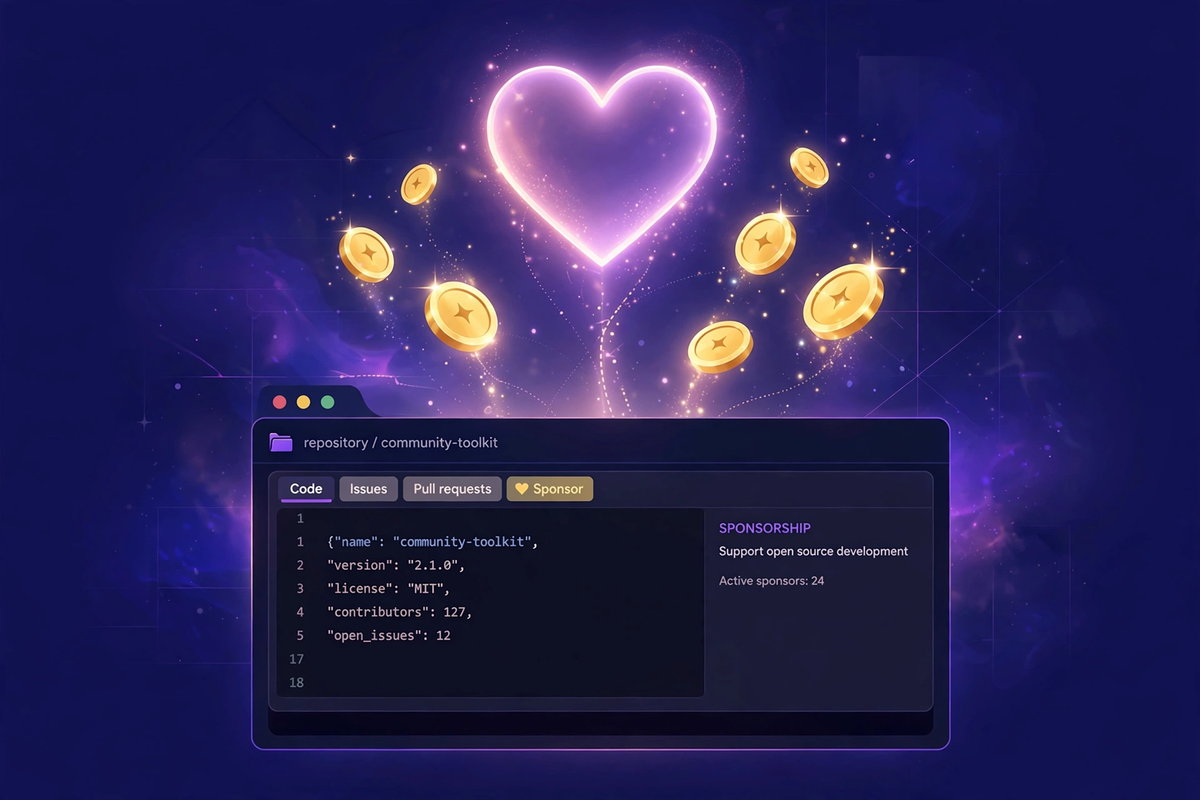
Route One: GitHub Sponsors / Donations — Turning Likes into Groceries
Donations are the lightest route of all: nothing changes about the code, the license, or anything else — you simply put a "buy me a coffee" button somewhere visible. GitHub Sponsors, Open Collective, Patreon, and Buy Me a Coffee are all tools in this lane.
Which projects fit
Donations work when three conditions hold: a large user base, low willingness to pay per user, and a project that's hard to productize. The textbook case is the developer toolchain: CLIs, build tools, frontend component libraries, editor plugins. Their users are developers — numerous, fast-spreading, but each willing to part with only a few dollars. That maps perfectly onto the psychology of donations: "this tool saves me 10 minutes a day; buying the author a coffee is the least I can do."
Conversely, if your project is itself a complete product (a notes app, a CRM), users expect "something that works out of the box," not "some code." Donations rarely work there. Those projects should skip straight to Route Two and Route Four.
How to write a sponsorship page that converts
Most sponsorship pages read like begging: "If you like this project, please consider sponsoring me." That copy converts terribly. Good sponsorship copy has three elements: say exactly where the money goes, give sponsors an identity, and set concrete milestones. Here's a template you can use directly:
What your sponsorship funds
This project is currently maintained by me alone, in my spare time — about 12 hours a week fixing bugs, reviewing PRs, answering issues, and writing docs. Every dollar you contribute converts directly into maintenance hours — not into my vacation fund.
Milestones
$500/mo: I can double weekly maintenance time, cutting average issue response from 5 days to 2.
$1,500/mo: I can quit my side gig and maintain this project full-time for three months; the v3.0 rewrite on the roadmap officially starts.
$4,000/mo: the project becomes sustainable, and I'll hire a part-time docs engineer.Sponsor tiers
$5/mo · Supporter: your name in the README thanks section.
$25/mo · Builder: voting rights on new features + a monthly live roadmap sync.
$100/mo · Partner: logo on the homepage + a priority issue channel.
$500/mo · Corporate sponsor: 1 hour of quarterly technical consulting + a discussion slot for custom feature scheduling.
Note the craft in this template. First, it translates "sponsorship" into "buying maintenance hours" — donors aren't buying sentiment, they're buying concrete outcomes (faster responses, faster releases). Second, the milestones use specific numbers, creating that "just a little more and we're there" final-push effect. Third, the corporate tier ($500) is where the real money is: a solo developer's $5 donation buys emotional value; a company's $500 buys relief from risk anxiety ("will this library we depend on still be maintained tomorrow?").
Managing expectations, honestly
A sober word: pure-donation models that sustain a full-time maintainer are extremely rare. Behind names like Sindre Sorhus and Evan You stand years of accumulated top-tier influence. For ordinary indie developers, donations are more realistically positioned as "covering server costs + a few coffees + validating willingness to pay." Their real value is the signal: if nobody will even pay $5 a month, your project hasn't yet created enough "sense of being depended on," and talking about open core or paid hosting is building castles in the air. Treat donations as a market-research tool and your mindset will be far healthier.
Route Two: Open Core — Three Ways to Draw the Line Between Free and Paid
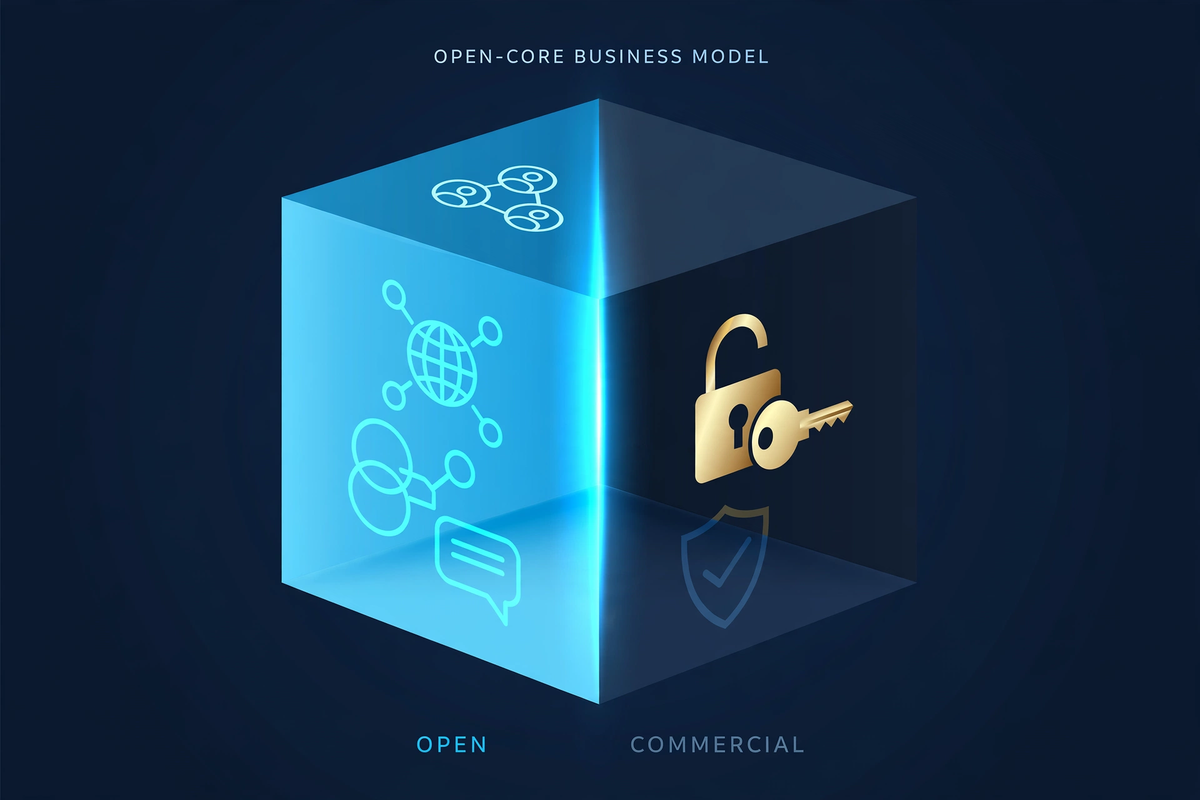
Open core is currently the most mainstream open-source business model: the core stays open and free forever, while advanced features ship as a closed-source commercial edition (GitLab CE/EE is the textbook case). Its essence isn't "which features to charge for" but where to draw the line. Draw it too close to the core and the community feels betrayed; draw it too far out and nobody buys the paid edition. Here are three proven ways to draw that line:
Line one: draw it by "people" — free for individuals, paid for teams
Individual developers get the full core for free; the moment team collaboration enters — permission management, SSO, audit logs, team workspaces — you're in paid territory. The logic is blunt: individual users have almost no budget, but they are your evangelists; enterprise users have budgets, and "multiplayer collaboration" is a need companies can't dodge. Project management tools, docs tools, and internal platforms fit this line best. Take an open-source kanban tool: creating boards and dragging cards is free forever; but "assign permissions by department" and "who moved which card when" audit trails only exist in the enterprise edition.
Line two: draw it by "scale" — small usage free, large usage paid
All core features are open, but usage beyond a threshold costs money: API calls, data volume, project count, build minutes. Set the threshold where "individuals and small teams never touch it, but any growing company will inevitably hit it." Say 10,000 API calls a month free — plenty for an indie hacker's side project, but a company with real daily actives burns through it in three days. The beauty of this line is that conversion happens automatically: the user never makes a "purchase decision"; business growth makes it for them. Your job is just to make the upgrade path smooth when the limit hits — not to brutally cut off service.
Line three: draw it by "ops burden" — features free, peace of mind paid
Every feature is open source, but the ability "to run these features stably in production" costs money: high-availability deployment, replicas, automated backups, monitoring and alerting, a 99.9% SLA. Indie developers enjoy tinkering with k8s configs; companies just want to sleep well. This is the cleanest line because it takes no features away from anyone — what you're selling is pure "not waking up at 3am to fix servers" peace of mind. Databases, message queues, and CI systems fit it best.
The three lines can be combined, but one iron rule applies: the free edition must be a complete, usable product — not a trial version of the paid edition. If free users keep hitting walls and feel "neutered" everywhere, they won't convert into paying users; they'll convert into angry ex-users, then fork a community edition. The test is simple: can an indie developer build one complete thing using only the free edition? If yes, the line is healthy.
Route Three: Dual Licensing — How to Set the AGPL "Tripwire"
Dual licensing means the same code ships under two licenses. The community edition goes out under AGPLv3 (or something stricter like SSPL): anyone can use and modify it for free — but the moment you offer a modified version as a network service, you must open-source your modifications too. Meanwhile, you sell commercial licenses to companies unwilling to open-source: pay up, and the AGPL's "viral" obligations don't apply to you.
The AGPL here is a "tripwire": it doesn't make money directly. Its job is to filter out the enterprise users who "want to freeload but won't open-source" and funnel them to the commercial-license checkout. MongoDB, Elastic (before its license change), and Qt all played this route. For indie developers, the appeal is clear: no two codebases to maintain, no feature-boundary design puzzle — one codebase, two ways to sell it.
Legal cost warning: this road isn't cheap
Dual licensing carries the highest hidden costs of the four routes, and newcomers chronically underestimate them:
- Copyright ownership must be clean. Selling commercial licenses requires you to own the code's full copyright. The moment you accept outside contributions, contributors must sign a CLA (Contributor License Agreement) transferring or licensing their copyright to you. A project without CLAs means, in theory, every contributor could surface and sue you for "having no right to sell commercial licenses on code I wrote." Drafting the CLA and maintaining the signing process both cost.
- License compliance is an ongoing investment. AGPL's boundaries are full of gray areas in practice: do microservices count as "modification"? Does internal use count as "distribution"? Your big customers will send legal teams to scrutinize your license text line by line. You need FAQs and compliance guides ready, and in serious cases, a lawyer. One consultation with an open-source licensing attorney can cost an indie developer half a year's server budget.
- Once a license is chosen, there's almost no going back. Moving from a permissive license (MIT/Apache) to AGPL unilaterally tightens every downstream user's rights, and the community backlash is fierce; moving from AGPL back to permissive requires the consent of every historical contributor — the more contributors, the more impossible. Choosing a license is a marriage, not dating. Think before you sign.
My judgment: unless your project already has clear enterprise users who are "interested but scared of the AGPL," don't proactively choose dual licensing. It's better understood as a defensive weapon — when a big company takes your open-source project, tweaks it, and sells it as a competing service, the AGPL is the only card in your hand. As an offensive monetization move, it demands legal energy and negotiating leverage — precisely the two things indie developers lack most.
Route Four: Paid Hosting — Turning "Deployment Pain" into Subscription Revenue
This is the route I most recommend to indie developers, and its logic is as plain as common sense: your open-source project is great, but deploying it means configuring databases, handling certificates, tuning parameters, and dealing with 3am outages. So you offer a hosted version: users sign up, pay monthly, and are live in five minutes — the pain is all yours. What users buy isn't software; it's "not having to operate it myself."
This route has three traits that are extremely friendly to indie developers. First, the open-source and hosted editions are the same codebase — no open-core boundary puzzle, no dual-licensing legal swamp. The code is 100% open; you're selling "the running service." The community won't feel betrayed, because the self-hosting path stays open forever. Second, revenue is subscription-based and predictable, not weather-dependent like donations. Third, the moat is built in: anyone can fork your code, but not everyone is willing to wake up at 3am to fix servers — which is exactly what you do every day anyway.
How to do hosting without blowing up
- Price against the user's self-hosting cost, not the software's value. An indie developer self-hosting your service spends 2 hours of tinkering plus a $10 VPS each month. Price your entry tier at $12–$20/month and the user's mental math is "spend $15 to buy back 2 hours" — an easy equation. Price it at $99/month and the math becomes "is this software worth $99?" — an equation you will lose.
- The free tier is a growth engine, not charity. Offer a free tier with real, hard limits (one project, 100MB of data) so users can get running at zero cost, accumulate data, and build dependence. Once switching costs exist, paid conversion follows naturally. But the free tier must have hard caps — an unlimited free hosted tier burns your own credit card.
- Write the self-hosting guide to perfection. This sounds counterintuitive: aren't you competing with self-hosting? Quite the opposite. The clearer the self-hosting docs, the better they filter for the exact cohort who reads them and thinks "this looks painful" — those are your paying users. The ones who persist with self-hosting become your hardest-core community contributors. Both sides win.
Supabase, n8n Cloud, and Plausible all walk this road: fully open code, subscription fees on the hosted version scaled by usage. For a one-person team the ops burden of hosting is real — but note that you're already maintaining this project's issues and releases. Taking on one more responsibility, "keeping it running stably," has a far lower marginal cost than building a SaaS product from zero.
The Four-Route Decision Table: Find Your Seat
The four routes aren't ranked; they're matched. This table locates you along three dimensions — find your project's cell and look at the recommended route first.
| Project type | Maintenance cost | Recommended route | Why |
|---|---|---|---|
| Dev tools / CLIs / component libraries | Low (mostly bug fixes) | Route One: donations & sponsorships | Many users, low price points, hard to productize; validate the "sense of being depended on" first |
| Complete apps (notes / kanban / form tools) | Medium (fast feature iteration) | Route Two: open core | Draw the line by "people" or "scale"; the individual edition stays fully usable, the enterprise edition taxes collaboration |
| Infrastructure (databases / queues / gateways) | High (brutal stability demands) | Route Three or Four: dual license / paid hosting | Highest freeloading risk from big companies; you need the license weapon or the ops moat |
| Stateful services that need deploying | Medium-high (ops is ongoing investment) | Route Four: paid hosting | Turn users' biggest pain — deployment and ops — into subscription revenue; keep the code fully open |
| Polished tools in a niche domain | Low (maintained as the author's own tool) | Route One, or skip monetization | The user base can't support any business model; donations covering costs is enough — don't force it |
| Enterprise users already evaluating | Any | Route Two or Four | Only talk monetization when there's a real payment signal; take design partners' money first, then set prices |
One special note on the last row: the best timing signal for monetization isn't star count — it's whether enterprise users are coming to you asking "is there a commercial edition / can we pay for support." Before that moment, all monetization design is armchair theory. After it, every day of hesitation is money pushed out the door.
Pricing and Conversion: Designing the Free-to-Paid Funnel
Route chosen — now comes turning "people use it" into "people pay for it." A healthy open-source monetization funnel has four layers, each with a different job:
- Discovery (the free open-source edition): the job is maximum spread. A clear README, a five-minute quickstart, a permissive license (MIT/Apache spreads best). Don't talk about money at this layer — money pollutes propagation.
- Dependence (deep usage): the job is making users unable to leave. The key metrics: have users put your project into production? Accumulated data on it? Written it into the team's onboarding docs? Once it's in production, switching costs are your moat.
- Intent (capturing payment signals): the job is identifying who will pay. Put an "enterprise / hosted edition" entry in the docs; add one line to the issue template: "Need priority support? Check out our commercial edition." Never blast promotions — open-source communities smell marketing a mile away, and one blast can destroy trust built over years.
- Conversion (payment): the job is making paying frictionless. Accept credit cards and issue invoices (enterprise procurement without invoices is no procurement at all), offer annual discounts (typically two months free), and give the first paid version an "early-bird price" that locks in early users.
Two practical pricing lessons. First, when in doubt, price the first version low, never high: a $19/month product nobody buys can be raised to $29; a $99/month product nobody buys, when dropped to $49, makes old users think "is this thing failing?" Pricing elasticity is always greater upward than downward. Second, "per seat per month" vs. "by usage" depends on your cost structure: if your marginal cost is mostly customer service and support, go per-seat; if it's servers and bandwidth, go usage-based. The latter is friendlier to indie developers — when usage doesn't grow, you aren't paying for idle capacity either.
Anti-Patterns: Two Bloody Lessons
Anti-pattern one: charging too early kills the community
I've watched more than one project rush to put up a paywall at 500 stars: the core feature barely validated by the community, and the author announces "advanced features will soon be paid." The result is catastrophic — contributors feel they're doing free labor for someone else's commercial product, the issue tracker shifts from "how do we make this great together" to "how dare you charge," and the most active contributors fork a community edition. The project splits in two, and both halves wither.
The test for "too early" isn't star count — it's whether a contributor network has formed that can keep moving without you. If every PR waits for you to merge and every question waits for you to answer, the project has no community yet, only an audience. Charging an audience is announcing the show is over. The right sequence: first grow 3–5 core contributors who can review PRs independently, then talk monetization — by then, the fee buys "this project will be maintained for the long haul," certainty the community will vote for with its wallet.
Anti-pattern two: flip-flopping the license
This is the most expensive tuition in open-source commercialization history, and it's been paid more than once. In 2021, Elastic moved Elasticsearch from Apache 2.0 to SSPL/ELv2 — and AWS forked OpenSearch as a direct consequence, splitting what could have been a win-win ecosystem into two camps. In 2024, Redis moved from BSD to RSALv2/SSPL, and within days the Valkey fork was born, taken under the Linux Foundation, with top Redis-ecosystem users migrating en masse.
Both episodes share a script: a license change is never a "technical decision" — it's a trust decision. When users choose an open-source project, they're buying a long-term contract: "this code's rules won't change while I sleep." The moment you unilaterally tear up the contract, your most capable users — precisely the big customers you most want to keep — are the first to fork and run, because they have the engineers, the motivation, and the determination to "never be held hostage again."
The lesson for indie developers is concrete: pick your license on day one and assume it never changes. If you might go dual-license later, start with AGPL on day one; if you want maximum spread, start with MIT/Apache. The dumbest strategy is "use MIT to acquire users, then tighten up once we're hot" — that is exactly the posture Elastic and Redis paid tuition for. The later the line is drawn, the bigger the community backlash — and nowhere is that truer than with licenses.
Closing: Draw the Line on Day One
Back to the core thesis: the business model of open source is not "free now, figure it out later." From day one, know which part stays free forever and which part is destined to be paid. This doesn't mean hanging a price list on day one — quite the opposite. Once the line is clear in your head, you can give things away more generously: because you know the free part is free forever, the paid part will come in time, and the two never trespass on each other.
The action list for indie developers is just three items. First, choose your project's license today, and write down "this license stays for five years." Second, honestly answer "among my users, who has budget and why would they pay" — if you can't answer, run Route One first to validate. Third, when the first enterprise user asks "is there a commercial edition," don't be modest, don't stall — have the quote ready. In that moment, your open-source project graduates from "a work" to "a business."
Stars can't pay the bills, but the people behind the stars can. Find them, tell them honestly where the money goes, and deliver something worth paying for — open-source monetization was never about taking from the community; it's about making a fair trade with it.
Comments (0)
Related articles

Taxes aren't an "after you scale" thing — they're an "after your first dollar of revenue" thing. A practical field guide for indie developers: three real-world cautionary tales, US/EU/China compliance playbooks, the minimum one-person toolchain, and a 30-minute monthly reconciliation SOP.

Involuntary churn — customers who never wanted to leave but whose renewal charge failed — typically makes up 20-40% of subscription churn. This guide covers the missing fourth piece of subscription revenue: failure triage by decline code, a D+1/D+3/D+7/D+14 retry schedule, four recovery email templates, grace-period and degradation strategy, the 8-element self-serve recovery page, a 4-metric weekly dashboard, and a production-ready invoice.payment_failed webhook skeleton.
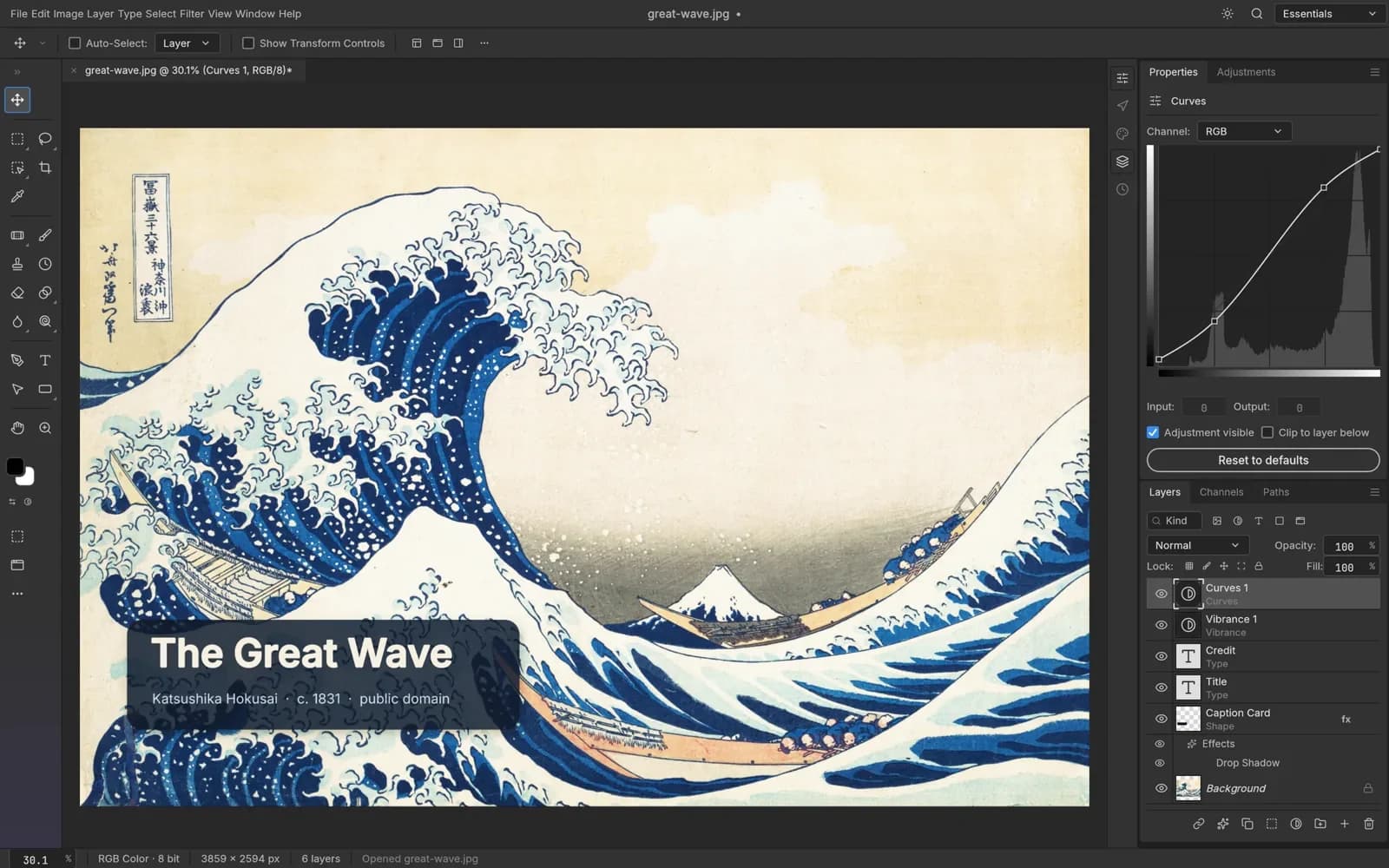
One person, two weeks, seven apps: Brandon Thomas used Claude Opus 5.5 and Rust to recreate Adobe's suite and open-sourced it, with PhotoCraft passing 23K stars in days. Free isn't the point — compatibility is: same panels, same shortcuts, byte-for-byte PSD round-trips, aimed squarely at professionals' muscle memory. Alpha bugs and legal risks remain, but 'software is being repriced' finally has a concrete shape.