Subscriptions Not Selling? A Hands-On Playbook for Lifetime-Deal (LTD) Monetization of Vibe Projects
When subscriptions stall, many indie hackers pivot to lifetime deals — but LTD is a financing strategy, not a pricing strategy. This guide does the LTV math of LTD vs. subscription, gives the pricing ≥ 3× annual fee rule, walks through an AppSumo launch (revenue share, review process, bad-review firefighting) and the self-run flash-sale process, and dissects five real pitfalls that killed products. One-page checklist included.
Scoping first, so this doesn't get confused with two other guides on this site. Vibe Project Pricing & Paywall Design (vibe-project-pricing-paywall-design-guide) is about what price to set — three price anchors, free-trial design, and when the paywall should appear. This guide is about an independent monetization strategy: when to sell a lifetime deal, how to price it, how to launch on AppSumo, and how to account for the support cost of lifetime users. Four Paths to Open-Source Monetization (open-source-monetization-indie-guide) covers Sponsors, Open Core, dual licensing, and paid hosting — but not LTD. Think of this piece as the "fifth path" for closed-source SaaS. If you haven't figured out basic pricing yet, read the pricing guide first; if you've already decided to walk the "pay once, use forever" road, keep reading.
1. What LTD Is: Why Indie Hackers Both Love and Fear It
LTD (Lifetime Deal): the user pays once and gets the product forever (usually including updates for some future period). It's no new invention — the buy-once model was mainstream in the early software era; it was "killed" by the SaaS subscription wave and then picked back up by indie developers as an old weapon. AppSumo turned it into a category: a marketplace dedicated to lifetime-deal software, moving hundreds of millions of dollars of LTD transactions every year.
Indie hackers love LTD for three very practical reasons:
- Upfront cash flow. Subscriptions are a "slow trickle"; LTD is "opening the floodgates." Sell 1,000 copies of a $49 lifetime edition and $49,000 lands in your account at once — for a solo, unfunded team, that money might cover every salary and server bill for the next six months. Subscriptions would take 12 months of grinding to accumulate the same cash.
- A cold-start user base. LTD buyers are the least price-sensitive, most tolerant crowd there is: they've paid for a lifetime, so they're naturally willing to give feedback, tolerate bugs, and spread the word. TidyCal (a scheduling tool) sold lifetime editions on AppSumo, and its founder has publicly shared that AppSumo alone brought in over a million dollars in revenue — more importantly, that batch of lifetime users became its earliest word-of-mouth engine.
- Pricing is marketing. "Lifetime, $199" is itself a viral hook. Compare: nobody retweets "19 dollars a month," but "pay once, use forever" gets screenshotted into a dozen group chats. LTD buying decisions are fast — users are afraid of missing out, so conversion is naturally higher than subscriptions.
The fear is just as real: you're trading infinite future liability for one-time revenue today. Server, support, and feature-update costs happen every year, but the money is collected only once. Get this math wrong and LTD is a slow suicide. Let's get the math right.
2. LTD vs. Subscription Math: LTV First, Romance Later
A minimal comparison model
Say your product costs $19/month, $190/year (20% off annual).
- Subscription path: an average user stays 14 months (roughly the median for indie SaaS), so LTV ≈ 19 × 14 = $266. 1,000 subscribers = $266,000, arriving over 14 months.
- LTD path: lifetime edition priced at $199 (a bit over 1× the annual fee, a common AppSumo price point), 1,000 lifetime users = $199,000, all at once.
On revenue alone, LTD comes in about 25% short. But factor in the time value of money and customer-acquisition cost and the conclusion flips: the $266k from subscriptions arrives in 14 monthly installments, minus the monthly re-acquisition cost of churn; the $199k from LTD is sitting in your account in month one. For an unfunded indie hacker, a certain $200k today beats an uncertain $260k over the next 14 months — because you might not survive to month 14.
The real cost line: discounting lifetime support
Most people calculating LTD only count server costs and miss the biggest line item: your time. Support, bug fixes, and OS upgrades for lifetime users never end. Estimation method:
- Work out the average annual variable cost per user: servers + third-party APIs + payment fees. Say $12/year;
- Assume a user "lifetime" = 5 years (the realistic lifespan of a software product): total variable cost $60;
- Lifetime price $199 − $60 = $139 gross margin, before your time is counted.
Then add support time. With 1,000 lifetime users, assuming 2% open a ticket each month at 15 minutes a ticket, that's 5 hours of support per month. 60 hours a year, 300 hours over 5 years — at a $50/hour rate of yours, that's $15,000 in hidden cost, directly eating 7.5% of total LTD revenue. If your product is "high-support" (say, a complex tool that needs hand-holding), that number doubles.
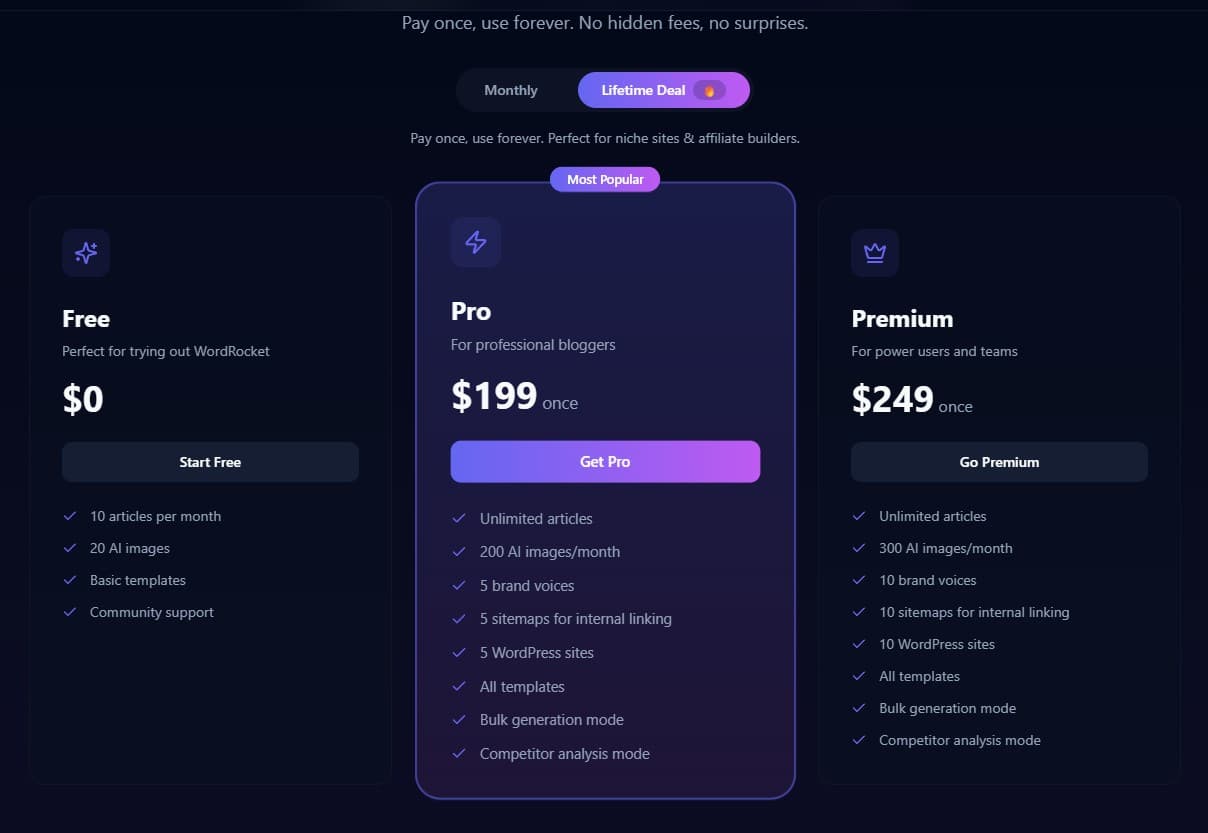
The rule: lifetime price ≥ annual fee × 3, and average annual variable cost ≤ price ÷ 5. Both conditions must hold for LTD math to work. WordRocket (an AI writing tool — see this article's cover for a real pricing page of its kind) is a textbook structure: a free tier for acquisition, Pro lifetime at $199, Premium lifetime at $249 — the lifetime tiers anchor at "multiple annual fees" as the psychological price point, not a number pulled out of thin air.
3. When to Sell LTD: Stage Judgment and Four "No-Go" Product Types
The best LTD window: the MVP validation phase
LTD's best entrance is when the product is usable but not yet market-validated (typically 0–6 months after launch):
- You need a first batch of paying users to validate that "someone will pay";
- You need cash flow to survive — not an MRR curve 12 months from now;
- The product is still incomplete — LTD buyers tolerate "missing features" far better than subscribers (they're buying the future; subscribers buy the present).
Use with caution once mature. When MRR is stable and organic growth is healthy, launching LTD is just "selling five future years of $266 for $199" — pure value destruction. LTD for mature products fits only one scenario: time-limited, quantity-limited, for a specific goal (e.g., charging up the Product Hunt charts, or covering three months of cash when funding falls through) — and clearly "once it's gone, it's gone."
Four product types that shouldn't touch LTD (touch them and you're in a pit)
- Usage-metered AI products. Every call burns your API cost (OpenAI/Claude tokens); the heavier users use it, the more you lose. Lifetime users will always include power users — one heavy "unlimited lifetime" account can burn through the profit of dozens of ordinary users in a year. Unless you dare to cap it (e.g., X calls/month on the lifetime tier), don't touch it.
- Human-service-heavy products. Managed services, custom dev, 1-on-1 consulting — your time can't be replicated; a lifetime edition is selling yourself into slavery.
- Products with rigid compliance/data costs. Products that must keep buying third-party data feeds or pay per-message SMS/email costs scale linearly with users — once the lifetime price is locked, you eat every future price hike yourself.
- Network-effect products. The value of social and collaboration tools materializes through growth; early lifetime users squat on "permanent seats" while paying nothing more, and when you later want to push ARPU up, those "grandfathered" users become the biggest obstacle to any pricing change.
4. Pricing Design: Anchors, Stackable Codes, and Tiering

Price anchor: 3–5× the annual fee
This is the range repeatedly validated in the AppSumo ecosystem: lifetime price = annual fee × 3–5. Below 3×, you're selling the future cheap; above 5×, users will do the finger math ("I need to use it 5 years to break even") and conversion falls off a cliff. With a $190 annual fee, pricing lifetime between $499 and $690 feels smoothest. Note this is the public list anchor — actual AppSumo transaction prices are usually $49–99 "deal prices"; the anchor exists to make the deal price look like a steal.
Stackable codes: LTD's hidden money printer
Stackable (stackable purchase codes) is the standard mechanism of AppSumo-style LTD: buy 1 code for the base tier, stack 3 codes to unlock a higher tier. The brilliance:
- Raises average order value without raising the entry bar. A $49 entry anyone can afford; power users stack themselves up to $147 (3 codes). For AppSumo stars like TidyCal and Publer, 30%+ of revenue comes from stacking.
- Natural tiering. 1 code = personal tier, 3 codes = team tier, 5 codes = unlimited tier — tiering designed by users voting with wallets, not by you.
- Creates the "buy one more" impulse. The "stack one more code to upgrade" prompt in a time-limited deal is the highest-converting upsell slot there is.
Three tiering principles
- Tier by usage, not by features. Lifetime editions must never be feature-crippled — buyers want the complete product; put tier differences in project counts, seats, and API calls. A feature-crippled lifetime edition will get the Q&A section blown up with "does the lifetime tier include feature XX."
- The top tier must look like a steal. Even if only 5% buy the top tier, its existence is there to make the middle tier look like a bargain (anchoring).
- Write down exactly what "lifetime" covers. "Lifetime all updates" or "lifetime current major version + 1 year of updates"? AppSumo requires deal pages to state plan boundaries explicitly; vague deals get rejected by reviewers — and get executed by buyers in the comments.
Scarcity and countdowns done right
LTD urgency must be real scarcity, not a trick. What works: capped code counts ("only 2,000 codes"), time limits (AppSumo deals typically run 60–90 day cycles), price ladders (first 500 codes at $49, then $69). What doesn't: fake countdowns (get caught once and your brand credit goes bankrupt), screaming "last day" for three years. AppSumo deal delistings are genuinely final — that "true scarcity" is one of the root causes of its high conversion, and self-run channels should learn exactly that.
5. AppSumo Launch Playbook: Revenue Share, Reviews, and Bad-Review Firefighting
Do the math first: AppSumo takes about 30%
AppSumo's standard cut is roughly 30% to the platform (varies slightly with negotiation), you keep 70%. On a $49 code you net about $34. Sounds painful, but what you get in return: a million-scale audience of precisely the right buyers, the trust endorsement of a deal page, and complete payment/refund/tax handling. For a cold-start indie hacker, that 30% buys acquisition you couldn't get with money — your own ad CAC for one paying user would most likely exceed $15, and probably be less targeted.
The review process: stricter than you think
- The product must genuinely work. The AppSumo team actually tries it; a "vaporware product" with only a landing page is rejected outright. The MVP can be rough, but the core flow must run.
- Deal page structure is fixed: one-line hook → pain scenarios → feature highlights (with screenshots/GIFs) → pricing tier table → code stacking rules → refund policy → FAQ. AppSumo has a dedicated copy team to help optimize, but the first draft is yours — screenshots and GIFs must show your product's real interface; mockups get exposed by buyers in the comments.
- A 60-day money-back guarantee is mandatory. AppSumo requires all deals to offer 60-day no-questions refunds. That means your first 60 days of revenue is "advance receipts" — don't rush to spend it. A 5–15% refund rate is normal.
- Scheduling tricks: avoid every November's "Black Friday season" (the big brands crowd in and dilute your exposure); January–March and September–October are LTD buyers' active months. An exclusive launch (AppSumo Exclusive) earns better homepage placement, at the cost of not selling cheaper elsewhere during the deal period.
Q&A operations and bad-review firefighting: where deals are won or lost
Every AppSumo deal page has a public Q&A section, and every prospective buyer reads it before ordering. The iron rules:
- Answer every question within 24 hours. AppSumo tracks your response speed; slow responders get deprioritized. Prepare 20 canned answers (data security, update policy, roadmap, refund process) and paste them with a personalized opener.
- The golden 4 hours after a 1-star review appears. Don't delete, don't argue — publicly acknowledge the issue plus a fix timeline, then compensate privately. AppSumo buyers buy "attitude"; a well-handled bad review is typically followed by three new "lightning-fast support" five-stars.
- Dare to write "won't do" on the roadmap. "We will NOT build XX in the next 6 months" wins more trust than painting rainbows. LTD buyers hate nothing more than "promised features a year late" — publicly saying "no" filters out wrong expectations instead.
6. Self-Run LTD Channels: The Full Website Flash-Sale Process
Don't want to give 30% to a platform? Sell it yourself. The complete self-run chain:
Warm-up (2–4 weeks before launch)
- Your email list is the core asset. Accumulate 1,000+ subscribers before launch (landing page + Product Hunt/BetaList traffic) — launch-day email converts 10×+ better than social posts. No list, no self-run LTD.
- Three warm-up emails: T-14 days announcing "lifetime edition coming + price-range survey" (and gathering price sensitivity for free); T-7 days announcing final pricing and tiers; T-1 day "sales open tomorrow at 10am, 500 slots."
- Give existing users/beta testers 24-hour early purchase access — they're your best first wave of word-of-mouth, and they'll fill the "30% sold" progress bar on launch day.
Launch (48–72 hour window)
- Take payments through a Merchant of Record (MoR) like Lemon Squeezy / Paddle — they handle global tax, invoices, and refunds; you just collect money. Fees run about 5–9%, saving you a pile of tax traps versus wiring Stripe yourself.
- Must-have launch page elements: countdown, live remaining-slot count, tier comparison table, FAQ (including "what exactly does lifetime cover"), refund-policy link.
- Price ladder: first 100 at $79, 101–300 at $99, then $129. The genuine urgency a ladder creates converts a notch higher than a flat "everything $99."
Refund policy design (divided with the refund-disputes guide)
The site's other guide, Subscription Refunds & Disputes (subscription-dunning-recovery-guide focuses on subscription recovery), has different refund logic — LTD refund policy works differently: recommend 30-day no-questions refunds (shorter than AppSumo's 60 days, because you lack platform trust endorsement and need to confirm revenue faster). Key detail: put the refund policy on the buy page, the checkout page, and the confirmation email — all three; and "lifetime" entitlements must be revocable after refund (reserve a license-revoke endpoint in your tech; don't wait until someone games refunds with chargebacks to think of it). For the full dispute playbook (chargebacks, PayPal disputes), see the refund-disputes guide — not covered here.
7. Five LTD Pitfalls: Each One Has Killed Real People
Pitfall 1: Runaway lifetime support costs
The most common way to die. After the product takes off, the lifetime-user base becomes a support black hole: they demand new features, chase old bugs, ask about every system upgrade. Three ways out: ① lifetime covers "current major version" updates only; major upgrades are paid (write it on the deal page); ② build a self-serve knowledge base + community to block 80% of repeat questions before they become tickets; ③ bake 5 years of support cost into the price (see the Chapter 2 formula). The deadliest sin is a verbal promise of "lifetime all free updates" — every word on the deal page is a contract.
Pitfall 2: Feature boundaries and grandfathering
You will raise prices and you will ship a Pro tier eventually. Then the first batch of lifetime users will wave their "lifetime everything" promise and demand free upgrades — give in and the company bleeds; refuse and the comments explode. The correct posture: state on the deal page that "lifetime = all features at purchase time + 12 months of new-feature updates," with new features after that at 50% off for existing users. The grandfathering principle: old users never lose (prices locked), but new features can be paid — keep "never lose" and you keep goodwill.
Pitfall 3: Resale and abuse
Lifetime codes get resold: a $49 code flips for $20 on secondhand markets, your own store can't sell at list price, and scalpers pocket the spread. The fix: bind licenses to the first-activated email/domain, require official transfers for resale (charge a $10 transfer fee); bind enterprise lifetime codes to company domains. Technically: license keys + activation-count limits, never "one code feeds the family."
Pitfall 4: How to gracefully retire LTD after raising prices
LTD must be able to retire — and retire gracefully. The standard sequence: announce 30 days ahead that "the lifetime edition retires on X, moving to subscriptions"; give hesitators one final window (it actually triggers a closing-sales bump); after retirement, keep a "lifetime edition — sold out" memorial on the page — it's proof of scarcity and respect for early users. The anti-pattern: quietly delisting it, so old users log in to find their entitlements gone — trust goes to zero.
Pitfall 5: The price anchor that won't come back
A product that once sold a $49 lifetime edition will look like it's "robbing" users when it later pushes a $19/month subscription. LTD permanently drags down users' psychological expectation of your product's value. The fix: sell lifetime only for the base edition; advanced features, team tiers, and API quotas always go subscription. Lifetime users are your base and your word-of-mouth source; subscriptions are the growth engine — the two lines never fight. TidyCal walked exactly this path later: lifetime held the base, team features and new modules went subscription upsell.
8. Decision Table: LTD vs. Subscription vs. Freemium, Pick One
- Pick LTD: 0–6 month validation window, need cash flow to survive, low variable cost (<price/5), low-support product, founder time goes to building not servicing.
- Pick subscription: product validated, MRR growing, ongoing API/data costs, needs continuous R&D investment, goal is predictable revenue.
- Pick freemium: network effects/virality are the core growth engine, marginal cost near zero, long conversion funnel (e.g., devtools, content tools).
- Hybrid (recommended): LTD sells base-edition lifetime (acquisition + cash flow) + subscriptions sell advanced/team tiers (growth engine) + free tier for acquisition. This is the most-validated combo in indie SaaS today; WordRocket's "free + lifetime Pro + lifetime Premium" three tiers (see cover image) are a live instance of the idea.
Appendix: One-Page Execution Checklist
- ☐ Run the LTD math: price ≥ annual fee × 3; average annual variable cost ≤ price ÷ 5
- ☐ Confirm the product is outside the four no-go zones (usage-metered AI / human-heavy / rigid data costs / network effects)
- ☐ Stage check: validation phase can sell boldly; maturity only time/quantity-limited
- ☐ Anchor price at 3–5× the annual fee; tier by usage; write stackable rules clearly
- ☐ State the "lifetime update boundary" on the deal page — treat every word as a contract
- ☐ AppSumo: 20 canned Q&A answers ready, 24h response commitment; reserve funds for 60-day refunds
- ☐ Self-run: 1,000+ email list, MoR payment (Lemon Squeezy/Paddle), revocable licenses
- ☐ Support plan: knowledge base first, estimate lifetime-user tickets at 2%/month for staffing
- ☐ Anti-scalping: bind licenses to email/domain; resale only via official transfer
- ☐ Retirement plan: announce 30 days ahead, keep a "sold out" memorial page
- ☐ Remember: LTD sells "base-edition lifetime"; growth always belongs to subscriptions
One last honest sentence: LTD is not a pricing strategy; it's a financing strategy. You're pre-selling five years of trust to survive today. Get the math right, write the boundaries clearly, keep an exit — and it's the sharpest cold-start weapon an indie hacker has. Get it wrong and it's a contract of indenture you signed yourself. The dividing line between the two endings is exactly the formulas and checklists in this guide.
Comments (0)
Related articles

The most common brand disaster for indie hackers: your product isn't launched yet and the name is already squatted. This guide gives the complete two-week pre-launch lockdown checklist — four-step name clearance, defensive domain registration, hands-on US/China trademark filing, 12 must-claim account slots, and how UDRP enforcement connects when squatting happens. Two weeks of prevention beats six months of lawsuits.

AI tools default to cloud-first: no signal, white screen. This playbook shows indie developers how to convert a vibe-coded project to local-first — a 4-question decision flow, sync-engine matrix, six rollout steps, five anti-patterns, and an offline test checklist.

AI picks your stack for speed, not for year three. This guide gives solo developers a third path between toughing it out and rewriting from scratch: a six-step migration playbook where the old system stays live and every step rolls back.