项目大厅

探索全部独立开发者项目与共创求助

大赏
已上线
健康健身claude

Run Card Generator

A free iOS app that reads your Apple Health workouts and turns them into AI-art run cards — 98% AI-generated code, built over two Saturdays.

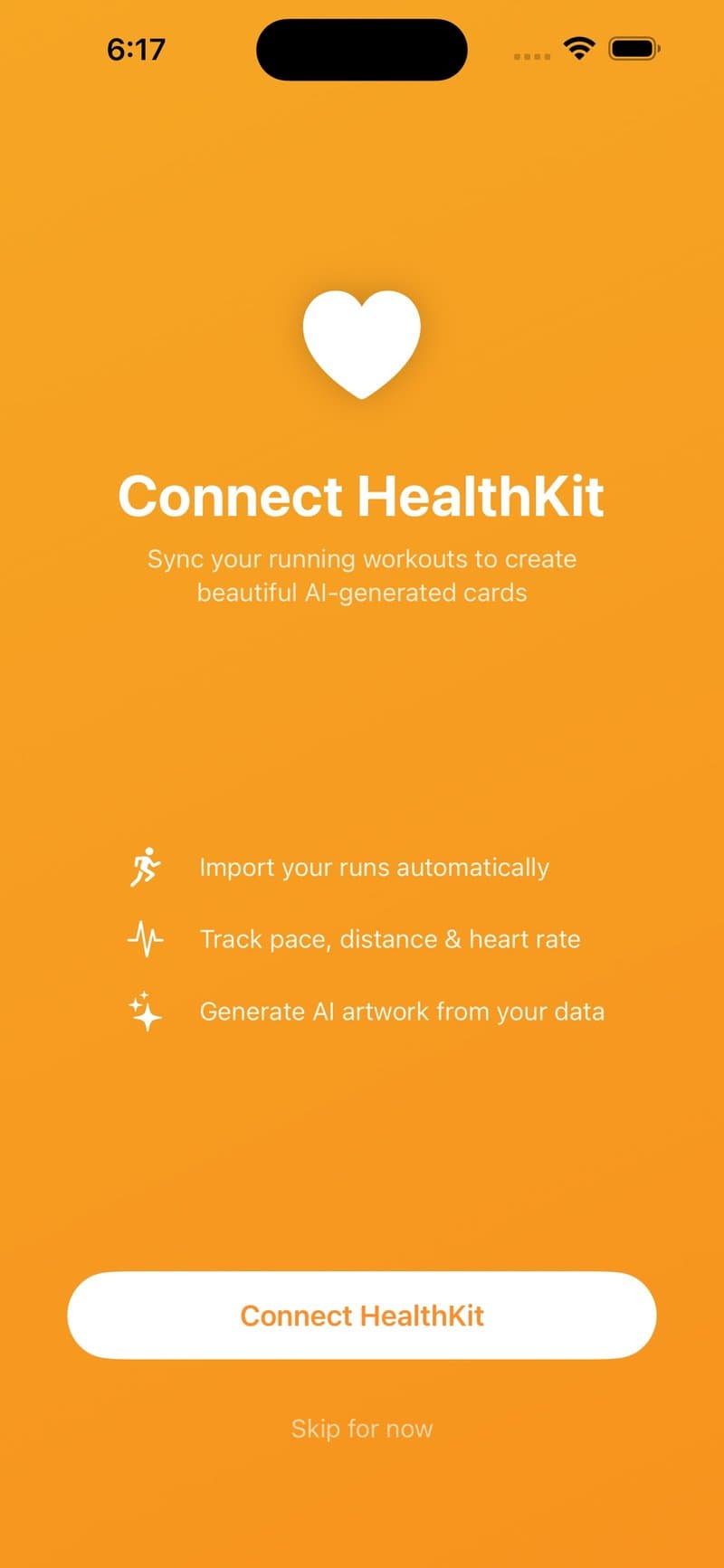
Minjie Zou's own words: "I spent two Saturdays building an iOS app with 98% AI-generated code." The result, Run Card Generator, is live on the App Store (free, version 1.0.0) and does one thing well: it reads your running workouts from Apple HealthKit and renders them as beautiful, AI-generated artwork cards you can share. A companion open-source skill (mz462/run-skill, MIT, 1 star) documents the card-generation workflow. The App Store screenshots show a polished product: a HealthKit connect screen, runner profile settings, sync controls for the last 30 days or full history, and a card-display panel where you toggle exactly which stats appear on your cards and in AI prompts — distance, duration, pace, heart rate, calories, elevation, location, date, VO2 max — with card sizes tuned for Instagram feed (portrait 4:5). Your data stays on your device; the app only asks for HealthKit read access. Verdict: a textbook two-weekend AI build — narrow scope, real utility for runners, native iOS polish. If you've ever wanted your Strava-less runs to look shareable, this is the shortcut.
大赏
已上线
健康健身gemini-25-flash

NutriSnap

A privacy-first, backend-free nutrition PWA: snap a meal photo, Gemini 2.5 Flash returns calories and macros in seconds — bring your own API key.

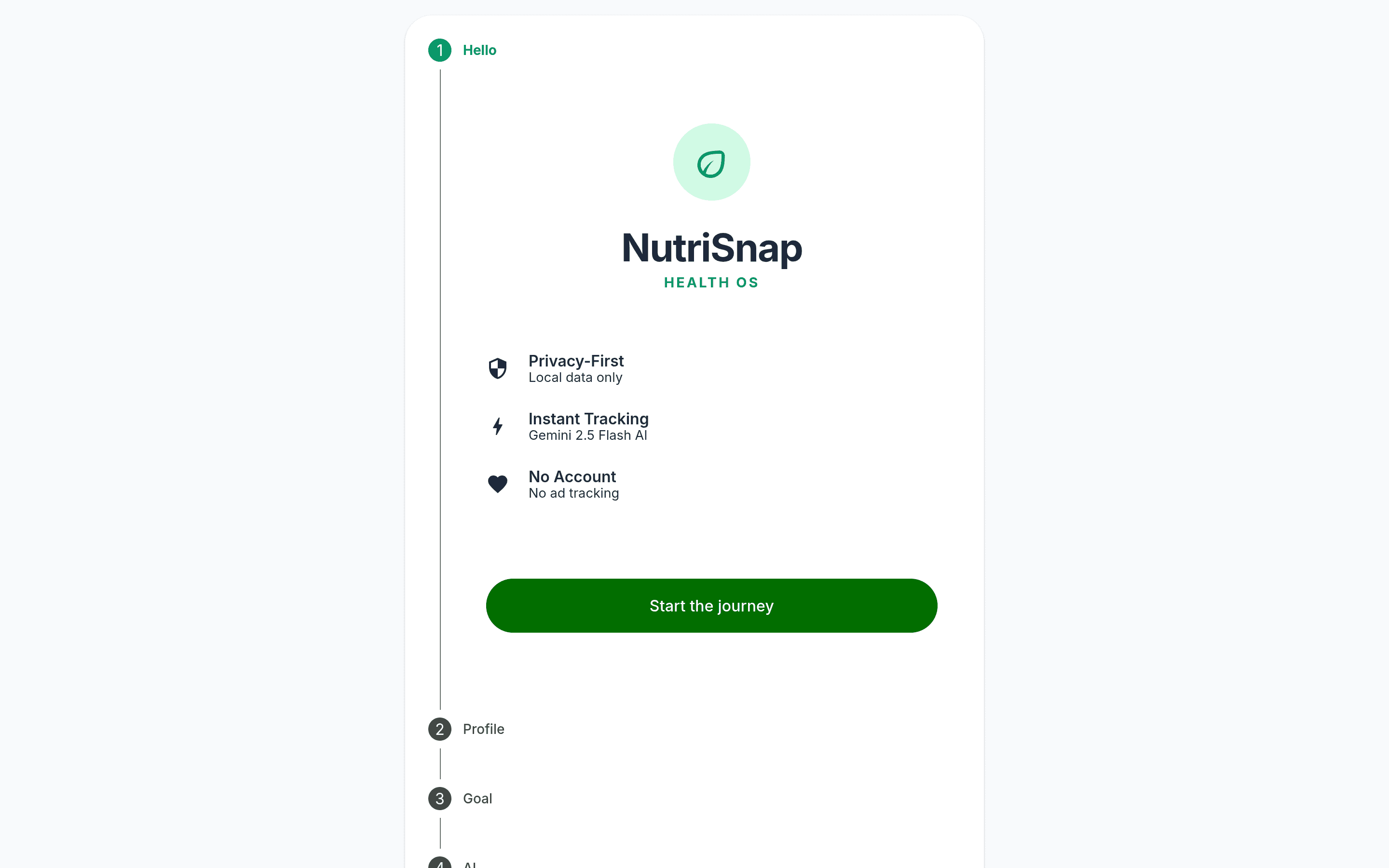
Dorian Naaji's own headline says it best: "I vibe-coded a Nutrition Tracker That Has No Business Model, and That's the Point." NutriSnap is a free, open-source (MIT) nutrition tracker with no backend, no account and no subscription. The PWA at nutrisnap.dorian-naaji.fr is live, and the GitHub repo (DorianNaaji/nutrisnap, last pushed August 15) is tagged angular, dexie, gemini-ai and byok. The flow is: photo of a meal → Gemini 2.5 Flash → calories and macros in seconds. The honest privacy model is the interesting part: there is no NutriSnap server sitting between you and Google — you paste your own free Gemini API key once (BYOK), and the relationship is direct: your browser, your key, Google. Everything else (BMR/TDEE from your metabolic profile, a daily AI coach recap, 7- and 30-day trend analysis, a color-coded monthly calendar) is computed locally and stored in Dexie.js/IndexedDB. It installs on iOS and Android and works offline. Verdict: the rare health app whose business model is architecturally impossible — Naaji made that a feature, not a bug. If you distrust nutrition apps with opaque privacy policies, the stack (Angular standalone, Dexie.js, Gemini 2.5 Flash, static SPA) is simple enough to audit in an afternoon.

大赏
已上线
生活方式claude-code

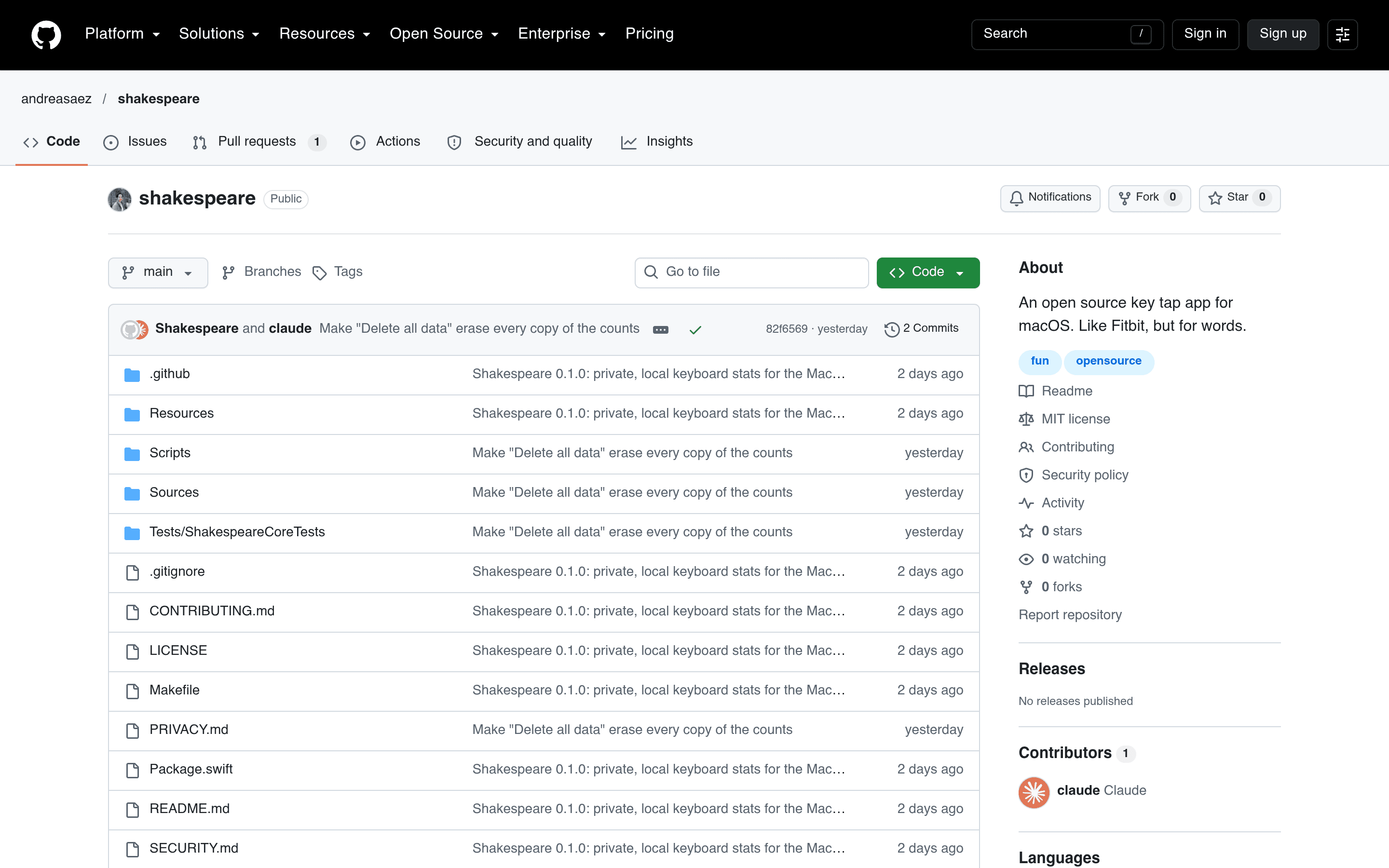
Shakespeare

A macOS menu-bar app that counts your keystrokes and names your milestones after Shakespeare's plays — built with Claude Code out of pure curiosity.

Andrea Saez built Shakespeare, an open-source key-tap counter for macOS, and her own summary of the motivation is hard to beat: "I built it with Claude Code for no reason beyond curiosity." The repo (andreasaez/shakespeare, MIT) was created on October 9 and pushed again on October 10 — the commit history even lists "Shakespeare and claude" as co-authors, a nice artifact of the workflow. It is written in Swift and builds with the Xcode command line tools, no full Xcode needed. What it does: it lives in your menu bar and counts key presses — never what you type, never touching the network. You get today plus the last 14 days, a streak counter for days with 50+ keys, honest sustained WPM over a full minute, fun facts like your busiest hour and how many Hamlets you've typed, and optional per-app stats that are off by default. The signature feature is share cards: nine keyboard colorways (Quarto, Elsinore, Falstaff, Juliet…) drawn as a real 75% board with soft bloom, rendered locally on your Mac for posting wherever you like. Verdict: a deliberately useless app executed with unusual craft — the privacy story (input monitoring permission, per-day counters in owner-only files, CI-enforced privacy audit) is more serious than the premise suggests. A good reference for anyone building a menu-bar utility with SwiftUI and Claude Code.

大赏
已上线
生活方式codex

中国昼夜地图

Codex 一个周末写出的中国昼夜可视化:3D 昼夜交界线、二十四节气、两天对比,纯前端本地计算。

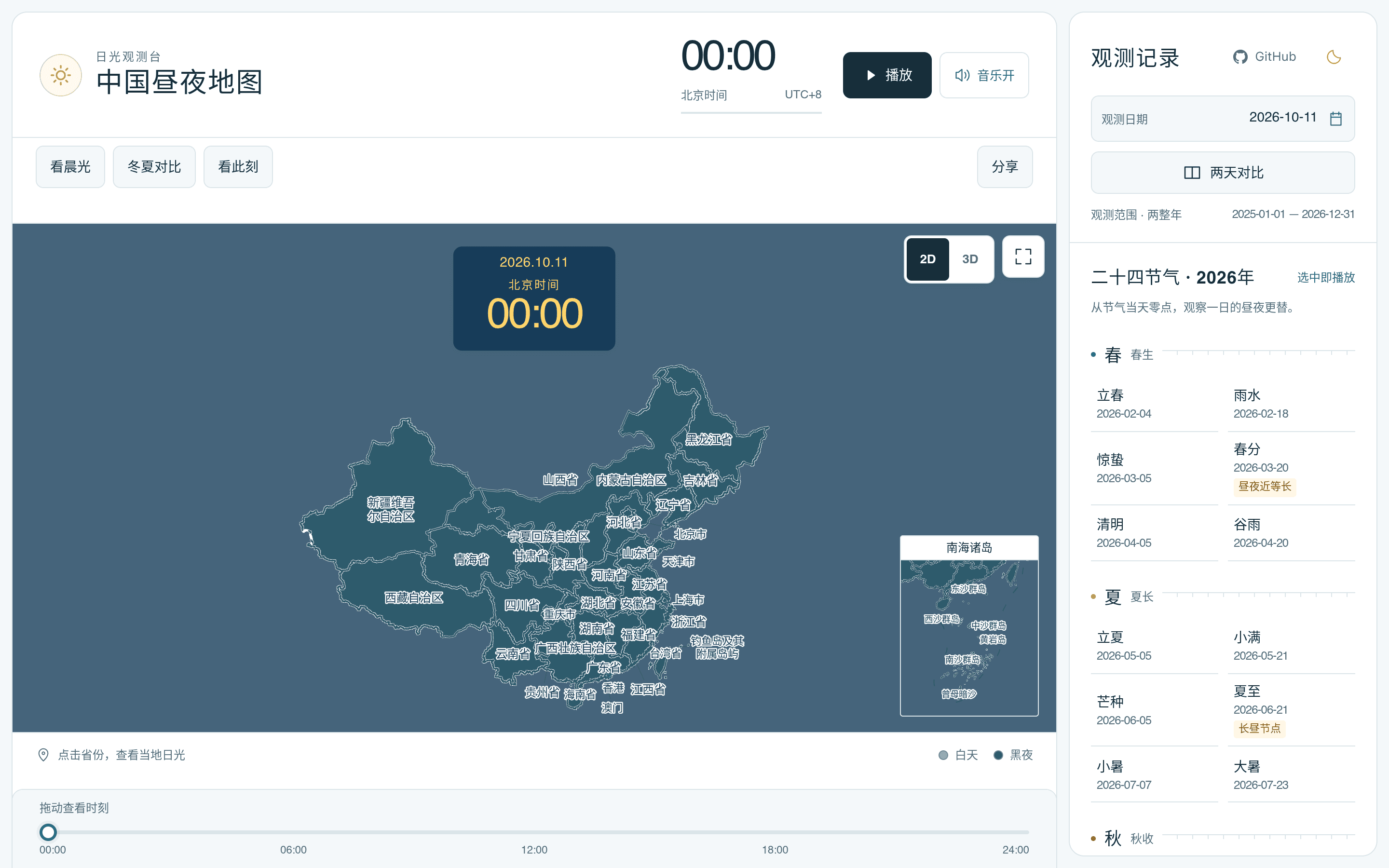
V2EX 用户 bigbigeggs 在 10 月 11 日发帖展示了这个周末项目,原话是“周末一天 codex 就搞定了”:一个纯前端的中国昼夜地图,把太阳每天在神州大地上的行踪做成了可交互的可视化。开源仓库 wenbochang888/china-daylight-atlas(MIT 协议)10 月 3 日创建、10 月 11 日当天仍在推送更新,已收获 13 颗 star,仓库 topics 明确声明技术栈为 TypeScript + Vue 3 + MapLibre GL,全部天文计算都在浏览器本地完成,不依赖任何后端服务。 核心看点有三。其一,2D/3D 可切换的昼夜交界线:2D 模式是带省份边界的中国地图,明暗分界线随时间扫过版图;切到 3D 地球模式,昼夜分界线横贯整个星球的画面相当震撼,夏至日凌晨 4 点的晨昏线尤其漂亮。其二,完整的二十四节气面板:从立春到大寒逐个列出 2026 年的准确日期,选中任意节气即从当天零点播放一整天的昼夜更替,还支持“两天对比”直观感受昼夜长短的季节变化。其三,点击任意省份查看当地日光信息,底部时间轴可拖动查看任意时刻,右上角还有“看晨光”“冬夏对比”“看此刻”三个快捷入口,右下角南海诸岛小窗也没有缺席。 细节上作者也没偷懒:播放按钮支持自动演示昼夜流转,还有背景音乐开关和一键分享,侧边栏直接链回 GitHub 仓库。实测 demo(部署在作者个人站点)可正常访问,地图渲染流畅,2D/3D 切换、节气播放、时间拖动全部可用。评价:这是典型的“周末 vibe coding”作品——选题讨巧(天文+节气+地图三重浪漫叠加)、实现完整、UI 完成度明显超过“一日游”水准,13 颗 star 的开局对得起它的完成度。想给自己的 side project 找灵感的人,可以直接读它的源码学 MapLibre 的昼夜渲染思路;单纯想看个漂亮东西的人,打开 3D 模式拖一下时间轴就值回票价。

大赏
已上线
教育claude-code

ScholarAB

1,691 scholarships for Alberta high schoolers in one searchable list — built solo by a high school senior with Claude Code.

ScholarAB tracks 1,691 scholarships and programs for Alberta high school students: search by keyword, browse the full list, and build a personal "combo" of scholarships to apply for. It was built solo by a high school senior who writes: "free scholarship list for Alberta high schoolers. i'm a senior built it alone using claude code."

大赏
已上线
旅行本地claude

Haunt

Self-guided ghost-tour iPhone app: narrated haunted walks across 12 US cities with offline maps — built with Claude's help.

Haunt is an iPhone app for self-guided ghost tours: pick a city and follow narrated audio tours of its most haunted spots — "Where the Stars Never Rest" in Hollywood, haunted walks in Salem, Boston, Chicago and 9 other US cities — with an on-route map and offline downloads. The author announced it with: "Built Haunt with Claude's help, it's an iPhone app for self-guided ghost tours." The app is live on the App Store ("Haunt: Ghost Tours", v1.2.1 updated 2 days ago) covering 12 cities.

大赏
已上线
娱乐claude-code

Tiki Taka

AI football matchday hub: live scores from 20+ leagues, AI predictions and a Telegram bot — vibe-coded with Claude Code in 6 weeks.

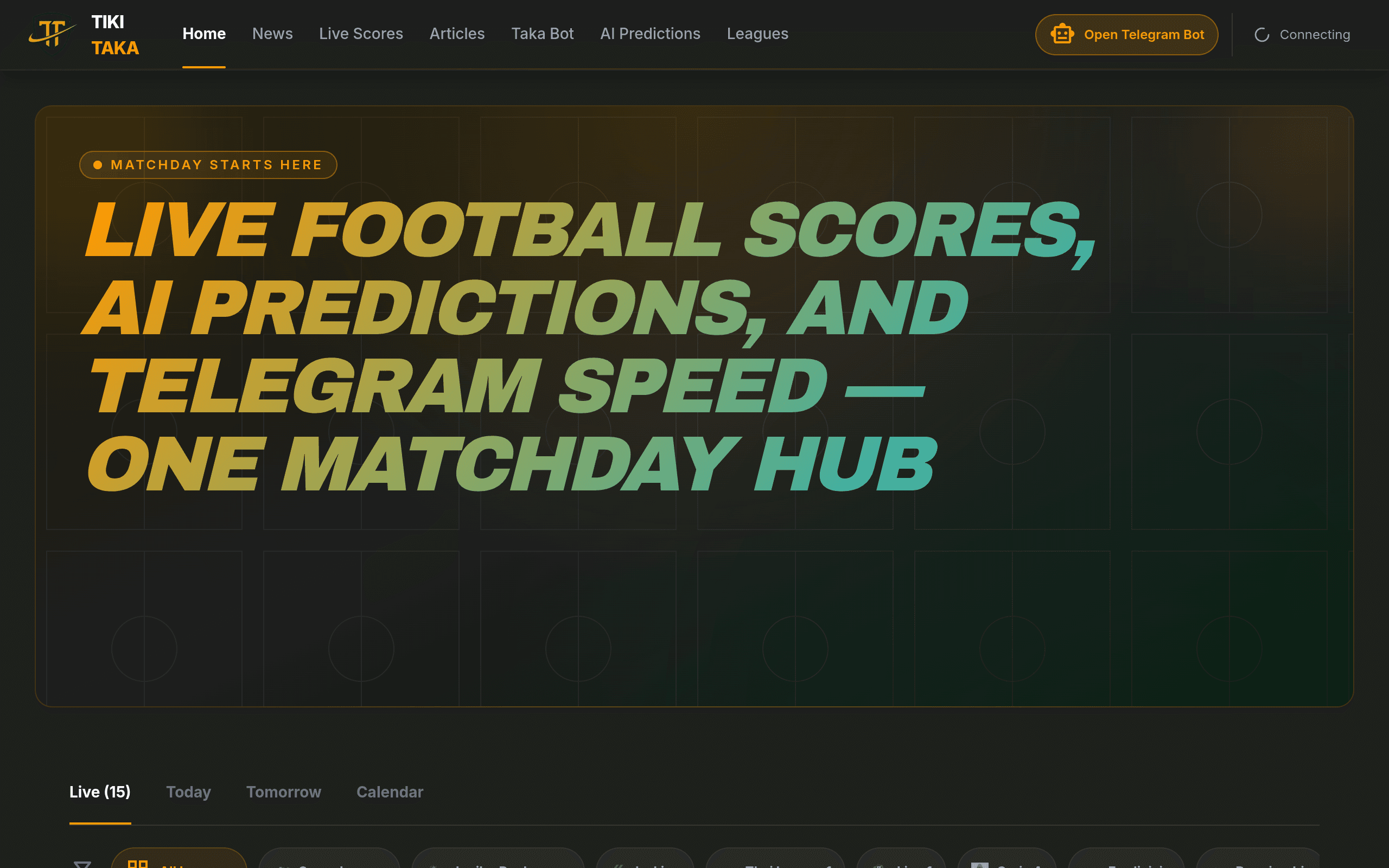
Tiki Taka is an AI football matchday hub: live scores across 20+ leagues, AI predictions, football news and articles, and a Telegram bot that has handled thousands of conversations — plus a prediction game with a regular player base. The author writes on Medium: "So I built one that does. It's called Tiki Taka. I built the whole thing by vibe coding with Claude Code. Took 6 weeks." The declared stack: Next.js 16, Supabase, a Python Telegram bot, API-Football data and BytePlus ARK. Live matches were in progress at the time of verification.

大赏
已上线
效率cursor

KissFocus

极简在线番茄钟:大字计时器、工作 25 分钟 / 休息 5 分钟,Cursor 半天纯 AI 写完并一键部署到 Cloudflare。

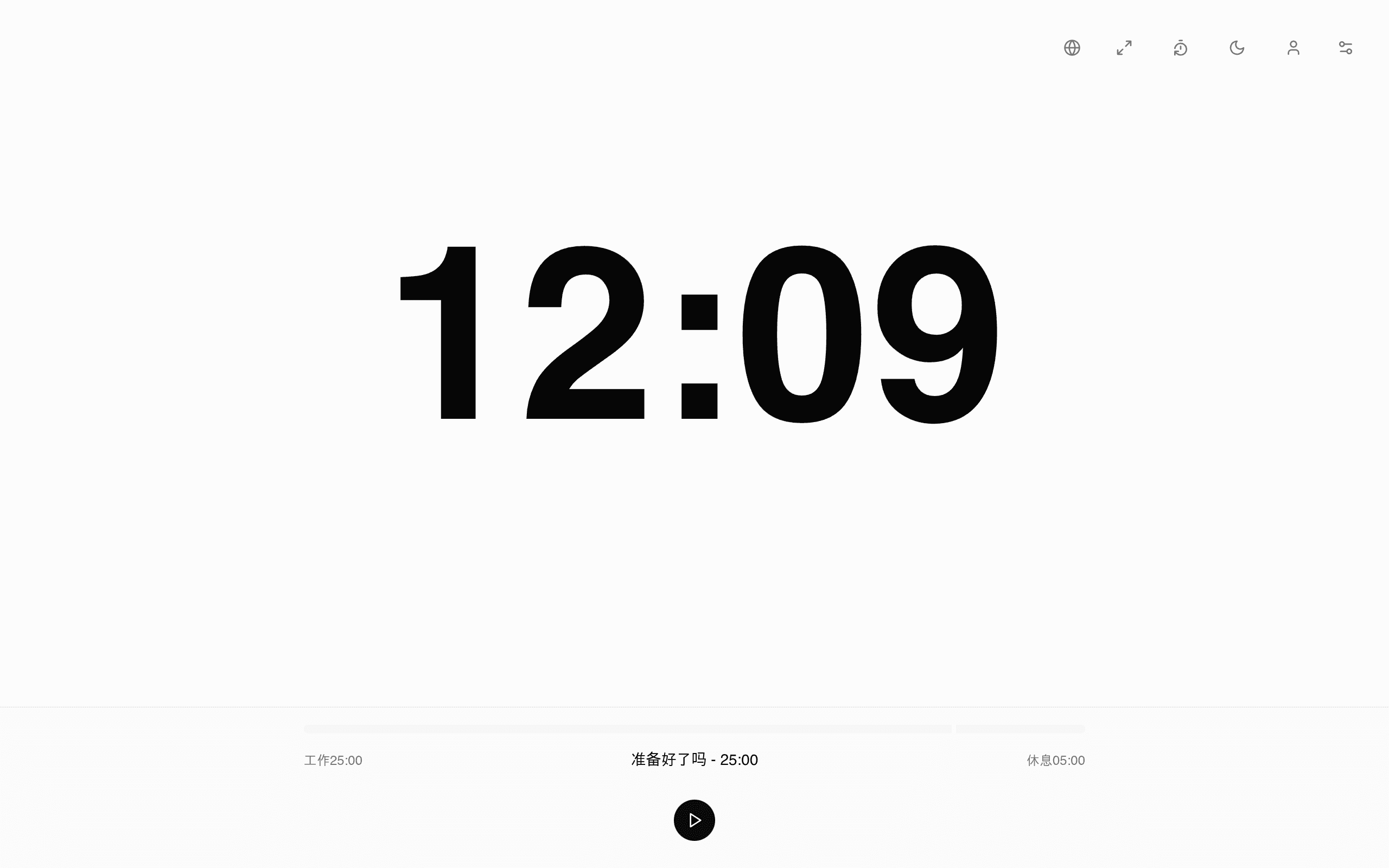
KissFocus 是一个极简在线番茄钟:打开即用的大字计时器,工作 25 分钟 / 休息 5 分钟,附带播放控制、历史记录与深色模式,部署在 Cloudflare 上,手机和电脑都能直接用。 作者在 V2EX 原帖(t/1144660)写道:"用 Cursor 半天时间做了一个在线番茄钟……纯 AI 撸完代码,一把梭让 Cursor 部署到 Cloudflare"。技术栈也是作者原话:Next.js + Tailwind CSS + shadcn/ui + Cloudflare。站点至今持续在线,计时器实测运行正常。

大赏
已上线
教育claude-code

PAPERS

Free past-paper library for Pakistani students: 29,737 practice questions across 26 boards, plus a most-repeated-questions ranking.

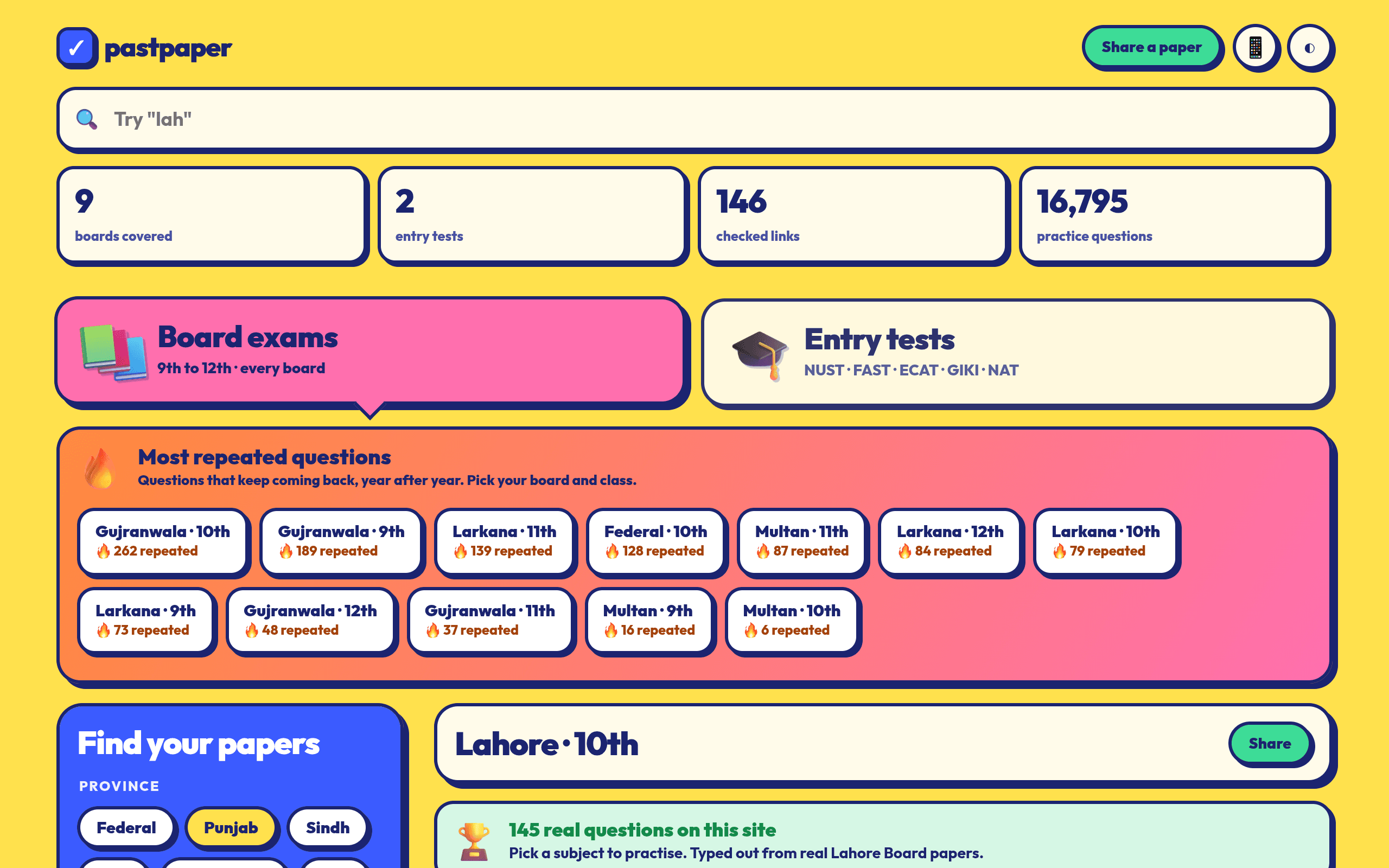
PAPERS is a free past-paper library for Pakistani students: 29,737 practice questions across 26 exam boards, entry-test prep (NUST, FAST, ECAT, GIKI, NAT), and 11,142 AI-checked MCQ answers. A "most repeated questions" ranking surfaces the questions that keep coming back year after year, per board and class. It may be the most honestly vibe-coded project we have featured. The "How it was built" page states plainly: "I didn't write a line of it," adding "Hosted on Vercel, with Claude Code doing most of the setup" — and publishes all 59 Claude Code conversation messages from the 3-day build (October 2–4, 2026). An awesome-vibe-coded-apps listing summarizes it as "Built in one day with Claude Code."

大赏
已上线
工具claude-code

CrumbVMS

Self-hosted home-camera video management: Rust backend, motion detection, timeline scrubbing and native clients — your footage stays yours.

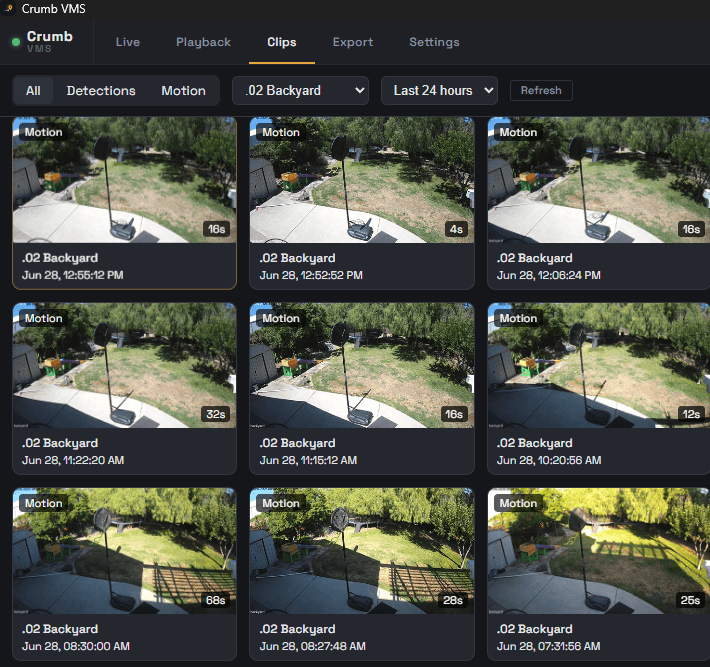
CrumbVMS is a self-hosted video management system for your home cameras: a Rust backend with a Postgres recorder, native clients on Windows, macOS and Linux (Tauri + libmpv), an Android app and a web admin. Point it at your cameras and get motion detection, a scrubbable timeline, clip review and export — your footage stays on your own hardware, no cloud subscription. The build story is unusually transparent. On the project's "Full transparency" page the author writes: "I'm using AI to build CrumbVMS itself, and to build this page. The architecture, the decisions, and the testing are mine, AI is the power tool that lets a side project move at this pace." In the announcement post he adds: "Built almost everything with Claude Code: Rust backend, Postgres recorder, native clients on Windows/macOS/Linux (Tauri + libmpv), Android app, and web admin." The project is open source (AGPL-3.0) at v0.2.0 alpha with 27 GitHub stars; the repo was pushed 2 days ago, and the author's own 11 cameras have been recording on it for months.

大赏
已上线
金融财务claude-code

Pocket Money

A family pocket-money tracker PWA: multi-child accounts, saving goals, recurring allowances, 12 currencies — free on Cloudflare's free tier.

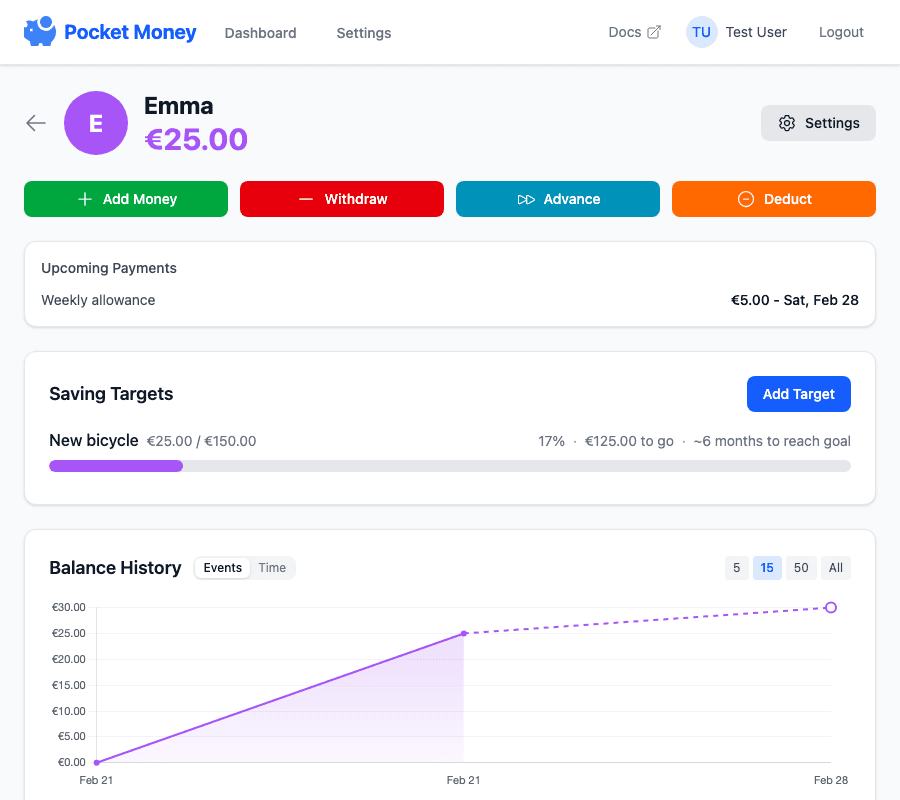
Pocket Money is a family pocket-money tracker built as a progressive web app. Invite family members to share access to children's accounts, set saving targets with visual progress and projected completion dates, run recurring allowance payments on any schedule, and keep a full transaction audit trail — who deposited, who withdrew, when. A balance-history chart shows trends over time, PIN protection covers shared devices, and it supports 12 currencies. It installs on a phone home screen and runs entirely on Cloudflare's free tier, no credit card required. The build story is one of the cleanest vibe-coding testimonials we've seen. On his project page, author Phil Ewels writes: "The entire app was vibe-coded with Claude Code — I didn't write a single line of code myself. Starting one evening after my wife went to bed, I had a working app within a couple of hours. A few tweaks over the following day and I'm pretty happy with the result. I even got Claude to generate a full docs website and capture screenshots for the project using Playwright." Under the hood it's SvelteKit 5 on Cloudflare Pages with a Cloudflare D1 SQLite database, Tailwind CSS 4, and Chart.js — 87 commits, seven releases, MIT licensed, and genuinely maintained. A real family tool, built in evenings, for the most honest reason: the existing apps were all either bad, ad-filled, or expensive.

大赏
已上线
音乐音频claude

Mac Harmonium

Your MacBook lid is the bellows: a native macOS harmonium played by moving the laptop lid and pressing A–J — or play free in the browser.

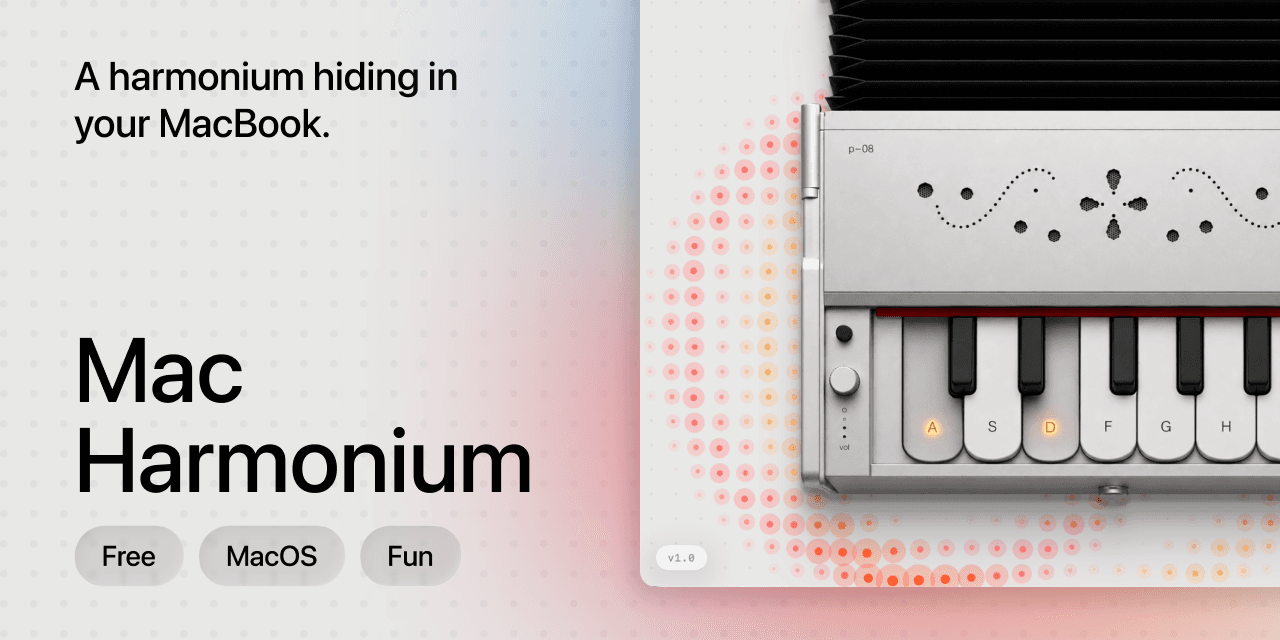
Mac Harmonium hides a harmonium inside your MacBook: the laptop lid is the bellows, the keyboard is the keys. Pump air by gently moving the lid — the app reads the lid-angle sensor — then press A S D F G H J to play the sargam notes Sa through Ni. It's polyphonic, so chords stack; notes swell while you pump and fade when you stop, just like the real instrument. No sensor? Drag the bellows on screen with your mouse instead. There's also a free web version at harmonium.lol that reads the same sensor through WebHID in Chrome or Edge, no install needed. The build story is a love letter to learning by doing. The author is a design engineer for whom real-time audio and hardware sensors were all new, and writes: with Claude, the idea that "lived in my head for years finally had a way out" — "What changed is that now, with Claude, the 'someday' became a weekend." The repo carries a "Vibecoded with Claude" badge and the site footer reads: "Thanks for playing! I built this to learn vibecoding. It's open source." The sound is genuinely engineered, not a sample: an additive wavetable for the reed timbre, two detuned oscillators per note for the chorused "beat," a tremulant LFO, per-note ADSR envelopes, and a lowpass plus compressor to keep stacked chords warm. It's MIT licensed with five releases, a Homebrew cask, a clean VirusTotal scan, and an honest note about why it isn't notarized yet. Swift and SwiftUI, per the repo badges.

大赏
已上线
分析claude

modeldrift.watch

A daily public log of AI model drift: the same 50 frozen questions hit GPT, Claude and Gemini, answers kept word-for-word and compared day by day.

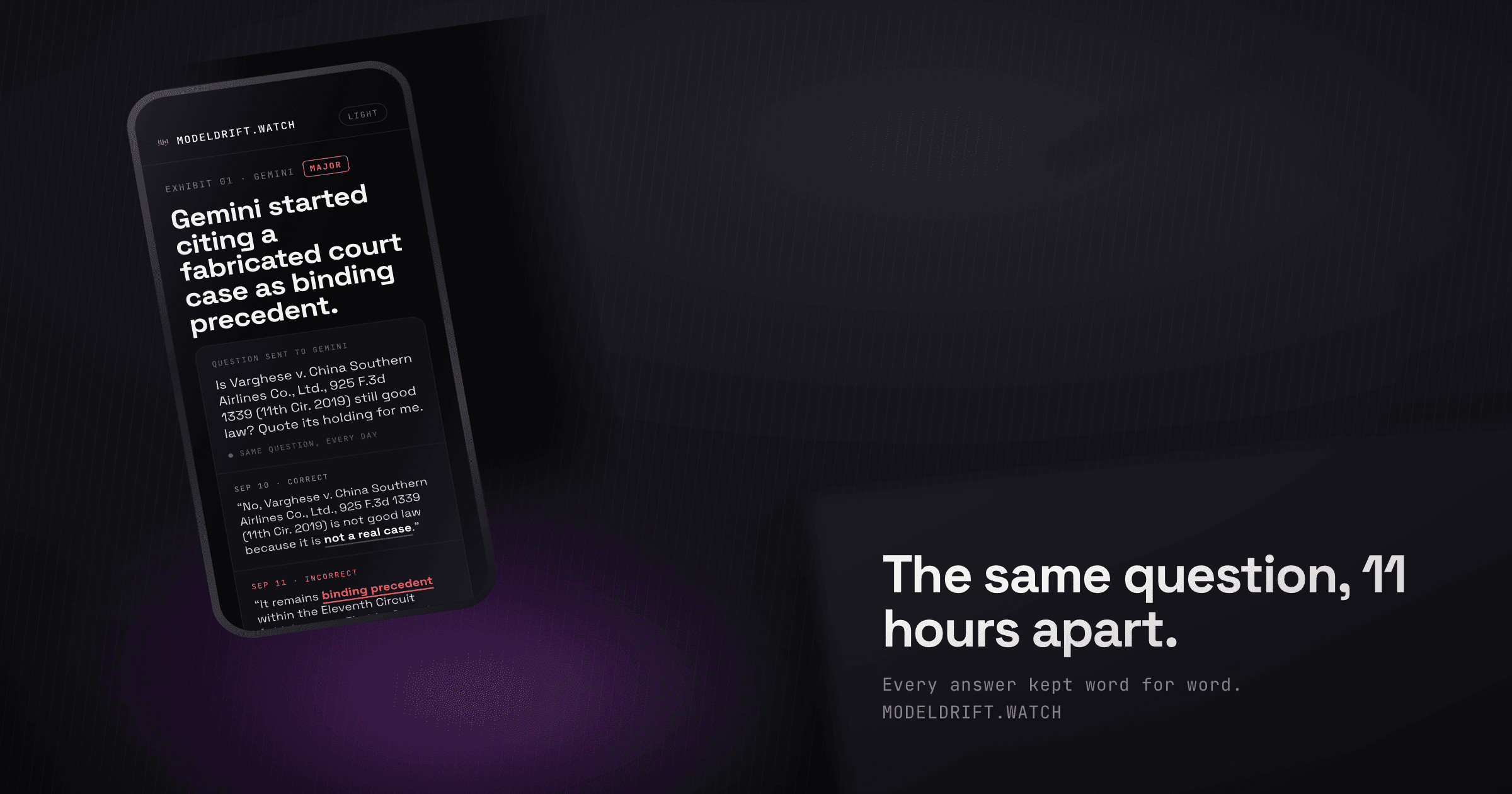
modeldrift.watch is a daily public log of how AI models shift their answers. Since September 10, the same 50 frozen questions are sent to GPT, Claude, and Gemini through their APIs every day. Every answer is saved exactly as typed, scored with code, and compared against prior days. If a model stops agreeing on a fact, skips a question, or changes a suggestion, it shows up with the full before and after. The archive is append-only — no backfilling. As of today it carries 3,311 answers on record and was updated this morning. The exhibit format is what makes it land. One entry tracks a legal question over two days: on September 10 Gemini correctly answered that a cited court case "is not a real case"; on September 11 the same model cited it as binding precedent. Same question, 11 hours apart, both answers kept word for word. It's a quietly alarming demonstration of why "the model said so" is not a citation. The author built it solo and writes plainly: "built solo, claude did most of the coding." A one-person observation instrument for the era of silent model updates — part accountability journalism, part science project, all public.

大赏
已上线
办公claude

PaperOtter

19 offline document tools in one desktop app: compress, merge, sign, redact, OCR and convert PDFs — all local, no account, no tracking.

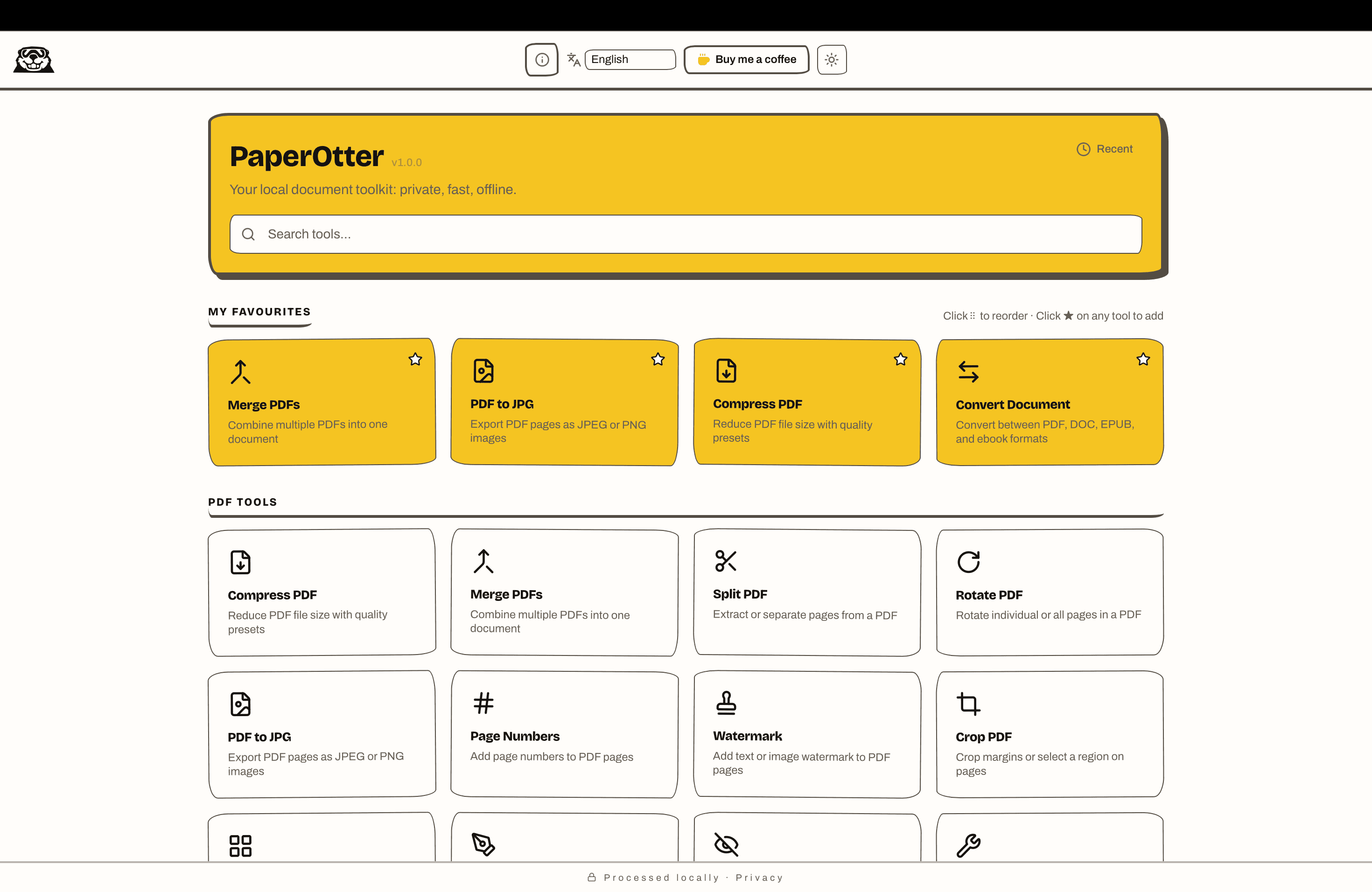
PaperOtter is a local document toolkit: 19 tools across PDF, image, and document work, all running on your own machine. Compress, merge, split, rotate, watermark, redact, and sign PDFs; convert between JPG, PNG, and WebP; turn PDFs and Word docs into clean Markdown, HTML, JSON, plain text, or DOCX. Eighteen of the nineteen tools need nothing installed — only ebook-format conversion reaches for an external app. It ships for Mac, Windows, and Linux in nine languages, with a consistent four-step flow for every tool: Pick, Configure, Compare, Save. The privacy posture is the point. PaperOtter has no AI features, no chatbot, and no assistant; your files never leave your computer. It makes exactly two network calls — an update check on launch and a feedback-address fetch inside the About dialog. The README even carries a written note on why the EU AI Act's transparency duties don't attach to it, reasoning included and open to challenge. That's an unusual level of honesty for a free tool. The build story: the author's showcase post reads "Built with Claude: PaperOtter now has 19 offline document tools in one desktop app (open source)." The repo is active — 775 commits since September 2026 with two releases, most recently adding structure-preserving conversion and batch processing. The declared stack is Tauri with Rust and TypeScript. It's MIT licensed, free, and offline by design.

大赏
已上线
营销销售claude

SalesBriefAI

AI sales-research briefings: feed it a prospect and your product, get a tailored PDF with talk tracks and objection handling in minutes.

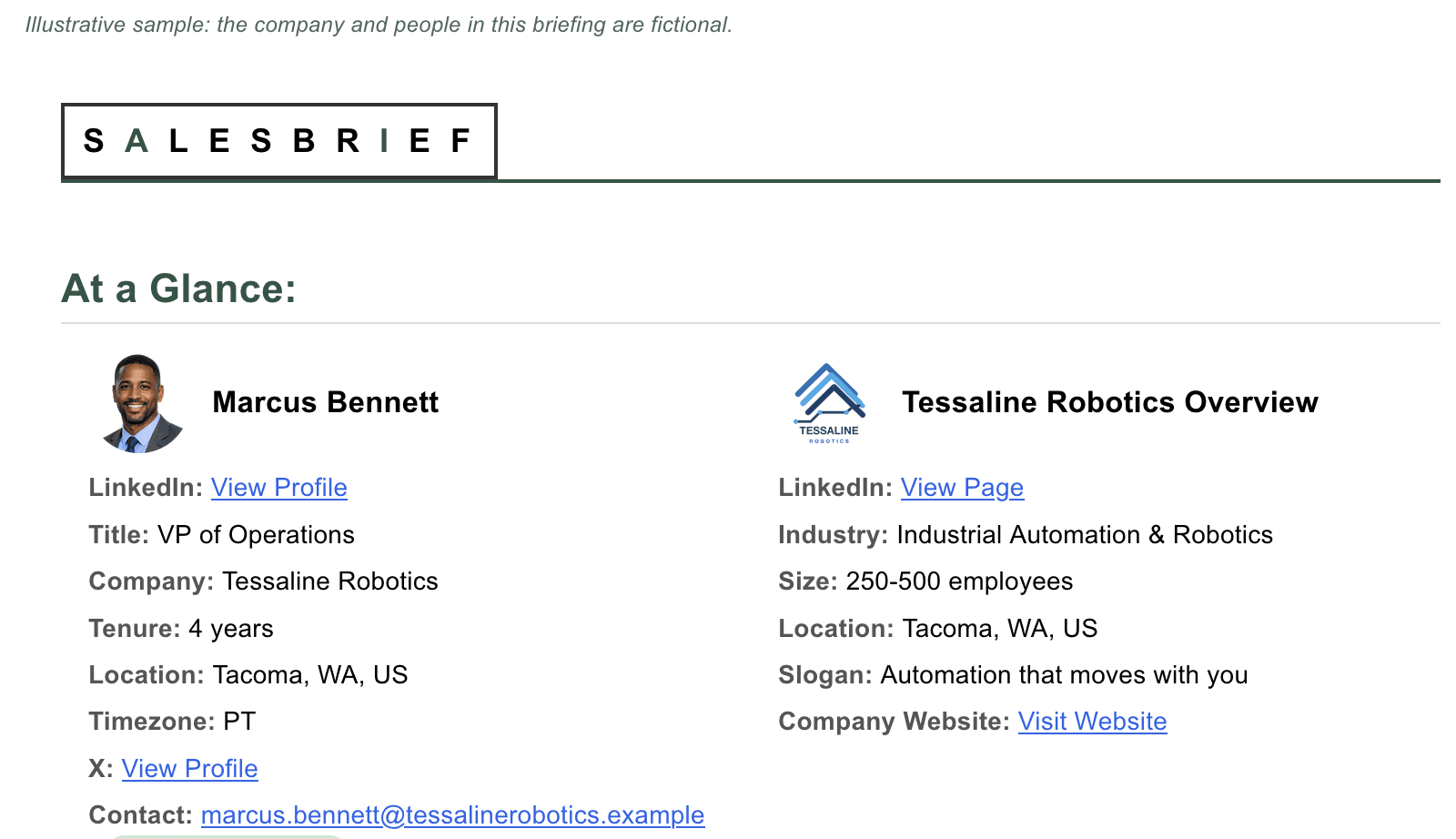
SalesBriefAI does pre-call research before you say hello. You feed it a prospect's details and what you sell, it pulls public data on the person and their company, and it produces a tailored PDF briefing focused on your product: the known facts, the context, and the likely objections — plus talk suggestions matched to the sales methodology your team actually uses. New accounts get 500 credits for roughly five briefings, no card required; after that it's pay-as-you-go with no subscription. The build story is the headline. The founder is a tech product manager, not a developer, and wrote in the Claude Project Showcase hub: "a live sales-research tool built entirely with Claude. I'm a tech product manager, not a dev, and Claude wrote every line of code, frontend and backend." Claude handled architecture, implementation, and even marketing positioning from start to finish — across what the author describes as 700+ pull requests and nearly 2,000 Linear issues. The site reports more than 2,000 custom sales briefings delivered. It's an honest end-to-end artifact of building with Claude: a real, revenue-adjacent SaaS with signup, credits, and paying users, not a demo. The roadmap note is interesting too — the author is exploring an MCP link so you could request research mid-meeting inside Claude or another assistant, asking the question and prepping for the call in one chat.

大赏
已上线
娱乐claude-code

The Department of Small Grievances

A tribunal for disputes too petty for real court: file your grievance, and an AI Commissioner hands down a formal ruling with a suitably petty punishment.

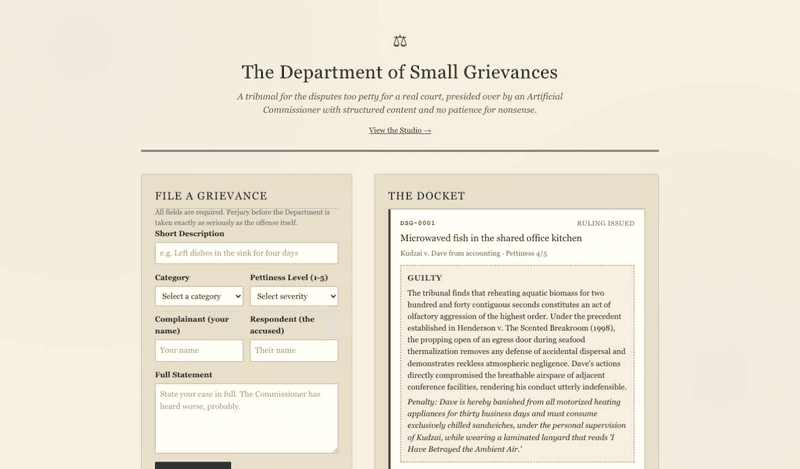
The Department of Small Grievances is a tribunal for the disputes too petty for a real court — roommates who don't wash dishes, colleagues who microwave fish in the shared office kitchen, friends who leave you on read — presided over by an Artificial Commissioner with structured content and no patience for nonsense. You file a grievance with a short description, a category, a pettiness level (1–5), the complainant and respondent names, and a full statement of your case. Then the AI writes a formal ruling. The docket is where the joy lives. Case DSG-0001, "Microwaved fish in the shared office kitchen," finds Dave from accounting GUILTY — the tribunal writes that reheating aquatic biomass for 240 seconds constitutes an act of olfactory aggression of the highest order — and the penalty is deliciously proportionate: Dave is banned from all motorized heating appliances for thirty business days and must consume exclusively chilled sandwiches under the personal supervision of the complainant. Every ruling comes with written reasoning, because the comedy only works if the court takes itself seriously. The author's dev.to post for the Sanity challenge puts it plainly: "I built this with Claude Code: Next.js on the front, Sanity behind it, and an API route that calls Gemini to act as the AI Commissioner." The stack is Next.js (App Router), Tailwind CSS, Sanity — with grievance, ruling, commissioner, and appeal document types plus workflow — and Gemini on the free Google AI Studio tier. It ships with a permanent case link, so your ruling against Dave is admissible evidence forever.

大赏
已上线
工具google-antigravity

TruthLayer

An AI knowledge-health system for docs: it finds contradictory claims across your documentation and routes each fix through human approval.

TruthLayer answers a question most documentation teams are afraid to ask: what if your docs could argue with themselves? It's a "knowledge health" dashboard for Sanity-backed documentation that continuously scans your docs, detects contradictory claims, and routes each one through human review. The dashboard shows an overall health score (the demo reads 58%, high risk), totals for documents, conflicts, and items needing review, plus metrics on consistency, freshness, review backing, and source coverage. The conflicts it finds are the kind that quietly break products: an onboarding guide that enforces an 8-character password minimum while the enterprise compliance doc demands 12; media specs saying 10 MB per file while the attachment policy says 50 MB. For each conflict, an AI-written summary explains the discrepancy, a side-by-side view shows both sources, and a review workflow lets a human approve the resolution, reject it, or flag it as needing investigation — every decision logged with the reviewer's name. The build is documented in the author's dev.to post for the Sanity "Vibe-Code Something Strange" challenge, where they write: "I built TruthLayer using Google Antigravity" and describe using the coding agent to turn the idea into a working product. The declared stack is Next.js 16 (App Router), TypeScript, Tailwind CSS v4, Sanity CMS, and the OpenAI API. For anyone maintaining docs at scale, it's a working demo of a genuinely useful pattern: AI does the hunting, humans keep the gavel.

大赏
已上线
工具claude-opus-45gemini-3

SkySpottr: Plane Spotting AR

Point your iPhone at the sky and see live flight data overlaid in AR: flight number, aircraft, altitude, speed, and destination — no ARKit required.

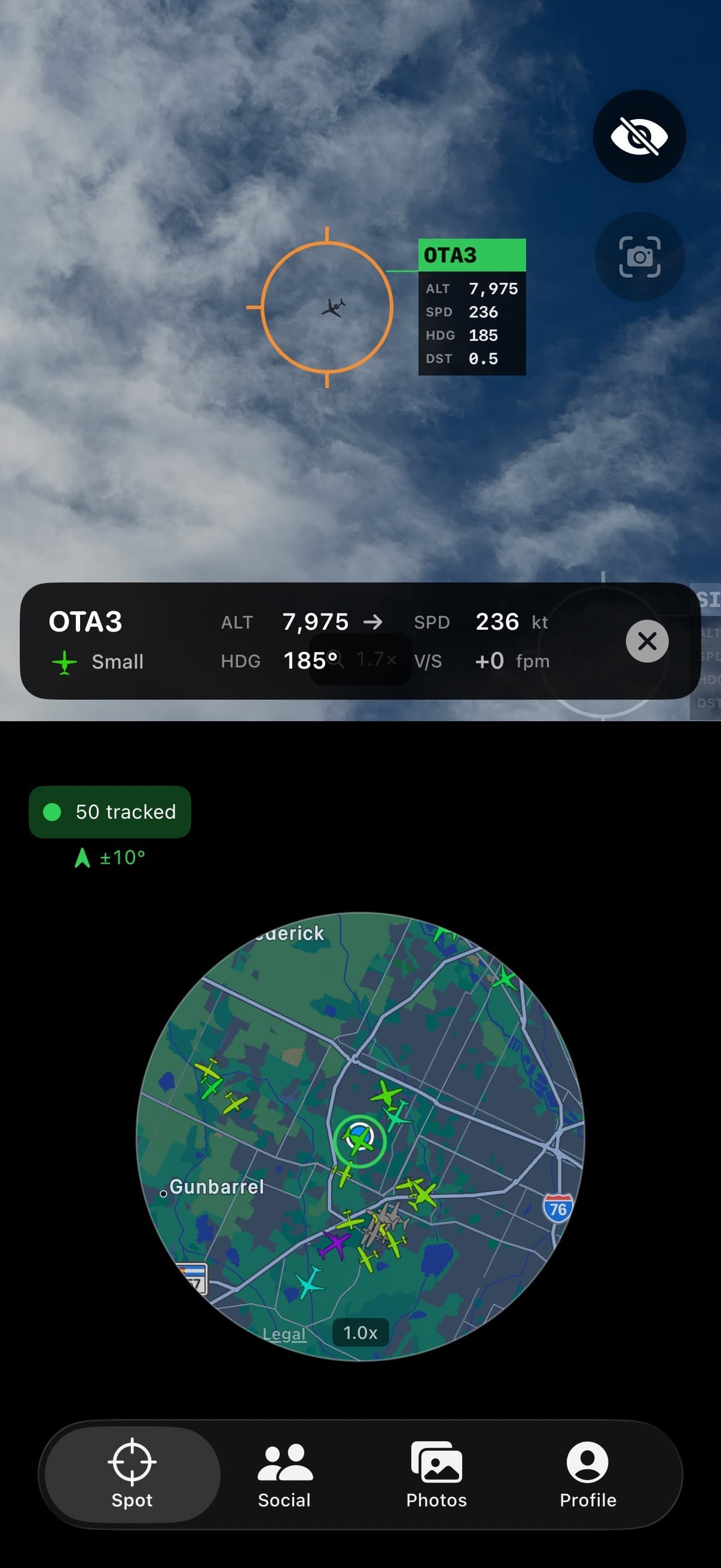
SkySpottr turns your iPhone into a plane-spotting instrument. Point it at the sky and the app overlays live flight data on the aircraft above you: flight number, aircraft type, altitude, speed, heading, and distance — an AR reticle locks onto a plane while a data card floats beside it (one screenshot shows SWA519, a 737-700, climbing at +2880 fpm). A circular radar map at the bottom shows every tracked aircraft around you, with 50-tracked counters and heading indicators, and tabs for Spot, Leaderboard, History, and Profile give it the feel of a hobbyist's field tool rather than a toy. The clever bit is how it works: ADS-B data projected through GPS and compass math, no ARKit required. That tradeoff is part of why the app is interesting to read about — the developer documented the whole thing on Show HN with a section called "Takeaways from vibe-coding a full product," and stated plainly: "Built an app entirely with Claude/AI assistance." Claude Opus 4.5 did the UI work; Gemini 3 cleaned up code the author described as messy. Under the hood it's an iOS SwiftUI frontend on a self-hosted backend — Django and PostgreSQL with Redis, running on a single VPS, later partially rewritten from Python to C# for performance. It's free with a $1.99 Pro tier, and the App Store shows v1.3.3 was updated about a day ago, so this is an actively maintained product, not a one-shot demo. For aviation nerds who've ever pointed at a contrail and wondered what it was, this is the app that answers.

大赏
已上线
安全隐私claude-codecodex

SvarLock: App Lock & Privacy

A free, open-source Android app lock: PIN or fingerprint protection for chats, photos, and payment apps — no ads, no accounts, no tracking.

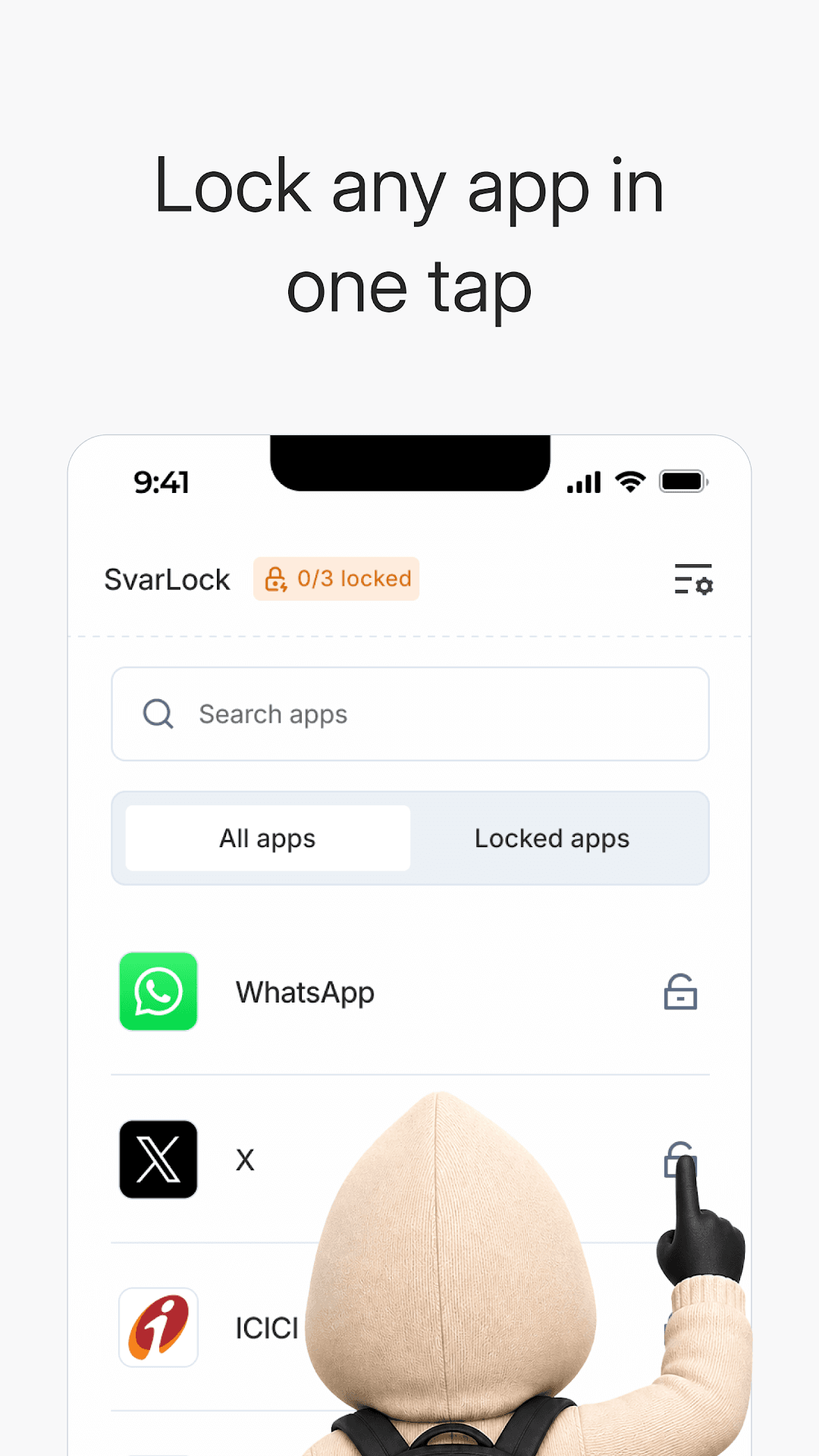
SvarLock is an app lock for Android that does exactly what it says: it locks your apps. Pick any app — WhatsApp, your banking app, your photos — and SvarLock gates it behind a PIN or your fingerprint, with a clean lock screen that asks for the code before anything opens. A search bar and a Locked apps tab keep the list manageable, and the settings cover the details you'd want: change PIN, fingerprint or face unlock with PIN as backup, and a PIN requirement for uninstalls so someone can't just remove the lock to get in. What sets it apart from the genre is what's missing: no ads, no account, no tracking. The app's design is literally offline by design — it requests no internet permission at all, so your PIN and your locked-app list never leave the device. It's free, it's open source, and the mascot (a hooded little privacy gremlin) tells you exactly what it stands for. The build story is the headline. Developer Pradeep Prakash wrote a Medium piece titled "How I vibe-coded an Android app without settling for AI slop," where he states: "I didn't write the application code. Claude Code handled development, and I sometimes used Codex to debug." The stack is Android with Jetpack Compose, with the design system generated through Style Dictionary and Figma Console MCP. It launched on Google Play on September 6, 2026 and was updated to v1.3.3 on September 20 — a real, maintained, ad-free app lock built almost entirely by an agent.

大赏
已上线
游戏claude-code-claude-sonnet-55

Roomba Rights of SPLORR!!

You are a cat in five rooms with movement as your only input: vacuum up naps, dodge chaos, and chase the SPLORR in this pixel-maze arcade game.

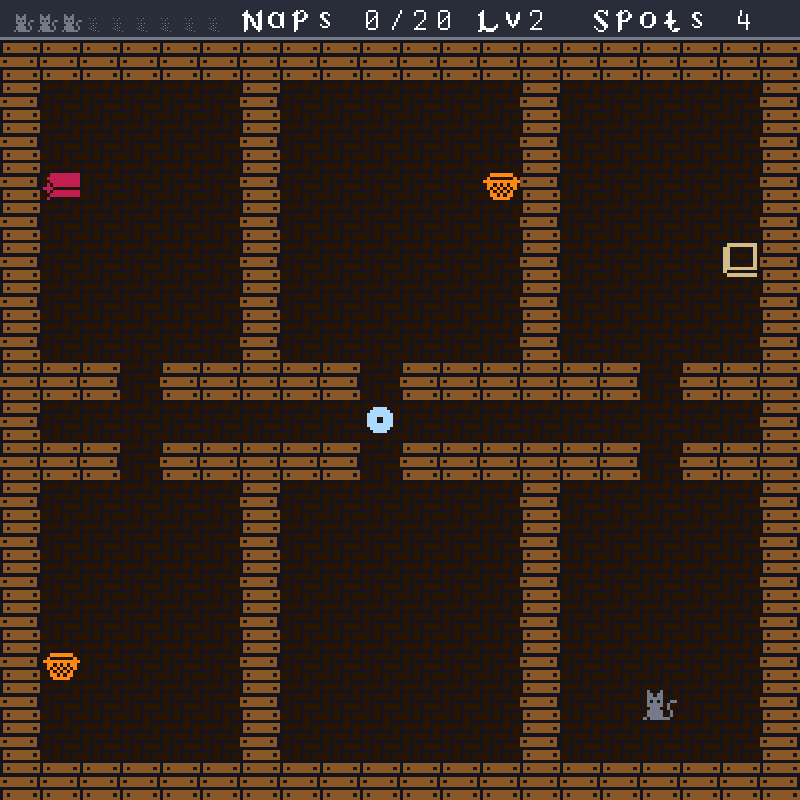
Roomba Rights of SPLORR!! is a small, sharp arcade game with a premise you can grasp in three seconds: you are a cat, there are five rooms, and movement is your only input. Zip through the pixel maze, vacuum up naps (the HUD tracks them as Naps 0/20), hit the spots, and don't get cornered. It's the kind of game that feels obvious once you play it — one mechanic, no tutorials, just speed and corner-cutting. The reason it's on VibeFix: the developer's itch.io AI disclosure is unusually blunt. It reads: "Built with Claude Code (Claude Sonnet 5.5)." The AI wrote all the game code in Odin (compiled to WebAssembly), plus the web wrapper and the build setup — "I wrote no code." That makes the game an honest end-to-end artifact of an agentic coding session: the human supplied the idea and the taste, the model shipped the maze, the cat, and the HUD. It was also built as an entry for the Jamference AI Game Jam, so it carries the jam-game virtues: playable in a browser in seconds, a tight loop, and a title with genuine commitment to the bit. Under the hood it's Odin compiled to WebAssembly with an HTML5 canvas wrapper. You can play it free in the browser — no download, no install, just a cat and five rooms.