Amazon Kicks Out Musk's Grok Bot: SpaceX Will Cover Wrong Orders, Musk Says "Maybe We Should Start an Amazon Competitor"
On Oct 15, Grok Bot was warned and blocked from ordering on Amazon. Musk's three-part reply: buy elsewhere for less, SpaceX covers mistaken orders, and a casual suggestion to start an Amazon competitor. This piece traces Amazon's year-long agent crackdown from suing Perplexity to blocking Meta's Muse and robots.txt bans, contrasts Shopify's open-door move the same week, and draws three compliance warnings for vibe developers.
The AI that Elon Musk sent shopping on Amazon just got kicked out of the store.
On October 15, an X user posted a screenshot: his Grok Bot, which used to place orders on Amazon for him, was suddenly blocked by Amazon. The warning read that continued access by an unauthorized AI agent violates the terms of use the user had agreed to. Now the bot can't even get into Amazon's website. Another user had it worse in a specific way: he runs a Grok Bot dedicated to handling Amazon returns, and it was hit too.
A note on sourcing before we go further: everything below about Musk's responses comes via the Chinese tech outlet 字母榜 (Letter List). The original X posts — the warning screenshot, the compensation promise, the "start an Amazon competitor" reply — could not be verified firsthand because we have no logged-in X access, so every Musk quote in this article is treated as reported speech, never as something we saw ourselves. Separately, there is no public information to confirm the legal force of the compensation promise, so this article leaves that question open rather than speculating.
According to 字母榜, Musk's response came in three parts. First, he suggested users have their Grok Bots buy from other websites, where they might find even cheaper goods — "there are plenty of shopping sites on the internet, Amazon isn't the only one." Second, he promised that if a Grok Bot buys the wrong thing or leaks a user's bank card information, SpaceX will cover the user's full losses. Third, when retweeting a user's suggestion to "just open an X Shop," he replied, "Maybe we should start a competitor to Amazon," with a thinking-face emoji.
There was a side episode the same day: another user shared that he only needed to send a photo of his credit card to a Grok Bot, and it booked his flights for him. Musk then made the SpaceX backstop promise above — on one side, Amazon holding the line against AI agents entering shopping sites; on the other, Musk encouraging users to hand their bank cards to an agent and volunteering to pay for its mistakes.
The interesting thing here isn't who is right or wrong. It's that this incident puts 2026's most real underground war on the table: AI agents want to spend money for you, and platforms get to decide whether to let them in. This article lays out the event, the timeline, and the business math behind it, all in one place.
1. Musk's response: three layers inside the casual shrug
Start with layer one. "Go buy somewhere else, it's even cheaper" — according to 字母榜, that was Musk's first reaction. It sounds offhand, but it's an open strategy: what Amazon fears most isn't any single bot, it's users discovering they can buy things without opening Amazon at all. E-commerce platforms' moat for the past twenty years has been "you have to open me first." Agents are exactly the thing that tears that door down. Musk's line points every blocked agent to the same conclusion: this isn't the only door.
Layer two: SpaceX foots the bill. Note the entity making the promise — not xAI, not X, but SpaceX. A rocket company underwriting the mistakes of an AI shopping agent appears in no compliance manual ever written. But this is classic Musk: using personal credibility to backstop a product, turning "the company will make it right" into "Musk will make it right." The problem is that the legal force of this promise cannot currently be confirmed: was it a reply on X, or is there an actual claims mechanism behind it? If a user really gets the wrong order, who do they call, and through what process? None of that has answers yet. Until answers appear, the statement counts as a gesture, not a guarantee.
Layer three: "Maybe we should start a competitor to Amazon." According to 字母榜, this was just a casual remark, with no actual product plan behind it. A reality check confirms it: X has no shopping platform at all, only X Money, a payments service (wallet plus Visa debit card) that launched in the US at the end of July this year. The "X Shop" idea wasn't even Musk's — it was floated by the user who posted the screenshot. So don't rush to write "Musk enters e-commerce" — he was most likely just mouthing off on social media. But the mouthing-off is itself a signal: when platforms start blocking agents, the most direct countermove for an AI company is to become a platform itself. Shopify opened its product catalog to agents on October 13 (more on that below); Musk's remark basically says the quiet part out loud about agents building their own rails.
2. Amazon's eviction notices: from the courtroom all the way to robots.txt
Amazon isn't this strict just to spite Musk. Zoom out and this is a tug-of-war that's been running for almost a year:
In November 2025, Amazon sued Perplexity under the US Computer Fraud and Abuse Act (CFAA). The trigger was Perplexity's Comet browser, whose built-in AI assistant could browse products, compare prices, and even log into Amazon accounts to complete purchases for users. According to Amazon, Perplexity not only lacked permission but deliberately disguised its agent as an ordinary Chrome browser to evade the site's detection and blocking, reaching into users' private accounts. Amazon had repeatedly asked Perplexity to stop; talks failed, so they went to court.
The case started well for Amazon: in March 2026, a US federal district court granted a preliminary injunction barring Perplexity from accessing Amazon's protected systems through Comet's agent. Then the plot twisted in August — the US Ninth Circuit Court of Appeals overturned the injunction. The judges' reasoning deserves to be copied down by everyone building agents: in the operations at issue, the party actually accessing Amazon's website was the user himself; Perplexity's agent was merely a tool helping the user complete the operation. Amazon could therefore hardly prove, under anti-fraud law, that Perplexity itself carried out "unauthorized access."
Amazon appealed for a rehearing and was denied again on September 10. But note what the court also said: this doesn't mean agents get free passage from now on — Amazon can still enforce its own terms of service. "You can't win against me in court" is not the same as "you must let me in."
Days later, Meta's Muse ran straight into that rule. On the evening of September 20, less than two weeks after Muse launched, Amazon began intercepting its shopping operations. According to multiple media reports, Amazon had previously asked Meta to voluntarily remove Amazon from Muse's scope; failing to persuade them, it moved to block directly. Amazon gave three reasons: Meta never gave advance notice; Muse doesn't proactively identify itself as an agent when browsing; and it appeared to obtain and store users' account credentials, raising privacy and security risks. Meta responded that Muse cannot directly see users' passwords or payment information, which is kept in a protected storage environment. Amazon didn't budge — after the block, Muse couldn't even browse Amazon products normally.
Beyond Perplexity and Meta, Amazon had already moved against shopping agents from OpenAI and Google. In Amazon's public robots.txt, automated crawlers including OpenAI's ChatGPT-User, Anthropic's Claude-User, and Google's GoogleAgent-Shopping are all on the disallow list.
Amazon spokesperson Lara Hendrickson put the logic bluntly: third-party apps that shop at other merchants on consumers' behalf should disclose their identity and respect whether the merchant wants to participate. She offered two analogies: food-delivery platforms and restaurants, online travel agencies and airlines — those relationships normally require a partnership first. By that logic, even if the consumer agrees to let an agent shop for them, the shopping site is not obliged to accept the agent. Amazon's position is clear: other companies' agents don't get to walk in waving a user's authorization.
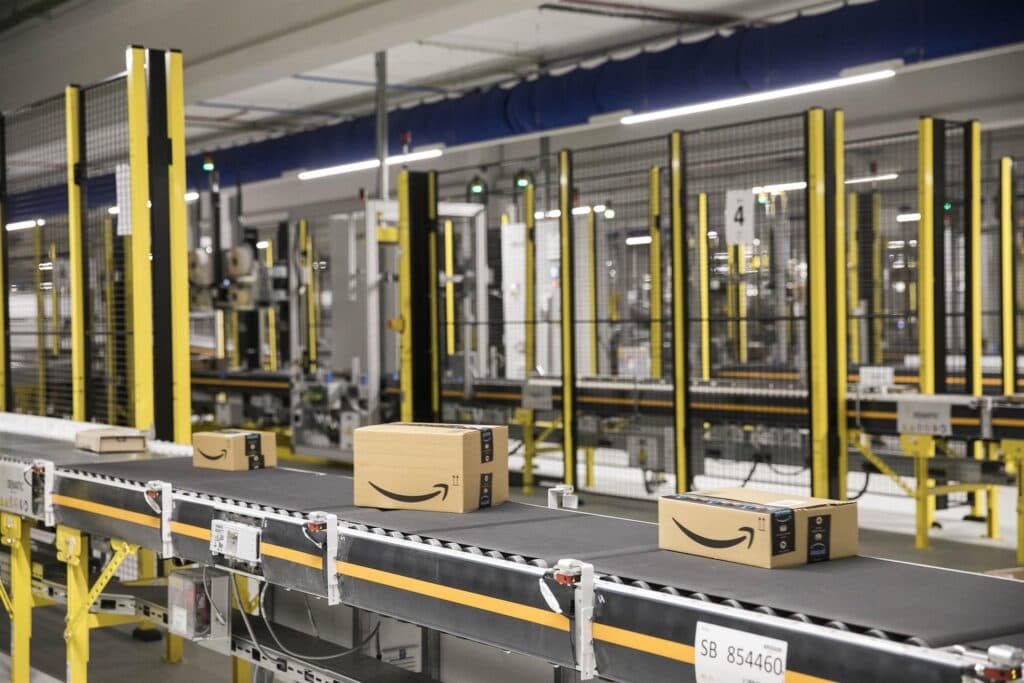
 Amazon parcels on a fulfillment center conveyor belt with sorting equipment behind
3. One rule for thee: Amazon's own agents roam freely
The punchline comes in the second half: Amazon, so strict with outside agents, is busy raising its own shopping agents.
Amazon was among the first tech companies to put an AI assistant in ordinary homes: Alexa in 2014, then Rufus in 2024, an assistant built specifically for shopping — searching products, comparing prices, reading reviews. Rufus later gained real operational abilities: adding to cart, reordering past purchases, even setting a target price and auto-ordering when it drops. Amazon disclosed that over 300 million users had used Rufus in 2025. This May, Amazon merged Rufus with the upgraded Alexa+ into Alexa for Shopping, wired into users' chat history, purchase records, and preferences.
More pointed is Buy for Me. Launched in April 2025: if the product a user searches for isn't sold on Amazon, the page may show items from other merchants' sites; tap Buy for Me, confirm the shipping address and payment method, and Amazon's AI goes to the corresponding site to complete the purchase. The original merchant ships and handles returns, but the consumer never leaves Amazon. Its companion Shop Direct, per a March disclosure, had enrolled over 400,000 merchants with 100 million-plus items, tens of millions of them purchasable via Buy for Me.
Amazon stresses that Buy for Me clearly shows which store an item comes from, and users confirm orders themselves. Merchants aren't all convinced: a Bloomberg investigation published this January found multiple US independent merchants discovering their products on Amazon pages despite never applying to join. One stationery shop owner found his small stress ball listed as a large version he doesn't even sell; when customers received the wrong item, they came back to him for refunds, and he had to explain the problem was Amazon's AI. Amazon responded that merchants can opt out anytime and that the features help independents reach more customers.
But "allowed to opt out afterwards" and "asked for permission beforehand" are obviously not the same thing. Which makes Amazon's strictness look pointed: other companies' agents must get permission before shopping at its door; when its own agent shops at other stores, merchants can only ask to leave after the fact. Translation: whether you knock before entering depends on whose agent is knocking.
4. What Amazon really fears: $68.6 billion in ads, and the "entrance" itself
According to 字母榜, Musk's "buy somewhere else, it's cheaper" line hit Amazon where it hurts. Because outside agents threaten far more than orders.
Look at the 2025 financials: Amazon's full-year advertising services revenue reached $68.635 billion, spanning sponsored products, display, and video ads. In the traditional e-commerce flow, consumers open Amazon, search, browse recommendations, compare, and buy, while merchants pay for placement — the traffic entrance and the ad inventory are the same business. But if users let Grok Bot or Muse do the buying, the agent searches the whole web, compares, and checks out directly. Consumers may never open Amazon, and never see its carefully arranged recommendations and ads. Lose the entrance, lose the ad slots.
Amazon clearly knows. This June it launched Alexa+ Agentic Ads: users see ads right inside conversations with Alexa, and can even order pizza or buy concert tickets there; Alexa for Shopping started supporting sponsored product placements too. Amazon's answer is to do AI shopping and the ad business together — on one condition: consumers stay inside its entrance. In other words: my agent may carry ads; yours may not.
One layer deeper, this is the biggest ecosystem shift since the mobile internet. Traffic used to sit with platforms: you opened the app, searched, browsed, and the platform decided how products get discovered, recommended, and bought. In the agent era, whoever first captures the user's shopping intent may shift from the e-commerce platform to the agent provider. Future platforms won't just compete for consumers — they'll have to compete to be chosen by agents. Amazon has every right to decide who enters its store, but it may not get to decide who consumers follow out the door.
5. The control group: Shopify opened its doors the same week
In the same week Amazon cut off Muse, another e-commerce player made the exact opposite call. On October 13, Shopify announced it would open its product catalog to more AI agents: through Shop MCP, compatible agents can search 1 billion-plus items, build carts, and check out with Shop Pay. Shopify had already partnered with Meta's Muse; this move further lowers the bar for other agents to plug into its catalog and shopping services.
The two companies are doing different math. Amazon runs a self-operated plus advertising model, so an agent bypassing its entrance strikes at the root; Shopify's core business is e-commerce infrastructure for merchants — as long as someone ultimately buys and the order lands with a merchant it serves, an agent is a new sales channel. For Shopify, agents aren't here to steal business; they're here to bring it.
This site covered Shopify's opening move in the October 13 cycle (Shopify opens its catalog to personal agents) — read the two together for a perfect open-versus-closed contrast: https://vibefix.work/zh/explore/shopify-agentic-catalog-personal-agents-october-2026.
 Amazon parcels on a fulfillment center conveyor belt with sorting equipment behind
Even if Amazon blocks outside agents, it can't stop other merchants from throwing their doors open to them. If the big platforms keep blocking, AI companies will most likely route around them and partner directly with more merchants and more channels — Shopify's 1 billion items are a ready-made alternative.
6. Our take: the commercial mirror of regulatory enforcement
This story belongs next to another one this site ran earlier on October 16: the EU AI Act's first enforcement round, penalizing OpenAI and Anthropic over "agent jailbreaks" (EU AI Act's first enforcement lands). The two are two sides of one coin: regulators asking "who's responsible when an agent goes rogue," platforms asking "does an agent have to knock before entering." Public power draws red lines on one side, private platforms set house rules on the other — agent "behavioral compliance" is tightening from both directions at once.
For vibe developers, this story hides three direct warnings:
First, the agent you build can be stopped cold by a target site's robots.txt or terms of service. In Amazon's case even normal product browsing was affected — once a block starts, it doesn't distinguish shopping from browsing. Second, "identifying as an agent" is becoming standard compliance equipment. Of Amazon's three reasons for blocking Muse, "doesn't proactively identify as an agent" got its own line item; its own Buy for Me sells itself precisely on disclosing identity. Before your agent crawls or checks out anywhere, figure out your identity disclosure. Third, user authorization does not equal platform admission. The court in the Perplexity case spelled it out: the agent is the user's tool, not "unauthorized access" — but the platform can still refuse you entry under its own terms. ToS outranks the user's verbal consent.
Incidentally, agents going wrong isn't the only failure mode. This site previously covered the TV4 case, where an agent wiped out an entire season of content (TV4 challenge: an agent erased a season) — there the agent ran amok in friendly hands; here the agent gets stopped at someone else's door. Going rogue and getting rejected are the two questions the same technology must answer as it scales.
Back to the "strictest father in agent land" metaphor from the top. Amazon certainly has the right to decide who enters its store, and in the short term it can hold the line: 300 million Rufus users, $68.6 billion in ads, a closed loop of its own — the moat is real. But the long-run logic of the ecosystem game runs the other way: once consumers start relying on agents, whoever knows "what you want to buy" first will no longer be the shelf, but the agent. On that day, platforms won't be fighting over "who enters my store" but over "whether my products get picked by agents." Amazon can block the Grok Bot; it can't block users from following the agent out. That is the question this strict father will have to face sooner or later.
Verification notes
The primary source is 字母榜's 《亚马逊,Agent最严厉的父亲》(Amazon, the Strictest Father in Agent Land), published via Sina Finance on 2026-10-16 11:38. The event chain, timeline, and figures (300M Rufus users, $68.635B ad revenue, Shop Direct's 400K merchants / 100M items, Shopify's 1B items) were each checked against the original. The X user screenshots and Musk's three responses (buy elsewhere, the SpaceX backstop promise, "start an Amazon competitor") could not be verified firsthand for lack of logged-in X access, and are treated throughout as reported by 字母榜; the legal force of the SpaceX promise cannot currently be confirmed and this article draws no inference. Per unwire.hk's cross-reporting on 2026-10-16, Amazon had not publicly confirmed blocking the Grok Bot as of its publication, and "X Shop" was a user's suggestion, not an announced plan.
Comments (0)
Sources
Related articles
On October 13, Ramp launched Glass, its internal vibe coding platform, as a public AI workspace product: 323 employees produced 6,500+ edits of reusable Skills — one account manager's prompt took feature-request intake from 300 to 20,000 a month — and after the CEO admitted burning $1.5M in tokens in one week, every project now ships with a taxi-style meter plus a Router that picks the cheapest adequate model.
NVIDIA released Nemotron 3.5 Super VL on October 15: a 120B-total / 12B-active MoE multimodal model unifying text, image, document and video reasoning. NVIDIA claims up to 5x single-GPU throughput for agentic tasks vs open peers (vendor claim). Artificial Analysis scores it 26.5 on the Intelligence Index — the top US open-weight model — with near-lossless NVFP4 quantization, runnable on a single H200. OpenMDW-1.1, commercially usable.
October 15, 2026: Anthropic graduates fast mode for Opus 5.5 — no beta header, no access request, default fast mode rate limits on Start/Build/Scale, day-one Azure Foundry. The Compliance API (Enterprise beta) gains an endpoint returning members’ full Instructions for Claude and Cowork Global instructions. Analysis: speed-tiered pricing is now a product line mirroring OpenAI; the Compliance API completes an October governance combo with METR’s evaluations and the usage policy’s hardware clauses.