NVIDIA Open-Sources 120B Multimodal Agent Model Super VL: Documents, Images and Video in One, Built for Always-On Enterprise Agents
NVIDIA released Nemotron 3.5 Super VL on October 15: a 120B-total / 12B-active MoE multimodal model unifying text, image, document and video reasoning. NVIDIA claims up to 5x single-GPU throughput for agentic tasks vs open peers (vendor claim). Artificial Analysis scores it 26.5 on the Intelligence Index — the top US open-weight model — with near-lossless NVFP4 quantization, runnable on a single H200. OpenMDW-1.1, commercially usable.
One boundary line first, to avoid confusion: two days ago we already published a piece on the Bolt member of the Nemotron 3.5 family (the 74B-parameter, 24GB-VRAM model built for personal local deployment), and nothing about Bolt's specs will be repeated here. The subject of this round is the other family member released in the same October 15 (US Pacific time) batch: Super VL. Bolt is the open model you bring home; Super VL is the open model you bring to the data center — one family, two deployment routes, and this article is only about the latter.
NVIDIA states Super VL's positioning bluntly: a multimodal reasoning foundation for "always-on enterprise agents". In plain terms, it is meant for the agents that enterprises keep running around the clock — processing vendor documents, reading financial reports, triaging security alerts — able to read text, charts, documents and video inside a single model, instead of stitching together a text model today and bolting on a vision model tomorrow.
120B total, 12B active: a body built to be "enough and easy to run"
Super VL is a mixture-of-experts (MoE) architecture: 120B total parameters, 12B actually activated per token. The fine print: including the vision encoder, projector and multi-token prediction module, the full count is about 124.453B parameters, with 512 routed experts per layer — but each inference wakes up only 12B of them. This "large reserve, low activation" design means its cost profile looks like a 12B-class model while its knowledge capacity is packed at the 120B scale.
The context window is 1M tokens, with one qualification: hosted endpoints (e.g. the public API on OpenRouter) cap out at 262K; the full 1M is the ceiling for self-hosted deployments. In practice, 1M context means hundred-page PDFs, multi-page earnings reports or the transcript of a two-hour meeting can be fed in whole for cross-document reasoning, without the usual engineering of chunking, retrieval and merging.
Inputs cover text, images, documents and video; output is text. Video input has a hard limit: MP4 only, max 2 minutes per clip — a detail from the Hugging Face model card, not the marketing page. So this is short-video understanding for things like surveillance replays, product demos or meeting clips, not long-form video analysis. Reasoning mode can be toggled through the chat template's enable_thinking switch: turn it off for simple tasks to save tokens, turn it on for complex agent work.
The deployment bar may be the most worth-underlining part of this news for enterprise readers. The NVFP4-quantized build (4-bit weights and activations on Blackwell) runs on a single DGX Spark, one H200, two H100s, or one GB200; the BF16 full-precision build needs 4xH100 or 2xGB200. How big is the gap between the two? A third-party evaluation put a hard number on it — more on that below.
What "all in one pot" actually replaces: retiring the "text + vision" two-model setup
NVIDIA's technical blog spells out the motivation concretely: teams building document agents used to deploy one text model for logic and another vision-language model for charts and layouts, then pass context between the two — losing information with every handoff. Super VL packs reasoning, instruction following, tool use and text/image/document/video understanding into one model, so "reading the chart" and "reasoning from the chart" happen in a single forward pass.
Take the blog's example: the same model can interpret a chart, connect it with a table on another page of the document, and produce a summary. That sounds obvious, but inside an MoE architecture, whether the text experts and vision experts can collaborate within one reasoning chain determines whether this "cross-modal skim reading" is a real capability or a demo effect. NVIDIA's reported number on CharXiv (a chart-reasoning benchmark) is 80.8%, versus 63% for its own Nemotron 3 Nano Omni; with Python code-assisted interpretation it reaches 84%. Those are vendor-reported numbers with no independent verification yet, but they at least signal where the bet is placed.
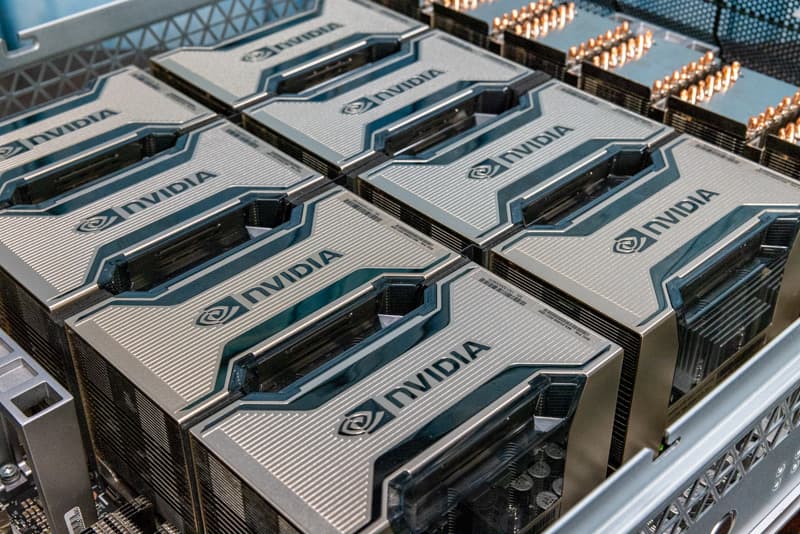
 Illustration of NVIDIA GPU servers: the 120B multimodal Super VL model for always-on enterprise agents runs on a single H200
The third-party scorecard: Artificial Analysis 26.5, top US open-weight model
Third-party evaluator Artificial Analysis benchmarked Super VL on release day, October 15, and several findings deserve to stand on their own:
First, an Intelligence Index score of 26.5 — the highest among US open-weight models, edging out Thinking Machines' Inkling Small (25.7) and NVIDIA's own previous flagship Nemotron 3 Ultra (23). Zoomed out, US open weights still trail the UAE's K2 Horizon (31) and China's MiMo-V2.6-Pro (46), but within the US camp NVIDIA has at least taken the crown from its own Ultra. Notably, it doubled the score of its predecessor Nemotron 3 Super (13) while using about 60% fewer output tokens per task — efficiency grew even faster than intelligence.
Second, speed. AA measured roughly 630 output tokens per second with 100K-token prompts, the fastest of any model scoring 20+ on the Index; about 5x Inkling Small, 2.7x Nemotron 3 Ultra, with a 1.8-second time to first token. NVIDIA's blog claim of "up to 5x higher single-GPU throughput for agentic tasks than open peers" — flagged as a vendor claim — at least finds a same-order-of-magnitude corroboration in third-party data on the speed dimension.
Third, near-lossless NVFP4 quantization. The NVFP4 build scores within 0.1 points of the BF16 full-precision weights on the Intelligence Index, with no sub-component dropping more than 2.6 points. That means the "runs on one H200" version pays almost nothing for compression — decisive information for enterprise deployment: no painful tradeoff between accuracy and hardware cost.
Fourth, a telling detail: on Hermes Bench (63.44%) and LangChain behavioral evaluations (87.05%), Super VL beats its own much larger flagship Nemotron 3 Ultra (56.33% / 84.3%). "One-fifth the parameters, higher accuracy on agent tasks" is exactly the story NVIDIA wants to tell: in the agent era, parameter scale is no longer the only yardstick for model selection.
Vendor claims corner: impressive numbers, read with a discount
Everything below comes from NVIDIA's official channels. These are one-sided vendor statements with no independent third-party verification — apply a mental discount while reading:
Three deployment case studies. Scale AI post-trained Super VL for vendor credit processing at Skydance, and NVIDIA says inference cost dropped 40x with latency down 5x. Ramp uses it to convert receipt images into structured JSON (merchant, dates, payment data), claiming 50% higher throughput and 10x lower latency. AI21 and Alice applied it to threat intelligence and vulnerability analysis, claiming a 41% accuracy improvement (the blog says 41%; some reposts wrote 40% — the official blog is authoritative).
The three cases share a pattern: "document-heavy, layout-heavy, fixed-process" work. Vendor credit forms, receipts, threat-intel reports — stable input formats, codifiable judgment criteria, controllable cost of error. These are textbook scenarios for "post-train a small specialist to replace a generalist giant". NVIDIA didn't pick these three by accident; they sketch the target customer: mid-to-large enterprises with private data and fixed workflows that want to slash their model bills.
On platform partners, NVIDIA's launch communications list Atlassian, CrowdStrike, Salesforce and Perplexity as integrating the model, alongside Dassault Systèmes, Synopsys and others (again, vendor statements). CrowdStrike's angle is enterprise network-defense agents, Salesforce's is government workflow automation, and Perplexity also appears in the blog's training-data acknowledgments — high-quality datasets from Perplexity helped improve mid-training.
Two more deployment-side numbers worth noting (vendor figures): NVIDIA Dynamo's deployment recipe on 16 B200 GPUs, at 50 tokens/sec per user interactivity, serves up to 8x as many users with 85% lower first-token latency; the newly open-sourced speculative decoding technique LiLiCorr is up to 2.3x faster than non-speculative decoding on DGX Spark. The test conditions are NVIDIA's own, so take them as directional — but they at least show real investment in the "inference cost of repeated agent calls" problem: prefix caching, Mamba state reuse, NVFP4 KV-cache, the full combo.
Open assets: not just weights, but the whole "agent factory" toolchain
Super VL's weights ship under OpenMDW-1.1, permitting commercial use, fine-tuning and redistribution. Channels are Hugging Face, OpenRouter and ModelScope, with base, post-trained, NVFP4 and BF16 checkpoints all on HF. What NVIDIA released goes beyond weights: training recipes, NeMo Gym-based RL environments, 40 vision-language datasets on HF, plus datasets for agentic tool use, finance reasoning, long context and safety alignment — per the official blog, "the entire toolchain for building specialized agents, open-sourced".
For smaller teams this may matter more than the model itself. The biggest cost of a specialized agent was never downloading weights; it is "turning your own data into training data and building RL environments to validate it". Open-sourcing NeMo AutoModel (SFT/LoRA), NeMo RL and NeMo Gym together effectively commoditizes the "post-train + validate" methodology that Scale AI and Ramp used. The caveat: open methodology is not turnkey — running it for real still requires someone on the team who understands RL and agent evaluation.
Three routes, one picture: open weights are stratifying "by deployment scenario"
This is the opinion increment of this piece. Connect the open-weight releases of the past month and a "stratification map" emerges:
 Illustration of NVIDIA GPU servers: the 120B multimodal Super VL model for always-on enterprise agents runs on a single H200
Tier one is maximum capability: Meta's Muse Spark Open, 816B total parameters with 42B active, co-engineered with Apple to run on Mac Studio clusters (two 512GB unified-memory M5 Ultra units, or four 256GB units networked) — betting that "flagship capability must be put in developers' hands", at the cost of extravagant desktop-grade hardware. (We covered it separately on October 15.)
Tier two is the enterprise-agent practical layer: today's Super VL, 120B-A12B, running on one H200 or one DGX Spark, optimized for enterprise agents that "read documents, call tools, run long workflows". It doesn't chase maximum parameter count; it chases three things — single-GPU throughput, lossless quantization, post-train friendliness.
Tier three is personal local: the same-batch Bolt 74B-A9B, 2-bit quantized into 24GB of VRAM, runnable on an RTX laptop; the even smaller Bolt E4B needs just 4GB, arriving October 23, targeting lightweight conversational agents on Jetson and desktop RTX. (Bolt's full specs are in the piece from two days ago; not repeated here.)
Taken together, NVIDIA is effectively answering a question: open weights shouldn't be judged on a single "bigger is better" scale, but stratified by "where you run it and what it runs". Meta occupies tier one; NVIDIA itself occupies tiers two and three. Once this stratification sets in, the model-selection logic shifts from "who scores highest" to "which tier is my scenario in" — for anyone doing technical evaluation, that is a more important change than any single benchmark score.
It's also worth noting this continues NVIDIA's established open strategy: from open-sourcing Nemotron models with IOI/IMO gold-level results (we covered that thread earlier) to releasing an "enterprise-agent specialist model plus the full training toolchain" this time, the playbook has always been "open models in exchange for ecosystem, ecosystem flowing back to own hardware". The hardware Super VL runs best on reads like an NVIDIA product list — DGX Spark, H200, H100, GB200. The open weights are real, and so is the commercial flywheel; the two are not in contradiction.
Who should care, who can wait
If you run document intelligence, finance automation or security operations agents inside an enterprise — "layout-heavy, long-workflow" projects — Super VL belongs on the evaluation shortlist: the 120B-A12B body, near-lossless NVFP4, a one-H200 starting bar and commercially usable OpenMDW-1.1. Few current open-weight offerings combine all four. Teams with private data to post-train will find the 40 vision-language datasets and NeMo Gym RL environments save real cold-start effort.
But if what you need is general chat or a primary code-generation model, or your team has nobody who can own post-training and agent evaluation, the word "specialized" in Super VL is a warning: its strength is the post-trained specialist agent, not an out-of-the-box generalist. Out-of-the-box work still belongs to closed APIs or larger general-purpose open models.
One closing judgment: Super VL's real test isn't launch week but the next three months — how many Scale AI- and Ramp-style cases graduate from "vendor claim" to "customer telling it themselves". The second half of the open-weights war will no longer be fought over benchmark scores, but over "whose post-training toolchain actually makes the enterprise math work". NVIDIA open-sourced the toolchain this time, moving the bet from the model itself to ecosystem execution. Whether that move is right will show in next year's Q1 adoption data.
Comments (0)
Sources
Related articles

October 15, 2026: Anthropic graduates fast mode for Opus 5.5 — no beta header, no access request, default fast mode rate limits on Start/Build/Scale, day-one Azure Foundry. The Compliance API (Enterprise beta) gains an endpoint returning members’ full Instructions for Claude and Cowork Global instructions. Analysis: speed-tiered pricing is now a product line mirroring OpenAI; the Compliance API completes an October governance combo with METR’s evaluations and the usage policy’s hardware clauses.
On October 13, Ramp launched Glass, its internal vibe coding platform, as a public AI workspace product: 323 employees produced 6,500+ edits of reusable Skills — one account manager's prompt took feature-request intake from 300 to 20,000 a month — and after the CEO admitted burning $1.5M in tokens in one week, every project now ships with a taxi-style meter plus a Router that picks the cheapest adequate model.

On Oct 15, Grok Bot was warned and blocked from ordering on Amazon. Musk's three-part reply: buy elsewhere for less, SpaceX covers mistaken orders, and a casual suggestion to start an Amazon competitor. This piece traces Amazon's year-long agent crackdown from suing Perplexity to blocking Meta's Muse and robots.txt bans, contrasts Shopify's open-door move the same week, and draws three compliance warnings for vibe developers.