Argo-Bench: Grading Data Agents on Consequences, Not Correct Answers — Best Model Clears Only 34.8% of Tasks
TextQL Labs' Argo-Bench grades data agents on the consequences of their actions inside a simulated 235-table, 7.5-billion-row ERP warehouse — not on query correctness. The best of 14 models (Opus 5.5) clears 95+ on only 34.8% of 210 tasks. What this exposes about data agents, and the consequence-checklist practices solo developers can steal.
On October 1, 2026, TextQL Labs published a new benchmark on arXiv: Argo-Bench (arXiv:2610.02122). Its pitch, translated into plain language, is a single sentence: stop asking only whether the agent's answer is right — look at what its actions caused.
The benchmark contains 210 data science and analytics tasks running inside a simulated enterprise data warehouse: 235 tables, 7.5 billion rows, modeled on the Oracle E-Business Suite ERP schema. It evaluated 14 frontier and open-weight models, and the results sting — the best-performing model (Opus 5.5) scored 95 or higher on only 34.8% of tasks, averaging 59.5 points.
This is not another "whose model topped the leaderboard" news flash. Its real value is that it puts a blind spot in all current data-agent evaluation on the table: in production, what makes a data agent dangerous is not "answering wrong" but "doing wrong". For vibe coders wiring agents into real databases, that distinction can be the difference between saving three days of work and getting woken up by PagerDuty at 3 a.m.
The old text-to-SQL exam paper is no longer enough
For years, data-agent capability has been measured almost entirely with text-to-SQL benchmarks: given a natural-language question, the model generates SQL, and a correct answer earns points. The logic is simple and clean, but it only covers the safest link in a real workflow — "reading".
Real enterprise data work is never just reading. An analyst's (or an agent's) chain is typically: reason across dozens of tables, run statistical analyses, then act on the results. Banning fraudulent accounts, allocating courier incentive budgets, issuing back pay — once executed, these actions have real, irreversible consequences. The Argo-Bench paper's abstract names an awkward reality: established text-to-SQL benchmarks evaluate query generation alone, and audits have found their answer keys frequently wrong; worse, real enterprise warehouses are too sensitive to release, so these benchmarks are built on public datasets where "a business event fits in a single table" — nothing like reality.
Let me first distinguish this from two benchmark articles VibeFix has already published, to avoid confusion: SWE-bench Pro tests "writing code" (can a model fix and write code given programming tasks); Meta's SWE-sweep tests "finding bugs autonomously" (can an agent discover software defects on its own). Argo-Bench tests the consequences of "touching data" — whether an agent navigating an enterprise-scale data environment understands, acts, and avoids breaking the real world. Three benchmarks, three tracks: code correctness, defect discovery, action consequences. This article is only about the third.
A fake New York with 7.5 billion rows — why it's a real test
Argo-Bench's approach: using public data, peer-reviewed industry literature, and regulatory filings, simulate a New York City food delivery platform — 81 million orders in 2024, with grounded economics, fraud patterns, and marketplace incentives. Then export that "world" into an ERP warehouse: 235 tables, 7.5 billion rows.
Two design details here are, in my judgment, the cleverest parts of the whole paper (my judgment — reasons below):
- The simulator's ground-truth state is withheld from the agent. The agent only sees the warehouse and must navigate it like a detective, reconstructing facts before acting. This restores the core difficulty of real data work: nobody lays the "correct answer" in front of you; the data itself is the maze.
- Every task ships with an executable reference solution, proving the task is solvable using only the warehouse. That closes off the "the task itself was unsolvable" excuse — if the model failed, it's a capability problem, not a task problem.
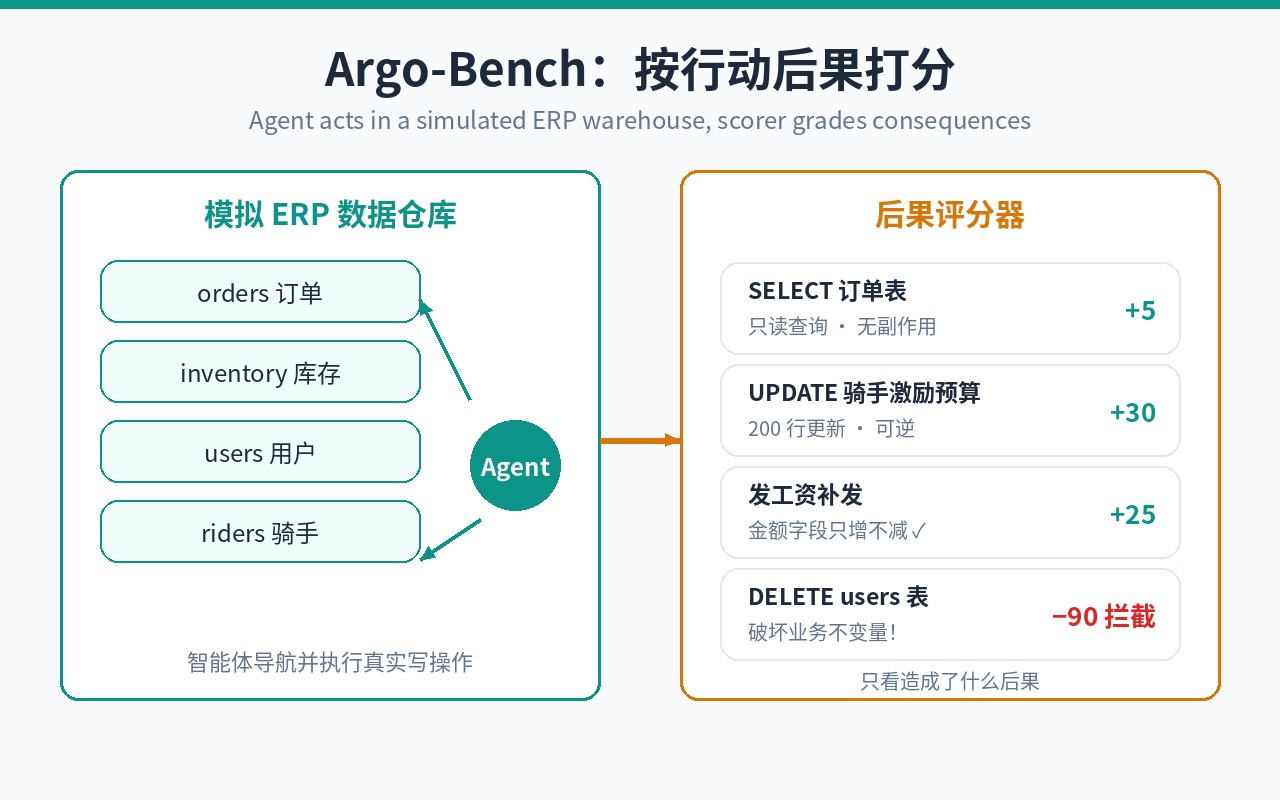
What the agent submits is no longer a SQL query but a series of "actions": banning fraudulent accounts, allocating courier incentive budgets, issuing back pay, and so on. The grader doesn't care how pretty your query is — it only scores what those actions caused inside the simulator: was data corrupted? Were business invariants broken? Were there unexpected side effects?
Three easily overlooked details in the paper
Beyond the headline numbers, the abstract hides several details worth savoring:
- Existing benchmarks' answers are themselves often wrong. The paper notes audits found established text-to-SQL benchmarks' answer keys "frequently wrong". That means many past "high scores" may just have been fitting a wrong exam paper. Argo-Bench's consequence-based scoring is a paper you can't pass by memorizing answers — you can't memorize "which account to ban"; you actually have to go figure it out in the warehouse.
- Tasks cover the full "reason–analyze–act" chain. The 210 tasks aren't 210 query questions but 210 mini-workflows: reasoning across dozens of tables, running statistical analyses, then acting. That's closer to a data analyst's real day than a Kaggle-style single-point Q&A.
- The fraud patterns and marketplace incentives are "alive". The simulated world has grounded economics, fraud patterns, and marketplace incentives — data distributions driven by underlying economic behavior, fraudsters who disguise themselves, incentives that distort behavior. The agent can't just run aggregations; it has to understand why the data looks the way it does. In my view, this is the key gap between this benchmark and traditional ones: it tests the ability to model the business world, not just SQL fluency.
34.8%: what that number is really saying
Of 14 frontier and open-weight models, the best (Opus 5.5) scored 95+ on only 34.8% of tasks, averaging 59.5. In other words, on nearly two-thirds of tasks, even the strongest model couldn't clear "basically no mistakes".
Note this score means something completely different from traditional benchmarks. Losing points on a text-to-SQL benchmark usually means "the answer was wrong"; losing points on Argo-Bench means the agent's actions caused real damage in the simulated world — banning the wrong people, paying the wrong amounts, breaking data consistency. It's a metric much closer to a production incident.
My take: this number tears off the veneer of "data agents are ready to take over data work". Query generation was benchmarked to high scores long ago, but that's just the appetizer; the hard part is "figuring out what's going on across 235 tables, then acting without breaking things". That's the daily reality of data jobs, and the best models today score roughly half-marks on that daily reality.
The benchmark's limitations deserve equal honesty (also my judgment): a simulation is a simulation — no matter how refined the delivery platform, it can't cover the "dirt" of real enterprise data: missing values, conflicting metric definitions, legacy tables, ancestral columns nobody dares touch. And all 210 tasks orbit a single business domain, food delivery; finance, healthcare, or manufacturing data environments might show completely different failure modes. Another question worth asking is about the scoring itself: how was the 95-point cutoff set? How are different consequences weighted (banning the wrong account vs. misissuing a payment) into one unified score — the abstract doesn't elaborate; the details are in the full paper. Argo-Bench is a good starting point, not a universal health check.
Why vibe coders should care about "consequence scoring"
If you're building apps with AI, you've likely already let (or are about to let) agents touch your database: auto-generating migration scripts, batch-cleaning data, updating records from natural-language instructions, running scheduled analysis jobs that write results back. In these scenarios, "is the answer right" is only the first question; the second is: after it executed, is the database still okay?
Traditional testing mindsets fail here. Unit tests tell you whether a function returns the right value, but not whether "running this UPDATE on the production database quietly polluted three downstream tables". SWE-bench-style evaluations tell you whether a model can write code, but not whether "the data pipeline script it wrote will delete rows it shouldn't at 3 a.m.". Argo-Bench's methodology fills exactly this gap: making "side effects" a first-class citizen in the scoring formula.
The practical payoff for solo developers: you don't need 7.5 billion rows to steal this methodology. Here are practices you can copy directly:
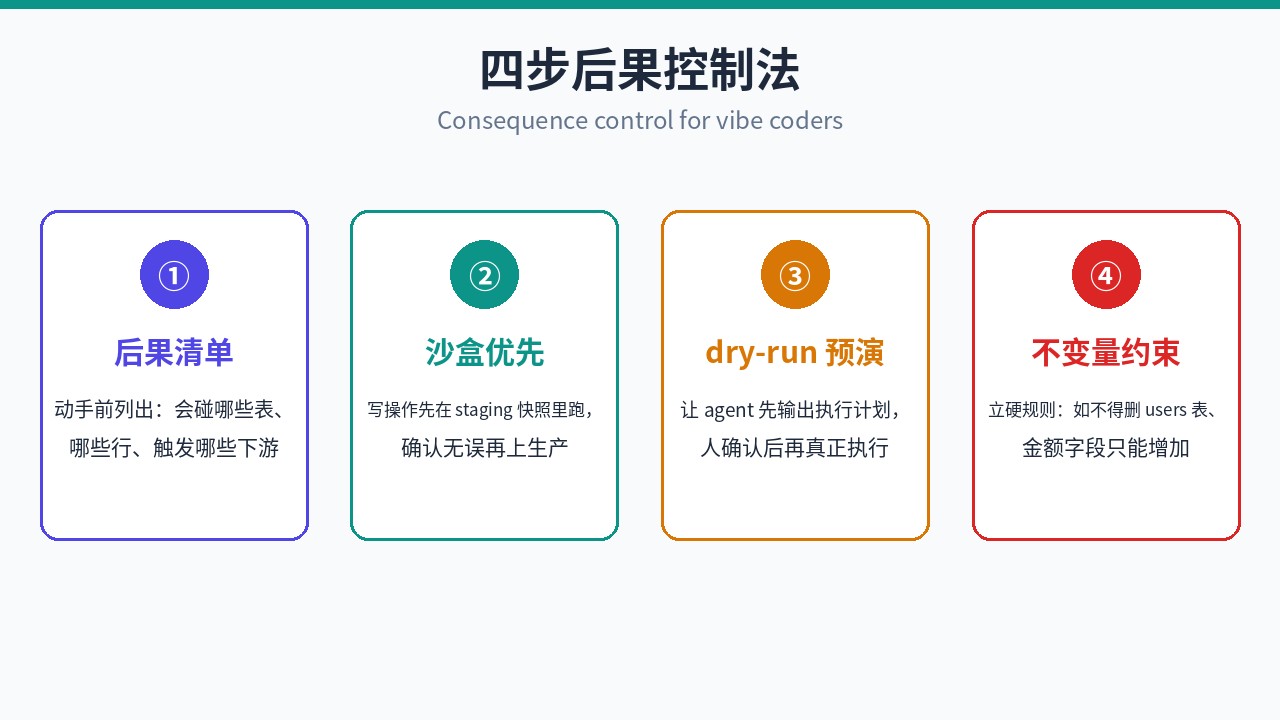
- Consequence checklists. Before letting an agent touch the database, force it (or yourself) to write down "which tables, which rows, which downstream processes this operation will touch". Argo-Bench's grader is essentially an automated consequence checklist — doing one manually blocks 80% of rookie incidents.
- Sandbox-first. Run every write operation on a database snapshot or shadow copy first, diff before and after, and only go to production when no unexpected side effects appear. That's the civilian version of Argo-Bench's "watch consequences in the simulator": your staging database is your simulator.
- Dry-run before executing. Require the agent to output its planned writes as a "plan" first (affected row counts, target tables, rollback plan), and only execute after human confirmation. Splitting "action" and "plan" into two steps is the cheapest form of consequence control.
- Give the agent "invariants". E.g., "never delete rows from the users table under any circumstances", "amount fields may only increase, never decrease". What Argo-Bench's grader checks as "business invariants" translates in engineering practice to database constraints plus application-layer guardrails. The more explicit the constraints, the less room the agent has to cause trouble.
- Build yourself a mini Argo-Bench. Pick your 3–5 most common agent data tasks; for each, prepare a database snapshot, a description of "correct consequences" (e.g., "should update only these 200 rows, zero changes to the users table"), and an automated diff script. Every time you switch models or change prompts, run the regression suite — that's consequence scoring turned into your CI.
A shift worth remembering
Argo-Bench may represent a shift in agent evaluation: from "is the answer right" to "is the doing stable". Code agents have SWE-bench, bug-finding agents have SWE-sweep, and now data-touching agents have Argo-Bench — three puzzle pieces covering three territories, and only together do they approach the ultimate question of "can I trust it to do the job".
For the vibe coding community, this shift arrives right on time. More and more people are upgrading agents from "coding copilots" to "operators that can touch production systems": connecting databases, calling APIs, shipping releases, rolling back. The more capable they get, the larger the blast radius of side effects. Under this trend, "consequence scoring" shouldn't be just an academic benchmark's gimmick — it should become the default checklist for anyone letting an agent near production.
One honest closing note (personal opinion): the 34.8% figure won't improve dramatically just because of "bigger models" in the short term. What Argo-Bench tests isn't knowledge volume but caution inside a complex state space — understanding schemas, tracing data lineage, anticipating side effects, restraining action. That is precisely the weakest link of current LLMs: they're trained to "confidently produce answers", not to "carefully avoid breaking things". Only when benchmark scores genuinely rise can we seriously discuss automating the "data analyst" role. For now, it's early.
The paper is public — read the original on arXiv if you're interested (arXiv:2610.02122, submitted October 1, 2026).
Sources
Related articles
Moonshot AI's Kimi K3 has entered OpenAI's enterprise Codex channel via US inference provider Baseten. Enterprise customers can now burn existing OpenAI spending commitments on the Chinese open model — no new supplier contract needed. Sina Finance calls it the first Chinese open model to enter OpenAI's enterprise billing system. This piece unpacks the three-way split (Baseten/Codex/OpenAI billing), the Bedrock revenue-sharing lead-up, and what billing-neutral model choice means for developers.
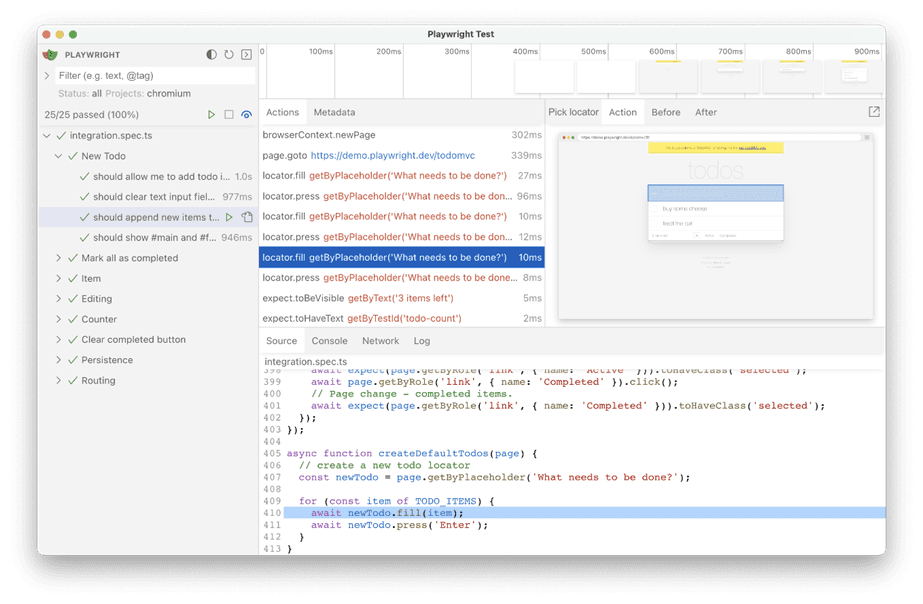
AI's biggest fear when editing code: fixing A breaks B. This execution-layer companion to our AI Testing Strategy shows solo developers how to build an E2E regression moat with Playwright, 5 golden paths, a data-testid convention, and GitHub Actions — one hour to set up, one hour a week to maintain, inside the free tier, with copy-ready code.

Model, prompt, or tool changes can silently break your agent while you're busy celebrating the fix. This guide shows how to build an eval harness from scratch: a 20-case golden set from real traffic, deterministic code scorers plus calibrated LLM judges, a three-layer scoring split, an anti-self-deception checklist, and a CI gate that actually blocks merges — closing the loop with production sampling and shadow runs.