Talk Like a Caveman, Save Like a CFO: Caveman 4.0 Ships With 112k Stars
Caveman 4.0 turns "talk like a caveman" into three layers of token engineering — output compression, input compression, and difficulty-based model routing. 54 sessions measured 33.2% fewer input tokens and 54% lower cost, independently verified by Adobe, JetBrains, and Elastic.
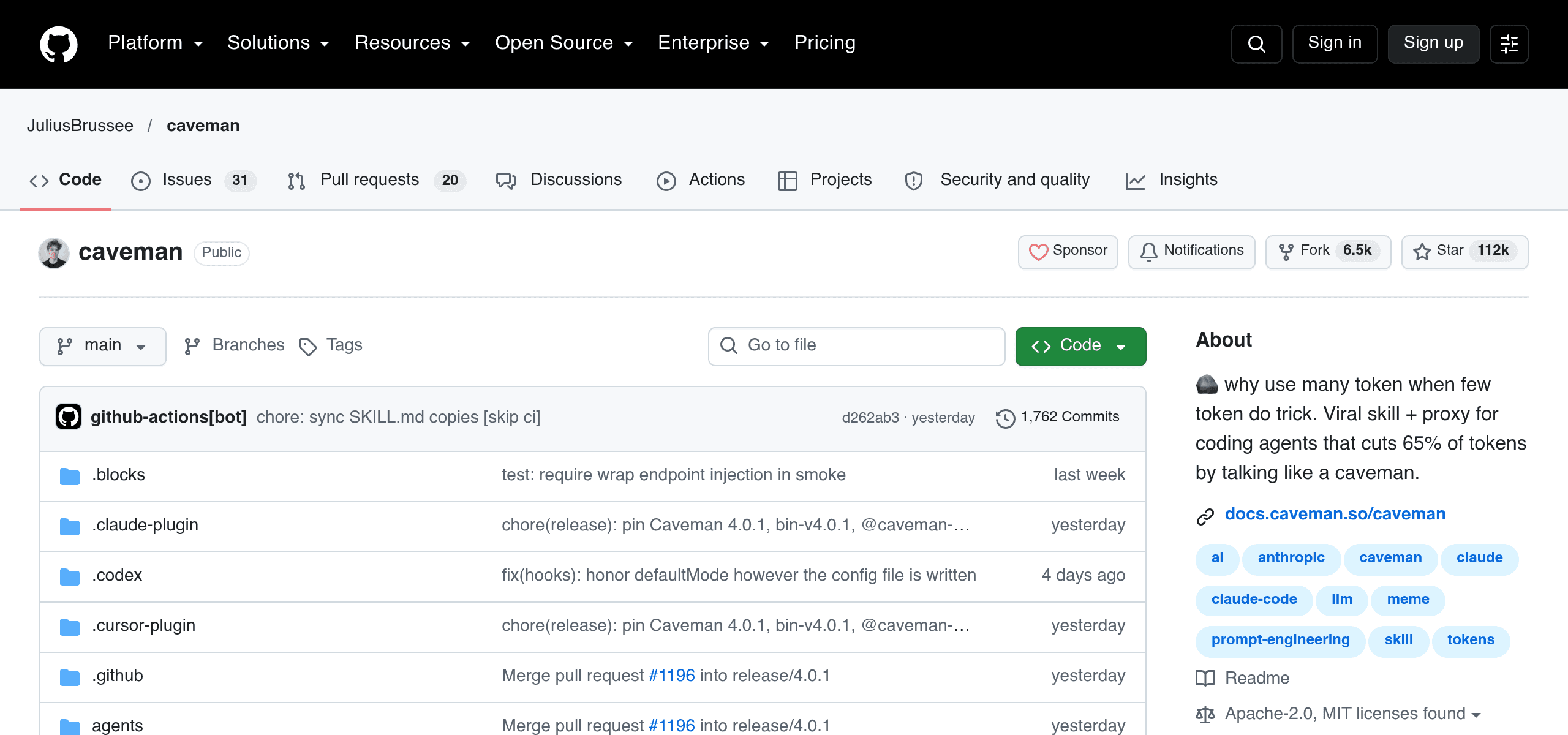
A "caveman" project just shipped 4.0: 112k stars, #1 on Hacker News
Last night (October 13, Beijing time), JuliusBrussee/caveman shipped 4.0.0 and then 4.0.1 within hours. The 4.0.1 notes are refreshingly honest: it fixes what surfaced in the first hours of 4.0.0 — a Windows uninstall bug, a sync that could never catch up on large backlogs, and mode-reset issues on OpenCode 2 and Pi.
How big is this project? Created in April 2026, it now has 112k stars, 6.5k+ forks, 1,762 commits and 51 releases, and has topped both Hacker News and GitHub Trending. Its tagline is a meme in itself: "why use many token when few token do trick." The pitch in one line: make your coding agent say less and read less, keep code quality identical, and cut the token bill by more than half.
For anyone running Claude Code or Codex all day, this is less a toy than a bill optimizer. Installation is one line:
npx @caveman-ai/cli@latestMac, Linux, Windows — after install, 30+ agents on your machine (Claude Code, Codex, Gemini CLI, OpenCode, and more) are all covered. Requires Node.js 22.13+.
Why does "talking like a caveman" actually save tokens? Three layers of engineering
At first glance this looks like a joke project. Take it apart and you find three non-overlapping layers of token engineering, each with measured data. The diagram below shows the architecture: six "rocks," each intercepting a different part of the agent loop.
 Figure 1: Where Caveman 4.0's six "rocks" sit in the coding agent loop. The key design rule: rocks only touch what the agent reads, writes, and runs — your original prompt is never rewritten. Data matches the repo README.
Layer 1: Say less (the output side)
The most famous layer. The author defined a "caveman voice" spec for agents: answer first, one idea per sentence, borrowing from ASD-STE100 — the simplified technical English of aircraft maintenance manuals — max 20 words per sentence, active voice, one term per concept. But three rules are ironclad: negations (not / never / no / only) are never dropped, numbers and units stay exact, and code, commands, paths, and error messages stay verbatim. Security warnings, irreversible actions, and confused users automatically get full sentences back.
The canonical example: the same React re-render question costs 63 tokens normally, 20 in caveman voice, with the fix identical. On ten dev questions with claude-opus-5-5: no instruction 6,983 tokens, "Answer concisely" 4,334, /caveman 4,119, /ultracave 2,693.
A detail worth savoring: the caveman rules themselves cost about 1,160 input tokens. The author states plainly that on per-request billing like GitHub Copilot, shorter answers save you nothing — output compression only matters when you pay per token. That kind of "when NOT to use it" honesty is rare in AI tool marketing.
Layer 2: Read less (the input side — this is the real prize)
The most technically substantial layer, and the easiest to miss behind the meme. JetBrains' A/B test found the key fact: agent sessions are dominated by code and tool calls, not natural language. So "make the AI talk less" has a low ceiling — the real goldmine is "make the AI read less."
Caveman's approach: shrink logs, JSON, CSV, test output, and YAML before the model reads them. Across 54 Claude Code sessions: whole-session input tokens fell from 885,793 to 591,673 — 33.2% fewer — with 18 of 18 answers correct. Single-file compression is even more dramatic: CSV 28,041→314 (98.9%), logs 22,810→348, YAML 20,447→178. Originals stay on your disk; the agent can pull them back anytime.
Again, nothing hidden: HTML has no compressor yet and made sessions 9.9% more expensive; the session runs used an older engine from August 2026; each test file hid one record in 61–72 KB of noise. Your mileage will vary.
Layer 3: Pay per difficulty (Auto model routing)
The headline addition in 4.0. A new "Auto" entry in the model picker lets caveman choose the model and effort per ask: hard questions get the big brain, easy ones get the cheap seats. On 85 real coding tasks (from SWE-Interact and SWE-Together): Opus 5.5 at xhigh every time cost $7.83 per try at 44.3% solved and 35.2 min median; Auto cost $3.59 at 43.7% solved and 15.9 min — 54% cheaper, half the time, roughly the same score.
Note "roughly": the 0.6-point gap is well within noise at n=85 (±7), and the author admits the run is half done. Auto needs a free account login; without it, nothing is sent.
The other three rocks: Blocks, Browse, Waste fixes
Blocks attacks "code mode" waste: instead of one tool call per command, the agent keeps the scripts it writes and re-runs them — one test run went from 397 to 76 tokens. Browse compresses fetched web pages to 1/129.8 of their size before the model reads them. Waste fixes hunts token waste spots; the new trick keeps the prompt cache warm while you pause.
Each rock has its own switch — caveman status shows what's on, caveman off browse turns one off. Only Auto needs an account; everything else runs locally with your own keys and Claude Pro/Max login.
Do the numbers hold up? Independent verification from three outside labs
Self-reported benchmarks are one family's story. What makes Caveman newsworthy is independent verification from three outside parties:
- Adobe Research: the CAVEWOMAN paper cites this repo — caveman-style output across eight models and five datasets cut cost 1.4× to 2.4× per model, up to 3×. It also surfaced a counterintuitive finding: cavemanning your own prompt makes answers worse — the origin of caveman's "never touch the user prompt" rule.
- JetBrains: a paired A/B over 86 real coding tasks found no measurable quality loss (p = 0.82), with 8.5% fewer output tokens.
- Elasticsearch Labs: officially remade caveman mode for Elasticsearch — eight live MCP scenarios, 63.6% fewer response tokens, rated "zero information loss."
 Figure 2: Measured savings per rock, plus independent external verification. Sources: repo README self-benchmarks (54 Claude Code sessions, 85 real coding tasks) and independent verification by Adobe Research, JetBrains, and Elastic.
My take: why vibe coders should install this
First: in the agent era, the bill is dominated by tokens machines read, not tokens humans read. That's caveman's most valuable insight. In 2026 everyone is optimizing prompts and "make the AI shorter," but JetBrains' data is clear: agent sessions are mostly code and tool calls. Caveman's clever move is shifting the battlefield from the output side to the input side and the routing side — compress what the model reads, route by difficulty. Both have far higher ceilings than rhetorical "be concise." For vibe coders running dozens of agent sessions a day, that's real money.
Second: the author's "honesty list" is the best trust signal. Rarely does a 112k-star project list its own weaknesses in the README: no HTML compressor yet, session data from an older engine, Auto's score gap within noise, no savings for per-request Copilot billing. Each item is precise to the number. Not hiding the red rows makes the green rows more believable — the core reason I'm comfortable recommending it as news.
Third: meme + one-line install is a cold-start textbook. "why use many token when few token do trick" is the README in one line: a value proposition you can't forget, meme-driven distribution (ThePrimeagen's reaction video is titled "No way this actually works"), and npx @caveman-ai/cli@latest pushing the install barrier to zero. Vibe coders building products should steal this playbook.
Get started in 30 seconds
npx @caveman-ai/cli@latestAfter that, plain claude is caveman'd automatically; same for Codex, Gemini CLI, OpenCode, and 30+ agents. Only want the voice, no proxy? npx skills add JuliusBrussee/caveman -g, then type /caveman in chat. Changed your mind: npx -y github:JuliusBrussee/caveman -- --uninstall. Claude Code plugin, Gemini extension, and a Windows PowerShell one-liner are all in the README.
Two caveats: 4.0 is two days old and 4.0.1 already fixed a batch of Windows and OpenCode bugs — wait a few 4.0.x patches before production use. And while caveman voice saves tokens, readability for humans still matters in team settings — save the machine's money, not people's comprehension.
Comments (0)
Sources
Related articles
After a $101,872 monthly Devin bill, LiteLLM open-sourced Moyai: dispatch tasks from Slack, let a cloud sandbox do the work, come back to a PR. You pick the agent and the model — but the 79% figure comes with an important footnote.

Google Cloud announced on October 7 that the MCP Toolbox Java SDK has reached v1.0, bringing type-safe agent database access to enterprise Java apps on Spring Boot, Quarkus, and Jakarta EE. The core design keeps the LLM away from the database: tools.yaml maps intents to parameterized SQL, with sensitive bound params pinned server-side. But the 'stable' claim clashes with a breaking change in the release notes, and Java still trails the Python/Go SDKs in features.
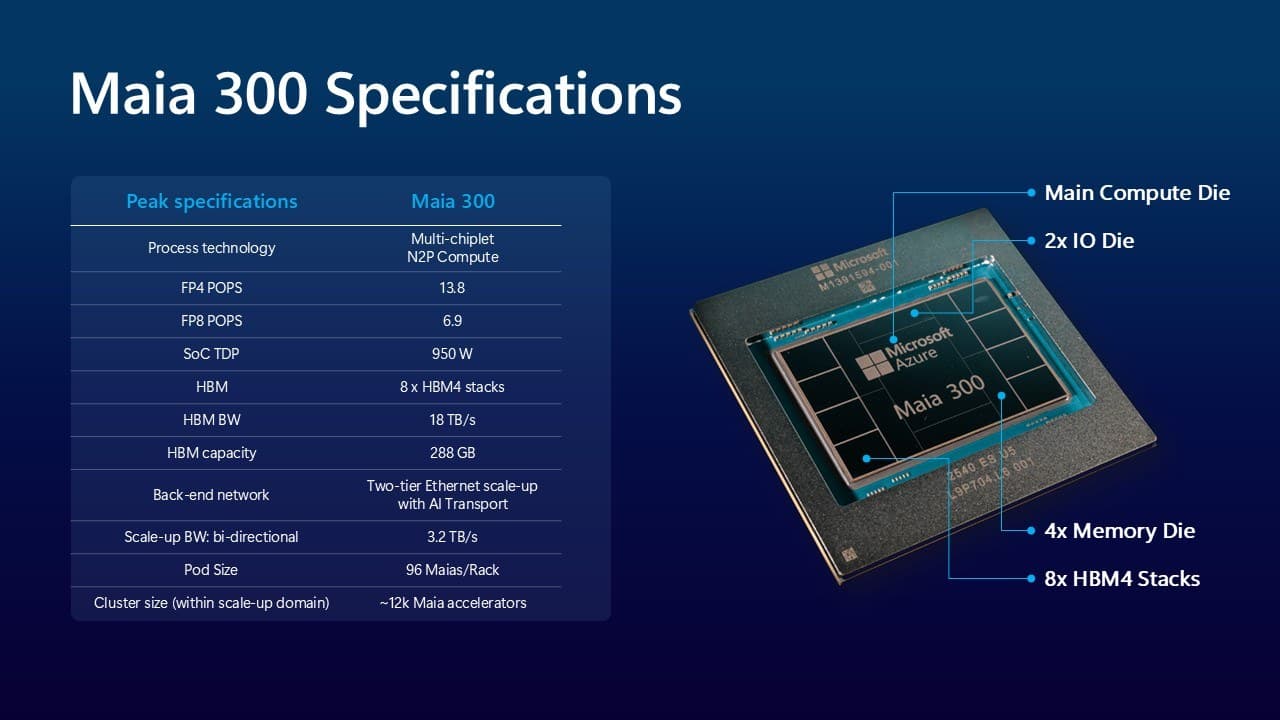
Microsoft unveiled its third-generation Maia 300 AI accelerator on Oct 12, claiming 40% more tokens per megawatt than leading GPU systems (vendor claim, unverified) and scaling to multi-gigawatt deployments from 2027. We break down the official blog post: why Microsoft is betting big on in-house inference silicon in the agent era, and what cheaper inference means for vibe coders.