Cloudflare Takes In Deno: Ryan Dahl Brings the Whole Team to Run Workers on Your Own Servers
Deno's entire team is joining Cloudflare: the runtime gets one more year of maintenance before development ends, and Deno Deploy shuts down in six months. The real bet is celld × workerd — making the Workers programming model first-class on your own servers. And Dahl's core thesis deserves every vibe coder's attention: Durable Objects are becoming the de facto standard for agent infrastructure.
On October 9, 2026, Ryan Dahl published an announcement on the Deno website with a restrained title: "Deno Is Joining Cloudflare." The wording says "joining," but the terms read like an acquisition: the entire Deno team is moving into Cloudflare; the Deno runtime gets one more year of monthly bug-fix and security releases, after which Deno the company stops developing the runtime — the code stays open source and the community is invited to carry it forward; Deno Deploy shuts down in six months, with migration support to Cloudflare Workers for paying customers; the JSR package registry keeps operating with its infrastructure moved to Cloudflare; rusty_v8 continues, with the goal of merging it into Cloudflare's workerd.
At almost the same moment, Kenton Varda published a companion post on the Cloudflare blog. Both sides are telling the same story, and the goal is stated without ambiguity: combine celld (Deno's open-source Durable Objects implementation, released this August) with workerd, so the Workers programming model can run outside Cloudflare's network — on your own servers — as a first-class citizen.
First, the hard terms: what stays, what shuts down
The announcement says "joining," but line up the terms and this is an acquisition plus a clearly written sunset schedule:
- People: Deno's entire team joins Cloudflare. Ryan Dahl and co-founder Bert Belder will lead a new effort — making the Workers programming model an officially supported way to run on self-hosted infrastructure.
- The Deno runtime: one more year of monthly bug-fix and security releases. Around October 2027, Deno the company ends runtime development. The code remains open source, and Deno explicitly invites the community to take it over.
- Deno Deploy: shuts down in six months, i.e. around April 2027. Paying customers get official migration support for moving to Cloudflare Workers.
- JSR: the package registry keeps operating, with its infrastructure moved onto Cloudflare.
- rusty_v8: maintenance continues, with the goal of folding it into Cloudflare's workerd.
What the announcement doesn't say is equally worth noting: Fresh (Deno's web framework), Deno Sandbox (the isolated execution environment for running AI agent code), Subhosting, and enterprise support have no announced future. Subhosting was built on Deploy's infrastructure to begin with. Developers have already pointed out publicly that Supabase's Edge Functions run on Deploy / Subhosting — those downstream vendors now have to produce their own migration plans before April 2027, which doesn't leave CTOs much thinking time.
Migration won't be painless either. Deno's own migration guide only covers simple cases like small request handlers; full web servers and applications are out of scope. Any code calling Deno-specific APIs has to be rewritten for Workers, and for data stored in Deno KV the announcement names no official replacement — teams pick their own and move it themselves.
The real bet: celld × workerd
Set the "acquisition" framing aside for a moment. This deal has exactly one technical bet: celld.
celld shipped as version 0.1.0 on August 5, 2026 — just nine weeks before this announcement. It is an open-source implementation of Durable Objects with a concrete goal: let companies run the Workers + Durable Objects programming model on their own servers, with a standard object-storage bucket as the only outside dependency.
Why does Cloudflare need it? workerd was already open source, but its Durable Objects support could only run single-instance — fine for local testing, incapable of scaling across machines. Cloudflare's production version, meanwhile, depends on an entire operations team and a pile of external services that no other company would want to replicate. In other words, open-source workerd was always missing one piece — "production-grade self-hosting" — and Deno happened to build exactly that piece over the past few months.
So this isn't Cloudflare buying a runtime; it's Cloudflare hiring, wholesale, the people who built the missing piece. Dahl and Belder's job from here is to fold celld's code into workerd and make "self-hosting" an officially supported way to run Workers. Kenton Varda's companion post on the Cloudflare blog says it even more plainly: two companies speaking on the same day about one platform, not two runtimes.
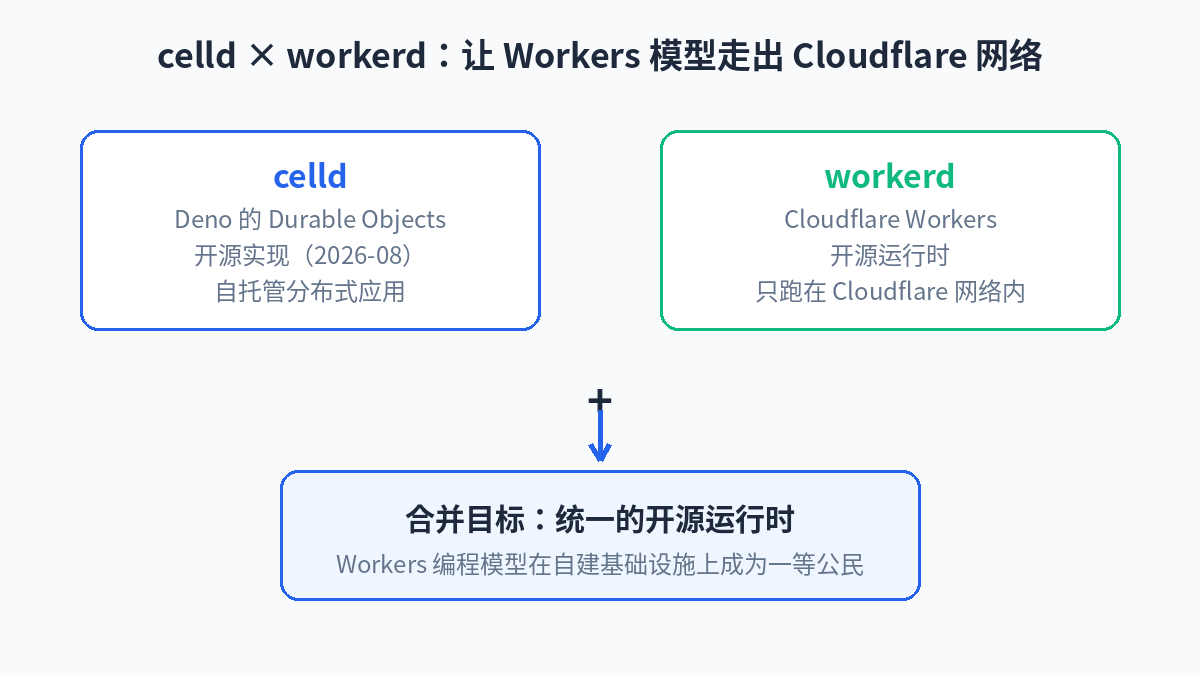 The celld × workerd merger goal: let the Workers programming model run across machines outside Cloudflare's network
There's a commercial calculation underneath. Cloudflare openly admits some of its largest customers have always wanted an "exit option." Back in 2022, Shopify told Cloudflare it couldn't build on Workers unless the underlying software was open source — which is how workerd got open-sourced. Now, with self-hosting completed, Cloudflare can tell large customers who "won't go on public cloud": start with us, and if you ever want to leave, the code and the programming model go with you. The more credible the exit option, the easier the big deals are to sign. This acquisition is a sales weapon first and a technology merger second.
Someone has run the cost numbers too: one third-party review put 100 Durable Objects for a month at $416.51 on Cloudflare versus $48 on a single celld server. But that's a vendor comparison of one narrow case — entertaining, not decisive. The same review warns that celld is still early-stage software, not yet safe for running untrusted outside code on the same machine. Self-hosting's discount comes with its own price tag.
Dahl's core thesis: Durable Objects are the natural substrate for agents
The line in the announcement most worth underlining for vibe coders isn't an acquisition term — it's Dahl's one-sentence thesis: Durable Objects pack cheap serverless execution, persistent state, WebSockets, and a JavaScript interface into a single thing, and that is exactly the substrate an agent harness needs.
Think about what agents are actually paying for: compute cheap enough to deploy at scale (experimentation has to be cheap), persistent state that "remembers what it was doing" (context can't be dropped), long-lived connections (WebSockets) for continuous interaction with people and tools, and an interface any JavaScript developer can pick up immediately. Durable Objects weld those four together by design — each object is an independent unit with its own small database, a natural fit for "one agent session" or "one agent instance." And scaling doesn't mean adding machines and editing configs; it means spawning more objects.
Dahl's move carries even more signal: he publicly invited people building agents at scale to email him directly. That's not politeness. A founder who just folded his company into a giant, holding the direction of a next-generation platform, doesn't lack money right now — he lacks feedback from real workloads. He's recruiting the first wave of agent teams to bet on celld × workerd, and your production pain points are his roadmap input.
Connect the dots of Dahl's trajectory and it gets clearer: Deno → Deno Deploy → celld, and the destination was never "yet another runtime" — it was "Durable Objects + the Workers programming model." He built Node.js in 2009, built Deno in 2018 to fix Node's security model and package management, and this time he changed the answer from "a different runtime" to "a different programming model." He's been fighting the runtime war for seventeen years; now he's decided the layer worth fighting for is the one above it.
The three-way race is over? Don't write the obituary yet
The JavaScript runtime "three-way race" — Node.js, Deno, Bun — just got its landmark closing chapter with this acquisition. Remember that in 2022 Deno was still working with Node.js and Cloudflare on runtime interoperability, and Dahl publicly called Workers Deno Deploy's "closest competitor." Four years later, he's bringing his entire team to build on his competitor's programming model. In business there are no permanent enemies, only roads that didn't work out.
On Hacker News the story hit 851 points and 467 comments, with the thread splitting roughly into two camps: one doing the migration math for Deno Deploy, the other debating a bigger question — is "acquisition + gradual sunset" the best ending an open-source company can get?
My judgment: this is a dignified exit, dignified enough for the textbooks. A clear timetable (one year of runtime maintenance, six months to Deploy's shutdown), migration support (paying customers get help), code left in the open-source community (welcome to take over), and the ecosystem's key piece (JSR) getting a new home. Compare that with this industry's usual endings — sudden shutdowns, slow rot, code locked into private repos — and Deno gave its users a choice at every step. Doing "losing" this methodically is itself a capability.
But don't write Deno's obituary just yet. The runtime war is over; the war just moved up a layer to the "programming model": the contest is no longer whose JavaScript runs fastest, but how simple "writing distributed applications" itself can become. Dahl is betting on the latter, and Cloudflare is willing to pay for that bet.
What this means for vibe coders
All of that said, here's what it means for those of us who write code with AI and treat prompts as productivity — five layers:
First, understanding Durable Objects matters far more than chasing the next new runtime. Over the next year or two, the de facto standard for agent infrastructure will most likely look exactly like this: cheap compute + persistent state + long-lived connections + a JavaScript interface. Spending one afternoon internalizing the mental model of "each agent session is a stateful, independent unit" is worth more than following ten new runtimes' release notes. Runtimes die; programming models live.
Second, if you're running things on Deno Deploy, start planning the migration now. Six months sounds long, but once Deno-specific API rewrites and Deno KV data moves enter the picture, time goes faster than you think. Workers is the officially designated destination; meanwhile third parties (Appwrite among them) are already competing for this migration wave — it costs nothing to compare.
Third, if you only use Deno locally to write code, don't panic. A year of maintenance with monthly security updates is plenty of time to decide. JSR keeps operating, so the packages you depend on won't vanish overnight. The one real to-do: stop deeply binding new projects to Deno-specific APIs.
Fourth, a flare for agent builders: Dahl is looking for you. If you're building agent systems at scale — multi-agent orchestration, long-running agents, agent infrastructure itself — Dahl has publicly said to reach out directly. Founders at his level don't personally collect feedback with a short window very often. More importantly, it confirms where Cloudflare's firepower is aimed next: agent workloads. Learning Durable Objects now means learning the lingua franca of agent infra for the next two years.
Fifth, and the biggest call: in the vibe coding era, the runtime itself matters less and less — the programming model is what matters. What your code looks like, where state lives, how it scales, how it grows from one machine to a thousand — the answers are moving from "the ops manual" into "part of the programming language." Dahl spent seventeen years going from Node to Deno and from Deno to Durable Objects, and the lesson for vibe coders is one sentence: when you pick sides, pick the model, not the runtime.
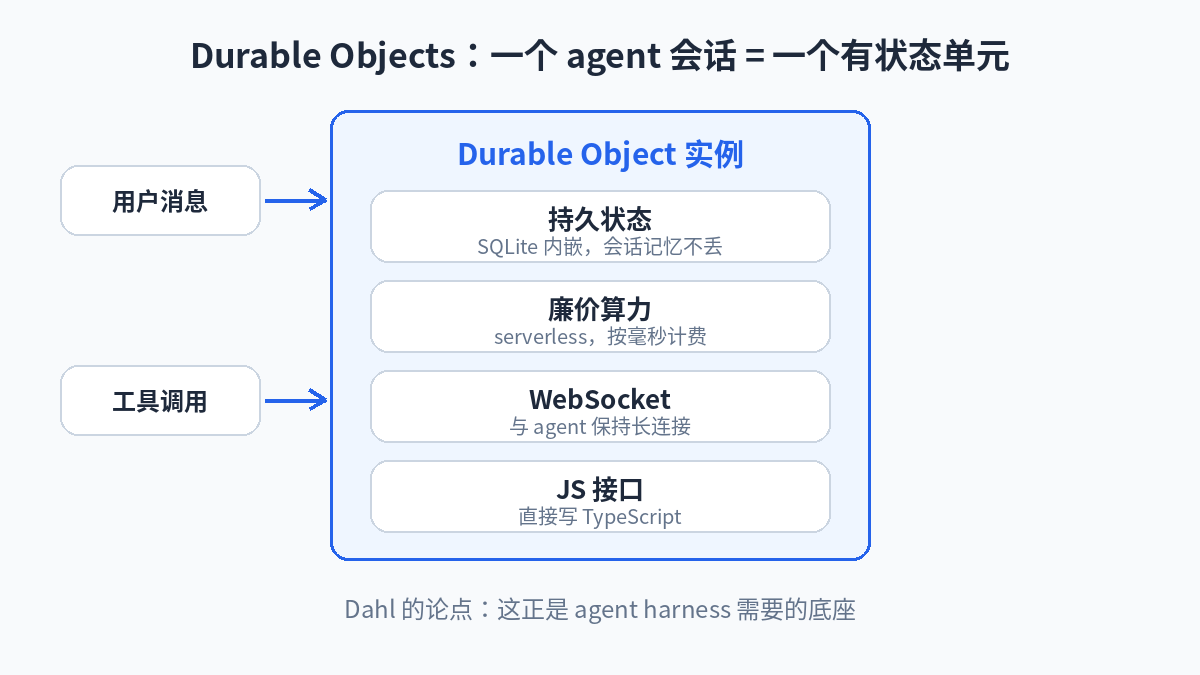 The Durable Objects mental model: one agent session = one independent unit with persistent state
Epilogue
Seventeen years ago, Dahl taught the world to write servers in JavaScript with Node.js; eight years ago, he tried to fix Node's original sins with Deno; this time, he's done building runtimes — he's going after why distributed applications are so hard to write. As of October 9, that battlefield is called workerd + celld, and the first test is whether it can become the default substrate of the agent era.
Date transparency note: the original deno.com announcement could not be opened directly; facts in this article were cross-verified against two independent sources — RuntimeWire (published October 9, 2026, primary source: Deno) and Shashi Bellamkonda (October 9, 2026); HN engagement figures (851 points / 467 comments) were cross-confirmed via the Hacker News front-page roundup.
Sources
Related articles
Codex desktop beta adds Composer predictions: after each response, a suggested next sentence appears in the input box. Tab to accept, review, then send. Free during beta and on by default, it shifts the cognitive load from wording intent to verifying it — but a suggestion is never an instruction.
On October 8, 2026, Harness announced the acquisition of select Augment Code assets, with Cosmos becoming the 'Harness Cosmos Software Factory Agent.' This piece breaks down what was bought, how the software factory works, Harness's agent-to-agent loop, and what it means for vibe coders.

Google's Nano Banana 2.1 is GA: image output tokens halved to $30 per million ($0.0336 per 1K image), but input tripled to $1.50 per million. We run the monthly math for a typical vibe project generating 200 images a week — plus a migration checklist for the deprecated Nano Banana 2.