Nano Banana 2.1 Is GA: Image API Prices Halved, Input Tripled — Running the Numbers for Vibe Coders
Google's Nano Banana 2.1 is GA: image output tokens halved to $30 per million ($0.0336 per 1K image), but input tripled to $1.50 per million. We run the monthly math for a typical vibe project generating 200 images a week — plus a migration checklist for the deprecated Nano Banana 2.
The bottom line first: output halved is real, and so is the input price hike
On October 6, Google announced in the Gemini API changelog that Nano Banana 2.1 is generally available (API ID: gemini-nano-banana-2.1), positioned as the "latest high-efficiency image generation and conversational editing model" and the successor to Nano Banana 2 (a.k.a. gemini-3.1-flash-image). On the same day, the older model entered deprecation.
Price is the part of this release most worth reading closely. The official pricing page states it in black and white: image output tokens dropped from $60 to $30 per million, so a 1K image (1024×1024) went from $0.067 to $0.0336 and a 2K image from $0.101 to $0.0504 — precisely halved in both cases. But input pricing for text/image/video rose from $0.50 to $1.50 per million tokens — tripled.
So "image API prices halved, but input got more expensive" in the headline isn't hype; it's literal. The real question: for people who actually build products on it, does the math work out in your favor or not? This article does exactly one thing — runs the numbers for you.
1. What actually shipped
Here are the facts as stated in the official changelog (October 6, 2026 entry), with no secondhand interpretation mixed in:
- New model GA: gemini-nano-banana-2.1, maintaining Flash-level speed and cost efficiency, with five stated improvements — visual quality, prompt adherence, multi-turn character consistency, text rendering, and wide/panoramic aspect ratio (1:4, 4:1, 1:8, 8:1) generation quality at 1K, 2K, and 4K resolutions.
- Old model retiring: gemini-3.1-flash-image was marked deprecated the same day. The official deprecations page (updated October 9) says "No shutdown date announced" — no shutdown date has been published, and the recommended replacement is gemini-nano-banana-2.1.
- API identity: the model string is simply gemini-nano-banana-2.1; migration is mostly about changing that ID.
Launch-day press coverage also reported that 2.1 is rolling out to the Gemini app, AI Mode in Search, Google Ads, and on the developer side AI Studio, Flow, and Stitch. Note this is the press's account — the official changelog only covers the API GA, so treat the product rollout as subject to each product's actual updates.
One more data point worth knowing: in the October 6 snapshot of the Arena text-to-image leaderboard, Nano Banana 2.1 scored 1328 and ranked #5 — the highest-scoring Google model. The score is marked preliminary, so don't enshrine the ranking, but the direction is clear: Google's efficient image line has entered the top tier's line of sight for the first time.
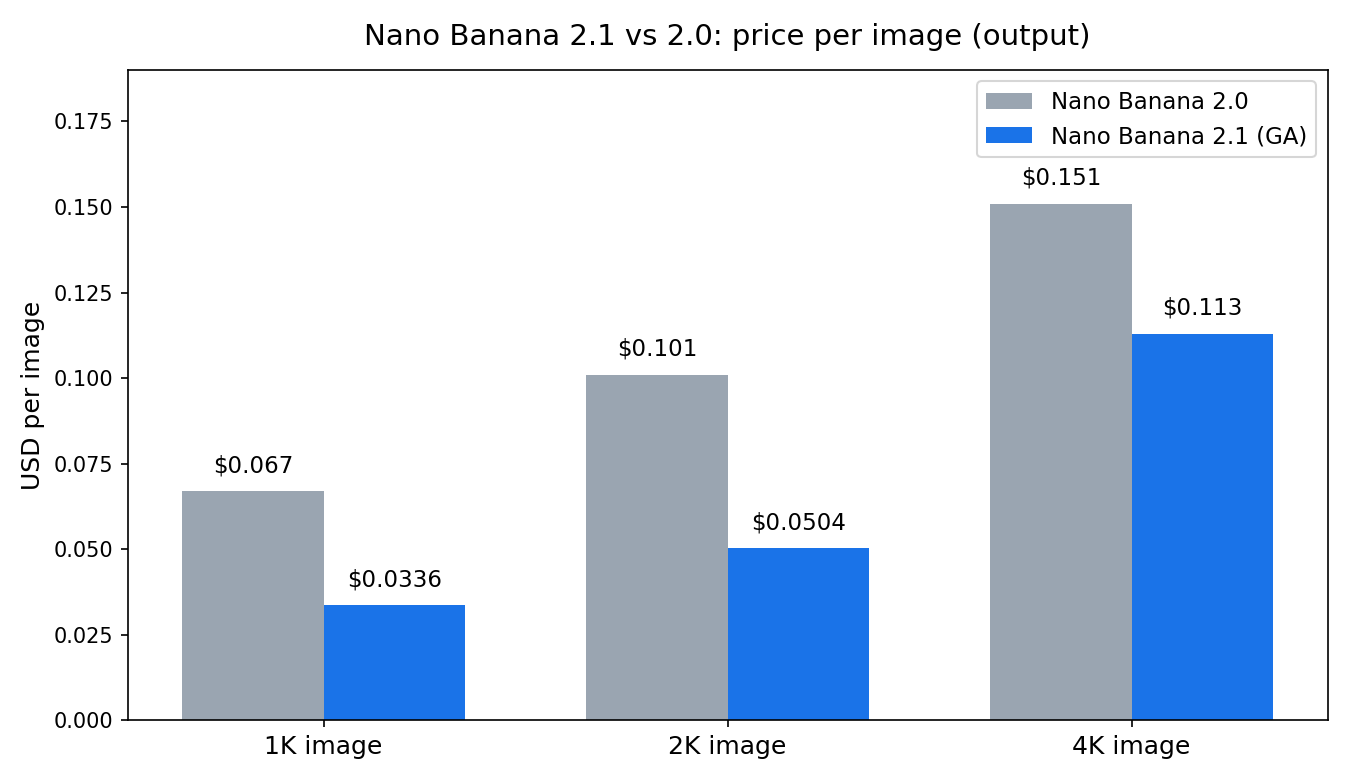 Nano Banana 2.1 pricing changes at a glance: image output token price halved, input token price tripled. Source: official Google Gemini API pricing page.
2. Price showdown: 2.1 vs 2.0 in one table
Every number below comes from Google's official Gemini API pricing page (paid tier, standard pricing), checked item by item:
| Item | Nano Banana 2.0 (gemini-3.1-flash-image) | Nano Banana 2.1 (gemini-nano-banana-2.1) | Change |
|---|---|---|---|
| Input (text/image/video) | $0.50 / 1M tokens | $1.50 / 1M tokens | 3× increase |
| Image output | $60 / 1M tokens | $30 / 1M tokens | Halved |
| 1K image (1120 tokens) | $0.067 | $0.0336 | Halved |
| 2K image (1680 tokens) | $0.101 | $0.0504 | Halved |
| 4K image (2520 → 3780 tokens) | $0.151 | $0.113 | ~25% cheaper |
| Batch API image output | $30 / 1M tokens | $15 / 1M tokens | Halved |
| Batch API per image (1K / 2K / 4K) | $0.034 / $0.050 / $0.076 | $0.0168 / $0.0252 / $0.0567 | Roughly halved |
Three details deserve to be called out individually:
First, 4K is the exception. A 4K image on 2.1 consumes 3780 tokens — 50% more than 2.0's 2520. Even with the per-token price halved, the per-image price only fell from $0.151 to $0.113, about a 25% cut, nowhere near "halved." If you're a heavy 4K user, don't let the headlines fool you: you're saving a quarter, not half.
Second, the Batch API is still half price. The pricing page explicitly notes the Batch API's 50% cost reduction; on 2.1, Batch image output is $15 per million tokens, or $0.0168 per 1K image — a thousand images for $16.80. That price has entered "don't even think about it" territory.
Third, an early briefing floating around put 4K at $0.0756 — that's wrong. The pricing page footnote is unambiguous: a 4K image consumes 3780 tokens, equivalent to $0.113 at $30 per million. I went with the pricing page for this article; forget the $0.0756 figure entirely.
3. Running the numbers: monthly cost for a typical vibe project
Suppose you're an indie developer generating 200 product illustrations/OG images per week via the API, all at 1K resolution. Prompts are estimated at 150 text tokens each (a "dark tech-style product shot, centered on…" style prompt lands about there). A month is 4.33 weeks. All working is shown — feel free to check it with a calculator.
Scenario A: one-shot, no rework (standard pricing)
| Nano Banana 2.0 | Nano Banana 2.1 | |
|---|---|---|
| Weekly output (200 × per-image) | 200 × $0.067 = $13.40 | 200 × $0.0336 = $6.72 |
| Weekly input (200 × 150 tokens) | 30K tokens × $0.50/1M = $0.015 | 30K tokens × $1.50/1M = $0.045 |
| Weekly total | $13.415 | $6.765 |
| Monthly total | ~$58.1 | ~$29.3 |
Verdict: about $28.80 saved per month, roughly a 50% cut. A tripled input price sounds scary, but in absolute terms the increase on 30K tokens is three cents — negligible next to output costs. That's the most common real-world feel of the "output halved, input hiked" structure: as long as you're genuinely generating images rather than using it as a text analyzer, the ledger is firmly in your favor.
Scenario B: conversational editing, two revision rounds per image on average
This is the Nano Banana family's real sweet spot: generate a first draft, then "make the background white" / "enlarge the title text" over multiple turns. Assume 3 generations per image (initial + 2 edits), 150 input text tokens per round (input tokens for passing reference images back are excluded here — see the note below).
| Nano Banana 2.0 | Nano Banana 2.1 | |
|---|---|---|
| Output per image (3 × per-image) | $0.201 | $0.1008 |
| Input per image (450 tokens) | $0.000225 | $0.000675 |
| Weekly total (200 images) | ~$40.25 | ~$20.30 |
| Monthly total | ~$174.3 | ~$87.9 |
Verdict: about $86 saved per month, roughly 50%. Multi-turn editing saves more in absolute dollars — because every edit round is "output," and output is exactly the side that got cheaper. One caveat: if you pass the previous render back as a reference image each round, input tokens rise noticeably (images are tokenized by resolution), and the pricing page doesn't publish input-image token counts, so the table excludes them. But the order of magnitude is safe: feeding back one 1K image costs thousandths of a dollar in input — still an order of magnitude below one output image ($0.0336).
Scenario C: Batch API for bulk runs (one-shot)
| Nano Banana 2.0 | Nano Banana 2.1 | |
|---|---|---|
| Weekly output (200 1K images) | 200 × $0.034 = $6.80 | 200 × $0.0168 = $3.36 |
| Weekly input | $0.0075 | $0.0225 |
| Monthly total | ~$29.5 | ~$14.7 |
Verdict: under $15 a month for 800+ images. The Batch API already carried a 50% discount; stacked on 2.1's cut, bulk-generation costs are now low enough to stop calculating — ideal for pipelines that crank out blog illustrations or product shots on a fixed weekly schedule.
Scenario D: how to choose between 2K and 4K
Output cost per 1,000 images (standard pricing, input excluded):
| Resolution | 2.0 / 1K images | 2.1 / 1K images | Savings |
|---|---|---|---|
| 1K | $67 | $33.6 | 50% |
| 2K | $101 | $50.4 | 50% |
| 4K | $151 | $113 | ~25% |
Practical advice for vibe coders: OG images, article illustrations, and social graphics are perfectly fine at 1K — take the full 50% cut. 2K suits product-site hero images. 4K, unless you're printing or displaying on large screens, is clearly worse value than the other two — it only got a quarter cheaper.
A counterintuitive question: could 2.1 ever cost MORE than 2.0?
Yes, but only under extreme conditions. The break-even point: a 1K image saves $0.0336 on output while input costs $1.00 more per million tokens. For the input hike to eat the output savings, one image would need 0.0336 ÷ (1/1,000,000) = 33,600 input tokens. In other words, unless you're stuffing 33K+ tokens of context into a single request (tens of pages of documents or a dozen hi-res reference images per generation), 2.1 is always cheaper. No normal image-generation workflow gets near that number.
4. Reading the pricing logic: what Google is actually incentivizing
"Output cheaper, input pricier" isn't a random combination — it's a coherent pricing philosophy, and understanding it helps you adjust how you use the API:
First, honest pricing for both sides of the cost. Image synthesis tokens got cheaper because the model genuinely got more efficient — the same 1120 tokens now render a better 1K image, and Google passed the efficiency gain to users. Multimodal understanding (parsing your prompt, reference images, and multi-turn context) is the more expensive compute, and $1.50 per million input tokens is closer to its true cost. The old $0.50 input price was arguably subsidized; the subsidy has now moved to the output side.
Second, it rewards "short prompt + multi-turn editing" over "one giant prompt, one big gamble." Think about it: cramming a 2,000-word spec into a single prompt to nail it in one shot costs 3× more on input under 2.1; but splitting the work into "short prompt for a first draft + conversational refinement" means every edit round enjoys half-price output while the short prompt's input hike is barely felt. The pricing nudges you toward the interaction style Nano Banana is best at — the "conversational editing" half of its product positioning.
Third, bulk workloads get extra love. The Batch API's 50% reduction stays, and stacked with the cut, a 1K image costs $0.0168 — Google clearly wants pipeline users who generate hundreds of images on a fixed schedule locked into its ecosystem. That price undercuts open-source self-hosting too: once you add up GPU ops overhead, calling this API likely beats running your own rig.
Google's bet in one sentence: make the act of "rendering pixels" too cheap to think about, and make the context of "figuring out what to render" the new center of the bill. The optimal strategy for vibe coders follows directly: write short, precise prompts, iterate freely across turns, and run bulk jobs through Batch.
5. Better text rendering: what it really means for poster-style use cases
Of the five improvements in the changelog, "text rendering" may be the most practical one for indie developers. Why? Because one of the most common things vibe coders generate with image APIs is images with words on them: OG images (headline + subheadline), blog covers, event posters, video thumbnails.
Anyone who's used the older models knows the pain: ask for a poster reading "SALE 50% OFF" and it renders the letters as alien script, or "50%%". So the real workflow became: generate → spot the typo → regenerate → still wrong → give up and overlay text in code. Retries are a cost too.
An "effective cost" calculation shows why the improvement matters. Suppose rework rates for text-heavy images were 40% in the 2.0 era (not an exaggeration), and 2.1 brings that down to 15% (Google's claimed improvement — verify it yourself):
- 2.0 effective cost per usable text image: $0.067 ÷ (1 − 0.4) ≈ $0.112
- 2.1 effective cost per usable text image: $0.0336 ÷ (1 − 0.15) ≈ $0.0395
That's about a 65% reduction — bigger than the headline price cut, because quality gains and price cuts multiply rather than add. This is the easiest point in the whole article to underestimate: the halved sticker price is visible, the lower rework rate is invisible, and their product is what actually shows up in your ledger. The 40%→15% figures are my illustrative assumption, of course — run a dozen of your own poster templates on 2.1 to verify. At 3 cents an image, the experiment costs essentially nothing.
Related: the improved extreme aspect ratios (1:8, 8:1) at 2K/4K directly benefit banner ads, phone wallpapers, and panoramic headers. These ratios used to produce tiling artifacts, forcing people to generate at 16:9 and crop — now you can generate at the target ratio directly, saving yet another step.
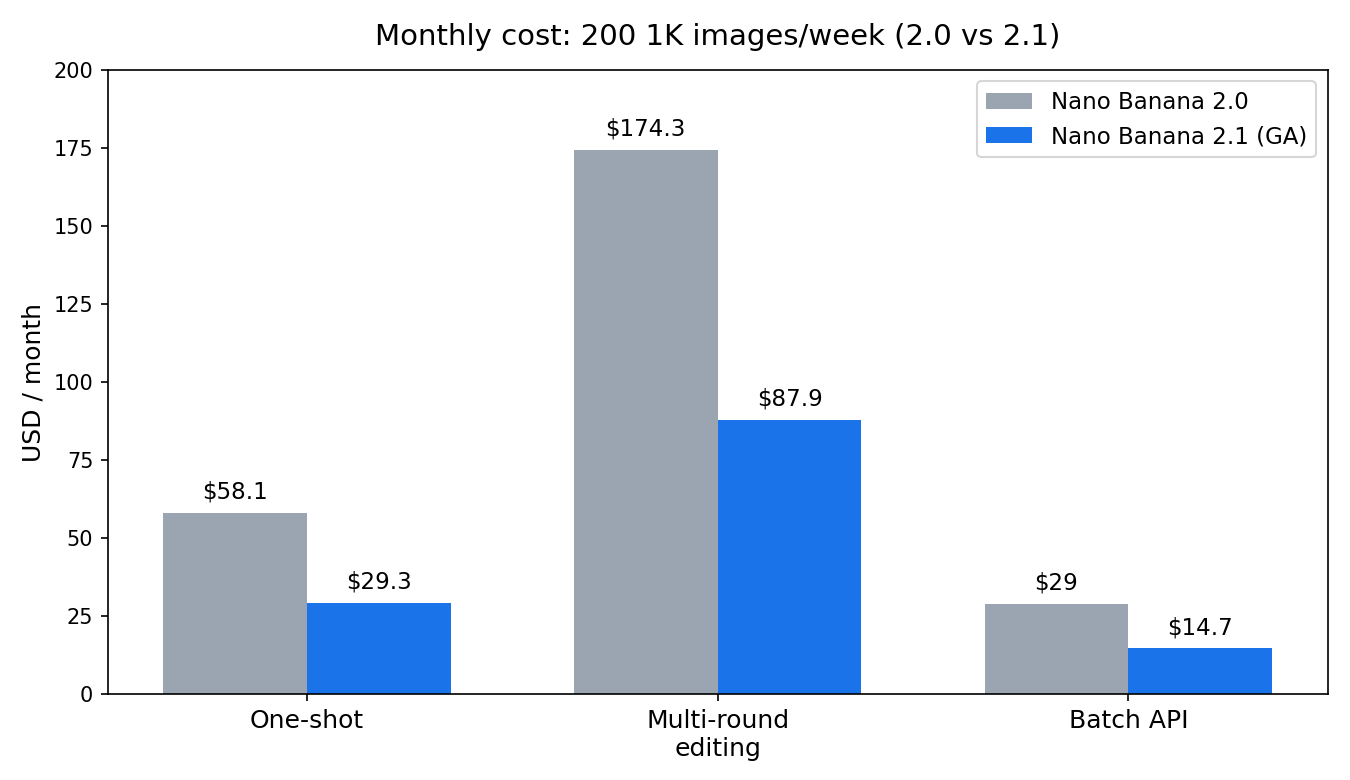 Monthly cost for a typical vibe project (200 1K images/week): across one-shot generation, multi-turn editing, and Batch bulk runs, 2.1 cuts costs by ~50% vs 2.0. Calculated from official pricing page data.
6. Deprecation migration checklist: old-model users should act this week
gemini-3.1-flash-image is deprecated. The official deprecations page (updated October 9) says "No shutdown date announced" — no shutdown date has been published. Rumors of an October 29 shutdown are circulating, but the official page doesn't confirm them; I'm going with the official word here: unannounced means unannounced. Don't panic — but don't dawdle either. By Google's usual pattern, a shutdown date can be added to the deprecation notice at any time.
The migration checklist, in order — an afternoon's work:
- Change the model ID: replace gemini-3.1-flash-image with gemini-nano-banana-2.1 everywhere. Grep the whole codebase first — don't miss hardcoded strings in env vars and config files.
- Update cost dashboards: if you monitor usage/spend, note that 4K token consumption changed from 2520 to 3780 per image — old "images × price" estimates will undercount 4K costs; compute from tokens × price to stay accurate.
- Audit input-heavy flows: input tripled in price, so check for "giant prompt + piles of reference images" call patterns and trim prompts where you can. Remember the break-even is 33K input tokens per image — far away means nothing to change.
- Test text rendering yourself: run a small batch of your own text-bearing templates (OG images, posters) and compare rework rates. This is 2.1's most verification-worthy improvement.
- Try the extreme aspect ratios: if you were working around 1:8/8:1 quality issues (generate at 16:9, then crop), generate at the target ratio directly now and simplify the pipeline.
- Evaluate the Batch API: move fixed bulk jobs (weekly blog art, product shots) to Batch — $0.0168 per 1K image is a price with no argument against it.
- Watch the deprecations page: the moment a shutdown date is published, schedule around it. Bookmark the deprecations page or add it to your monitoring.
7. What #5 on the leaderboard means — and doesn't
"1328 points, #5, Google's highest" needs unpacking. What it means: Google's efficient image line has, for the first time, entered the top tier's field of view in public blind testing — a strong rebuttal to the "cheap can't be good" reflex. It also means 2.1's prompt adherence and visual quality genuinely clear the usability bar; no model scores there on price alone.
What it doesn't mean: four models still sit above it; the score is preliminary and rankings will move; and most importantly, Arena measures blind-test preference — not your brand poster's first-pass acceptance rate or your pipeline's monthly bill. Leaderboards decide who you test first; the ledger decides who you ship with — and this article has already done the ledger part.
8. Three concrete moves for vibe coders: turn the pricing change into workflow
The math is done and the logic is clear — now it comes down to the keyboard. Three moves, ordered from smallest to largest effort:
Move one: put your prompt templates on a diet. With input tripled in price, the first thing to check is the "just in case" filler in your templates. Many people's generation prompts look like this: 200 words of brand-tone preamble, 300 words of negative list (no six-fingered hands, no watermarks, no…), and only then what to actually draw. That was fine in the 2.0 era when input was cheap; now every thousand tokens costs $0.0015. Practical advice: trim the negative list to the 5 items that have actually bitten you, distill brand tone into 3 keywords (e.g., "dark, minimal, high-contrast"), and keep each round's prompt at 150–200 tokens. At Scenario A's volume, that saves tens of dollars a year in pure input spend — not much, but it's pure waste, so take it.
Move two: build multi-turn editing into your pipeline instead of calling the API once. Many people used to work as "one giant prompt → one call → unhappy → tweak prompt → call again" — iterating on the prompt side. The new pricing says: iterate on the conversation side instead. Round one uses a 100-token short prompt for a first draft; then 20–30-token micro-instructions like "change the primary color from blue to orange" or "make the headline one size bigger." Every round's output enjoys the halved price, and the short instructions' input hike is negligible. The multi-turn character consistency improvement highlighted in the changelog exists precisely for this workflow — the same character or product surviving five or six rounds of edits without drifting is what makes such a pipeline trustworthy.
Move three: add a cost dashboard to your image pipeline, tracking both "cost per image" and "cost per usable image." Watching only "how much did the API bill" isn't enough. Track two numbers: nominal per-image cost (bill ÷ images generated) and usable per-image cost (bill ÷ images approved). In the 2.1 era the gap between them should narrow — better text rendering and prompt adherence directly compress rework rates. If after two weeks your usable per-image cost dropped more than 50%, the quality gains materialized in your scenario; if it only dropped ~40%, your rework was already low and most savings came from the sticker price. That data decides whether your next optimization should target rework or unit price (switching to Batch).
None of these moves requires waiting — all can be done today. The real danger of a pricing change isn't the hike; it's running your old workflow against the new price sheet. That's what actually costs you money.
One-sentence advice
If you're generating product art, OG images, or marketing creatives on Nano Banana 2 today: switch the model ID to gemini-nano-banana-2.1 this week, tighten your prompts, and route bulk jobs through the Batch API — same workload, half the monthly bill, better quality. When a vendor serves you "cheaper + better + old version deprecated" all at once, every day of hesitation is money left on the table.
All prices in this article come from Google's official Gemini API pricing page (paid tier, standard pricing); GA and deprecation facts from the official changelog's October 6, 2026 entry and the deprecations page (updated October 9). The Arena score is from the October 6 leaderboard snapshot cited in launch-day coverage (preliminary). Prices follow the official page's live data; calculations are for reference only.
Sources
Related articles
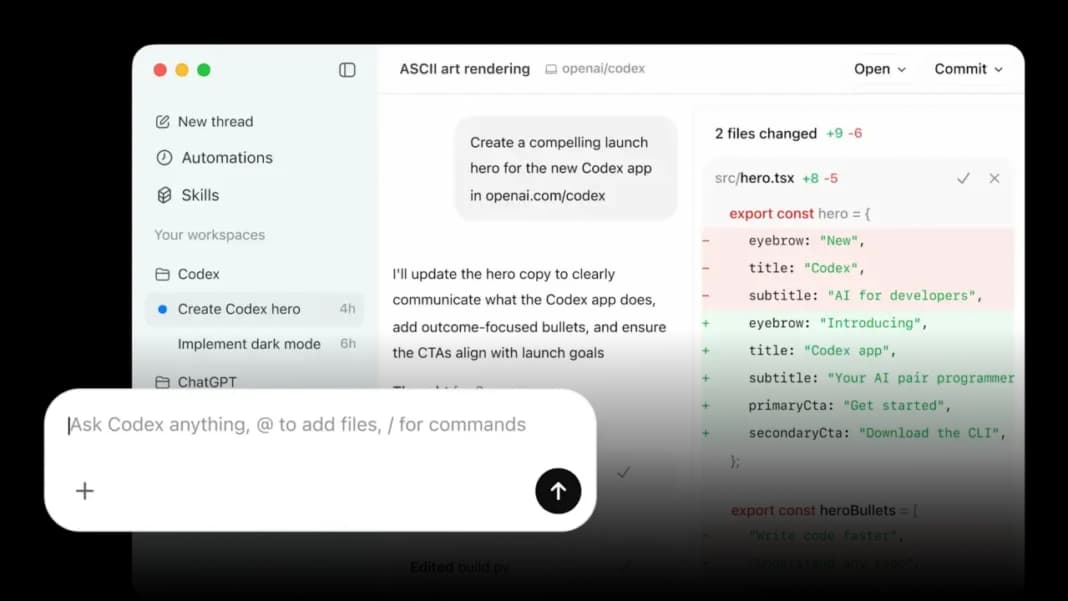
Codex desktop beta adds Composer predictions: after each response, a suggested next sentence appears in the input box. Tab to accept, review, then send. Free during beta and on by default, it shifts the cognitive load from wording intent to verifying it — but a suggestion is never an instruction.
On October 8, 2026, Harness announced the acquisition of select Augment Code assets, with Cosmos becoming the 'Harness Cosmos Software Factory Agent.' This piece breaks down what was bought, how the software factory works, Harness's agent-to-agent loop, and what it means for vibe coders.
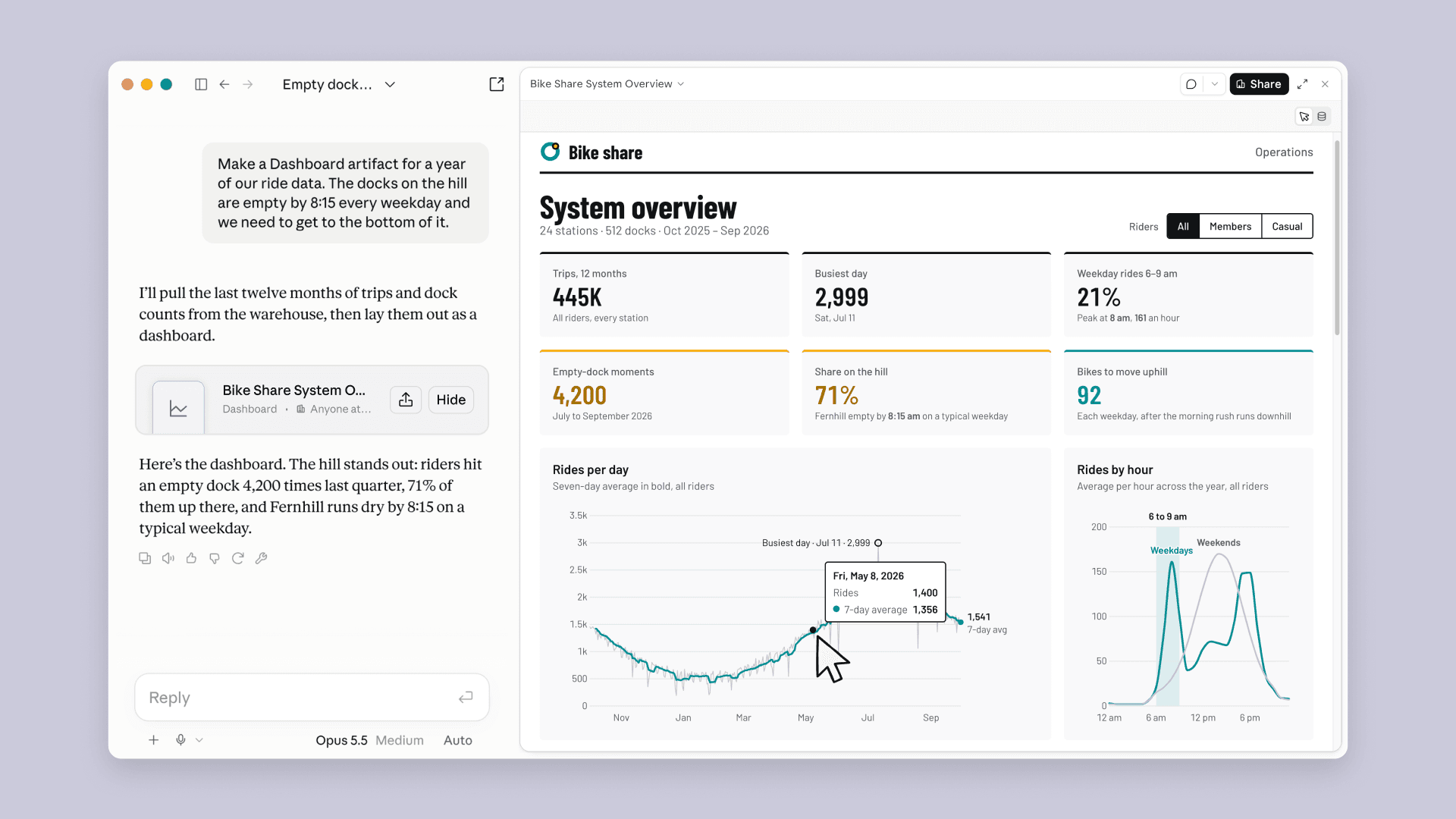
On October 8, 2026, Anthropic put Claude Dashboards and Claude Motion into beta: dashboards built from plain-language questions on live company data, and animations generated as editable code rather than video-model footage. Docs, Slides, and Design went GA on all plans, with 45M+ artifacts created to date.