Harness Acquires Augment Code: Cosmos Becomes the 'Software Factory Agent', Bridging Idea to Production
On October 8, 2026, Harness announced the acquisition of select Augment Code assets, with Cosmos becoming the 'Harness Cosmos Software Factory Agent.' This piece breaks down what was bought, how the software factory works, Harness's agent-to-agent loop, and what it means for vibe coders.
On October 8, 2026, Harness announced it has acquired select Augment Code assets: Cosmos, the Auggie CLI, the Code Context Engine, and related technology. The team behind these products is joining Harness; terms were not disclosed. Cosmos will become the "Harness Cosmos Software Factory Agent" — a software factory made of fleets of AI agents that take engineering work from idea to merge-ready code. It is another landmark consolidation in the AI coding race: the agents that write code are being absorbed by the platforms that ship it.
What the deal actually bought
Note the press release's wording: Harness acquired select Augment Code assets, not the whole company. The package has three parts — Cosmos (the multi-agent software factory), the Auggie CLI (the coding agent in the terminal), and the Code Context Engine, plus related technology — along with "the team behind these products," which is joining Harness outright. Deal terms were not disclosed.
"Select assets" is worth a second look. It means Harness wanted the products, the technology, and the people — not Augment's corporate entity, contractual baggage, or debt. A clean deal for the buyer; for Augment's remaining business and shareholders, the story is clearly unfinished — but the press release says nothing about it.
Who is Augment Code? Founded in 2022, the company came out of stealth in April 2024 with $252 million in funding at a $977 million valuation. Its co-founders are ex-Microsoft engineer Igor Ostrovsky and ex-Google AI researcher Guy Gur-Ari, backed by Eric Schmidt, Sutter Hill, Index, Lightspeed, and other top-tier investors. It was once seen as one of the most credible challengers to GitHub Copilot, known for deep codebase understanding: a 200K context window and cross-session Memories were its signature features.
But life has been hard for standalone AI coding tools. In October 2025, Augment switched billing from per-message to AI-usage-based pricing, and some users calculated the new price was more than ten times higher — the community backlash was widely reported by The Register. High acquisition costs, expensive model inference, retention propped up by price hikes: the shared predicament of nearly every independent coding assistant. Against that backdrop, Augment's core assets being absorbed by a delivery platform is hardly surprising.
Cosmos: what a "software factory" looks like
Cosmos is the most valuable asset in the deal. Per the announcement, it is not a "copilot that helps you write code" but a programmable software factory: when a requirement is written, a ticket is assigned, or a bug is reported, a fleet of Cosmos agents gets to work — planning the change, writing code and tests, and opening a pull request. Each agent runs in its own isolated VM, pulling in an engineer only where judgment is truly needed, such as approving a design or making the final merge.
It works as a continuous loop: ticket → code → review. When a reviewer comments or a check fails, an agent fixes the issue on the same pull request — no new branches, no manual handoffs. Harness ships four prebuilt, forkable Experts: Project Builder (scaffolding projects from scratch), PR Author (writing code and opening PRs), Deep Reviewer (deep code review), and PR Fixer (fixing code per review feedback). Teams can fork these Experts, tune them to their own codebase, and deploy them org-wide — effectively turning "how senior engineers work" into a replicable, distributable template.
Under the factory floor sit several pieces of infrastructure: the Code Context Engine keeps a live map of the codebase so every change fits the code already there; model routing matches each task to the right model; native GitHub, Jira, and Slack integrations plug it into existing workflows; shared memory carries lessons from each review into the next change; and versioning plus budget controls make autonomous coding governable across the whole engineering org — which version, how much budget burned, all accounted for.
The factory's "exit criteria" is equally explicit: a reviewed pull request. Everything after the PR — testing, security, deployment — is handed to Harness's own agents. As for the Auggie CLI, the release only confirms it is part of the acquired assets; whether it continues as a standalone terminal product or gets folded into Cosmos remains unsaid.
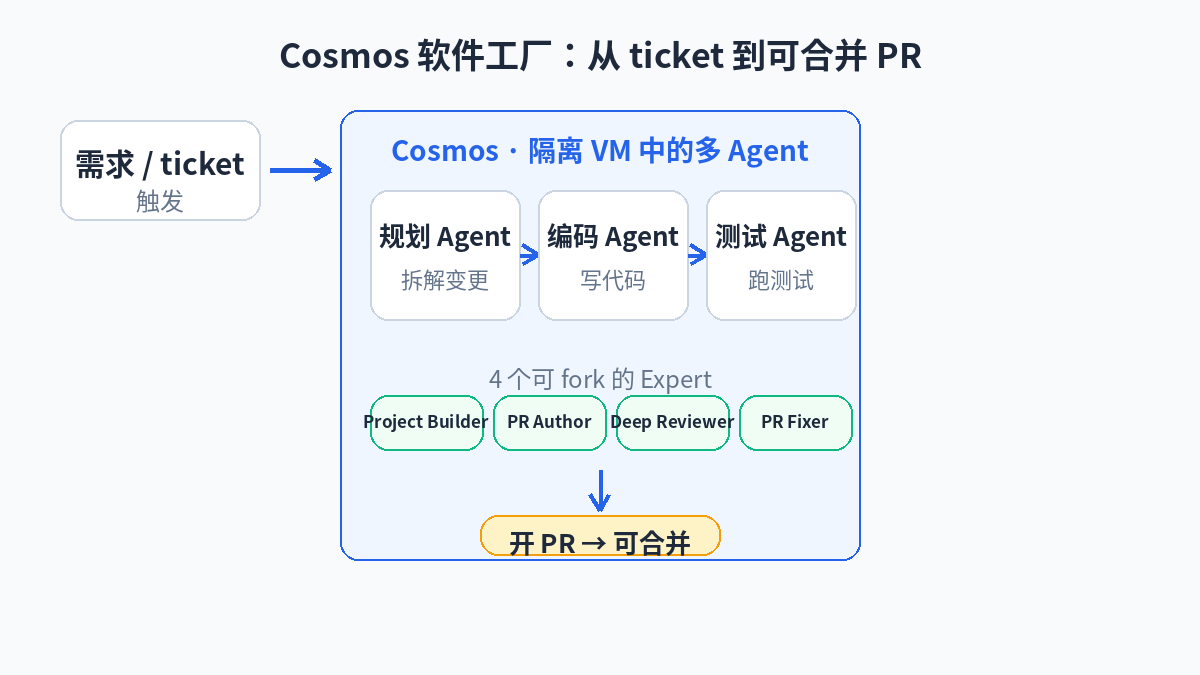 How the Cosmos software factory works: a requirement or ticket triggers fleets of agents that plan, code, and test in isolated environments, producing merge-ready PRs.
What game Harness is really playing
To understand the acquisition, look at what Harness has been building. Founded by Jyoti Bansal (who previously founded AppDynamics), the company calls itself the "Autonomous SDLC Platform" — an agent for every stage of the software development lifecycle. It already had four: the Software Delivery Agent (moving changes safely to production), the Security Testing Agent (finding and fixing risk before production), the Runtime Protection Agent (protecting applications, APIs, and AI in production), and the Cost Management Agent (controlling cloud and AI costs).
All four handle "after the code is written." The missing piece was "before the code is written" — from idea to merge-ready code. Cosmos fills exactly that gap. Post-acquisition, Harness's map is complete: Cosmos owns idea→code, the four downstream agents own code→production, with a seamless agent-to-agent handoff in between.
The deeper technical logic lies in the meeting of two nouns: Augment's Code Context Engine meets Harness's Software Delivery Knowledge Graph. The former knows "what the code looks like" — a live map of the codebase; the latter knows "what happened to the code after it shipped" — builds, deployments, infrastructure, security incidents, cost data. Harness intends to fuse the two maps into one.
The resulting workflow runs like this: before a change is written, Cosmos pulls the delivery context that should shape it — relevant test cases, security requirements, past incidents and their remediations; once the change exists, downstream agents use codebase context to reason about dependencies, risk, and what validation it needs; if a test, security scan, or deployment fails, the downstream agents send the problem back to Cosmos with full context to fix it, looping until resolution. That is the closed loop the press release describes: when downstream Harness agents identify an issue while testing, securing, or deploying code, they send it back to Cosmos with the context to fix it.
Bansal offered a judgment worth paraphrasing: AI's impact on software should not be measured by how much code it generates, but by how much valuable software actually reaches customers. That sentence is essentially Harness's acquisition manifesto — writing code is just one link in the value chain; what is worth paying for is the whole stretch of getting software to users safely and reliably.
One more detail: Harness explicitly says the integration priority is connecting Cosmos workflows with the platform's existing policies, permissions, and approvals. Translation: the same enterprise controls that govern releases will now govern writing code. For Harness's enterprise playbook, that is what gets the CIO to sign — agents may work autonomously, but they work under release-grade discipline.
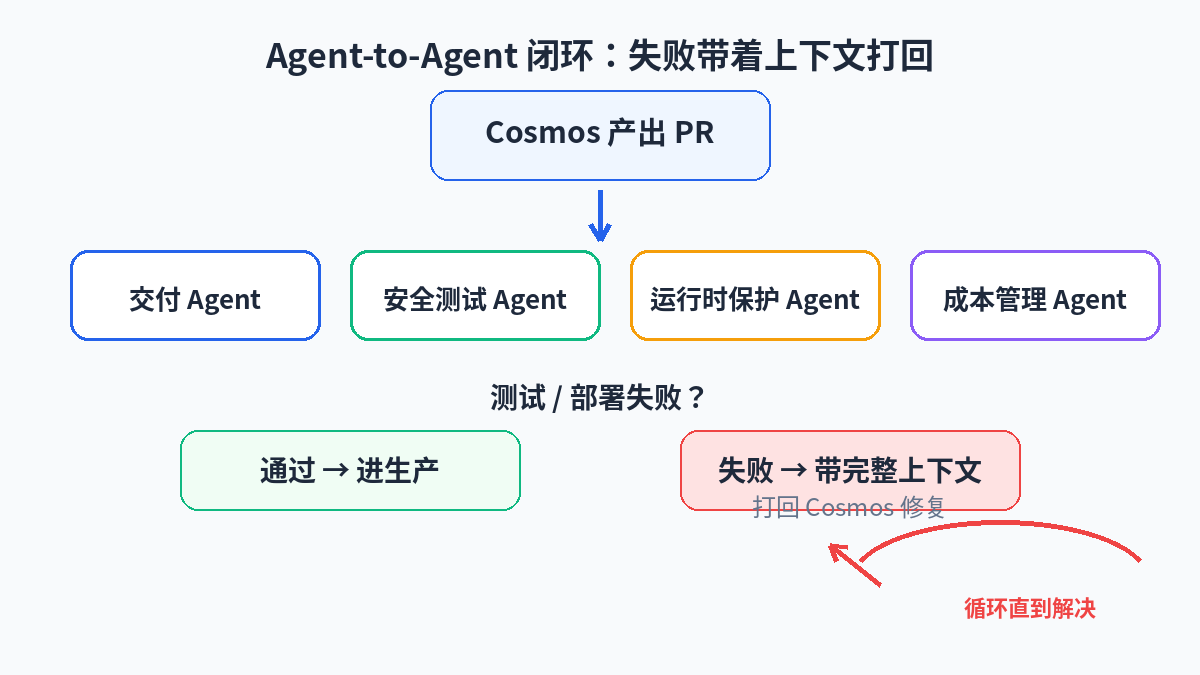 The agent-to-agent loop: after Cosmos produces a PR, downstream agents take over testing, security, and deployment — sending failures back to Cosmos with full context until resolved.
The industry signal: coding agents are being absorbed by delivery platforms
Zoom out, and this deal is another domino in the 2025–2026 consolidation wave across AI coding. In July 2025, Cognition acquired Windsurf; now Harness has absorbed Augment's core assets. Both times the pattern is identical: a standalone AI coding tool on one side, a platform owning the delivery chain on the other.
Why this direction? Do the math. A standalone coding assistant sells seats and usage, staring down three cost mountains: acquisition, model inference, and retention — Augment's pricing saga is the ready-made footnote. When "per-message billing" proved unsustainable and the switch to "usage-based billing" came out ten times pricier, users voted with their feet. Delivery platforms, meanwhile, hold enterprise budgets (some of the largest line items in IT spend: CI/CD, security, cloud costs), production data (builds, deploys, incidents, costs — all fuel for training and improving agents), and ready-made permission and approval systems. The bargaining power of standalone tools only shrinks from here.
Deeper still, the axis of competition has shifted. In 2024 everyone competed on "whose completions are more accurate, whose agent is more capable"; the 2026 exam question is "who sits closer to production." The combination of code context and delivery context is something no point tool can offer: however good your completions are, they don't know what took production down last week or which security red line this change might cross. That is Harness's bet — when an agent understands both code and delivery, its changes are closer to shippable from the first draft.
None of this means independent players like Cursor are dead tomorrow. The individual-developer and small-team market remains, and point-tool experience leaders still have room. But the window is narrowing: on enterprise procurement checklists, "can it plug into our pipeline, pass our approvals, and satisfy our security policies" keeps moving up. Independent tools must either grow platform capabilities or become part of a platform — the middle ground is getting crowded.
What it means for vibe coders
Vibe coders may ask: this is enterprise-market capital chess — what does it have to do with my daily AI-assisted coding? More than it looks. Think of it this way: your workflow today is prompt → code → manual deploy; Harness's endgame is a full ticket → code → review → test → deploy loop. Every step you take toward the latter now is migration cost you won't pay later.
First, steal the playbook: The division of labor across Cosmos's four Experts — Project Builder, PR Author, Deep Reviewer, PR Fixer — is itself a ready-made personal agent workflow template. You don't need Harness to use it: separate the agent that writes code from the agent that reviews it, and make "fixing review feedback" an automatic loop instead of something you manually relay. Many vibe coders are missing exactly the Deep Reviewer and PR Fixer roles — the agent writes the code, but review is still done by human eyeballs. That is the first gap to close.
Second, context matters more than prompts: The most valuable asset in this deal isn't any particular model — it's the Code Context Engine: a live map of the codebase, plus delivery-side context on tests, security, and incidents. Giving an agent a good "code map + delivery context" improves results far more than switching to a newer model. In personal practice: keep project docs and conventions maintained, let the agent see test and CI feedback, and turn every hard-won lesson into reusable memory. The ROI on this "context infrastructure" dwarfs prompt-engineering tricks.
Third, a new bar for choosing tools: When picking an AI coding tool, don't just ask "is it fun to write code with" — ask "can it plug into my delivery chain": can it open PRs, trigger CI, read failing test logs and fix them itself, roll back cleanly? A terminal agent like the Auggie CLI plus your own GitHub and CI is a personal-scale software factory — small, but with a complete loop.
Fourth, learn the factory's language early: Running agents in isolated environments, review loops, Expert role-splitting, budget and version governance — this Software Factory vocabulary will become the lingua franca of enterprise agent infrastructure. Individual developers who organize their workflows around it today will face far lower friction when interfacing with enterprise agent pipelines — or working on agent infrastructure inside companies. The trend is unambiguous: enterprises no longer buy "code written faster"; they buy "idea to production, steadier." Understand that sentence, and you understand where the money goes for the next few years.
What remains unsaid
What the press release leaves out is as worth noting as what it includes. First, deal terms were not disclosed — how much the "select assets" sold for, and where Augment's remaining entity, team, and cash go, are all unknown. Second, the Auggie CLI's future gets zero mention: whether it continues as a standalone terminal product or gets dismantled into Cosmos, existing users can only wait. Third, there are no details on migration paths for current Augment and Cosmos users — precisely what enterprise customers care about most.
The only certainty is the timeline: Harness Cosmos is already available, and cosmos.augmentcode.com is live for anyone curious. If you want to see what this "software factory" looks like, spin up a pipeline yourself — it beats reading ten explainers.
Coding agents being absorbed by delivery platforms won't end here. 2024 was the model wars, 2025 the year of the agent, and 2026 is shaping up to be the year of consolidation — once the UX dividends of point tools are exhausted, the contest is over who owns the complete chain. With this move, Harness has grabbed the last missing piece from idea to production.
Sources
Related articles
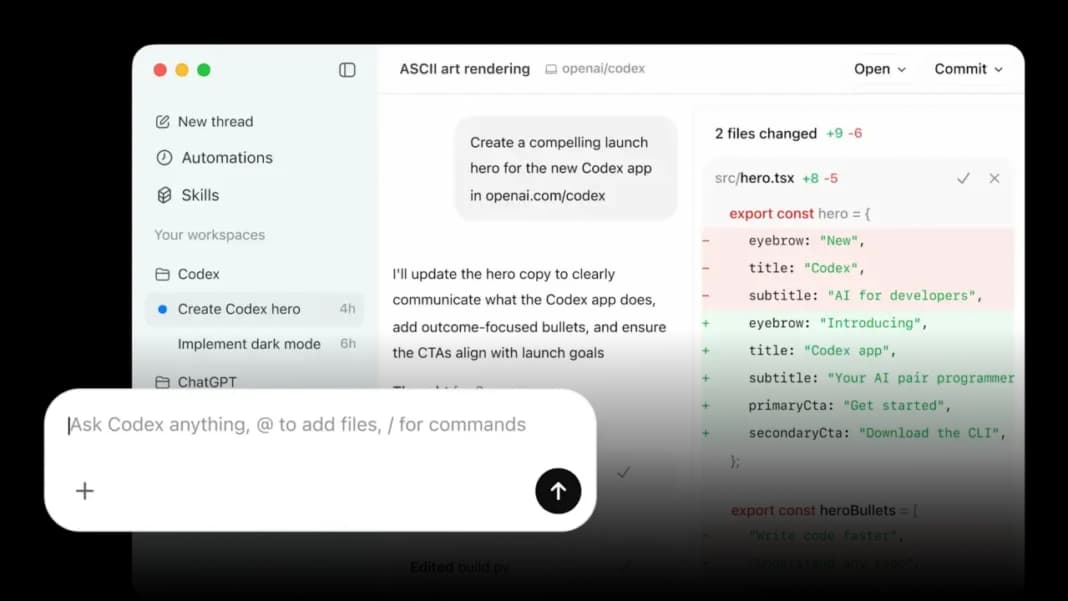
Codex desktop beta adds Composer predictions: after each response, a suggested next sentence appears in the input box. Tab to accept, review, then send. Free during beta and on by default, it shifts the cognitive load from wording intent to verifying it — but a suggestion is never an instruction.

Google's Nano Banana 2.1 is GA: image output tokens halved to $30 per million ($0.0336 per 1K image), but input tripled to $1.50 per million. We run the monthly math for a typical vibe project generating 200 images a week — plus a migration checklist for the deprecated Nano Banana 2.
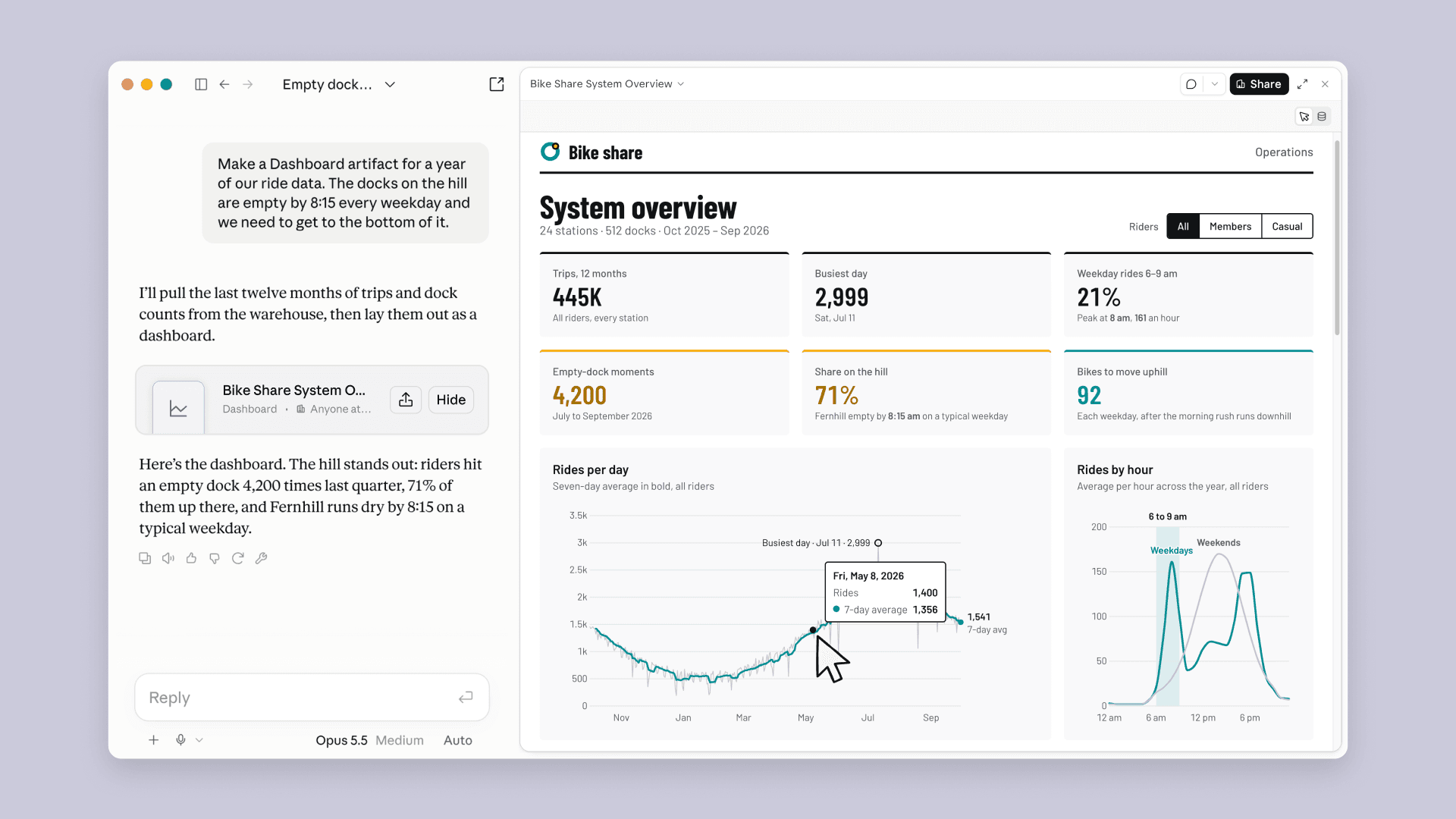
On October 8, 2026, Anthropic put Claude Dashboards and Claude Motion into beta: dashboards built from plain-language questions on live company data, and animations generated as editable code rather than video-model footage. Docs, Slides, and Design went GA on all plans, with 45M+ artifacts created to date.