DOE Releases Genesis Agent Skills: National-Lab Research Know-How as Invokable Skills for AI Coding Tools
On Oct 15 the U.S. Department of Energy released Genesis Agent Skills, the first national-lab-backed skill pack for research: AI safety, data governance, and multi-agent know-how packaged as Skills that AI coding tools can invoke directly. Free and open to contributions.
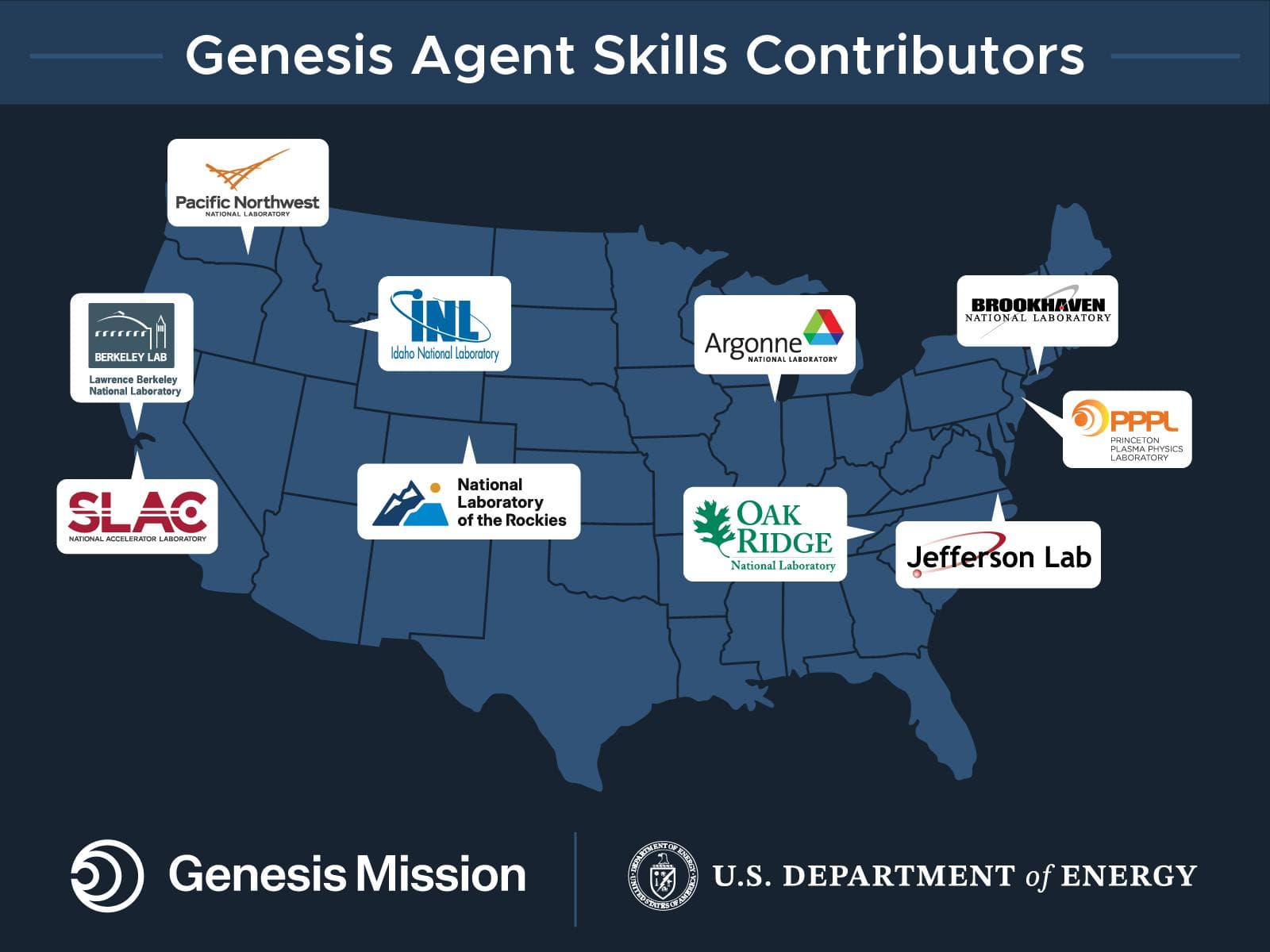
What happened: the U.S. Department of Energy shipped an "official skill pack" for AI coding
On October 15, 2026, the U.S. Department of Energy (DOE) published an announcement on energy.gov: the release of "Genesis Agent Skills." It is the first set of technical resources produced under the Genesis Mission by ModCon (Transformational AI Models and Data) and the American Science Cloud, built jointly by the BASE (Baseline AI R&D Capabilities) team drawn from multiple national laboratories. The package is free for researchers, developers, and the public, hosted on GitLab, and open for anyone to browse, adapt, and contribute improvements.
In one sentence: the DOE has packaged its national laboratories' know-how on "how to do science" — AI safety, agent evaluation and monitoring, data governance, scientific workflows, multi-agent systems — into Skills that AI coding tools can invoke directly. When a researcher asks an AI coding assistant a question in plain language, the relevant Skill fires, and the answer comes back infused with lab-validated working methods.
The announcement gives two examples. First: you are working with a complex dataset and casually ask your AI coding assistant to take a look; the data-governance Skill activates, and the generated code comes out compatible with other Genesis Mission systems — instead of a script that "runs but nobody downstream can use." Second: you ask the AI to review a codebase for safety; the safety Skill activates and runs a lab-"validated" safety analysis workflow, rather than a checklist the model improvises on the spot.
A Skill is not a prompt: it is methodology, packaged to execute
Let's get the concept straight. Many people hear "Skill" and think "isn't that just a well-written prompt?" Not quite. A prompt is a one-shot instruction; a Skill is a reusable work package: operating instructions, workflow steps, reference resources, and trigger conditions for "when to use me." It lives beside the task instead of sitting in some document waiting to be read.
One line in the DOE announcement deserves a closer look: the package is "complementing existing skill libraries focused on coding and software engineering." It acknowledges a reality: general-purpose coding skill libraries already exist — Anthropic's Skills, Vercel Labs' find-skills — but the "science" vertical is empty. And research code differs from business code: terabyte-scale datasets, experiments that must be reproducible, conclusions that must survive peer review, compute queues you have to book. Those constraints are not covered by generic coding Skills.

So the real news here is not "a U.S. government agency released an open package." It is this: the first national-lab-backed Agent Skills specification for the research vertical now exists. It turns "how domain knowledge gets fed to AI coding tools" from each lab's private practice into public infrastructure.
Why the DOE, and why now
Some background. The Genesis Mission is the DOE's umbrella program for AI for Science in this cycle, aiming to fuse the compute, data, and talent of its national laboratories against hard scientific problems. ModCon is the technical foundation; the BASE team does the work — co-led by Nathan Hodas of Pacific Northwest National Laboratory (PNNL) and Stefan Wild of Lawrence Berkeley National Laboratory, with contributors from labs across the country. Matt Baughman of Princeton Plasma Physics Laboratory stressed in the announcement: "This is a product of the entire Laboratory system, not a single institution."
Why now? Because AI coding tools have already seeped into the research front line, and there is a wide gap between "fun to use" and "right to use." A materials-science PhD student can get Claude Code to write a molecular-dynamics analysis script — the model can write it, but it doesn't know the DOE's data-governance red lines, the audit requirements for lab notebooks, or which supercomputer queue the code will eventually run on. Skills are meant to close exactly that "last mile": turning an institution's tacit knowledge into capability the AI can reach for.
One layer deeper, this is a footnote to the "Super Intelligence (SI)" discourse becoming operational. The announcement calls AI coding tools "SI coding tools" and positions the package as "the first building block of the Genesis Mission's shared research infrastructure." Translation: the DOE believes future research competitiveness will partly depend on whose AI tools better understand the rules of research — and "understanding the rules" can be deposited and distributed through a standardized carrier like Skills.
A wider view: Skills are becoming the agent ecosystem's "second-layer protocol"
Zoom out, and a clear layering is forming in the 2026 agent ecosystem: models at the bottom, agent runtimes in the middle (Claude Code, Codex, Cursor), and on top, the Skills layer — portable, composable, versionable methodology packs.
Anthropic's Skills ecosystem is the early mover on this layer; Vercel Labs even built find-skills, a Skill for finding Skills. The open-source community is following: the Tsinghua-linked PilotDeck 2.0 team (covered separately in this cycle) explicitly thanks "Anthropic Skills — Agent skill framework and built-in skills" in its README. Notably, the DOE release lands on the same beat as the open-source community: the official side sets the spec, the community builds implementations, and the two feed each other.
But the DOE version has something the community versions don't: authority. When PNNL's Court Corley (interim technical director of the Genesis Mission) says the goal is "to put the collective expertise of the laboratory system into the hands of researchers," the subtext is: doing AI-assisted research inside the DOE system, using this Skill set may one day become part of compliance and review. Today it is "contributions welcome"; tomorrow it could be "recommended"; the day after, a precondition for project proposals? Worth watching.
What it means for vibe coders: your domain knowledge should become Skills too
This story is closer to ordinary developers than it looks. Think about your own workflow: every time you start a new project, do you re-explain the same "our team's code conventions, deploy process, review checklist" to the AI? What the DOE did is essentially "Skill-ifying" that repeated labor.
Here's the call: in the second half of 2026, agent-tool competition is shifting from "whose model is stronger" to "whose Skill ecosystem understands your trade better." Generic coding Skills will commoditize fast; the real moat is in vertical Skills — research, financial compliance, healthcare, industrial control. The DOE's move is the landmark event of vertical Skills going mainstream. Teams building industry applications should start organizing their domain methodology into Skills now, instead of waiting for the model to "figure it out."
One more small call: the fight over Skill distribution channels is just beginning. The DOE chose GitLab (gitlab.osti.gov); the Anthropic ecosystem orbits GitHub; Tessl even runs a Skill Registry that scores Skills. In the future, evaluating an agent platform may come down to three numbers: the model, the runtime, and the shelf depth of its Skill store.
Practically speaking, "Skill-ifying" your own workflow doesn't require a national lab's budget. The pattern is simple: first, write down the three to five review checklists you repeat most often; second, turn each into a standalone Skill file with trigger conditions ("when the user asks for a deploy, run this"); third, put them in a shared repo your whole team (and their agents) can pull. The DOE just proved at national scale what small teams can start doing this week: stop re-teaching the AI your rules, and start shipping the rules with the work.
Honesty notes
Facts in this article follow the DOE announcement on energy.gov dated October 15, 2026 (Published: 2026-10-15T10:46:12-0400), cross-checked against HPCwire's same-day reprint and ExecutiveGov's coverage. The announcement's claim that its AI-safety Skills are "validated" is the DOE's own characterization; the validation methodology and coverage are not disclosed in the announcement. The speculation that Skills could become a compliance precondition is this publication's judgment, not an official position. PilotDeck 2.0 is covered in a separate article in this cycle and is cited here only for ecosystem comparison.
Comments (0)
Sources
Related articles

At the Oct 10 X Takeover event, Musk took 61 seconds to explain the Cursor acquisition: building superintelligence means solving coding, and only OpenAI, Anthropic, and Cursor hold enough coding training data. The $60B bought the world's scarcest coding-behavior data — not an editor.
Tsinghua THUNLP, ModelBest, and OpenBMB ship PilotDeck 2.0 (AGPL-3.0): WorkSpace isolation ends context contamination, white-box memory is auditable and rollback-safe, Always-on runs tasks in the background; "strong-lead, weak-follow" routing scores 70.6 on 7 hard tasks for $3.15, beating an $18.36 flagship-only setup.
Ramp raised $1.85B at a $60B valuation, up 36% in four months. The real story is its AI pivot: agents inside finance products, a corporate card for AI agents, a model-routing business with token spend management, and Glass. Keith Rabois: 'We're going to compete with Anthropic.'