Moonshot's Kimi K3.1 Pro Nearly Matches Claude Opus 5.5 on Terminal-Bench 4.0; Open Weights Due November 4
Moonshot's Kimi K3.1 Pro scores 65.7% on Terminal-Bench 4.0, just 0.7 points behind Claude Opus 5.5, with API prices cut by a third and full open weights promised by November 4. The launch blog also quantifies a rare open-source-vs-safety trade-off: scrubbing cyber data cost 9.5 points on its internal exploit benchmark.
Scope note: This is a different story from our October 7 piece on Kimi K3 entering OpenAI's enterprise Codex channel (kimi-k3-openai-codex-channel-october-2026). That was a distribution story — K3 as a third-party model inside OpenAI's enterprise Codex offering. This is a model launch — Moonshot's post-trained upgrade of the K3 line, Kimi K3.1 Pro and its Highspeed variant, with new benchmarks, new pricing, and an open-weights commitment. Same model family, two separate news lines.
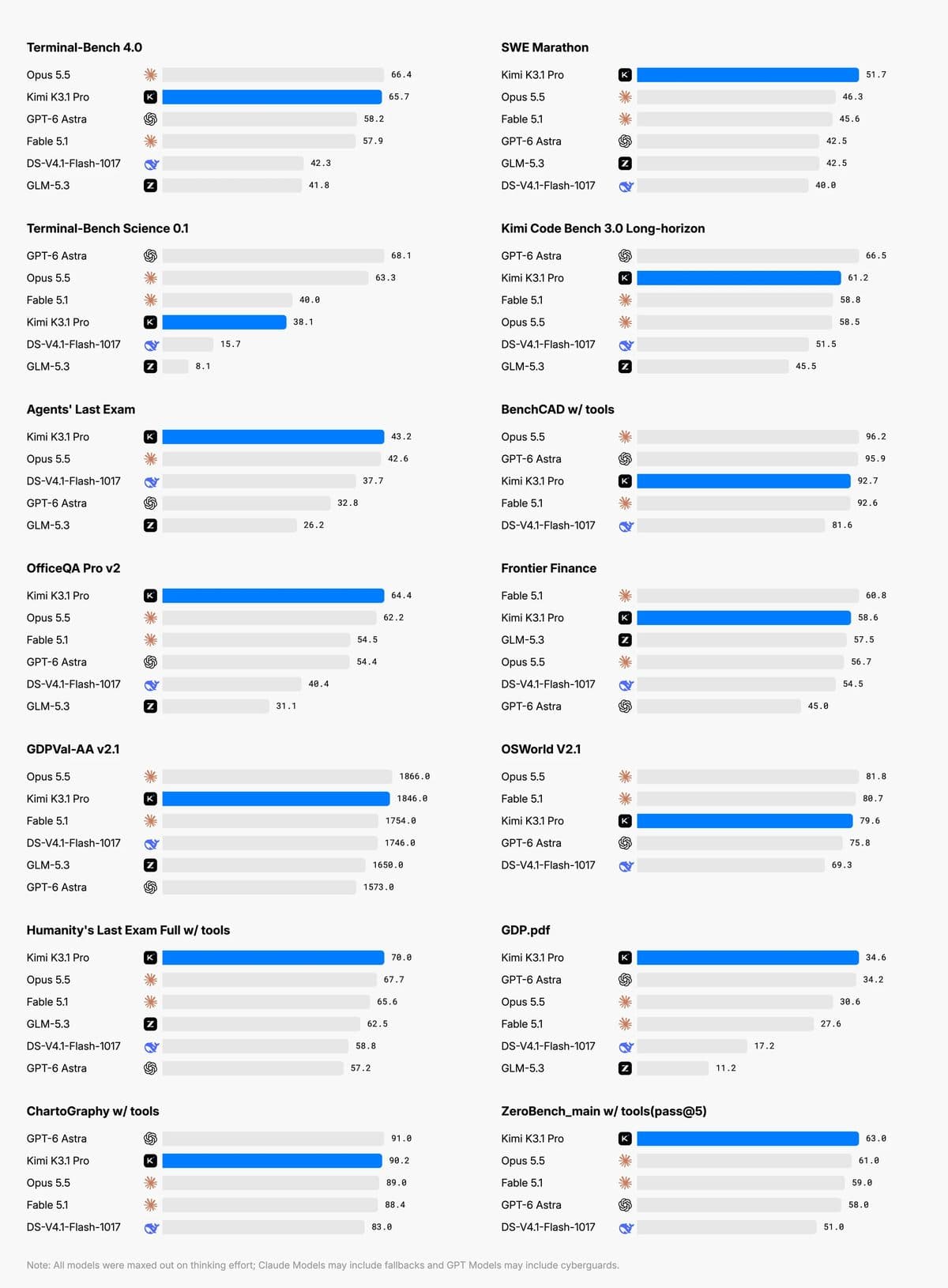
On October 23, Moonshot released Kimi K3.1 Pro, the first model in its new K3.1 series and, in the company's words, its "most capable 3T-class open-weight model to date." The headline number: 65.7% on Terminal-Bench 4.0 — just 0.7 points behind Claude Opus 5.5's 66.4%, and well clear of GPT-6 Astra's 58.2%. And this is a model whose full weights are promised by November 4.
The numbers are striking, and unusually, they come with a readable instruction manual: Moonshot's footnotes are candid about how the scores were produced. This piece works through three layers — what was announced, how to read the numbers, and the business logic and rare honesty buried in the release.
What actually launched
K3.1 Pro is not a new architecture. It is a post-trained Kimi K3: same skeleton, "substantially larger post-training compute." The company confirmed the specs on X and LinkedIn — 2.8T total parameters, 104B active per token in a MoE design, a 1M-token context window, multimodal input. Everything that changed happened in reinforcement learning: Moonshot says it reworked the RL framework, long-context inference, training efficiency, sandbox infrastructure, rollout scheduling, and environment quality checks to run large-scale joint RL across hundreds of downstream domains, so that each increment of RL compute delivers "stable, predictable returns."
Alongside it comes Kimi K3.1 Pro Highspeed, rated at 2–3× the speed of the standard Pro for latency-sensitive interaction and agent loops. It ships as a separate model identifier, not a toggle.
Availability covers the whole Kimi family:
- Kimi.ai and mobile apps — iOS, Android, HarmonyOS, and web
- Kimi Work desktop app — version 3.1.0 and later (Windows and Apple Silicon Macs)
- Kimi Code — switch via the
/modelcommand - Kimi API — model IDs
kimi-k3.1-proandkimi-k3.1-pro-highspeed, with Zero Data Retention available - Kimi Enterprise / Business — admins must opt in; access is off by default at launch
Pricing is the bluntest signal in the release: Pro costs $2 per million input tokens and $10 per million output tokens, with cached input at $0.20; Highspeed doubles that to $4/$20. Against K3's launch pricing of $3/$15, that is a straight one-third cut across the board. The API is live today; the weights wait until November 4. That two-week gap deserves its own section.
The 0.7 points, and how to read vendor benchmarks
The short version: the "open weights within 0.7 points of the closed frontier" story holds — on the track Moonshot chose. Reading the 0.7 correctly means holding three numbers at once:
| Benchmark | Kimi K3.1 Pro | Claude Opus 5.5 | GPT-6 Astra |
|---|---|---|---|
| Terminal-Bench 4.0 | 65.7% | 66.4% | 58.2% |
| BenchCAD (with tools) | 92.7% | 96.2% | 95.9% |
| Kimi Code Bench 3.0 Long-horizon | 61.2% | — | — |
| OfficeQA Pro v2 | 64.4 (claimed SOTA) | — | — |
| Kimi Hallu Bench Hard (claim-level hallucination rate; lower is better) | 8.3% | 15.0% | 5.5% |
Terminal-Bench 4.0 carries the most weight here. It grades coding agents on realistic, resource-constrained terminal tasks with strict task-specific tests, and several labs now treat it as the practical proxy for "can this do my job." At 65.7% versus 66.4%, the gap is genuinely negligible — especially for a model about to be downloadable, measured against Anthropic's flagship closed model.
But the footnotes have to be read alongside. Moonshot's tech-blog footnotes state that K3.1 Pro was evaluated with the Claude-Code harness, while competitor scores are taken as the maximum values reported in their official blogs or leaderboards. In other words: their own model got a careful in-house run on one harness; rivals got their best historical public numbers. That is not dishonest — the methodology is disclosed — but it means the 0.7-point gap was computed under the comparison most favorable to Moonshot. The real cross-check comes after November 4, when the community can run the same harness on the released weights.
There is already one independent corroboration, and it arrived fast: Artificial Analysis scored the model 55 on its Intelligence Index on launch day — fourth overall, behind Claude Opus 5.5 (58), Claude Sonnet 5.5 and Muse Wonder Full (56 each), and ahead of Claude Fable 5.1, GPT-6 Astra, and Gemini 4 Argon (53 each). On the same index, K3 scored 44 — one post-training pass added 11 points. Artificial Analysis also ran Terminal-Bench 4.0 independently: K3.1 Pro at 67%, above Claude Sonnet 5.5's 64%. Vendor claims and an independent evaluator pointing the same way on the same benchmark meaningfully raises confidence in the 65.7%.
Three rules for reading vendor benchmarks: check whether the harness was the same for everyone; check whether rival scores are fresh runs or historical maxima; look for independent replication. Moonshot is generous to itself on the first, transparent on the second, and backed by Artificial Analysis's 55 on the third — about as clean as vendor-reported numbers get.
One more discount to apply: Kimi Code Bench 3.0 Long-horizon (61.2%, up from K3's 55.95%) is an internal benchmark, and the 64.4 "SOTA" on OfficeQA Pro v2 is on Moonshot's home turf. Internal benchmarks are good for measuring vertical progress — the K3-to-K3.1-Pro gains are real — but weak for horizontal comparison. Same with the hallucination rate: claim-level errors down from 23.4% to 8.3% is a 65% cut, but the company itself notes the test is a deliberately adversarial stress test, not a daily-use error rate.
The price war: agentic coding keeps getting cheaper
If benchmarks are the face of this release, pricing is the substance. The price list reads item by item:
| Model | Input / 1M tokens | Output / 1M tokens | Cached input / 1M tokens |
|---|---|---|---|
| Kimi K3.1 Pro | $2 | $10 | $0.20 |
| Kimi K3.1 Pro Highspeed | $4 | $20 | $0.20 |
| Kimi K3 (July launch) | $3 | $15 | $0.30 |
Three things stand out. First, capability up, price down: a model a clear step above K3 costs a third less — the classic move of subsidizing price with post-training dividends. Second, the $0.20 cached-input lane is aimed squarely at coding agents, which resend large repository context every turn; the cache lane is where the real cost of agent loops lives. Third, Highspeed at $4/$20 sits in the same bracket as closed-flagship list prices while promising 2–3× speed — Moonshot is selling "faster" as a product, not giving it away as a perk.
In the bigger picture, the per-token cost of agentic coding is falling on a quarterly cadence. From K3 to K3.1 Pro, input and output prices both dropped a third while capability closed in on the most expensive closed models. For teams running agents in loops, that means the same budget buys more trials and longer horizons — which happens to be exactly the long-horizon task type K3.1 Pro is best at. Price and capability reinforce each other here: cheap makes long-horizon agents affordable, and long-horizon skill makes cheap meaningful.
The cybersecurity section: a rare, quantified honesty
This is the strangest section of the launch blog, and the part of this release most worth remembering. Moonshot devotes a full section to explaining that it deliberately made the open model weaker for safety — and puts the number on how much weaker.
The story: as post-training scaled, the team watched vulnerability-research capability climb. Tracing it, they found cyber-related content embedded in the general mid-training corpus and cyber-related tasks in the RL environment mix — a natural byproduct of training on broad data. In preliminary experiments on internal models, removing the data at either the mid-training or the RL stage was not enough; without removal at both, downstream cyber capability would rise substantially. So for the open release they identified and removed cyber-related data from both stages, keeping the general-purpose coding tasks the model needs to stay useful.
Here is the number that matters: on xdev-bench-hard, Moonshot's internal benchmark of exploit-development tasks built from recently disclosed vulnerabilities in the Linux kernel, Node.js, JavaScriptCore and others (pass@3), the checkpoint without the safety scrubbing solves 90.5%; the released K3.1 Pro solves 81.0% — a 9.5-point tax on offensive capability. For reference, K3 scored 33.3% on the same benchmark, while DeepSeek-V4.1-Flash, which made no such scrubbing commitment, reached 85.7%.
Line those four numbers up and the trade-off is unmistakable:
- Unscrubbed K3.1 Pro pipeline ceiling: 90.5%
- DeepSeek-V4.1-Flash (no scrubbing commitment): 85.7%
- Released K3.1 Pro (scrubbed): 81.0%
- Previous-gen K3: 33.3%
The company's stated position is blunt: it will not release open weights that extend the absolute frontier of offensive cyber capability. K3.1 Pro's offensive capability is, by design, below what Moonshot's own pipeline can produce, and behind frontier proprietary models that have been public for at least three months. At the same time, it intends to "progressively raise" the cyber capability in open weights, because defenders need dual-use capability to audit code — including legacy systems that rarely get dedicated security review.
Why this is rare: vendors normally say "we did safety evaluations" and stop there. They do not say "we weakened the model by this many points." Moonshot has now admitted two things in public: first, that its pipeline could have produced a more offensively capable open model; second, that the line between open and safe is drawn unilaterally by the vendor, in a place buyers and the community cannot audit. Call it transparent paternalism — the trade-off is quantified for you to see, but the pen stays in their hand. Given that open weights cannot be recalled once published, the "scrub first, release second" ordering is itself the most contested and most practical move in open-model governance right now.
Weights on November 4: the two-week API-first play
The timeline is worth a second look: API and the full product line on October 23, full weights "by Nov 4" — a two-week gap. That is not an engineering delay; the blog and the LinkedIn announcement both state it as a committed date, not an aspiration.
The logic is straightforward. First, a two-week exclusive monetization window: while the hype peaks — the launch topped Hacker News the same evening, Artificial Analysis's 55 landed the same day — the only way to run the model is through Kimi's API and products. Second, ecosystem priming: API-first lets developers wire kimi-k3.1-pro into their toolchains, so that when the weights drop, the demand for self-hosting has already been proven and community quantization and deployment guides grow on their own. Third, risk buffer: given the scrubbing described in the cybersecurity section, two weeks of API-only operation is two weeks of real-world feedback before the irreversible step — a weights release cannot be hotfixed.
The cost is stated plainly too: until the weights ship, the "open-weight model" label is a promise, not a fact. Every "strongest open weights" narrative currently rests on a date. November 4 is the first real test — do the weights ship on time, what does the license actually permit, and can the community reproduce 65.7%? If any of those three wobbles, it will eat directly into the goodwill banked over these two weeks.
What to watch next
- The November 4 weights release: on-time or not, how open the license really is, and what the 64+ accelerator supernode requirement means in practice (MoE at this scale is not a hobbyist self-host — the real beneficiaries are cloud providers and well-resourced teams).
- Independent replication: once weights are out, the community rerunning Terminal-Bench 4.0 on a common harness. Whether 65.7% holds is the only hard test of the "0.7 points" story.
- The Highspeed trade-off: Moonshot published no separate benchmarks for Highspeed. How much accuracy the 2–3× speed costs, and whether $4/$20 is worth it, is currently unknown.
- Where the scrub line moves next: "progressively raising" cyber capability in open weights — who decides the pace, and on what evidence. That line gets renegotiated at every release from here on.
The real significance of K3.1 Pro is not any single benchmark number. It is that the distance between open weights and the closed frontier has been compressed to a single model version. For two years the default assumption was that open weights trail the frontier by a generation and catch up six months later at a discount. K3.1 Pro shrinks that lag to one post-training iteration — and if the weights land on November 4 as promised, "downloadable AI" will sit just 3 points off the global lead on the most-watched independent index. That distance is the question every closed lab now has to answer.
Comments (0)
Sources
Related articles
Vercel open-sourced durable-harness, a set of adapters that bolts durability onto existing harnesses — Pi, OpenCode, Codex, Claude Code — logging every step's intent and outcome so crashed turns resume from a durable log, finished calls never re-run, and tokens are never billed twice.
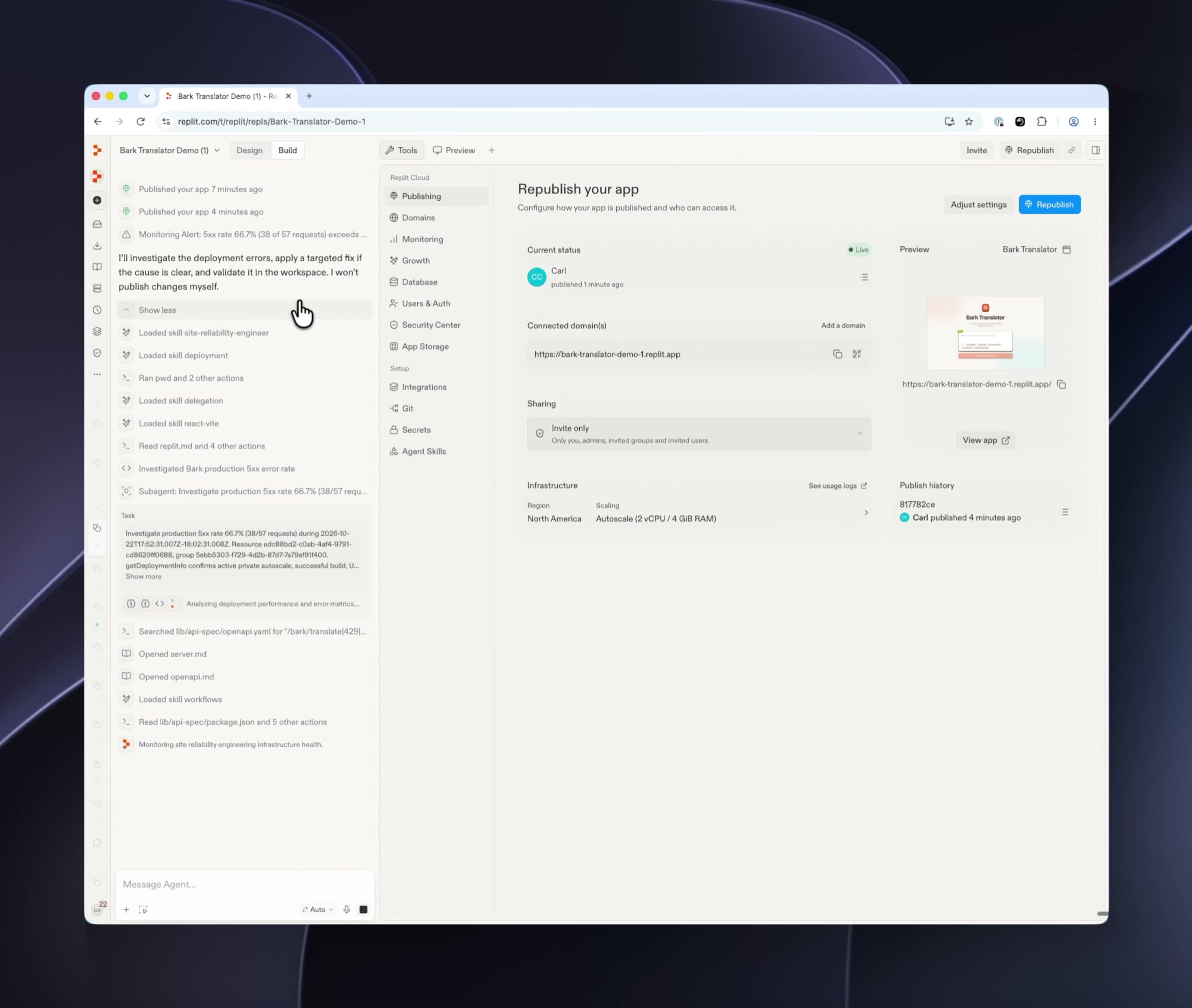
Replit 10 月 22 日发布 Monitoring Agent,给每个人的应用配一个 autonomous on-call engineer:告警一响,自动调查根因、验证修复、发邮件汇报,还能可选直发生产。官方演示用 Bark Translator 应用,5xx 误报(38/57 请求)2 分钟修完、留检查点。三层渐进授权看/修/发,是 vibe coding 从“写代码”到“养代码”的第一步。
llm-d 1.0 is out: the open-source distributed inference framework backed by IBM, Red Hat, Google, NVIDIA and CoreWeave now ships Day 2 capabilities — multi-tenant QoS, zero-downtime upgrades, session-aware routing. IBM's demo: 3,000 coding agents at ~$0.11 per million tokens. We unpack the release, the Kubernetes analogy, and the self-host vs. API cost math for vibe developers.