Perplexity launches Teammates: always-on AI agents that own ongoing work
Perplexity has launched Teammates, persistent AI agents that own long-running work on Perplexity Computer, remember project context, and collaborate in Slack. They are a research preview for Max subscribers only, at $200 a month.

Perplexity wants you to hire colleagues, not a chat box. In an official blog post dated November 4, the company launched Teammates — persistent AI agents built for long-running work — and CEO Aravind Srinivas announced the launch on X on November 5. Each teammate owns a piece of ongoing work: it has a role, remembers project context, and follows up when things change, instead of waiting for your next prompt.

The backdrop is that AI assistants are collectively moving from answering questions to taking on jobs. OpenAI has its always-on Dots, Anthropic has Claude Duet, Manus has Cue — The Verge put Teammates straight into that comparison group. Perplexity's entry builds on its own Computer, the cloud agent system it launched in February 2026 that executes tasks on a user's computer. Teammates are not a new chat entrance; they add a layer of "continuous ownership of work" on top of Computer.
What makes a "colleague" different from a chat assistant
Perplexity's official blog puts the difference in three things: memory, initiative, and handoff. Teammates remember project goals, task history and shared files, so each new task builds on work already done; they monitor ongoing work and investigate and act when something changes, without waiting for a fresh instruction; and they hand work to each other — one finds bugs on a website, another prepares the fixes.
The company's examples are specific, and revealing about its ambition. A sales teammate that notices a regular customer has stopped transacting will first review order history and support issues to work out what changed, then produce a relevant offer — or flag the issues that need resolving before anyone reaches out. It shares progress updates and asks for approval until the work is done. An operations teammate chases missing items 72 hours before a deadline, and once told an agency needs two weeks' notice, builds that lead time into future schedules automatically. The blog walks through marketing, sales, support and operations in turn — Perplexity clearly wants Teammates to look like a team that can start work on day one, not a demo toy.
The collaboration is deliberately colleague-like, too: you can add a teammate to a Slack channel, where co-workers can hand it work or ask for updates; it draws on the Projects, skills and memory already in Computer — for example, using a project's existing account research and sales goals, a skill for writing outreach, and a weekly automation that reviews the pipeline, finds stalled conversations and drafts follow-ups for review.
Isolation, credentials and human takeover
Putting an agent inside Slack, Gmail and GitHub makes security the first hurdle. Perplexity's design: each teammate runs in its own isolated environment, with its own desktop and browser session, separate from other teammates; saved credentials are encrypted and entered securely, and teammates cannot view them; permissions follow the tool and Project permissions the user has already set up in Computer. Users can review completed work, take over the desktop, or redirect a teammate mid-task.
New teammates use Claude Opus 5.5 by default, and you can pick a different model per teammate or per task. That detail is worth noting: Perplexity does not force its own model on anyone, but hands the choice to the user — the selling point of Teammates is the layer that organizes the work, not any particular model.
What it costs, and who gets it
The bar is not low. Teammates are available only to individual Max subscribers, on the web first, with iOS to follow; Free and Pro users need to upgrade in Settings; Enterprise Pro and Enterprise Max are not included by default. Max costs $200 a month, or about $167 a month billed annually ($2,000 a year), and includes 10,000 Computer credits a month plus a one-time bonus of 35,000 credits; 100 credits equal $1. Teammates are free to use during a promotional period, after which usage draws on the monthly allowance; the help center warns that complex projects use more credits, "particularly when agents run in parallel."
In other words, the real price of Teammates cannot be calculated yet. Perplexity has not published how many teammates one account can run at once, nor what a typical teammate costs in credits for a week of work. The internal figure Srinivas shared on X is that about 10,000 teammates were used in the company's internal workspace over the last 30 days, with roughly 1,000 active on November 4 — company-reported, not independently verified. His vision is hundreds of agents per person; the reality of credit-based billing is that every extra "colleague" adds to the bill.
The real test is not launch day
Teammates are a research preview, and Perplexity itself says the feature is still under development and its behaviour may change. There are no third-party tests, no published success rates, no public reliability record. The real test for always-on agents was never how vivid the launch examples are, but three practical questions: will it do the wrong thing when nobody is watching, who pays for the mistake, and what does a month of it actually cost? Perplexity's answers — approval requests, isolated environments, human takeover — are all necessary, but how much they actually cover will only be known after real users run them for a few weeks.
For Perplexity, this launch is also a positioning shift: it is no longer just a search company, but a direct contender in workplace agents. Its advantages are real — search is its home ground, and Computer's execution layer is already in place; its weakness is equally real — a $200-a-month Max plan keeps most users out. Whether Teammates grow from a toy for $200 subscribers into a team staple will not depend on remembering a two-week notice period. It will depend on whether a teammate can take a real job from start to finish, for weeks, unsupervised, without blowing up the bill.
From Comet to Teammates
Teammates are the latest step in a product line Perplexity has been building for over a year. In July 2025 it launched the Comet browser, billed as the first web-capable AI assistant; in February 2026 Computer arrived, moving agents from "find things for you" to "do things for you"; Computer has since added local execution on Mac and a faster speed tier. Teammates, on November 4, add the last piece: agents that continuously own work rather than starting from scratch each time. Each layer answers the same question — how much work will users hand to a system that moves on its own — and Teammates are the boldest step yet, because they ask users to trust not the quality of one answer, but a system that keeps running and making decisions while they are away.
The credit math, and who should wait
The pricing deserves a careful look. Max includes 10,000 Computer credits a month — $100 of agent work at 100 credits to the dollar — plus a one-time bonus of 35,000 credits, worth $350. Teammates are free during the promotional period, then draw on that allowance; the help center warns that complex projects cost more, especially with agents running in parallel. Reported figures add a default spending cap of $200 a month, raisable to $5,000, with extra credits available for purchase or auto-refill. But what a teammate costs for a typical week of work, nobody knows — Perplexity has not published it, and no third party has measured it. Perplexity's own advice is to start with two or three teammates, which says a lot by itself: even the vendor knows the bill gets out of hand if you scale too fast.
The field is crowded. OpenAI's Dots give each person one primary agent with its own cloud computer, for ChatGPT Pro and Business Premium users, with team features still planned; Anthropic has Claude Duet; Manus's Cue puts several personal agents in group chats, invite-only and free in early access, each with its own email and phone. Perplexity's bet is the orchestration layer: several teammates with distinct roles passing work between each other, on its home ground of search, with Computer's execution already built. Notably, Teammates run Claude Opus 5.5 by default — a rival's model — because Perplexity is betting that models will commoditize and the organization layer is what lasts.
Who should try it now: people already paying for Max, whose work already lives in Slack, GitHub and Linear, with clear recurring long-running tasks, and who are willing to watch the approval flow. Start with two or three, pick low-cost-of-failure work, run it for a few weeks, and look at the real credit consumption and error rate before scaling. Who should wait: Pro and free users who would have to upgrade to $200 a month, enterprise users who are not included by default, anyone cost-sensitive, and anyone thinking of handing over a business-critical process. A research preview means behaviour may change and there is no mature support system if things go wrong. The concept is right — an assistant's real value is owning work, not answering questions — but a right concept does not make the product worth $200 a month today. Waiting for the first real bills and error rates costs nothing.
Comments (0)
Sources
Related articles
On November 6, 2026, Meta launched Spaces in the Muse app: describe an idea in one sentence and Muse builds a small tool that keeps itself updated from your connected apps. This article separates the official claims from the four open questions — sharing, data boundaries, the complexity ceiling, and availability — and what it means for indie developers.
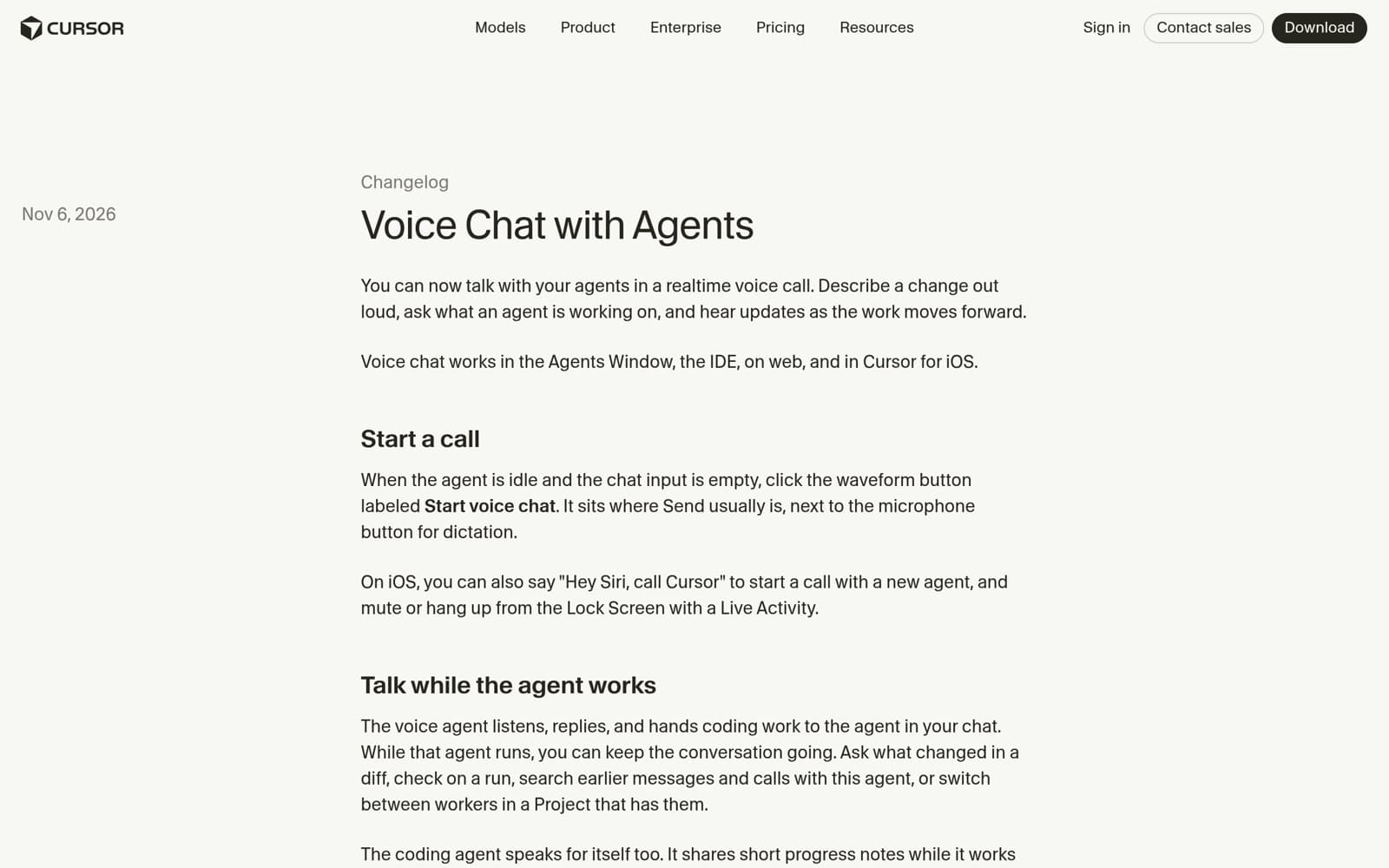
On November 6, 2026, Cursor shipped Voice Chat with Agents: realtime two-way voice calls in the Agents Window, IDE, web, and iOS, powered by Grok Voice while your chosen coding model keeps writing the code. A day after Live Apps, the IDE moves from typing instructions to speaking them. This article walks through how calls start, what the voice agent can do, the limits, and the open questions.

On November 5, Thinking Machines released Inkling 2 Small: 594B total parameters, 17B active, a 31 on the Intelligence Index — and it trained a forecasting model unsupervised for 4.5 hours. But the weights are still closed; the Apache 2.0 release waits for next week's safety testing.