From Solo Tool to Team Business: Multi-Tenant Isolation Architecture for Vibe Projects in Practice
The second customer is a vibe project's coming of age: single-tenant code hides three implicit assumptions — a global single user, hardcoded config, no tenant boundary — and they collapse on contact. This guide scores the three isolation models on six dimensions, lands Postgres RLS hands-on (middleware resolution, CREATE POLICY, Prisma auto-filtering), compares routing options, and includes 10 negative leak tests, a 5-step zero-downtime migration SOP, and minimal per-tenant metering.
When I signed my first paying customer, I was floating: a little tool built by one person over a few weekends, and someone was willing to pay $29 a month for it. The second customer came through a friend's introduction — I spent 10 minutes setting up their account on the same database, just adding one more user_id. The day the third customer signed, I made the decision I regret most in my life: in the name of "speed," I stuffed the new customer's data into the same tables. "Just get it running," I told myself.
The blowup happened at 2 AM on a Tuesday. Customer A clicked "Export all data" in the admin panel, and the downloaded CSV contained 40+ order records belonging to Customer B. The cause was embarrassingly dumb: the export endpoint was one of my earliest, and its WHERE clause never included user_id. Worse, this wasn't a bug — it was architecture. My codebase was full of implicit "there is only one customer right now" assumptions, and the moment the second customer arrived, they started collapsing one by one. Fixing the export took 20 minutes; the next two weeks I grepped out 47 similarly naked queries, 3 sets of hardcoded third-party keys, and 1 global singleton "current user."
Multi-tenant isolation isn't a big-company luxury — it's the coming-of-age ceremony that turns a vibe project from a "solo toy" into a "team business." This guide covers every pitfall from my rebuild in one place: how to choose between the three isolation models, how to land Postgres RLS in practice, how to migrate single-tenant legacy code without downtime, and how to meter billing per tenant. One boundary to draw first: if you've read this site's RBAC permissions guide — that one covers "who can do what" inside a single tenant; this one covers "how tenants' data stays invisible to each other." They're two halves of the same story, no overlap.
1. Why Vibe Projects Die at the "Second Customer": 3 Hidden Assumptions in Single-Tenant Code
The first customer never exposes architecture problems, because when n=1 every isolation bug is invisible. The second customer doesn't bring 2x complexity — it brings an N² cross-contamination surface. These three assumptions hit nearly everyone in the vibe phase:
Assumption 1: A global single user — "current user" is a singleton
The classic pattern: one global getCurrentUser(), every query defaulting to "fetch mine." Flawless for solo use; the moment the second customer arrives, the "My Projects" page becomes "Everyone's Projects." A subtler variant is using user_id as tenant_id: an employee leaves, an account gets handed over, and data ownership instantly scrambles — people come and go, but the tenant is the stable unit of billing and ownership.
The rule: user_id answers "who is operating," tenant_id answers "whose bill this goes on." Two columns, not one. The first job in any rebuild is converting every "isolate by user" query into "isolate by tenant." Users solve login state; they don't solve data ownership.
Assumption 2: Hardcoded config — one set of secrets for the whole site
Stripe keys, OpenAI keys, email sender domains, webhook secrets — all stuffed in one .env. Fine with one customer; then the second customer says "I want to use my own Stripe account," and you discover the config layer has no concept of per-tenant overrides. Worse is notification copy: Customer A wants it called "Workspace," Customer B wants "Console," and hardcoded strings mean every copy tweak risks the whole site.
My advice: anything that "might differ per customer someday" goes into a tenants table or tenant_settings table from day one. Keys, domains, brand colors, feature flags — all stored per tenant. Environment variables are only for things identical across the entire app (like the database connection string). The habit costs 5 extra minutes of thought at table-design time; the payoff is zero refactoring when customer number two arrives.
Assumption 3: No tenant boundary — queries default to full-table, "filtered" by the frontend
This is where blowups live. List pages, search, CSV export, background cron jobs, admin dashboards — every casually written query defaults to the full table. The frontend only renders the current user's data, so everything looks fine — until someone hits the API directly, exports a file, or a search engine crawls an unauthenticated share link. Remember this: frontend filtering is UI convenience, not a security boundary; the real boundary must live in the database layer.
Self-check: grep for findMany( / SELECT * FROM and inspect each WHERE clause for a tenant condition. Of my 47 naked queries, 31 were "thought it was filtered but wasn't" — e.g., filtered by userId but not tenantId, which cross-team collaboration scenarios punch straight through.
2. Three Isolation Models, Scored: A 6-Dimension Decision Table (Solo Teams: Just Pick the First)
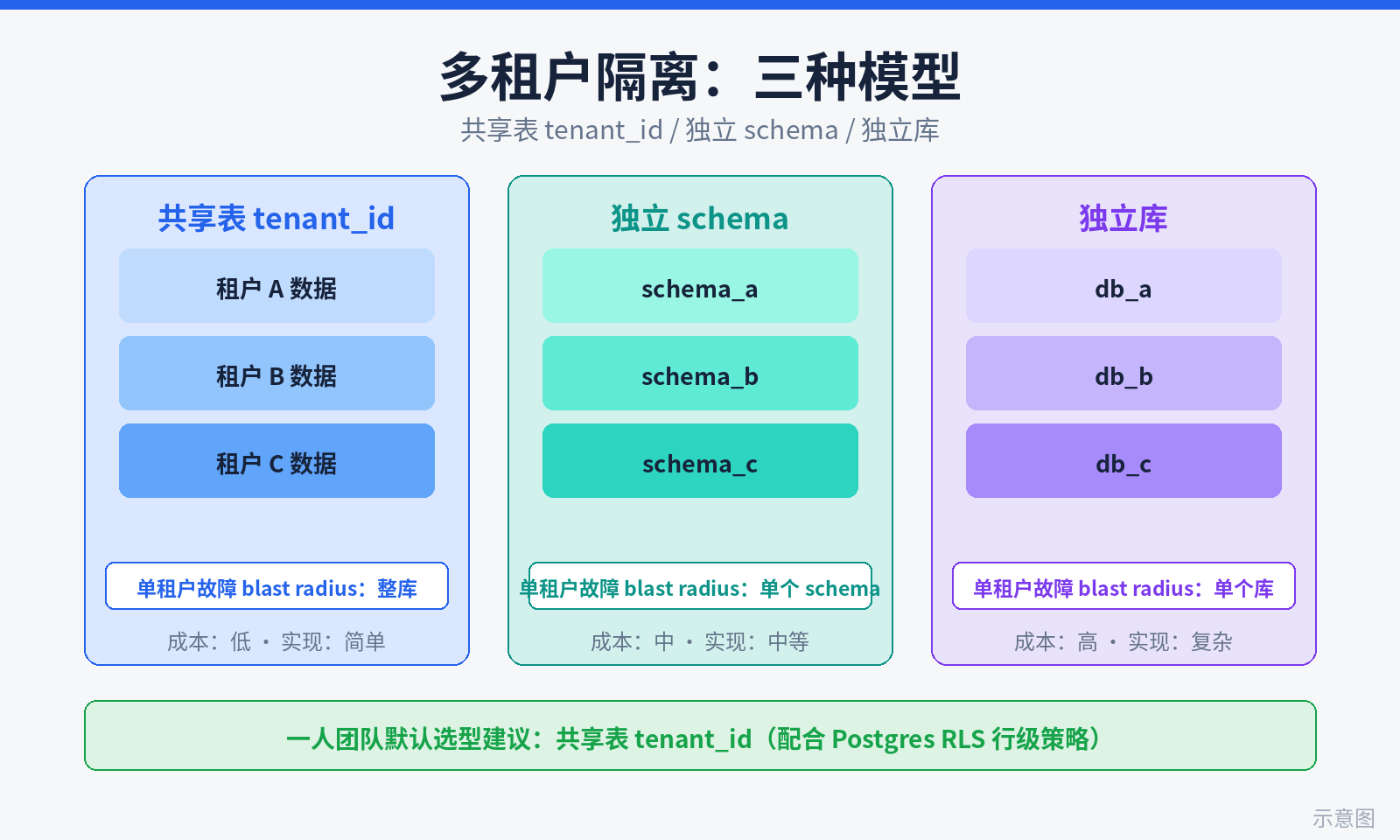
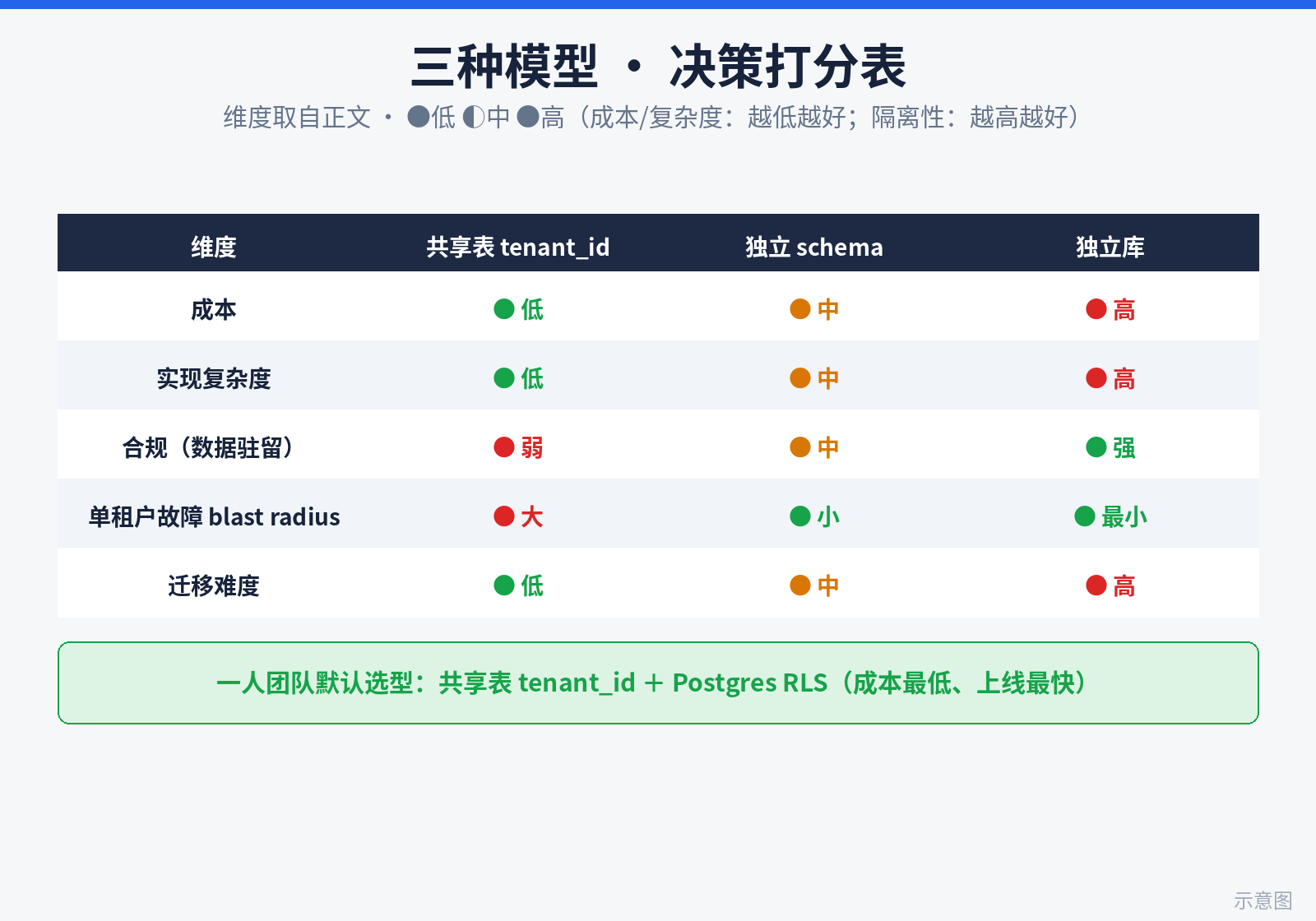
There are exactly three mainstream approaches to multi-tenant isolation — no silver bullets. I've scored them on 6 dimensions. ★ means "higher cost" on cost dimensions and "stronger capability" on capability dimensions:
Model                    New-tenant cost  Impl. complexity  Ops burden  Compliance/data residency  Fault isolation  Migration difficulty
───────────────────────  ───────────────  ────────────────  ──────────  ─────────────────────────  ───────────────  ────────────────────
Shared tables(tenant_id)        ★               ★★              ★                  ★★                    ★                 ★★★★
Schema-per-tenant              ★★              ★★★             ★★★                 ★★★                   ★★★                 ★★
DB-per-tenant                 ★★★★            ★★★★            ★★★★★               ★★★★★                 ★★★★★                 ★

Note: first three columns — more ★ = pricier/harder; compliance & fault isolation — more ★ = stronger;
migration difficulty — more ★ = harder to move away from later.- Shared tables + tenant_id (row-level isolation): all tenants share one set of tables; every row carries a
tenant_id. Adding a tenant costs nearly nothing (one row in tenants), but every query must carry the tenant condition — miss one spot and you leak. Right for 95% of vibe projects starting out. - Schema-per-tenant: one Postgres schema per tenant, identical table structures. Isolation comes free, and backup/restore works per tenant; the price is running every migration against N schemas, plus steeper connection-pool and ORM config complexity. Fits the stage with dozens to hundreds of tenants and real compliance requirements.
- DB-per-tenant: one database per tenant. Smallest fault blast radius (one tenant's slow query can't kill the others), easiest data-residency compliance; the price is ops hell — backups, monitoring, and upgrades all multiplied by tenant count. Fits high-ACV customers with dedicated compliance contracts.
Default pick for a solo team: shared tables + Postgres RLS. Don't overthink it. When to upgrade? Move only when any of these signals appears: ① a customer contract explicitly requires physical isolation or data pinned to a specific region; ② one tenant's data passes ~100GB, or a large tenant's slow queries are already affecting others; ③ a big customer will pay 3–5x for a dedicated database. None of the three? Don't touch it — premature DB-per-tenant is the most common way indie developers "add drama to their lives with ops complexity."
Anti-pattern warning: I've watched someone go DB-per-tenant with exactly 3 customers "for architectural elegance," then spend half a day every week running migrations across 3 databases — all vibe burned on ops. Remember: the strength of your isolation model should track your price per customer, not your architectural taste.
3. Landing Postgres RLS: Middleware + Policies + Prisma Extension — All Three, No Shortcuts
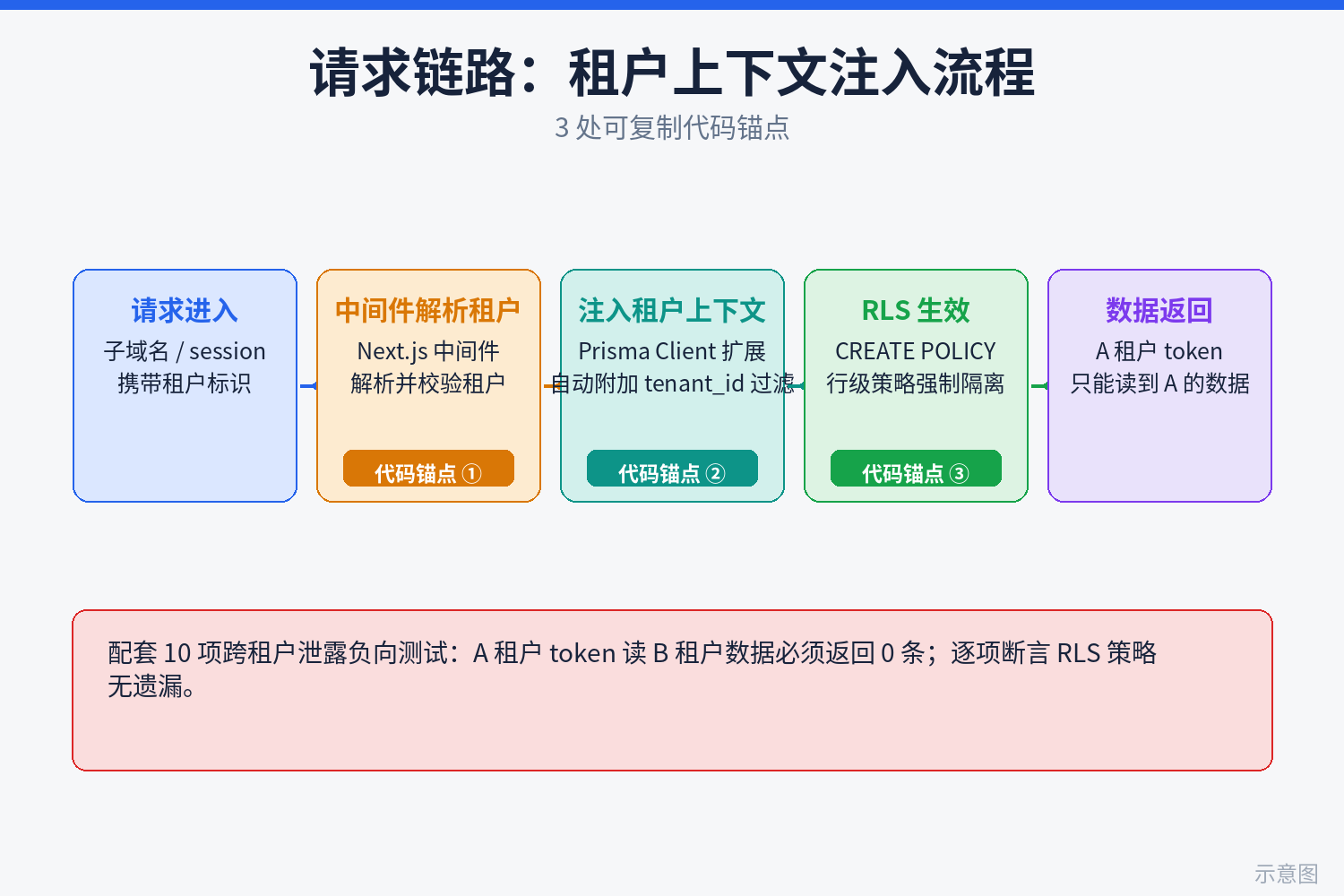
With the shared-table model, isolation rests on three layers: middleware resolves the tenant → database RLS enforces isolation → the ORM auto-attaches filters. RLS (Row Level Security) is the last line of defense — even if application code misses a spot, the database simply refuses to return someone else's rows. The code below is copy-ready; adjust table and column names per the comments.
1. Next.js middleware: resolve the tenant from subdomain/session and inject context
// middleware.ts
import { NextRequest, NextResponse } from 'next/server';
import { getToken } from 'next-auth/jwt';

export async function middleware(req: NextRequest) {
  const res = NextResponse.next();
  // 1) Prefer the subdomain: acme.example.com -> acme
  const host = req.headers.get('host') ?? '';
  const subdomain = host.split('.')[0];
  const reserved = new Set(['www', 'app', 'api', 'localhost']);
  // 2) Fall back to session/JWT (path-prefix routing, local dev, custom domains)
  const token = await getToken({ req });
  const tenantSlug = !reserved.has(subdomain) && subdomain
    ? subdomain
    : (token?.tenantSlug as string | undefined);
  if (!tenantSlug) return new NextResponse('Unknown tenant', { status: 404 });

  // 3) Look up the tenant id from the tenants table (cache this in production — see note)
  // Note: Edge Runtime can't hold direct Postgres connections well; put tenantId in the
  // JWT and keep only a cached slug -> id lookup here, so no DB hit per request.
  const tenant = await lookupTenantBySlug(tenantSlug);
  // 4) Inject the request header: the backend trusts ONLY this header,
  // never a tenantId passed in as a frontend parameter
  res.headers.set('x-tenant-id', tenant.id);
  return res;
}

export const config = { matcher: ['/api/:path*', '/dashboard/:path*'] };
Two pitfalls: ① never trust a frontend-supplied tenantId parameter — tenant identity may only come from the subdomain, the session, or a signed JWT; anything else is an express lane to privilege escalation; ② don't open direct Postgres connections from Edge Runtime — carry tenantId in the JWT or use a cached lookup, or cold starts will push your P99 to 2 seconds.
2. RLS policies: the last wall at the database layer
-- 1) Add the tenant column to business tables
-- (for existing tables use a nullable column + backfill — see the migration SOP in section 6)
ALTER TABLE projects ADD COLUMN tenant_id uuid NOT NULL REFERENCES tenants(id);
CREATE INDEX idx_projects_tenant ON projects(tenant_id);

-- 2) Enable row-level security: once on, queries with no matching policy return 0 rows
ALTER TABLE projects ENABLE ROW LEVEL SECURITY;

-- 3) Policy: reads and writes may only touch the current tenant's rows
CREATE POLICY tenant_isolation ON projects
  FOR ALL
  USING (tenant_id = current_setting('app.tenant_id')::uuid)
  WITH CHECK (tenant_id = current_setting('app.tenant_id')::uuid);

-- 4) Inject the context at the start of each request (transaction-scoped:
-- SET LOCAL is cleared automatically when the transaction ends)
-- Run this in your db middleware / request entry point:
-- SET LOCAL app.tenant_id = 'xxxxxxxx-xxxx-xxxx-xxxx-xxxxxxxxxxxx';
Three field-tested notes: ① FOR ALL in one shot is the low-maintenance choice — it covers SELECT/INSERT/UPDATE/DELETE; don't write four separate policies and dig your own hole; ② the index on tenant_id is mandatory, or the RLS filter falls back to full-table scans and your P99 explodes as data grows; ③ if you run pgBouncer in transaction mode: SET LOCAL is transaction-scoped and auto-cleared on transaction end, which fits pooled-connection reuse perfectly — but never use plain SET (session-scoped); when the connection gets recycled to the next tenant, the leftover context is an officially certified leak channel.
3. Prisma Client extension: make "forgot the tenantId" impossible at dev time
RLS alone isn't enough — an RLS block surfaces as 0 rows at runtime, and while debugging you can't tell "genuinely no data" from "policy blocked it." Add automatic filtering at the app layer for a far better dev experience:
// lib/prisma.ts
import { PrismaClient } from '@prisma/client';
import { AsyncLocalStorage } from 'node:async_hooks';

// Per-request tenant context: populated from the x-tenant-id header in middleware
export const tenantStore = new AsyncLocalStorage<{ tenantId: string }>();

const base = new PrismaClient();

export const prisma = base.$extends({
  name: 'tenant-isolation',
  query: {
    $allModels: {
      async $allOperations({ model, operation, args, query }) {
        const ctx = tenantStore.getStore();
        // Allowlist: the tenants table itself, global settings, etc. skip tenant filtering
        const skip = new Set(['Tenant', 'GlobalSetting']);
        if (ctx && !skip.has(model!) && args && typeof args === 'object' && 'where' in args) {
          (args as any).where = { ...((args as any).where ?? {}), tenantId: ctx.tenantId };
        }
        return query(args);
      },
    },
  },
});
// Usage: await tenantStore.run({ tenantId }, () => handler(req));
Remember the division of labor: the Prisma extension keeps you from writing it wrong (dev-time peace of mind); RLS keeps a wrong write from leaking (production-time life insurance). Only with both in place is isolation truly landed. One more thing: aggregate queries (count/groupBy) and raw SQL ($queryRaw) bypass this extension — anywhere you hand-write SQL, add the tenant_id condition yourself, and make it a mandatory code-review checklist item.
4. Tenant Routing Trade-offs: Subdomain vs. Path Prefix vs. Custom Domain
Tenant routing decides how users reach you — and how your middleware is written. Pick one of three; there is no "best," only "best for your current stage":
- Subdomain (acme.example.com): strongest isolation feel — users perceive "my own dedicated backend"; the most natural middleware parsing (take the first host segment). The price is wildcard certificates and DNS setup. My default recommendation for a SaaS that's formally live and cares about brand.
- Path prefix (example.com/acme): zero DNS cost, easiest local dev; the price is that every link, redirect, and OAuth callback must carry the prefix — miss one and it's a 404 — and users feel like they're "renting a corner." Fits MVP validation or a tiny (<5 tenants) private beta.
- Custom domain (app.acme.com): big customers love it — "dedicated domain" looks great in a contract; the price is per-domain verification + certificate issuance (CNAME onboarding + ACME DNS-01 challenges), plus alerting for renewal failures. Treat it as a paid upsell, not the default.
Wildcard certificate checklist (configure once for the subdomain approach — copy directly):
[ ] 1. DNS: add an A/ALIAS record for *.example.com pointing at your server or LB
[ ] 2. Certificate: issue *.example.com via the DNS-01 challenge (HTTP-01 can't do
      wildcards); Let's Encrypt / ZeroSSL both work, 90-day validity
[ ] 3. Auto-renewal: cron `certbot renew` weekly; alert your phone on renewal failure —
      don't discover it from a user reporting "certificate expired"
[ ] 4. Local dev: add 127.0.0.1 acme.localhost to /etc/hosts (modern browsers
      support *.localhost with no hosts entry — works in Chrome/Firefox)
[ ] 5. Middleware reserved words: www/app/api/status/docs etc. follow public logic —
      don't mistake them for tenant slugs and 404 on a DB lookup
[ ] 6. Cookie domain: set the login cookie's Domain to .example.com, or users will
      have to log in again every time they hop from acme.example.com back to the main site
The pitfall is item 6 — I missed the cookie domain at first, and users had to re-login every hop from subdomain to main site; it got reported as a bug three times before I traced it. And custom domains must have domain ownership verification (have the customer add a designated TXT record) — otherwise anyone can CNAME app.evil.com at your server and impersonate a tenant.
5. Cross-Tenant Data Leaks: 10 Negative Test Cases (Run Them All Before Launch)
Whether isolation actually works can't rest on "I feel good about it" — it rests on negative tests that prove "what shouldn't be visible is invisible." The 10 below go straight into your test files; every one is a pitfall I or someone I know stepped in for real:
[ ] T1 Cross-tenant read: with tenant A's token, GET /api/projects/<tenant-B-resource-id> —
      expect 404 (note: 404, not 403 — a 403 reveals "this id exists")
[ ] T2 Cross-tenant write: with tenant A's token, PATCH /api/projects/<tenant-B-resource-id> —
      expect 404, and the row's updated_at in the DB is unchanged
[ ] T3 List penetration: with tenant A's token, GET /api/projects (no filters at all) —
      assert the count equals tenant A's true count and every row's tenant_id equals A
[ ] T4 Search penetration: search for tenant B's unique keyword (e.g., their company name) —
      expect 0 results (search is the #1 place where the tenant condition gets forgotten)
[ ] T5 Export penetration: with tenant A's token, call "export all data", unzip the CSV —
      assert no row has tenant_id != A (the opening story's incident was this untested case)
[ ] T6 Cache cross-contamination: after tenant A hits /api/dashboard, tenant B hits the same URL —
      assert B gets B's own data (cache keys must carry a tenant prefix,
      e.g. dashboard:{tenantId}:summary)
[ ] T7 Background-job tenant bleed: run the scheduled jobs (e.g., the daily digest email) —
      assert the job log shows correct context switching per tenant, with no
      "emailed B using A's config"
[ ] T8 Admin overreach: with tenant A's admin token, hit /api/admin/tenants —
      expect 403 — a tenant admin is not a platform admin; cross-tenant management
      goes through a separate platform console + operation audit log
[ ] T9 Share links: open tenant A's "public share link" in a logged-out browser —
      assert only that single shared resource is visible, nothing else of A's;
      then splice tenant B's resource id into the share URL — expect 404
[ ] T10 Tenant deletion: after deleting a test tenant, call any endpoint with its old token —
      expect 401; and the tenant's data must be physically deleted after a 30-day
      freeze (or anonymized per contract), invisible to every query during the freeze
Execution advice: T1–T5 belong in CI and run on every deploy; T6–T10 get a manual pass monthly (cache and cron behavior drift with refactors). One line to remember: the value of negative tests isn't in "passing" — it's in the first failure that blocks a real leak. These 10 have run in my CI for over half a year and caught two genuine regressions.
6. Single-Tenant → Multi-Tenant: A 5-Step Migration SOP (With a Rollback Point per Step)
Already have live data and paying customers? Migrate without downtime in five steps — each with an explicit rollback point. A migration plan with no rollback points is gambling.
Step 1: Add the tenant_id column, backfill a default tenant
Add a nullable tenant_id uuid column to every business table, create one "default tenant" (your existing customer), and backfill all legacy rows. Code stays completely untouched — it's just a new column. Rollback: DROP COLUMN, recovered in a minute. Backfill large tables in batches (10k rows each) — don't lock the whole table with one UPDATE and take production down.
Step 2: Dual-write in code + filters on read paths (behind a feature flag)
New writes always carry tenant_id; read paths get automatic filtering via the Prisma extension from section 3, wrapped in a flag (if (flags.multitenancy) ...). Turn it fully on in staging first, keep production off, and observe for a week. Rollback: flip the flag off — code returns to the old path, zero data changes. This step is the grind: walk through every naked query one by one; each one you miss is a future T3 failure.
Step 3: Turn on RLS — audit mode first, enforce mode second
Create the policies but start in "lenient + logging" mode: use an audit trigger/table to compare "rows RLS would block" against "rows the app layer returns" for 3–7 days. Once the diff is zero, flip the policies to enforcing. Rollback: DROP POLICY — database behavior reverts instantly. Gotcha: grant BYPASSRLS to the postgres superuser and your migration role, or your own migrations get blocked by the policies and a midnight deploy freezes solid.
Step 4: Gradual traffic cutover — internal tenant first, then 5% of real customers
Stand up an internal test tenant and run the full new chain (subdomain + RLS + usage metering) for two weeks; then canary 5% of customers (id % 20 == 0 on the tenants table) while watching three metrics: P99 latency, error rate, and the T1–T5 negative tests. Rollback: flip the flag off for canary tenants back to the old chain; the tenant_id column stays in the data layer, harmless. During the canary, read the RLS audit log daily and confirm everything blocked is genuinely unauthorized, not friendly fire.
Step 5: Make tenant_id NOT NULL, clean up legacy code
After two stable weeks on the full cutover, alter the column to NOT NULL and delete the feature flag plus old query paths. But don't DROP old columns/tables in a hurry: keep a 30-day "tombstone period" with daily backups; physically clean up only after 30 quiet days. Rollback: on any day within the 30, restore the backup table and re-enable the flag.
The whole SOP boils down to one line: keep both the old and new paths walkable at every step, and only tear down the old road once the new one is proven. The extra storage and code branches during migration are the cheapest insurance you can buy.
7. Billing Mapping: The Minimal Per-Tenant Usage Metering Implementation
Multi-tenancy ends at the cash register: how many API calls, AI tokens, and storage bytes each tenant used is what the invoice says. The minimal implementation is three pieces — middleware instrumentation + Redis counters + scheduled aggregation into a table — buildable in half a day:
// middleware.ts (excerpt): instrument every API request at near-zero cost
const day = new Date().toISOString().slice(0, 10); // 2026-10-11
const pipe = redis.pipeline();
pipe.incr(`usage:${tenantId}:${day}:api_calls`);
// AI token spend is instrumented in business code:
// pipe.incrby(`usage:${tenantId}:${day}:ai_tokens`, tokens);
pipe.expire(`usage:${tenantId}:${day}:api_calls`, 86400 * 3); // keep 3 days so a
                                                              // dead aggregator doesn't lose data
await pipe.exec();
-- Aggregation table: an hourly cron flushes Redis counters here
CREATE TABLE usage_daily (
tenant_id uuid NOT NULL REFERENCES tenants(id),
day date NOT NULL,
api_calls bigint NOT NULL DEFAULT 0,
ai_tokens bigint NOT NULL DEFAULT 0,
storage_bytes bigint NOT NULL DEFAULT 0,
PRIMARY KEY (tenant_id, day)
);
-- Plan-limit checks are one SQL statement:
-- SELECT api_calls > plan.monthly_api_limit FROM usage_monthly WHERE tenant_id = $1;Four field-tested notes: ① instrument with pipeline + incr — one Redis RTT, invisible in middleware latency; never write Postgres synchronously in the request path — that's volunteering for P99 pain; ② keep Redis keys for 3 days and run the aggregation cron hourly — if the cron dies you have time to backfill; lost metering data is lost revenue: prefer duplicate aggregation (idempotent upserts) over ever losing a count; ③ don't compute storage live — sweep object storage by tenant prefix once a day at quiet hours and write it into storage_bytes; ④ decide the overage policy up front: hard block (403 + upgrade nudge) or soft overage (meter it, settle at month end) — put it in the contract, don't argue after a customer blows 10x past their quota.
One line to sum up: multi-tenant isolation is the discipline of turning every "default to whole-site" assumption in your code into "default to this tenant." Shared tables + RLS are the highest-ROI starting point, the 10 negative tests are the CI that keeps you alive, the 5-step migration SOP gets legacy projects on board without downtime, and per-tenant metering ties every line of isolation code back to an invoice. Starting with your second customer, your vibe project is truly open for business.
Related articles
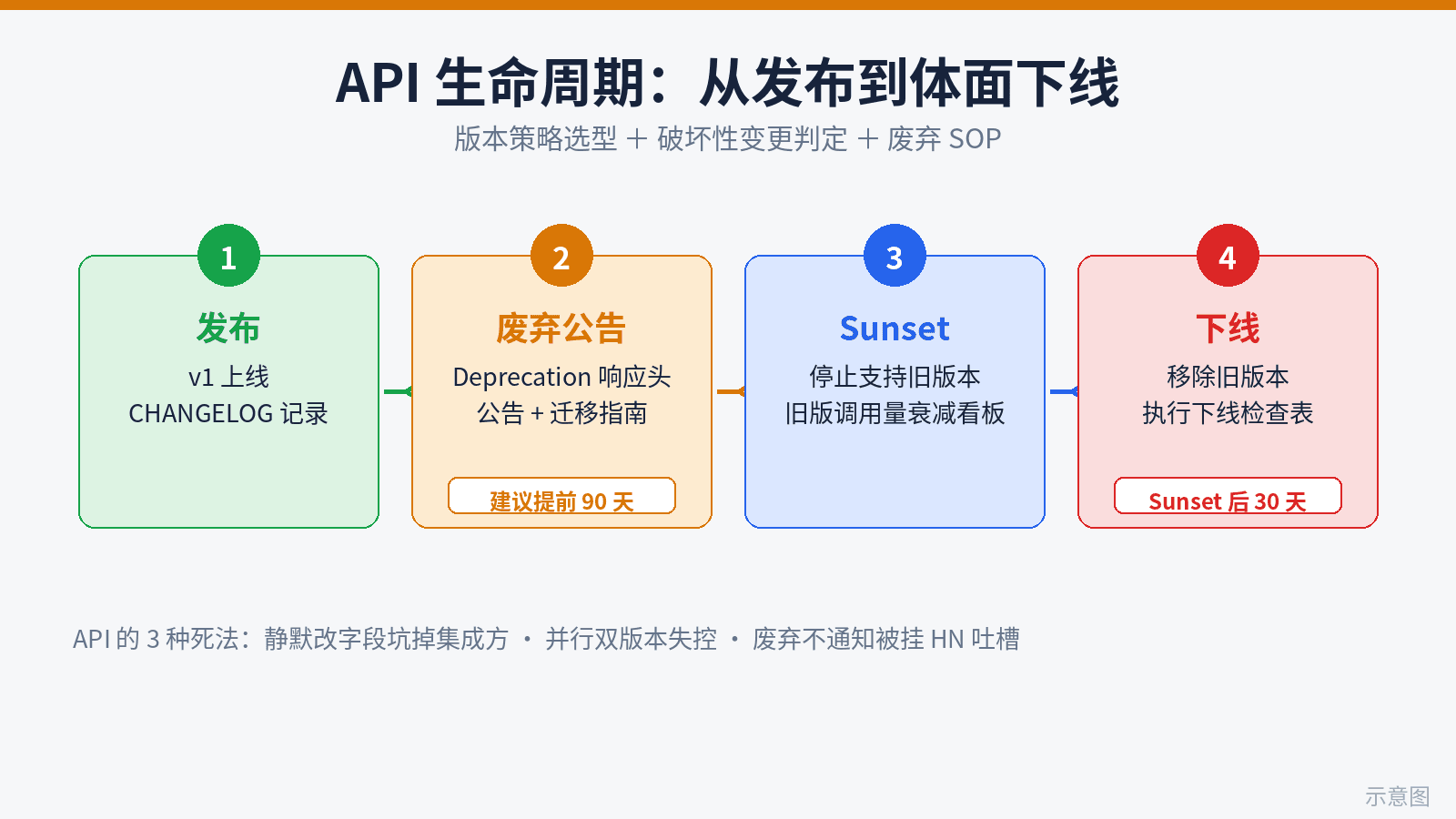
Vibe coding ships 10x faster than API contracts can move — where solo projects blow up. This guide fills the gap: 3 real ways vibe APIs die, a version-strategy decision table (URL path vs header vs versionless), a 12-rule breaking-change checklist, a 4-step deprecation SOP (headers, announcements, dual-run dashboards, sunset checklist), a copy-ready migration template, and the minimal solo setup: CHANGELOG-driven development plus CI auto-blocking breaking changes via openapi-diff.
This guide flips that mindset: a clear refund policy is the cheapest trust advertising, well-handled refunds bring 30% of users back, and one mishandled chargeback can eat a month of profit. Covers three-tier policy design with copy-ready templates, Stripe Dashboard vs API refunds, a charge.refunded webhook closed loop, a save-vs-refund decision tree, the chargeback evidence playbook, Radar anti-fraud rules, and cross-border tax notes for MoR platforms.
Vibe coding made building easy and getting noticed hard; community and open source are the few fair arenas where time trades for traffic. This tactical manual covers venue picks, 5 seed-user sources for the 0-20 cold start, a daily 15-minute ops SOP for 0-100, the README-as-landing-page formula, GitHub trending mechanics and launch timing, issue-driven marketing, build-in-public rhythms, crisis playbooks, 5 health metrics, and the path from community to revenue.