Shengshu's Vidu Q4 Preview: Flagship Video Generation at $0.014/sec, 15 Reference Images, 2K/4K — Public Preview First
On October 7, Shengshu Technology launched Vidu Q4 Preview: flagship video generation starting at $0.014/sec (~14 cents for a 10-second clip), with up to 15 image references, 3 audio references, and 2K/4K 10-bit output. The public preview ships first, with creator feedback shaping the final release. We break down the price war for indie developers, the 15-image consistency fix, positioning vs. Sora/Runway/Veo, and when vibe coders should wire video generation in.

October 7, Singapore. Shengshu Technology announced Vidu Q4 Preview via PR Newswire — the first public preview of its next-generation flagship video model. The release's dateline reads "SINGAPORE, Oct. 7, 2026". Two numbers in that release deserve every indie developer's attention: first, launch pricing starting at $0.014 per second, roughly ten cents in RMB terms; second, support for up to 15 image references and 3 audio references, with output at 2K/4K resolution and 10-bit color depth.
This is a press release, but it deserves a full article to unpack: the price war has reached "priced by the cent," and 15 reference images represent an engineering answer to the consistency problem. For vibe projects working on AI video, marketing assets, or product demos, both developments touch your cost model and your technical choices directly.
1. Do the math: what 14 cents buys you
Start with the official pricing language: launch pricing starts at $0.014/sec, with output tiers spanning 540p, 720p, 1080p, 2K, and 4K. Third-party reviewer alfw.ai did the intuitive conversion: a 10-second clip at 540p costs 14 cents. That means a single 30-second marketing clip costs less than loose change from a bubble tea run.
The release offers an even bolder comparison: under "comparable output specifications and billing conditions," the same budget buys "up to five times as much output." That's the vendor's own arithmetic — don't treat it as universal law — but it points to a real trend: AI video is moving from luxury good to utility.
Why does this turning point matter for indie developers? Because in the cost structure of AI video, the biggest line item was never "one finished clip" — it was the scrap rate. The release itself admits that a production-ready shot rarely comes from a single attempt: creators refine expressions, compare camera angles, test different openings. When each generation was expensive, every reroll hurt. When a 10-second test shot costs 14 cents, iteration stops being something you ration and becomes something you do freely. For product teams, that makes A/B-testing video assets, making personalized versions for different audiences, or producing a demo clip per SKU realistically affordable for the first time.
Two pricing caveats are mandatory: first, $0.014/sec is the starting price at the 540p tier — 4K output will cost considerably more. The release only publishes the starting price, not the full tier table; the real 4K cost lives on vidu.com's pricing page. Second, the release explicitly calls this launch promotional pricing. Promotional pricing expires. When you model costs, budget conservatively — say, double the promo rate — and don't treat a preview-period price as a long-term commitment.
2. Fifteen reference images: an engineering answer to consistency
If price is the headline of this launch, the 15 reference images are its most technically substantive feature. The AI video world has a two-year-old pain point: consistency. The same character's face subtly shifts after a cut, text on clothing melts during motion, the prop in a character's hand vanishes in the next shot. The old approach was "roll the dice" — gambling on multiple generations — or wrestling with elaborate prompt engineering.
Vidu Q4 Preview's answer is to make the constraint an engineering input: up to 15 reference images can simultaneously define characters, wardrobe, props, products, and environments within one creative setup; three audio references guide voice consistency and emotional delivery. The release's concrete example: creators of narrative shorts get "more deliberate control over how a scene is staged and how its characters perform."
Third-party analyst alfw.ai (October 9 analysis) offered a sharp reading: the 15 slots shouldn't be treated as "a bigger upload allowance" but as "a production kit." Its recommendation: three slots for the character (front, three-quarter, profile), two for wardrobe (worn and shown flat, for costume changes), two or three for key props (shot on plain backgrounds so the model learns the object, not the room), three or four for environments (the wide, the mid, the detail that sells the location), and one or two held in reserve. The core discipline: the 15 references must agree with each other — same lighting mood, same style register, same character design. Contradictory references don't average out; they drift.
For vibe coders, this matters because it turns the arcane into the engineerable. People building AI video products used to gamble on consistency with prompt templates and retry logic; now you can make the "reference kit" part of the product itself — a tool where e-commerce sellers upload three product views plus brand-environment images and get a showcase clip automatically, or where indie game developers lock a character's three views and generate cutscenes. The 15-image ceiling sets the ceiling for that kind of product. The one warning, from alfw: preview-period behaviors can change, so don't hard-code them into your product's contract.
Also worth noting is the design of the three audio references. The official line: "up to 3 reference audio clips to guide voice consistency and emotional delivery." alfw's advice is not to upload the same line three times — instead, give a range: the neutral read, the emotional peak, the quiet moment. The model cannot extrapolate a delivery style it has never heard. The same principle applies to vibe projects in AI voiceover and audio content.
3. Preview first: a beta-driven launch playbook
The most interesting thing about this launch isn't a feature — it's a word: Preview. The release states plainly that Vidu is shipping Q4 Preview ahead of the full Q4 model so creators can use it in real projects and "help shape the final release." Feedback on performance, creative control, and everyday production needs will feed directly into further improvements.
It's a very Silicon Valley — and very Shengshu — playbook: public beta first, collect feedback, then finalize. It's the opposite of Sora's old path of mysterious demos, limited invites, and sudden openings. The upside is real production data, fast; the downside is unstable model behavior during the preview. The release already buries the disclaimer: final pricing, supported resolutions, feature availability, and usage terms "may vary by plan and region."
The practical takeaway for developers cuts both ways. If you're making marketing assets or running content experiments, now is a good time to get in — it's cheap, there's an API, and there's a web product. But if you're wiring video generation into your product's core paid loop (say, a "one-click promo video" feature users pay for), treat Q4 Preview as a replaceable vendor: isolate the model version, and don't hard-code its output characteristics (reference-slot semantics, resolution tiers) into your data structures. Lock in the dependency after the full Q4 release lands with stable pricing and features.
4. The competitive map: what Sora, Runway, and Veo are each fighting for
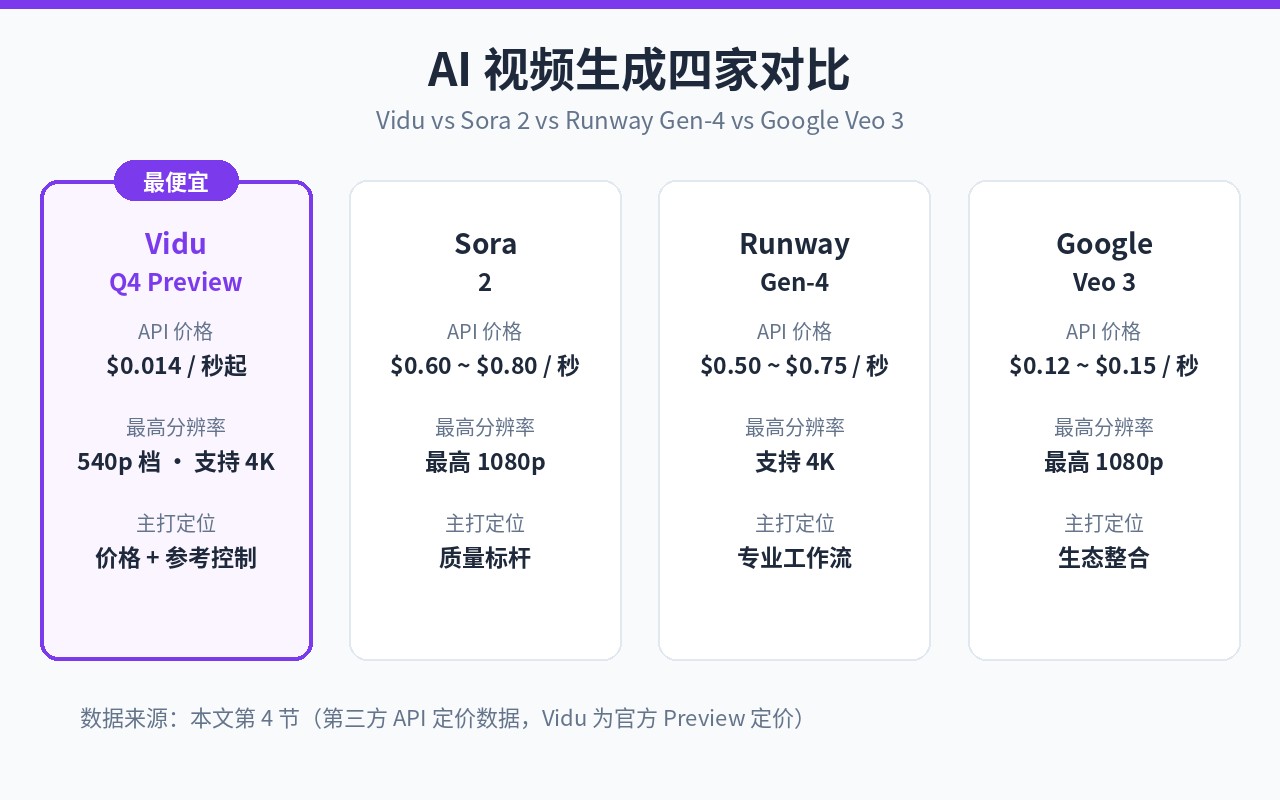
A note on method first: the competitor prices below come from a third-party comparison source (crazyrouter's API pricing roundup, September 2026). Official prices change, and subscription vs. pay-as-you-go models aren't directly comparable — treat these as directional reference, not precise rankings.
- Sora 2 (OpenAI): third-party data puts API pricing around $0.60–$0.80/sec (image-to-video ~$0.60/sec, text-to-video ~$0.80/sec), maxing out at 1080p. Sora's edge is physics simulation and cinematic feel, but it's the most expensive option on this chart, with persistently limited availability.
- Runway Gen-4: roughly $0.50/sec standard, ~$0.75/sec in Turbo mode, up to 4K. Runway's strength is its editing toolchain (motion brush, compositing) — it positions itself as a link in professional production pipelines, and its per-second price reflects that.
- Google Veo 3: text-to-video ~$0.15/sec, image-to-video ~$0.12/sec, up to 1080p. Considered a good quality-to-price ratio, backed by the Google Cloud ecosystem.
- Vidu Q4 Preview: starting at $0.014/sec (540p tier), up to 4K with 10-bit color, 15 image references plus 3 audio references. The lowest price on this chart and the highest reference-image ceiling.
My read (this is an opinion, not a fact): these four aren't fighting the same war. Sora fights for the "quality benchmark," Runway for the "professional workflow," Veo for "ecosystem integration," and Vidu is now betting on "price plus reference control." For indie developers, the selection logic shouldn't be "which is strongest" but "what's most expensive in my scenario." If you're doing social content at volume, price and API reliability dominate. If you're delivering brand-grade TVCs, quality and 4K delivery dominate. If you're producing character-IP series, reference consistency dominates. Vidu betting on "volume" and "consistency" at once is aimed squarely at the indie-developer and small-studio middle layer.
One underappreciated comparison axis: the Chinese-language context. Shengshu is a Tsinghua-rooted Chinese company, and the release specifically claims Q4's Chinese text rendering is strong enough to rival doing your own post-production VFX. For Chinese marketing assets, Chinese short dramas, and scenes with Chinese signage and subtitles, that could be a quiet advantage over American competitors — with the caveat that this is the vendor's own claim, and you should verify it with your own test runs.
5. Practical advice for vibe coders: when to wire video generation in
Finally, something directly usable. Once video generation API pricing hits a dime a second, the "should I integrate" question stops being about cost and becomes about product. I look at three signals:
Signal one: your product already has a step where users pay for visuals. The classic case is marketing-asset automation — e-commerce sellers, indie-site owners, app developers all need product showcase videos and can't afford editors. If you're already doing "one-click product images," video is the natural next step: the same reference set (three product views, brand environment) extends from stills to clips at tiny marginal cost.
Signal two: your content production has a "batch plus customization" structure. Making an opening promo for each of 50 franchisees — the person becomes the store manager, the sign becomes the store name, the address becomes the location — is the shape AI video does best: templated customization. The 15-reference ceiling lets you lock the "brand asset pack" (logo, store environment, products, spokesperson look) once, and batch-generate without drift.
Signal three: your users are already paying for trial and error. Short-drama creators, ad agencies — they produce multiple versions of every idea anyway. A $0.014/sec starting price turns "multiple versions" from a luxury into the default. Your product's value then isn't "generating video" but "managing versions": organizing reference kits, comparing variants, accumulating prompt templates that work. A tool's value is always in turning uncertainty into process.
Three engineering reminders: first, get the pipeline working at low resolution before paying for the final. The tiers run 540p to 4K, and alfw's advice is sound: validate camera moves and cutting logic at 540p, check faces and lip-sync at 720p, and only pay for 2K/4K on the take that survives. Second, write the scrap rate into your cost formula. Real cost = unit price × duration × retries — don't budget for one-shot success. Third, treat the reference kit as an asset and persist it. Vidu has a My References feature for this; your product should have a "brand asset pack" concept too — reuse the same kit, and consistency compounds.
Closing
The Vidu Q4 Preview launch marks AI video generation's formal entry into the "priced by the cent" era. For the giants, this is a price war; for indie developers, it's a supply-side liberation — when a 10-second video costs 14 cents, "should we do video" stops being a budget question and becomes an imagination question.
But don't let the price go to your head. Promo prices expire, preview builds change, and 15 reference images can't save a contradictory kit. The real dividend always goes to whoever turns "cheap" into "process": accumulate reference kits, run low-cost iteration loops, and embed video generation into steps where users already pay. The price war fights over supply; making money fights over demand — don't confuse the two.
Disclosure: pricing and feature information in this article comes from Shengshu Technology's official PR Newswire release of October 7, 2026 (dateline: SINGAPORE, Oct. 7, 2026) and alfw.ai's third-party analysis of October 9, 2026; competitor prices are cited from a third-party comparison source (September 2026), and official prices may have changed — check the vendors' sites. Strategy and selection advice reflects the author's opinions.
Sources
Related articles
On October 8, 2026, Harness announced the acquisition of select Augment Code assets, with Cosmos becoming the 'Harness Cosmos Software Factory Agent.' This piece breaks down what was bought, how the software factory works, Harness's agent-to-agent loop, and what it means for vibe coders.

TextQL Labs' Argo-Bench grades data agents on the consequences of their actions inside a simulated 235-table, 7.5-billion-row ERP warehouse — not on query correctness. The best of 14 models (Opus 5.5) clears 95+ on only 34.8% of 210 tasks. What this exposes about data agents, and the consequence-checklist practices solo developers can steal.
Moonshot AI's Kimi K3 has entered OpenAI's enterprise Codex channel via US inference provider Baseten. Enterprise customers can now burn existing OpenAI spending commitments on the Chinese open model — no new supplier contract needed. Sina Finance calls it the first Chinese open model to enter OpenAI's enterprise billing system. This piece unpacks the three-way split (Baseten/Codex/OpenAI billing), the Bedrock revenue-sharing lead-up, and what billing-neutral model choice means for developers.