Tags, categories and collections each do a different job, hierarchies should stay flat, and naming rules must come before tagging. This guide covers how to design a tag system, clean it up, decide who may create tags, and why AI tagging still needs human review, with a launch checklist.
VIBEFIX GUIDES
AI Coding Guides
Practical knowledge for tools, deployment, workflows, and building projects.
When agents go wrong it is rarely malice — usually nobody ever told them what they may touch, what they may not, when to stop spending, or how to revoke them. This guide gives a five-part permission contract: separate identity, allow-list, three-tier limits and approval, traceable records, and one-click revocation, plus a copy-ready template and three enforcement layers.
Vibe developers ship fast but rarely shut down cleanly — zombie features quietly eat all maintenance time. This guide turns sunsetting into a launch in reverse: the three sunset questions, a 30/90-day announcement window, data export scripts, pro-rata refunds, farewell email templates, 301 redirect maps, code archiving, and a 12-item acceptance checklist.
Your code runs in three different environments: your laptop, a fresh agent session, and CI — and they disagree. This guide standardizes the dev environment for vibe projects: a full devcontainer.json template (Node+Postgres), the nix-flakes endgame, and a 15-minute minimum viable version.
Your vibe project's AI feature will face provider outages, rate limits, timeouts, and bad outputs. Design the degraded mode before launch: timeouts, retries, a fallback ladder, honest caching, queues, and an outage-night runbook.
'Improved the experience, fixed known issues' says nothing wrong and tells users nothing. This guide gives a five-section structure for three reader groups, good-versus-bad examples, a four-step workflow from code changes to notes, five common pitfalls, a ten-phrase ban list, and a copy-ready template.
Audit logs are not business logs or ops logs. This standalone guide covers the actor/action/resource data model, hash-chain plus WORM immutable storage, three forensic query patterns (who deleted data, who exported reports, who changed prices), the deletion-right vs. audit-retention legal balance, and a minimal one-afternoon implementation for solo teams — with runnable code.
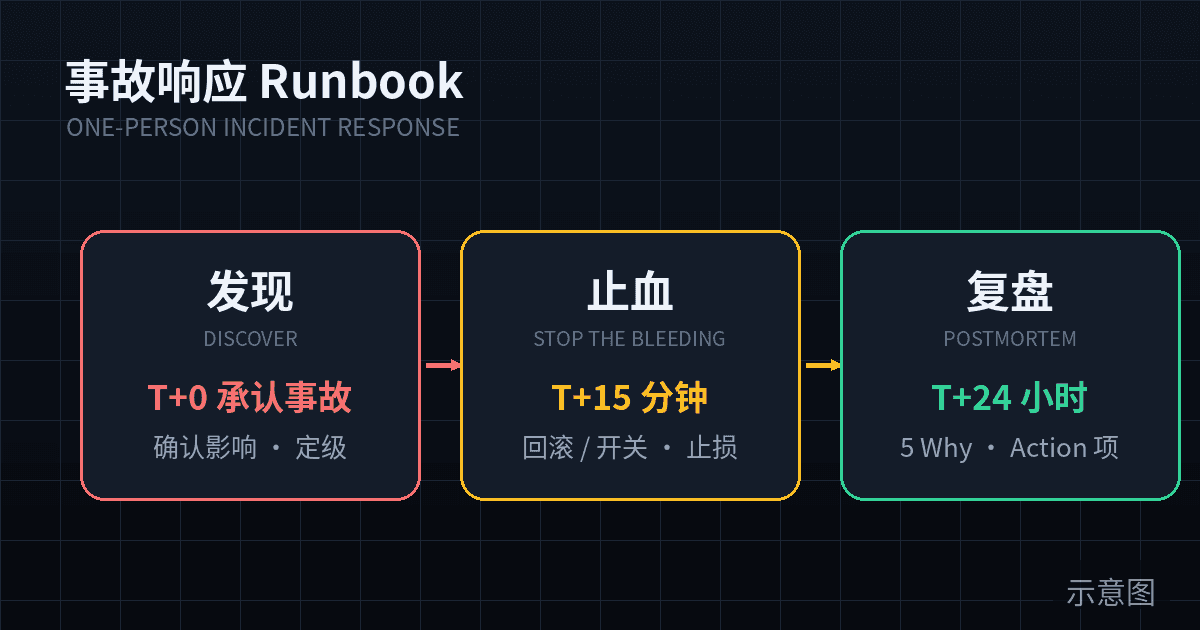
The alarm fired — now what? A practical incident-response playbook for one-person teams: a SEV1/SEV2/SEV3 triage checklist plus a 'when to let it go' list, a free alerting stack you can build in 15 minutes, the 5 fixed moves for the golden 15 minutes, a one-click rollback SOP, and copy-paste-ready timeline, communication, and blameless postmortem templates — plus 5 anti-patterns solo developers keep repeating.
Great UX can't answer policy questions, error-message searches, or pre-purchase trust checks. This guide gives solo developers a shippable help-center methodology: a four-quadrant matrix for what to document, a 6-category IA template, writing skeletons for 6 article types, a three-stage AI-drafting workflow from your codebase, a minimal docs-as-code setup for one person, a release-tied doc-debt checklist, and a monthly 1-hour maintenance SOP.
Without evals, every model swap is a gamble. This guide gives solo teams an evaluation system built in half a day: mining 50–200 exam questions from real logs, rule assertions vs LLM-as-judge (and taming judge bias), a regression pipeline, the production sampling flywheel, and launch gates with rollback — plus copy-paste run.py, CI configs, and checklists.