Writing an MCP client is harder than writing a server: it manages connections, tool discovery, parameter validation, approvals, degradation, and injection defense. This guide covers stdio vs Streamable HTTP selection, official SDK vs hand-rolled minimal client skeletons, tools/list parsing with zod validation, a four-tier approval table, a failure fallback checklist, a consumer-side security checklist, and a 10-step checklist for wiring a real MCP server into your product.
VIBEFIX GUIDES
AI Coding Guides
Practical knowledge for tools, deployment, workflows, and building projects.
AI-written code runs perfectly for one user and can collapse under 100 concurrent ones on launch day. This guide gets your first k6 script running in 15 minutes: derive load scenarios from real user behavior, read p95/p99 and saturation signals, locate DB, connection-pool and third-party API bottlenecks with a three-axe method, convert test numbers into paying-user capacity, and put load testing into CI as an automatic gate.
The distance from a vibe coding demo to a real business is often exactly one payment button. Stripe is the most vibe-coder-friendly way to collect money: docs an AI can read and get right, hosted Checkout pages with zero frontend work, and Payment Links that collect money in 5 minutes. This guide covers two integration paths, the steps from zero to your first payment, and four pitfalls you're guaranteed to hit — the first of which costs people money every year.
SMS OTP is the fastest login to ship — and the easiest to get burned by. This guide covers the three pits (cost, SMS bombing abuse, template compliance), a production-ready code/verify flow with rate limits, layered anti-abuse defenses, cost controls, and when to switch to email OTP or social login. Includes a launch checklist and copy-pasteable verification logic.
In 2026, APIs are increasingly called by agents, not humans. This guide dissects the five pillars of agent-friendly API design — contracts, error codes, idempotency keys, pagination, and machine credentials — through real cases from Stripe and GitHub, plus a ready-to-use checklist, OpenAPI quality scorecard, and self-test prompt template.
A bad SDK hurts adoption more than no SDK. This guide gives solo developers the full playbook for shipping an SDK from zero to one: the build-or-not decision gate, semver and a breaking-change checklist, the OpenAPI-to-SDK generation pipeline, language-matrix trade-offs, deprecation notices and codemods, npm/pip publishing checklists, support-surface control, and a v1 minimum-viable checklist.
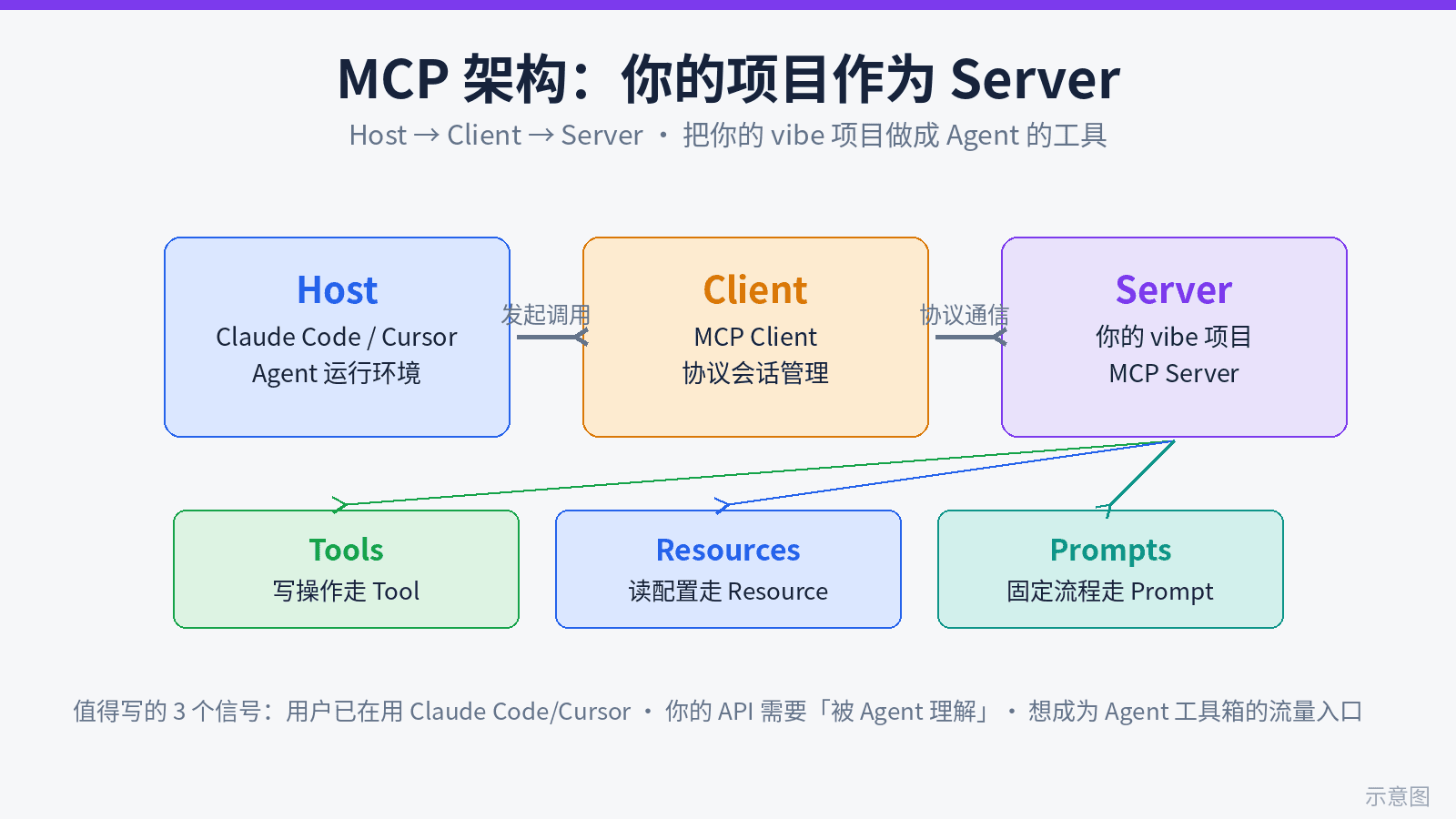
This is the supply-side MCP guide: turn your own project into an MCP server so agents come to call you. From 3 signals it's worth building and the Tools/Resources/Prompts decision table, to 150 lines of runnable TypeScript, 7 tool-schema design principles, stdio vs Streamable HTTP selection, a security red-line checklist, plus the registry submission list and a README install template — one afternoon to get your project into agents' toolboxes.
Models are rented; data is owned. This guide gives solo developers the complete data-flywheel playbook: the four links and the minimum closed loop, collection design (the three questions), a lightweight labeling pipeline, dataset versioning and eval-set growth, four reflow paths ordered cheapest-first, cold-start data sources, and a one-page weekly checklist.
Toasts look trivial, yet they appear at the user's most fragile moments: just deleted something, just paid, just finished an upload. When to show one, how to write the copy, how long to keep it, where to put it, how to make Undo really undo — and five test groups to run before launch.
AI picks your stack for speed, not for year three. This guide gives solo developers a third path between toughing it out and rewriting from scratch: a six-step migration playbook where the old system stays live and every step rolls back.