Meta Superintelligence Labs has released its first frontier model series, Muse Wonder and Wonder Full: self-reported SWE-Marathon hits 57.5% vs 46.3% for Opus 5.5, but the third-party Artificial Analysis index still trails 56 to 58; the standard model is $4/$20 via API while the best version is locked to Muse Code subscribers — with Contributor mode training on your code by default.
VIBEFIX NEWS
AI Coding News
Original perspectives on tools, frameworks, open source, and the creator ecosystem.
Google DeepMind's new Polaris team is hiring Research Engineers to build evaluation frameworks for AI coding agents — no degree required, no minimum years of experience. The reported total comp of $550K–$1.1M comes from Tamay Besiroglu's X post (base salary is listed at $164K–$252K). Polaris hand-builds a small number of tasks, about a week each, to mirror real-world coding complexity. Evaluation itself has become a frontline lab job.
On October 8, the UK's ICO announced that ten AI giants — Amazon, Anthropic, Apple, Cohere, DeepSeek, Google, Meta, Microsoft, OpenAI, Stability AI — have made or committed to data-protection improvements. The bigger story is the regulator's next target: agentic AI. A six-week call for evidence is open until November 20, with a statutory code of practice on AI decision-making in the works. Three duties indie devs should know: lawful basis, transparency, safeguards.
SiliconFlow (无问芯穹) has closed a ¥2.3B Series C, bringing total funding to ¥4.3B — a record for China's AI-native infrastructure sector. The numbers that matter: 37,000P of aggregated compute, 16 chip types, 40x token-call growth in seven months, and inference costs down 10x in a year with 'another 10x to go'. The bet is simple: whoever drives inference cost down defines the economics of the agent era — the same cost curve every vibe coding tool lives or dies on.
On Oct 10 Tencent Cloud open-sourced its internal TeamAI: team skills, rules, MCP, env vars and knowledge bases live in a Git repo, distributed via push → review → pull — configure once, reuse everywhere, across 16 agents. Timeline note: the repo was created Apr 27; Oct 10 was the official announcement. Tencent's claimed '76% cost cut' is a vendor claim; the product thinking matters more than the marketing numbers.
CNBC reported Oct 11: US software-developer postings rose nearly 15% since late Feb 2025 while overall postings fell 7%. But seniors drove 71% of the gain and AI-titled roles 37%; totals remain 27.5% below pre-pandemic. Stanford's 2026 AI Index shows early-career developer employment down nearly 20%. What's growing isn't code-writing jobs — it's machine-driving jobs.
The Oct 8 arXiv paper 'Skill Constellations' rebuilt agent-skill copy networks from git history: of 2.19M adoptions, half of SKILL.md files are verbatim copies; the top 1% of repos drive 94.7% of transmissions; upstream fixes never reach installed copies. Auditing the network-ranked top 100 repos would intercept 14.9% of later high-risk adoptions vs 0.5% for the top 100 by stars. Stars can't find hubs; the missing update channel is the structural risk.
On October 11, Piotr Sarnacki published 'I'm sorry, but you still have to think' on It's all about the bit — a teardown of DHH's AI-rewritten Campfire Once, shipped unread. Rust delivered ~1% of notifications under load and hid blocking DB calls in async tasks; Elixir delivered better but hit 1.8GB of memory. One line — stream_capacity 256 to 16384 — delivery 14% to 90%, but pMAX latency 11s to 130s+. Sequel to our cycle37 DHH manifesto: AI made writing cheap; thinking is the scarce resource.
On October 8, Chinese team MirroS published the paper 'AgentGarten: Code Worlds for Evolving Agents' and open-sourced the repository (Apache-2.0). Its thesis: code handles physics, a neural renderer handles light, and agents accumulate experience in playbooks — one short skill file per lesson. In a reenactment of OpenAI's 2019 hide-and-seek, skills that took ~100M episodes of self-play RL now emerge within 10 rounds of play-review-write cycles across five code worlds.
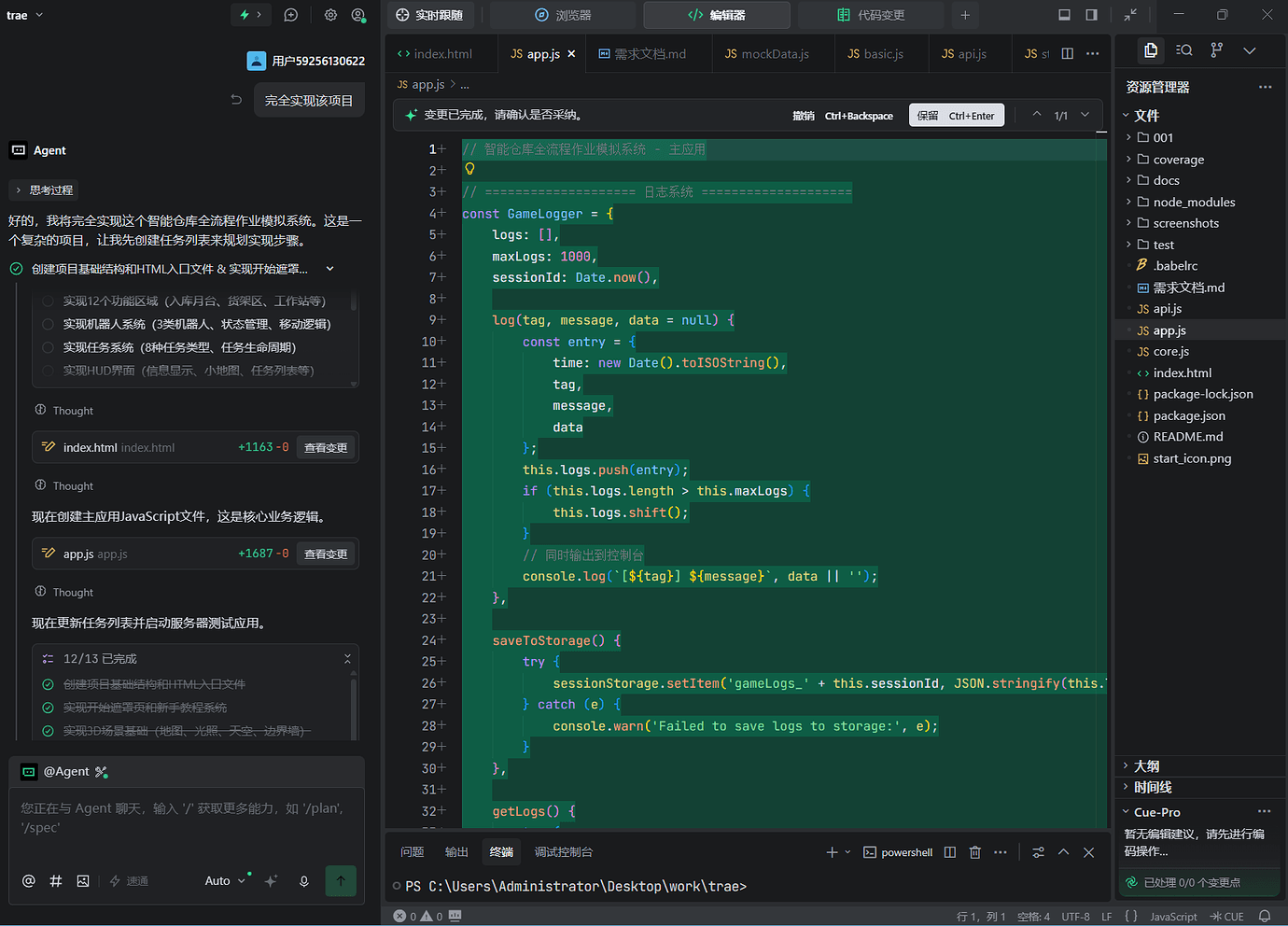
On October 9, ByteDance merged TraeWork and TraeCode into a unified TRAE: one entry point for continuous tasks, one-click switching between Agent mode and IDE mode. Agent mode is a global workbench where multiple agents split coding, testing and fixing; IDE mode keeps full editing for detail work. All deliverables settle into a Project Artifacts hub instead of chat history. The real story: 'work' and 'code' in one agent workflow, plus a labor-division playbook for one-person teams.