Project Directory

Browse all indie developer projects and co-creation requests

Active: AI Apps
Showcase
Online
AI Apps

Sidelong

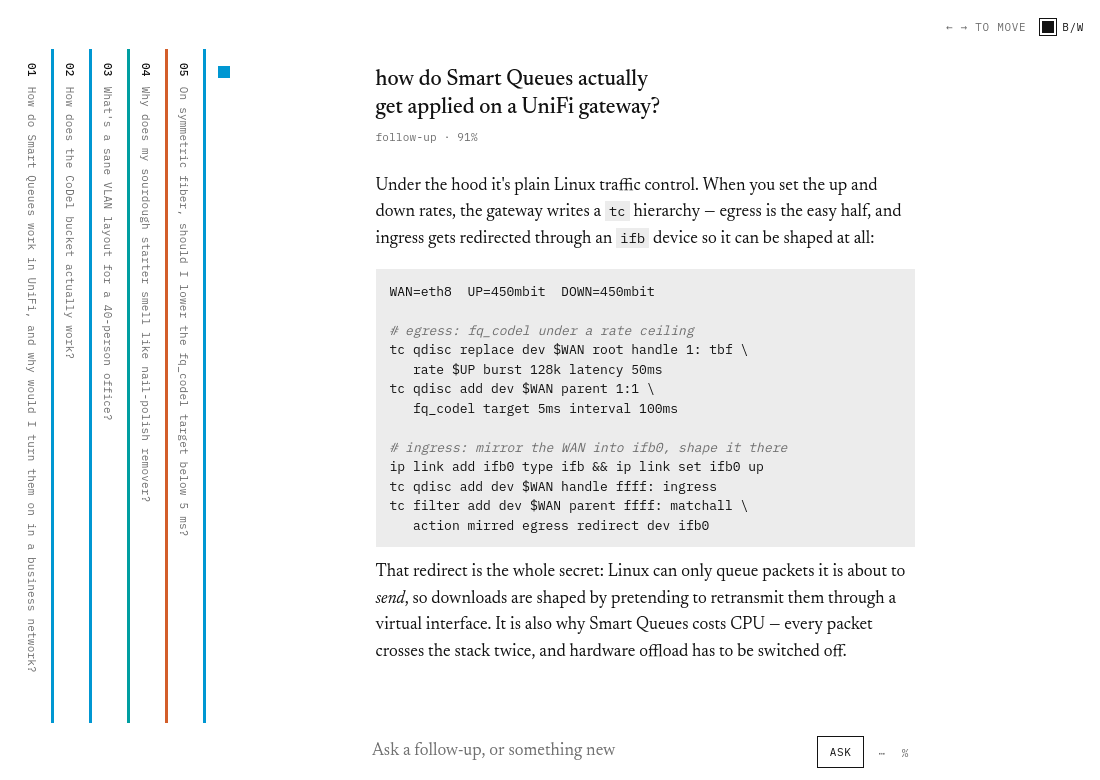
A sideways LLM chat interface — every Q&A is a page, topics get color codes, and chat runs on your own Claude Code subscription.

Sidelong is a chat interface laid out sideways — and it fixes a real annoyance with LLM conversations. Instead of one endless vertical scroll where topics blur together, every question-and-answer pair becomes a page: the open page sits in the middle of the screen while older pages collapse into thin vertical strips on the left, so a long session reads as a row of tabs. Each page gets a colored mark — hue encodes topic, saturation encodes classifier confidence — so follow-ups share their thread's color and you can spot a conversation in a stack of twenty pages without reading a word. There are no API keys to manage: chat runs through the Claude Code CLI you're already logged into, billed to your normal Claude subscription like any other claude session (one deck = one resumed Claude session, turn by turn). Topic embeddings come from a local Ollama model and never leave your machine — the whole thing is local-first by design. The author says it plainly in the Show HN thread: "It's vibe coded, but I think it's actually a better way to not get stuck in a loop of forgetting everything while you use them." Scouted the day after it was created, with two stars — a one-day-old experiment in rethinking how we talk to LLMs.
Showcase
Online
AI Appsclaude-codecodex+1

ImageAI

Desktop + CLI client for multi-provider AI image and video generation — prompt tools, social-size presets, cost estimates, MIDI-synced video workflows.

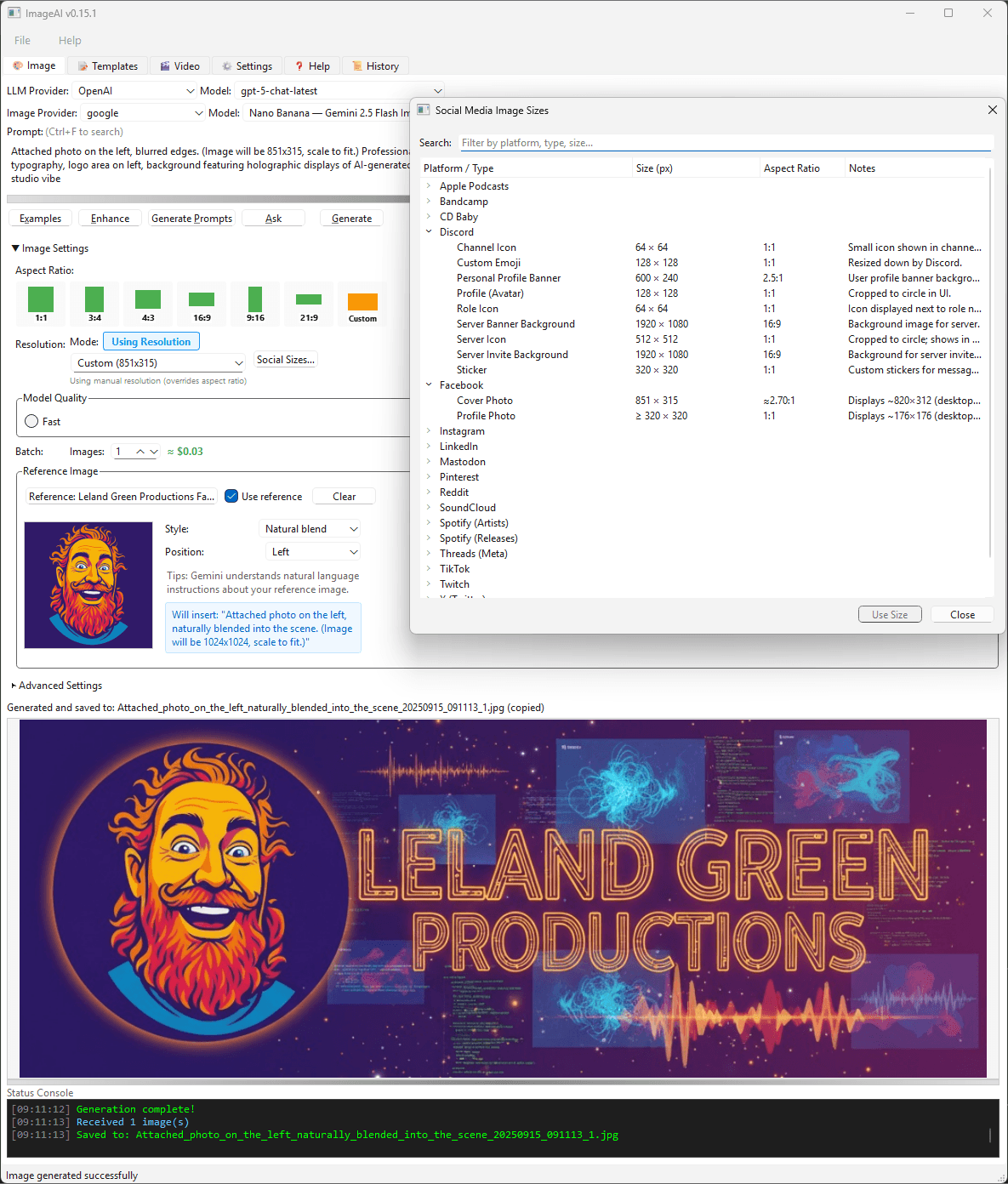
ImageAI is a desktop application and CLI for multi-provider AI image and video generation — the kind of power-user client the big labs never ship themselves. Pick an LLM provider and model (OpenAI, Google's Gemini 2.5 Flash Image, and more), tune aspect ratio, resolution, batch size and reference-image blending in natural language, and generate; a built-in social-media size table covers every platform from Discord emojis to Facebook cover photos, and there's even a MIDI-synced karaoke/video workflow for the adventurous. The app is enterprise-flavored in a way most vibe-coded toys aren't: multiple authentication methods, provider failover, prompt-enhancement tools, a status console with per-generation cost estimates ("≈ $0.03"), and a full history view. Version 0.49.1 was current at scouting time. The author is unusually transparent about the build: "Created primarily with Anthropic Claude Code, with PyCharm IDE and AI assistance from Junie (early-on), Codex." With 15 stars and commits three days before scouting, it's a living example of a complex, multi-provider AI desktop app assembled almost entirely by agents.

Showcase
Online
AI Apps

Actell

An experimental vibe-coded AI phone agent for iPhone: it sees the screen via CoreDevice and performs taps, drags and waits for you.

Actell (执言) is an experimental AI agent that runs on an iPhone and operates the phone the way a person would: it captures the screen, reasons about what to do next, and performs taps, drags, and waits. Instead of depending on app-specific integrations, it calls Apple's CoreDevice services directly for screen capture and touch input. Two connection routes are supported. The default on-device VPN loopback route works with your regular VPN app (verified with LocalDevVPN, Shadowrocket, and Clash) so no extra hardware is needed. Alternatively, an ESP32-S3 USB NCM relay provides a hardware-backed path for screen capture and touch. The agent supports OpenAI Chat Completions-compatible model providers with an explicitly selectable native Responses path, Markdown/TXT skill-package imports, conversation history, image attachments, tool approval, and manual stopping. The README is unusually honest about prototype status: production readiness and reliable long-running background execution are not guaranteed, and validation records (for example, a VPN-loopback screenshot and real tap test on an iPhone 15 Pro in October 2026) are documented alongside the claims. Tech: iOS app in Swift with the Xcode project checked in, a shared CoreDevice backend built in Rust, and ESP32-S3 firmware on ESP-IDF 5.5.5. Released under GPL-3.0. The author describes it as a vibe-coded project shared in its early prototype stage to explore ideas.

Showcase
Online
AI Appsopus-55

Transformer Visualisation

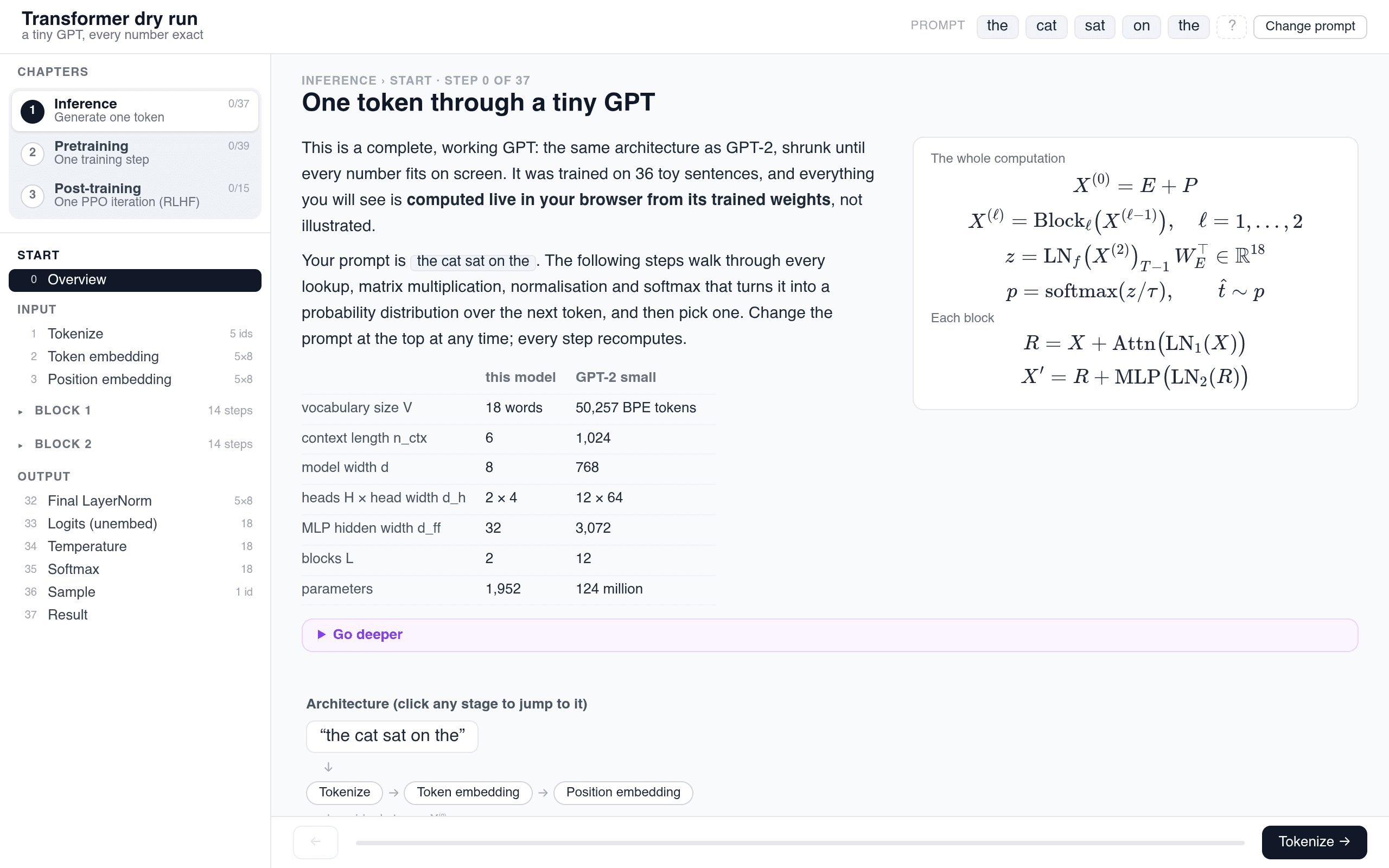
Watch one token flow through a 1,952-parameter mini GPT — every lookup, matrix multiply and softmax computed live in your browser

Transformer Visualisation walks one token through an entire working GPT. Not a diagram of a transformer — a complete, trained model, shrunk until every number fits on screen: 1,952 parameters, an 18-word vocabulary, 36 training sentences, and the exact architecture of GPT-2 scaled down to 2 blocks, 2 attention heads and width 8. Type a prompt, and every lookup, matrix multiplication, normalisation and softmax recomputes live in your browser from the trained weights. The step-by-step explorer has 37 steps from tokenisation to sampling, plus a pretraining chapter showing one training step and a post-training chapter with one PPO/RLHF iteration. Hover over any number to see exactly how it was computed — all arithmetic in 64-bit floats, cells shown to 2 decimals. The model itself was trained with Adam for 6,000 full-batch steps in plain NumPy with a hand-written, gradient-checked backward pass, reaching a loss of 0.4994 nats per token — essentially perfect for the corpus. The author, xtcntr, announced it on Hacker News on 2026-10-07 with the note "So here it is, made with Opus 5.5." As an education tool it's the rare artefact that treats the learner as an adult: no metaphor-only explanations, just the actual numbers, all of them, computed for real. Tech stack per the repo: TypeScript, Vite, NumPy, hosted on Vercel. curated by the VibeFix editors

Showcase
Online
AI Apps

QuoteSearch

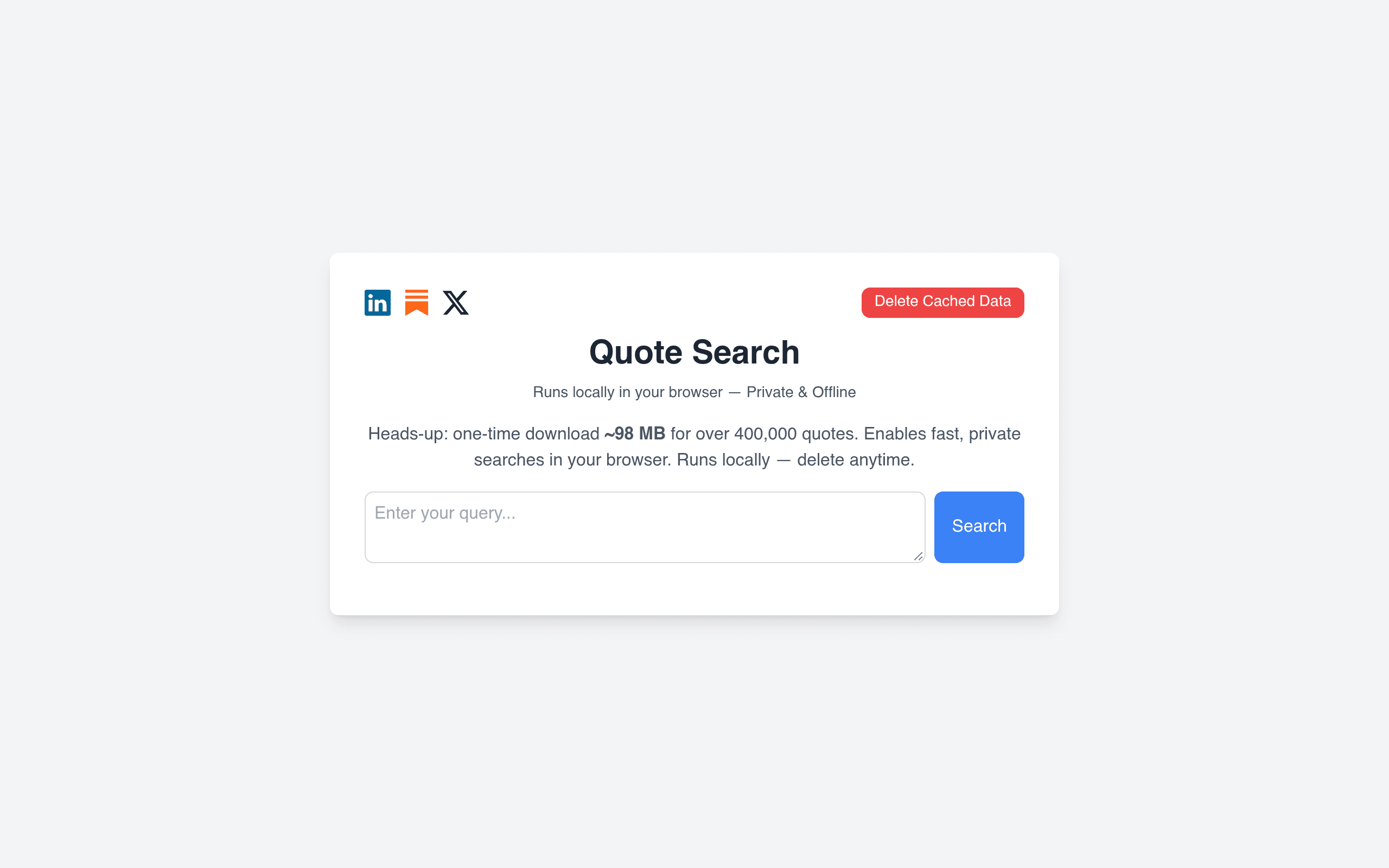
Search 400,000 quotes with AI semantic search — fully private, running in your browser with no server.

QuoteSearch is a serverless AI search engine over more than 400,000 quotes. After a one-time data download of about 98 MB, everything runs entirely in your browser: your query is embedded locally and a full cosine-similarity search runs against a quantized vector index — no network calls, no tracking, and it keeps working offline. The trick is the offline/online split. Raw quote data from archive.org was cleaned and embedded offline into a single compact binary index, paired with a small static embedding model (model2vec's potion-base-4M). The browser loads both once and does all semantic matching client-side, so search is instant and private by construction — and the whole thing costs the author nothing to run. Author ruidiao describes the project as completely "vibe coded" — built in about a day. It lives as a static Hugging Face Space (Python offline pipeline, zero server runtime) and remains live and searchable today. curated by the VibeFix editors

Showcase
Online
AI Appsclaude-code

Padh Ke Batao

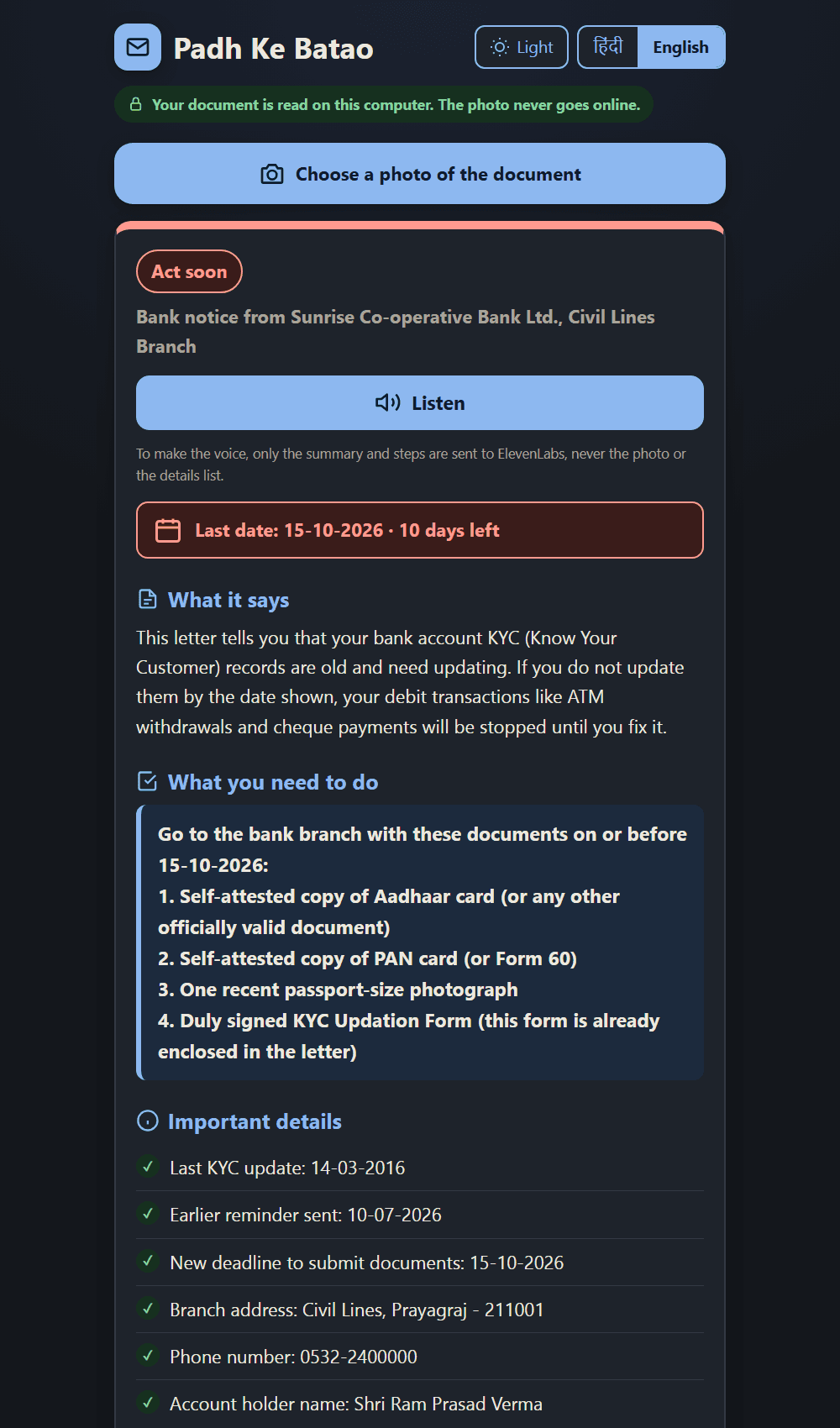
Snap a photo of any document and hear it explained in simple Hindi or English — what it says, what to do, by when — read aloud, all processed locally.

"Padh ke batao" is Hindi for "read it and tell me" — what the author's grandfather says whenever he hands someone a letter he can't read. Padh Ke Batao is built for him: take a photo of a document — a bank notice, hospital report, pension circular, government letter — and get it explained in simple Hindi or English: what it says, what to do, and by when. Then it reads the explanation aloud, in a voice he actually enjoys listening to. The privacy architecture is the point. An open-weight vision model (Qwen 3.5) reads the photo locally through Ollama on a laptop with no GPU, so the photo never leaves the computer. A Fastify server extracts six structured fields — document type, summary, key details, action needed, deadline, urgency — with a deadline countdown, and only the summary text is sent to ElevenLabs for the voice; without a key it falls back to a voice installed on the computer. No account, no upload, no per-document cost. It was built with Claude Code as a pair programmer for the Hacktoberfest "Build for a Friend" challenge, and the dev diary shows the agent doing real work: renaming the package, regenerating screenshots when one was cut off, and reasoning through why ElevenLabs stays optional. One big button, Hindi/English switchable anytime, honest limitations section included. Note: This project is curated by the VibeFix editors from public sources. All rights belong to the original creator.

Showcase
Online
AI Apps

MealMuse

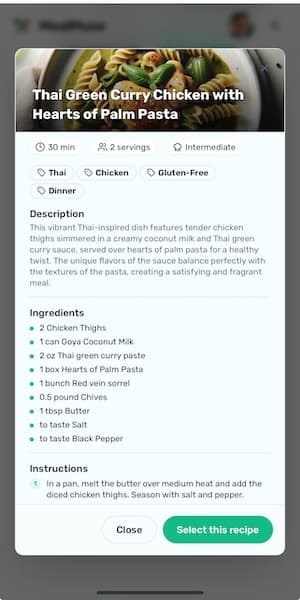
拍一张冰箱照片,AI 生成一周食谱的 meal planner

MealMuse 把"今晚吃什么"这道世纪难题交给了 AI:拍一张冰箱或食材的照片(甚至直接扫一张购物小票,最多 3 张图),它会自动识别所有食材,生成你的数字食品柜;再结合你的饮食偏好和日程,输出个性化的一周 meal plan 和具体食谱。 工作流很完整:缺的食材会自动汇总成智能购物清单,还按超市分区排好序;可以设置忌口、辣度偏好、菜系倾向和用餐人数;你保存和评分的食谱越多,它越懂你的口味,推荐越准。 网站 slogan 是 "Smart Meal Planning, Simplified",目标就是减少食物浪费、告别临时点外卖。后端用 Supabase,是 AI 应用 + Supabase 的标准 vibe coding 组合。 注:本项目由 VibeFix 编辑从公开渠道精选收录,版权归原作者所有。

Showcase
Online
AI Apps

Originality.ai:内容上线前的 AI、抄袭与质量检查台

把 AI 检测、抄袭、事实、语法和可读性检查放在一个工作台里,适合内容团队做发布前复核。

Originality.ai 面向编辑、写作者、教育工作者和内容团队。它的核心不是给文章贴一个“AI 写的”标签,而是把发布前常见的几类检查放到一处:AI 生成概率、抄袭、语法、可读性、事实核查和内容质量。 我觉得它比较适合内容流程已经跑起来、但缺少统一复核环节的团队。把稿件粘贴、上传或输入网址后,可以选择需要的扫描项,再把报告留给编辑或客户查看。 主要能做什么 • AI 检测:支持对 ChatGPT、Claude、Gemini、Grok 等常见模型生成文本进行检测。 • 抄袭、语法、可读性、事实核查和内容质量检查,减少在多个工具间来回切换。 • Deep Scan 会解释一段内容为什么可能被标记,并给出更合规的修改方向。 • 可扫描整站内容;团队版还提供成员管理、标签、报告历史和 API。 • Chrome 扩展可记录 Google Docs 的写作过程,用于展示文档如何完成。 一个值得保留的提醒 Originality.ai 自己也明确写了:AI 检测分数只是一个信号,不是结论。遇到重要的学术、雇佣或内容纠纷,仍要结合写作记录、草稿和人工判断,别只凭一个百分比下结论。 价格参考 官网当前年付页面显示:Pro 为 12.95 美元/月,含每月 2,000 credits;Enterprise 为 136.58 美元/月,含每月 15,000 credits。1 credit 对应 100 个词;免费 AI 检测可试用,但次数有限。 一句话 如果你把内容发布当作一道正式流程,而不是“写完就发”,Originality.ai 提供的是一个更完整的复核工具箱。

Aron@Aron
0
0
108
0