Project Directory

Browse all indie developer projects and co-creation requests

Active: Travel & Local
Showcase
Online
Travel & Localclaude-code

Unfenced

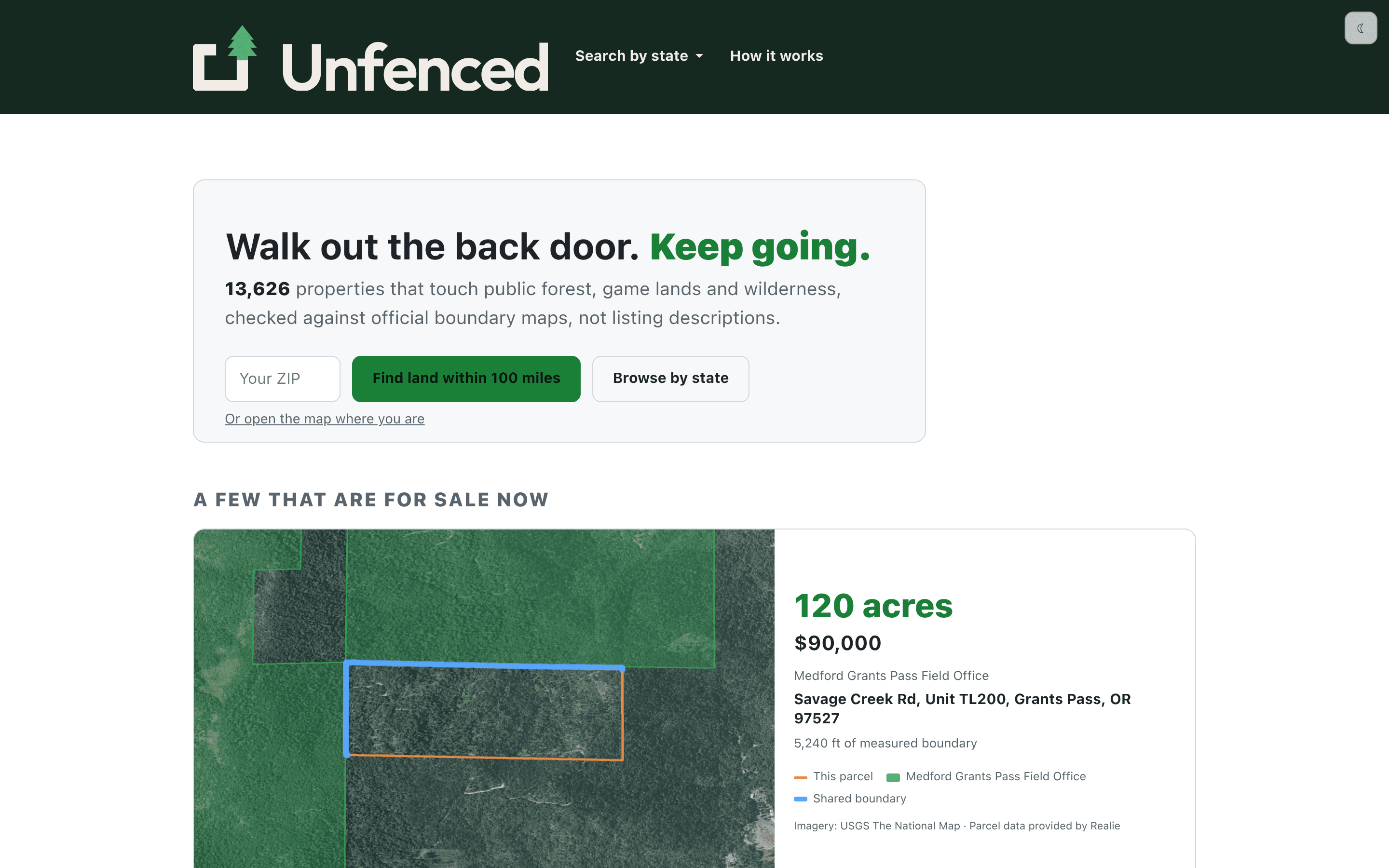
Land for sale that borders public land — 13,626 parcels verified against official boundary maps, not listing descriptions.

Unfenced answers a question that no real-estate search engine bothers to ask: which parcels for sale actually touch public land? The site tracks 13,626 properties bordering national forests, game lands, and wilderness areas across all 50 US states plus DC — and crucially, it verifies adjacency against official boundary maps and parcel GIS data rather than trusting whatever the listing description claims. The hard part, as the author readily admits, is lining up maps from different sources: listings come via the RentCast API, parcel boundaries from state and county GIS services plus Realie. The author — who comes from 3D design and geospatial mapping — made the judgment calls about what counts as "bordering," then let Claude Code do most of the building. His own words on Hacker News: "Mostly Claude Code." It is a textbook case of agentic coding amplifying domain expertise rather than replacing it: the taste and the data decisions were human, the implementation largely AI. The result is a genuinely useful niche tool. Search by state or ZIP, open the full map with satellite and terrain layers, and filter by relation, confidence, public-land type, access, designation, price, and acreage. Each listing shows the measured shared boundary in feet — for example a 120-acre, $90,000 parcel in Grants Pass, Oregon with 5,240 ft of measured boundary against neighboring public lands. That level of specificity is what separates it from a generic land search. Caveats are worth knowing, many of them raised in the lively Hacker News discussion: owning land next to public forest means fence-line headaches, wandering hikers, and seasonal hunters — the romance has practical costs. But as a discovery tool for a very specific dream — walking out your back door and keeping going — Unfenced is the rare vibe-coded launch that is both technically interesting and immediately usable.
Showcase
Online
Travel & Localclaude

HumSafar

An India travel planner site vibe-coded in a 2–3 hour hackathon: UNESCO sites, wishlist, rough trip-cost estimates.

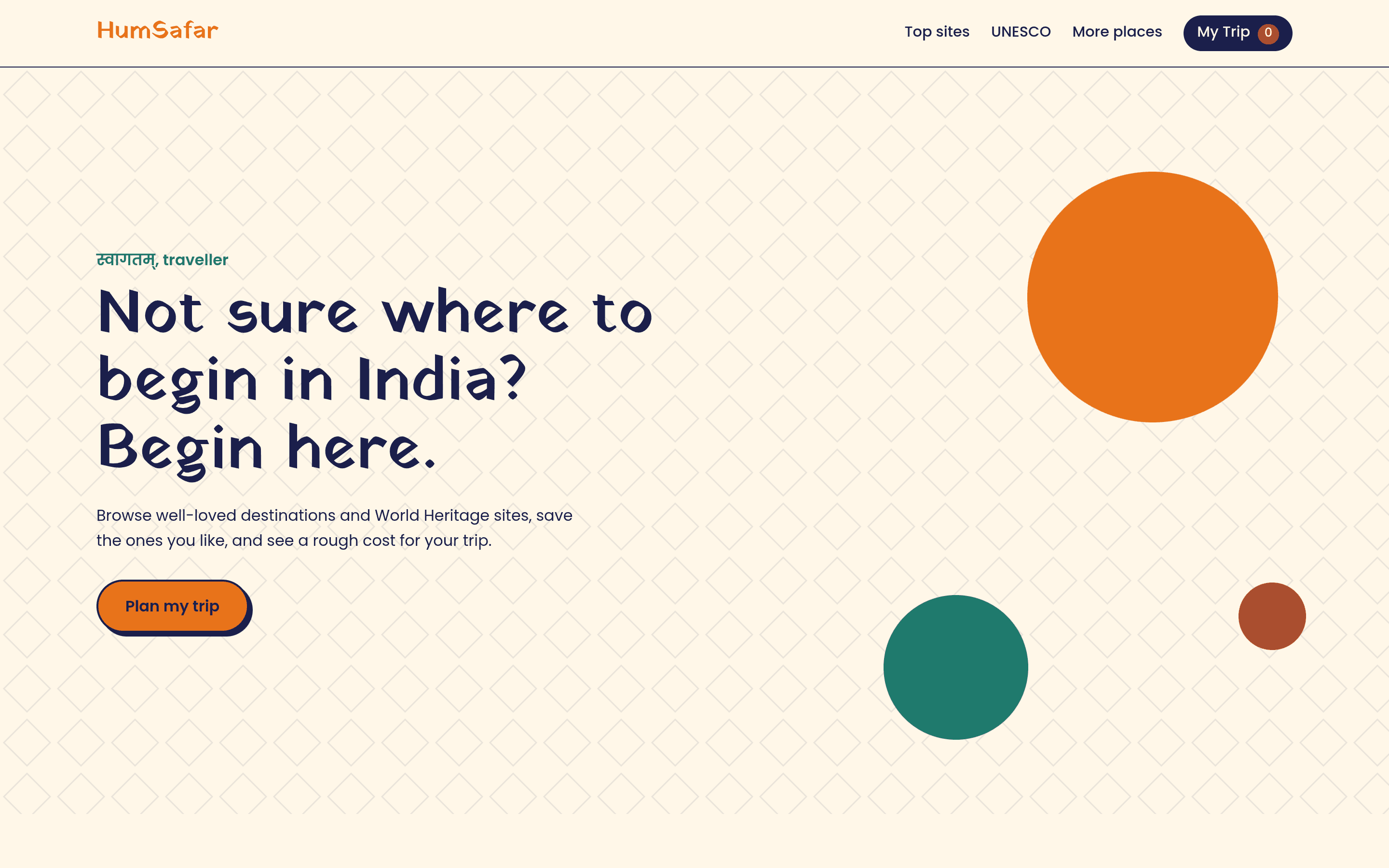
HumSafar (हमसफ़र, "travel companion") is an India travel-planning website built from scratch during a 2–3 hour website-development hackathon. Browse well-loved destinations and UNESCO World Heritage sites, save the ones you like to a "My Trip" wishlist, and see a rough cost estimate for the trip. The team is honest about how it was made: the README says "The whole project was vibe coded: we described the idea to an AI assistant, refined it into a detailed prompt, and used that prompt to generate and iterate on the site," and "Claude was the only AI tool used in this project." Tech stack is deliberately minimal — plain HTML, CSS and JavaScript with no frameworks or build step, hosted on GitHub Pages. A clean, rough-and-real hackathon artifact: the README still carries unfilled placeholder sections from the time crunch, which is exactly what a 2–3 hour AI-assisted build looks like. Live and browsable now.

Showcase
Online
Travel & Localclaude

Haunt

Self-guided ghost-tour iPhone app: narrated haunted walks across 12 US cities with offline maps — built with Claude's help.

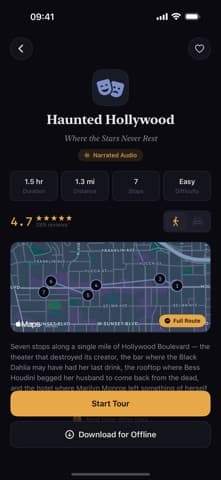
Haunt is an iPhone app for self-guided ghost tours: pick a city and follow narrated audio tours of its most haunted spots — "Where the Stars Never Rest" in Hollywood, haunted walks in Salem, Boston, Chicago and 9 other US cities — with an on-route map and offline downloads. The author announced it with: "Built Haunt with Claude's help, it's an iPhone app for self-guided ghost tours." The app is live on the App Store ("Haunt: Ghost Tours", v1.2.1 updated 2 days ago) covering 12 cities.

Showcase
Online
Travel & Localclaude-code

MonkeyEatingMango

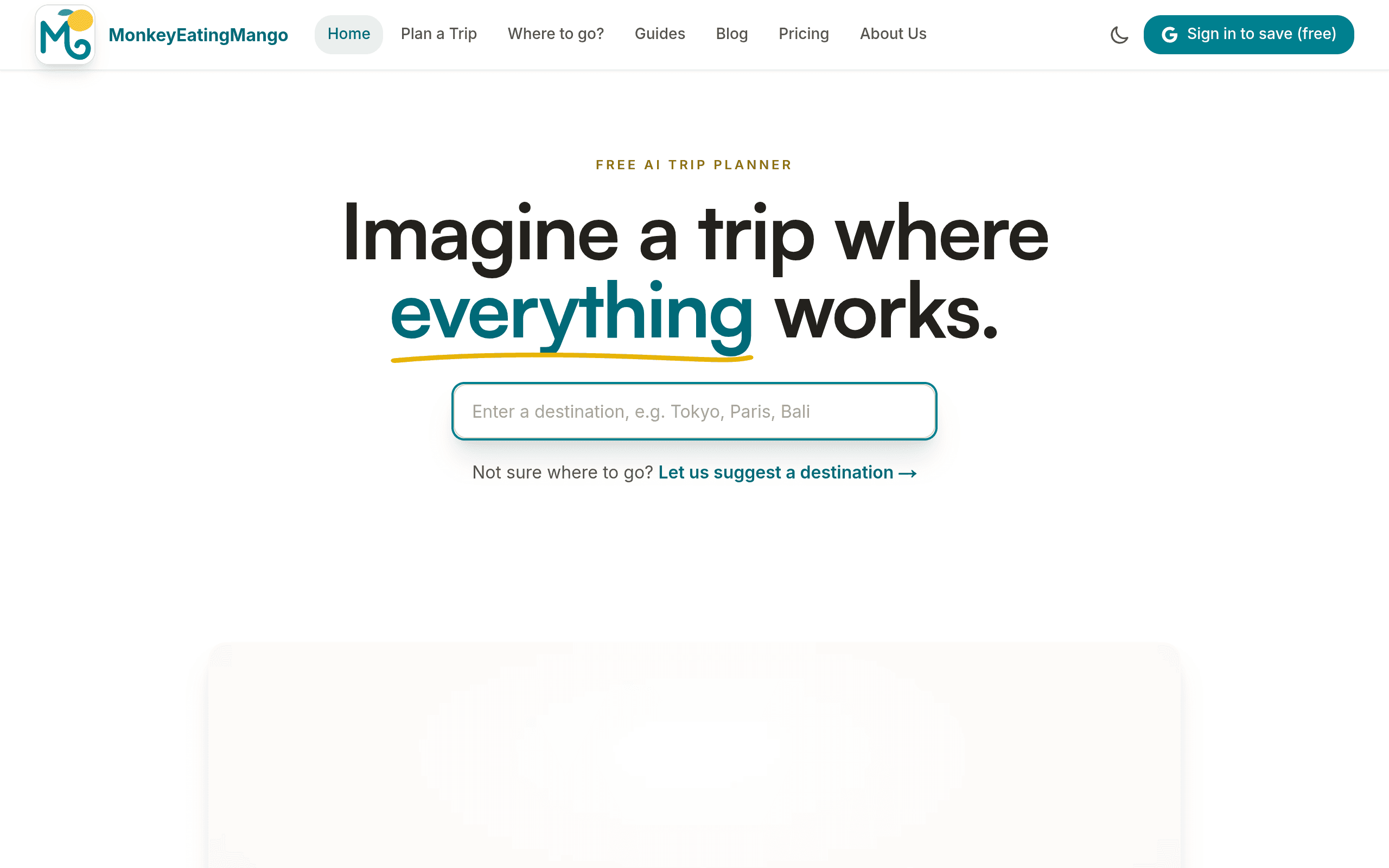
A free AI trip planner built with Claude Code: answer eight questions and get a day-by-day itinerary checked against real opening hours.

Most AI trip planners generate plausible-sounding days that fall apart on contact with reality — a venue that's closed, a route that doubles back. MonkeyEatingMango's answer: generate the plan, then check every day against live venue data and rewrite the days that fail. The author cites a study of 356 AI-generated trips that found a fault in 43% of first-draft days; this tool exists to fix exactly that. Answer eight questions about your trip and you get a full day-by-day itinerary: a Google Maps route for every day, realistic cost breakdowns, a food guide pinned to meals, a shopping guide, a booking checklist, festivals on your dates, and practical essentials like visa rules and transit cards. The first two days are free to read; a one-time $0.99 Trip Pass unlocks the rest. The author introduced it in the Claude Project Showcase hub with a single line: "Built MonkeyEatingMango as a trip planner using Claude Code."

Showcase
Online
Travel & Localagent-duel

Weather Ribbon

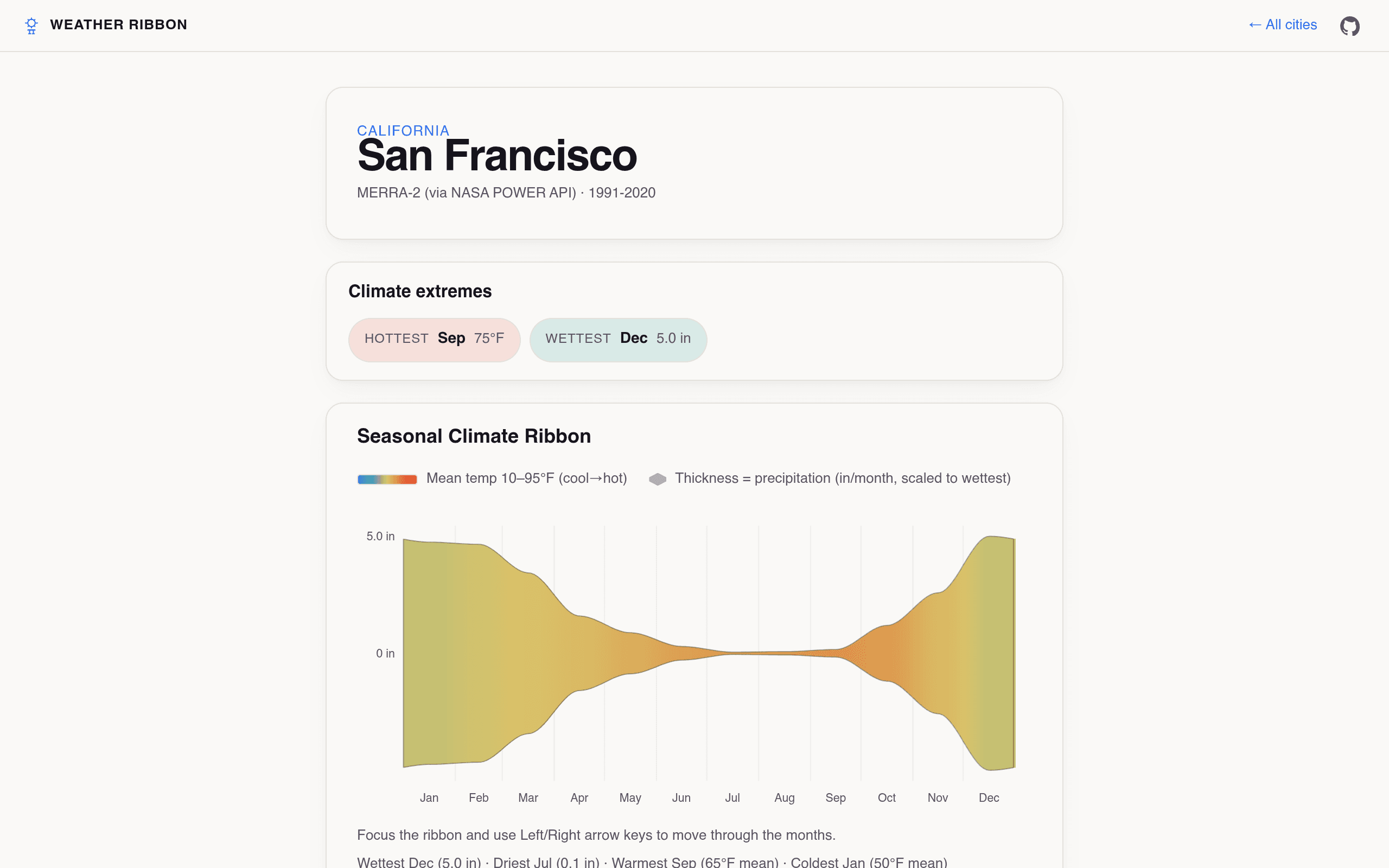
Open-source full-year climate visualizations: 30-year normals for any city, rendered as a single static ribbon chart.

Thirty years of climate, drawn as one ribbonWeather Ribbon is an open-source climate visualization site: each city page renders 30-year normals (1991–2020) for temperature, precipitation, snowfall, humidity, cloud cover, wind and daylight as static SVG charts — one "seasonal climate ribbon" per city. All data is pre-fetched from MERRA-2 (via NASA POWER) and CAMS (via Open-Meteo) and committed to the repo, so the site runs with zero runtime API calls and no ads. Fully vibe coded with a local agent arenaThe author launched it on Show HN in October 2026 with a simple note: "Fully vibe coded using Agent Duel (a local coding agent arena)." The README confirms it: "Weatherribbon was built using Agent Duel" — and the sponsor section notes Agent Duel covers the hosting costs. Why it stands outIt's a rare thing on the web: a fast, fully static, open data-viz site with no tracking and no paywall. MIT licensed, accepting contributions for new cities — a clean example of vibe coding producing a genuinely useful public utility.

Showcase
Online
Travel & Localclaude-code

Drum Bun

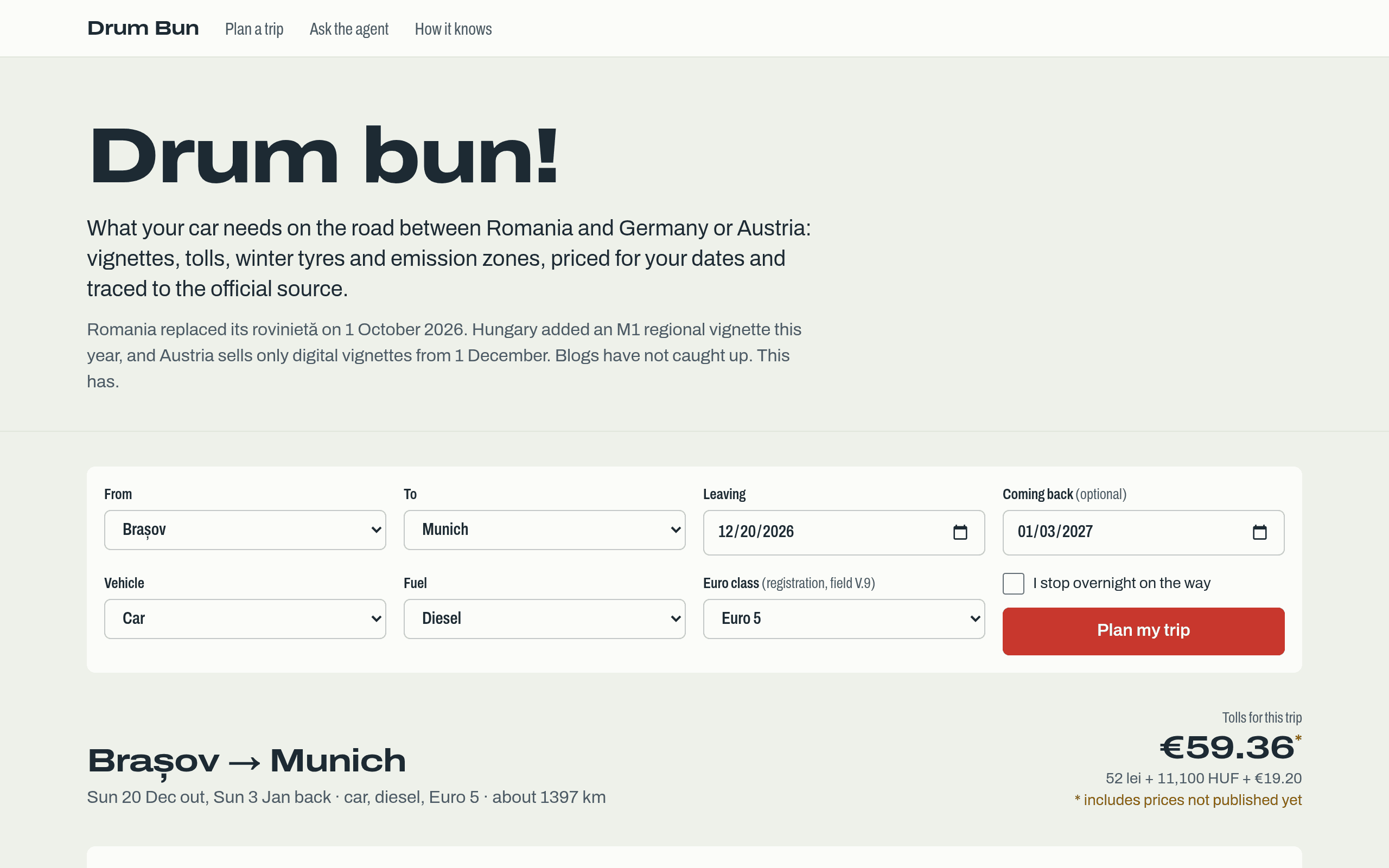
A road-trip agent for Romania–Germany drives: cheapest vignette combos per travel day, dated rules, and every answer traced to the official source behind it.

Drum Bun — "have a good road", what Romanians say before a journey — is an agent that tells a driver exactly what their car needs between Romania and Germany or Austria. Ask "Brașov → Munich, 20 December, back 3 January, Euro 5 diesel" and it computes the cheapest set of vignette products per country for your dates, the rules that apply on those dates (winter tyres, emission zones, border checks), and the outdated claims you probably read online — each linked to the fact that corrects it. The clever part is the architecture: the content is modeled as structured pieces in Sanity (routes → legs → road sections, toll products with dated prices per Euro band, rules with yearly season windows, and claims with verdicts). A pure planner with 21 unit tests walks that structure — picking the price valid on each date, solving an exact set cover over Hungarian county vignettes — and the model only presents the result. The model never computes a price. On the author's 18-question eval in four languages, the agent scored 18/18 against 16 for semantic search and 4 for the same model with no documents. It was built with Claude Code for the DEV × Sanity challenge, and the build diary is unusually honest: the first eval run lost to keyword search (6/16), the knowledge base once inherited the author's own data error and hardened it into prose, and the author documents every fix. The live site works without login and includes a "How it knows" page showing every issue, both sides, and why one was kept. Note: This project is curated by the VibeFix editors from public sources. All rights belong to the original creator.

Showcase
Online
Travel & Localopencode

Ninety

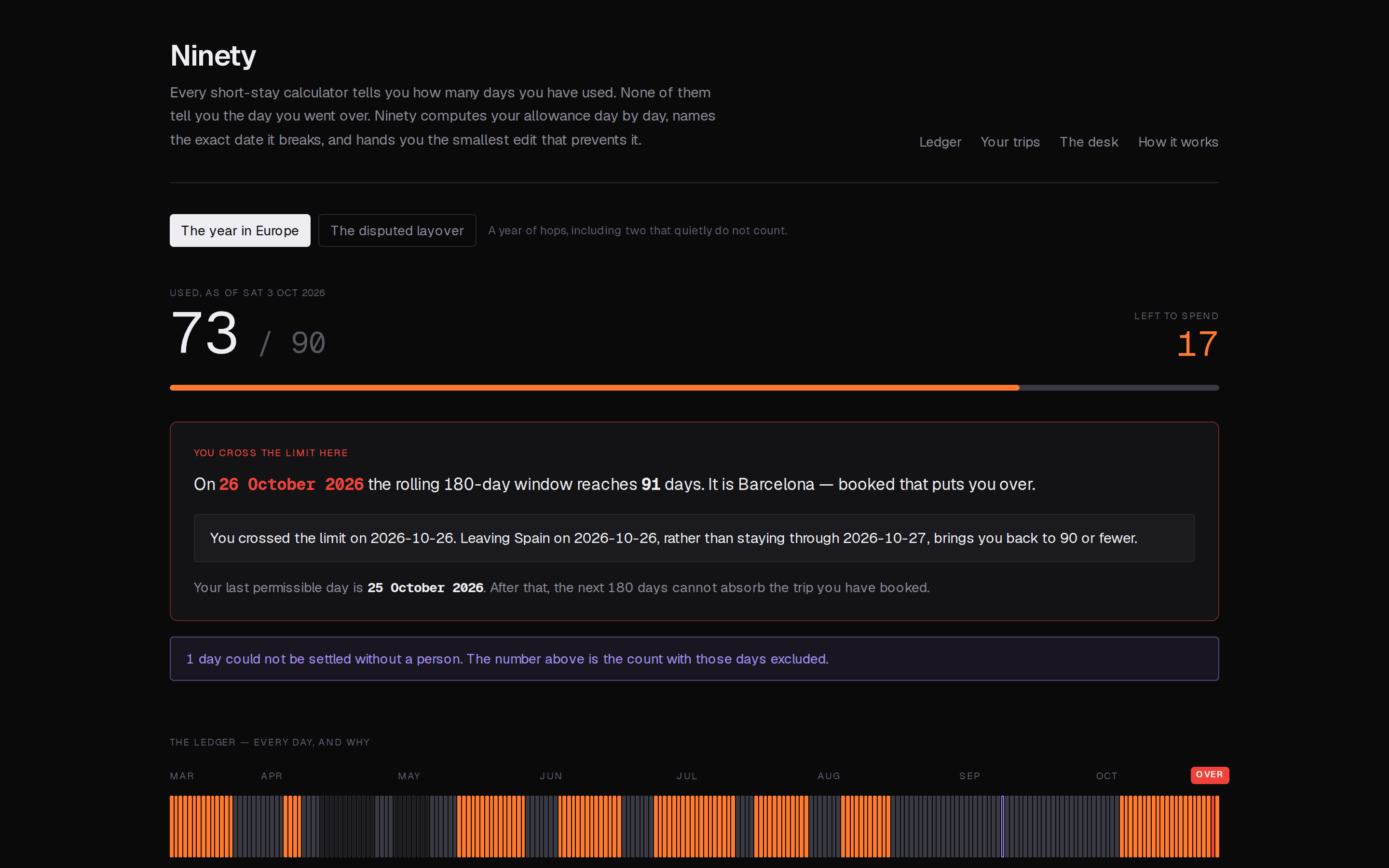
A Schengen 90/180 day accountant that names the exact day you went over — and admits when it doesn't know.

Ninety is a day accountant for the Schengen 90-in-any-180 rule, vibe-coded by kiter in about a day with OpenCode (documented in a dev.to post on 2026-10-04). Every Schengen calculator tells you *how many* days you've used. Ninety tells you *which day* you crossed the line, *why* that day counted, and *what to change*: "73 of 90 days used — on 26 October the window reaches 91 days. It is Barcelona — booked that puts you over. Leave on the 26th, not the 27th." Three things make it different from a calculator. First, it names the day, not just the number — an attribution algorithm finds the rolling window and maps the breach back to the trips that caused it. Second, it classifies instead of adding: three weeks in the Canary Islands is 0 days, a month in Dublin is 0, a week in Reykjavík is 0 (Iceland is EEA, not Schengen), an airside transit is 0 — and the same trip into Sofia counts overland but not by air in February 2025, because Bulgaria's land borders opened months before its air borders did. Third, and most important, it refuses visibly: hand it a passport it doesn't know and you get "Ninety declined to answer" instead of a confident wrong number. "A confident wrong number here costs someone money." The technical thesis is worth stealing: the verdict engine is pure TypeScript with no model and no network calls — the agent may retrieve, classify and explain, but it may never produce a number. The build log is unusually honest: the author's own evaluation caught six of his hand-written expectations being wrong (the engine was right every time), plus a real corpus bug where Iceland was modeled as a full Schengen member. 56 tests, all committed. For anyone who's ever squinted at a Schengen calculator before a Europe trip, this is the one that respects you enough to say "I don't know." Note: This project is curated by the VibeFix editors from public sources. All rights belong to the original creator.

Showcase
Online
Travel & Localclaude-code

MN Coffee(MPLS Coffee)

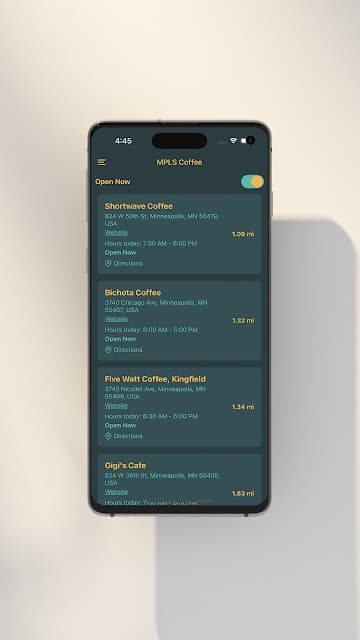
明尼苏达 276 家独立咖啡馆地图,免费 iOS / Android 应用

MN Coffee(原名 MPLS Coffee)是一张"只收独立咖啡馆"的明尼苏达咖啡地图:276 家手工精选的独立咖啡馆,覆盖 96 座城市,连锁品牌一家不收。iOS 和 Android 免费下载,无广告,不用注册账号。 每个店铺都有一段 AI 生成的简介和真实信息:营业时间实时显示"正在营业"过滤,最实用的是"远程工作评分"——从 WiFi 稳定性、插座数量、噪音水平到座位舒适度打分,找个能坐一下午写代码的咖啡馆非常方便。 整个项目用 Claude Code 纯 vibe coding 完成:从数据整理、评分体系到双端 App,一个人加 AI 就把一整座州的咖啡版图做出来了,独立开发者的教科书案例。 注:本项目由 VibeFix 编辑从公开渠道精选收录,版权归原作者所有。